How to start saving money
Lorem ipsum dolor sit amet, consectetur adipiscing elit lobortis arcu enim urna adipiscing praesent velit viverra sit semper lorem eu cursus vel hendrerit elementum morbi curabitur etiam nibh justo, lorem aliquet donec sed sit mi dignissim at ante massa mattis.
- Neque sodales ut etiam sit amet nisl purus non tellus orci ac auctor
- Adipiscing elit ut aliquam purus sit amet viverra suspendisse potent
- Mauris commodo quis imperdiet massa tincidunt nunc pulvinar
- Excepteur sint occaecat cupidatat non proident sunt in culpa qui officia
Why it is important to start saving
Vitae congue eu consequat ac felis placerat vestibulum lectus mauris ultrices cursus sit amet dictum sit amet justo donec enim diam porttitor lacus luctus accumsan tortor posuere praesent tristique magna sit amet purus gravida quis blandit turpis.

How much money should I save?
At risus viverra adipiscing at in tellus integer feugiat nisl pretium fusce id velit ut tortor sagittis orci a scelerisque purus semper eget at lectus urna duis convallis. porta nibh venenatis cras sed felis eget neque laoreet suspendisse interdum consectetur libero id faucibus nisl donec pretium vulputate sapien nec sagittis aliquam nunc lobortis mattis aliquam faucibus purus in.
- Neque sodales ut etiam sit amet nisl purus non tellus orci ac auctor
- Adipiscing elit ut aliquam purus sit amet viverra suspendisse potenti
- Mauris commodo quis imperdiet massa tincidunt nunc pulvinar
- Adipiscing elit ut aliquam purus sit amet viverra suspendisse potenti
What percentege of my income should go to savings?
Nisi quis eleifend quam adipiscing vitae aliquet bibendum enim facilisis gravida neque. Velit euismod in pellentesque massa placerat volutpat lacus laoreet non curabitur gravida odio aenean sed adipiscing diam donec adipiscing tristique risus. amet est placerat in egestas erat imperdiet sed euismod nisi.
“Nisi quis eleifend quam adipiscing vitae aliquet bibendum enim facilisis gravida neque velit euismod in pellentesque”
Do you have any comments? Share them with us on social media
Eget lorem dolor sed viverra ipsum nunc aliquet bibendum felis donec et odio pellentesque diam volutpat commodo sed egestas aliquam sem fringilla ut morbi tincidunt augue interdum velit euismod eu tincidunt tortor aliquam nulla facilisi aenean sed adipiscing diam donec adipiscing ut lectus arcu bibendum at varius vel pharetra nibh venenatis cras sed felis eget.
Managing a plumbing fleet requires tracking the right performance metrics. This helps control costs, improve service delivery, and maximize profitability.
Without clear data on vehicle utilization, fuel consumption, maintenance schedules, and technician efficiency, plumbing business owners miss opportunities for optimization. They also become vulnerable to profit loss.

Successful plumbing companies track specific fleet metrics across financial performance, operational efficiency, vehicle costs, compliance requirements, and customer service outcomes. These data-driven decisions directly impact their bottom line.
Fleet operating costs usually consume about 30% of revenue in plumbing operations. Measuring performance is critical for maintaining healthy profit margins.
This guide covers the essential metrics plumbing fleet managers need to monitor. It includes financial indicators, maintenance benchmarks, fuel efficiency standards, compliance requirements, customer satisfaction measures, and the tools that simplify performance tracking.
Core Plumbing Fleet Performance Metrics
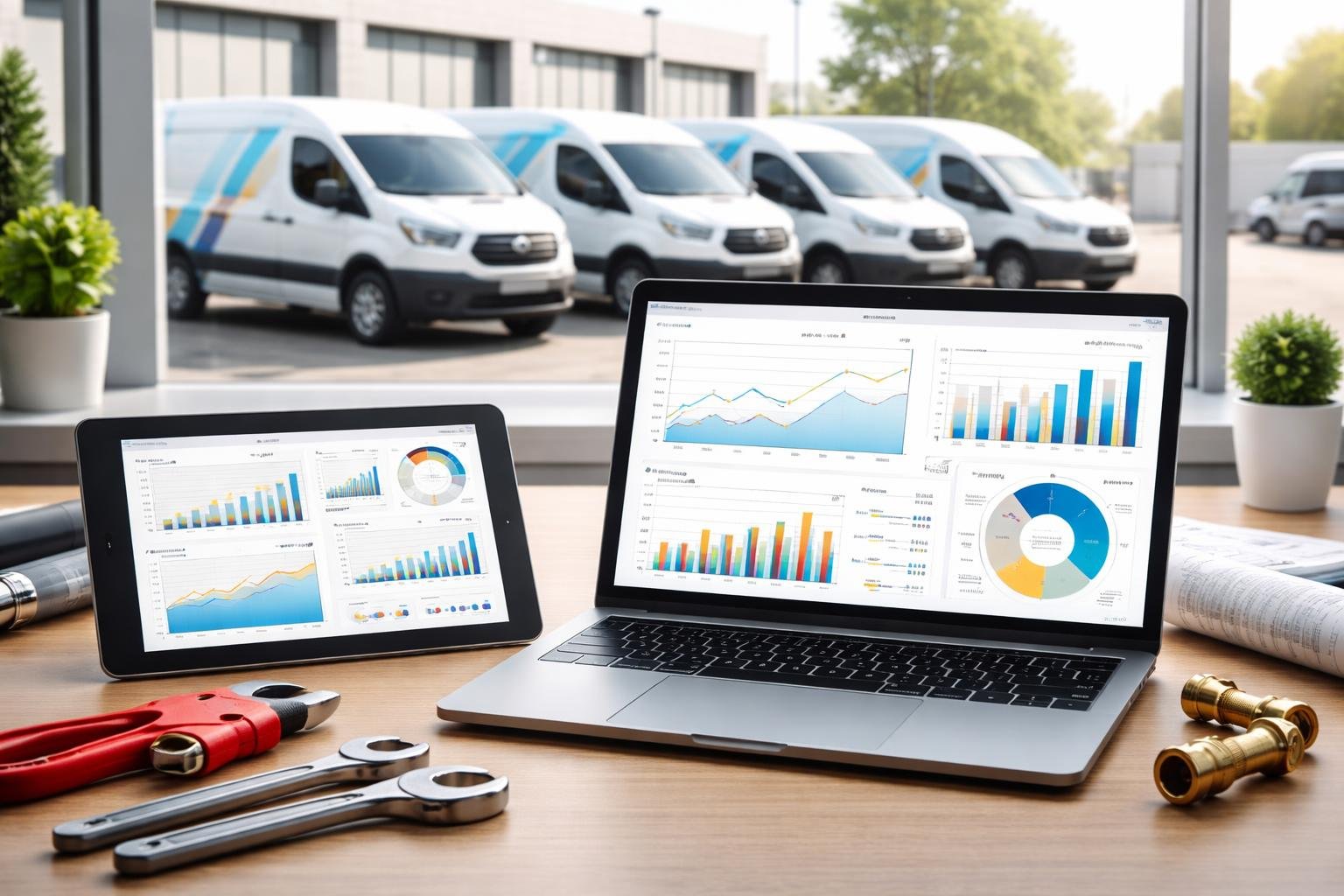
Tracking the right fleet metrics separates profitable plumbing operations from those struggling with inefficiency. Fleet managers need to monitor vehicle and technician performance along with financial indicators.
Utilization Rate and Asset Utilization
Utilization rate measures how effectively a plumbing fleet uses its vehicles and equipment during work hours. It is calculated by dividing billable hours by total available hours.
Strong performers usually achieve 65-75% utilization across their vehicles. Asset utilization checks if vehicles are working on job sites or sitting idle.
Low utilization signals scheduling inefficiencies, excess capacity, or poor route planning.
Key utilization metrics include:
- Daily vehicle deployment percentage
- Hours per vehicle per week in active service
- Idle time versus productive travel time
- Equipment downtime for maintenance
Geographic service area density affects utilization rates. Companies serving concentrated areas often achieve higher utilization.
First-Time Fix Rate
First-time fix rate shows the percentage of service calls completed during the initial visit. This directly affects customer satisfaction, fuel costs, and technician productivity.
Plumbing operations targeting 80-85% first-time fix rates typically maintain better profitability. Each return trip uses additional fuel, labor hours, and vehicle capacity.
Tracking this KPI reveals inventory management gaps and technician training needs. Low rates may indicate vehicles lack necessary parts or technicians need more training.
Fleet managers should monitor first-time fix performance by job type, technician, and service area.
Technician Productivity and Utilization
Technician utilization rate is the percentage of paid hours spent on billable work. High-performing plumbing businesses keep technician utilization between 70-80% of available time.
Technician productivity measures output quality and efficiency. This includes jobs completed per day, revenue per technician, and average job completion time.
Critical productivity indicators:
MetricTarget RangeJobs per technician per day4-6 callsBillable hours percentage70-80%Travel time percentage15-20%
Mobile technology and GPS routing improve utilization and productivity. Real-time dispatching allows managers to assign nearby technicians to urgent calls, reducing drive time and fuel use.
Revenue and Profitability Metrics
Revenue per technician is a primary indicator of plumbing business profitability and fleet efficiency. Successful operations in 2026 generate between $300,000-$500,000 in annual revenue per field technician.
Fleet-specific profitability metrics track costs against revenue generation. Managers should monitor fuel expense per job, maintenance costs per vehicle mile, and total fleet operating costs as percentages of revenue.
Keeping fleet costs below 8-12% of total revenue usually indicates healthy operations. Cost per vehicle per month helps identify which assets drain resources.
This metric includes fuel, insurance, maintenance, and depreciation divided by jobs completed or revenue generated.
Financial Metrics and Fleet Cost Management

Plumbing businesses need clear financial visibility into their fleet operations. This allows them to make informed decisions about vehicle investments, pricing, and resource allocation.
These metrics show if fleet expenses align with revenue generation. They also help identify ways to reduce waste and improve service delivery.
Gross Profit Margin and Net Profit Margin
Gross profit margin is the difference between service revenue and direct costs of goods sold (COGS). This includes parts, materials, and technician labor.
For plumbing fleets, gross margin shows how efficiently each service call turns into profit before overhead expenses. Net profit margin accounts for all operational expenses, including vehicle payments, insurance, and fuel.
A plumbing company might have a 45% gross profit margin but see net profit margin drop to 12% after accounting for fleet maintenance, depreciation, and overhead.
Comparing these two margins reveals the true cost of fleet operations. The gap highlights opportunities to negotiate better rates, optimize routes, or retire underperforming vehicles.
Cost per Mile and Total Cost of Ownership
Cost per mile (CPM) divides all vehicle expenses by miles driven. Plumbing fleet managers include fuel, maintenance, insurance, registration, and depreciation.
This metric allows direct comparisons between different vehicle types and age groups. Total cost of ownership (TCO) covers the complete financial impact from acquisition through disposal.
TCO includes purchase price, financing, fuel, maintenance, repairs, insurance, downtime, and resale value. For example, a van with a $35,000 purchase price might have a five-year TCO of $75,000.
Job costing systems use CPM data to ensure accurate service pricing. Knowing the average CPM helps build appropriate travel charges into customer quotes.
This prevents underpricing distant service calls that can erode profit margins.
ARR and Recurring Revenue Plumbing
Annual recurring revenue (ARR) from maintenance contracts provides predictable income. This helps offset variable fleet costs.
Plumbing businesses with strong ARR can invest in their fleets more confidently. Subscription-based services like quarterly drain maintenance or annual inspections generate steady cash flow.
For example, 200 annual maintenance contracts at $400 each produce $80,000 in ARR. Fleet utilization improves when recurring service routes are optimized geographically.
Scheduled maintenance visits allow dispatchers to plan efficient routes. This reduces drive time, lowers CPM, and improves technician productivity.
Break-Even Analysis and EBITDA
Break-even analysis determines the monthly service volume needed to cover all fleet-related costs. Fleet managers calculate the minimum number of service calls or billable hours needed before vehicles generate profit.
EBITDA (earnings before interest, taxes, depreciation, and amortization) removes non-cash expenses. For fleet-intensive plumbing businesses, EBITDA shows operational health more clearly than net income.
Tracking EBITDA margin helps managers decide if fleet expansion makes sense. A plumbing company with an 18% EBITDA margin has more flexibility to add vehicles than one at 6%.
Fleet Operations and Maintenance Metrics
Tracking maintenance performance shows if plumbing fleets are operating efficiently. The right metrics help managers identify repair bottlenecks, measure preventive maintenance adherence, and quantify the cost of vehicle unavailability.
Preventive Maintenance and Scheduling
Preventive maintenance scheduling is key for reliable fleet performance. Plumbing fleets with consistent PM schedules have 30-50% fewer unexpected breakdowns compared to reactive approaches.
A structured preventive maintenance program includes regular oil changes, brake inspections, fluid checks, and system diagnostics. These are performed at set intervals based on manufacturer recommendations, operating conditions, and vehicle usage.
Plumbing vehicles carrying heavy equipment and making frequent stops need more frequent maintenance than standard commercial vehicles. Work orders for preventive maintenance should be generated automatically based on mileage, engine hours, or calendar days.
Maintenance shop automations trigger alerts when vehicles approach service thresholds. This ensures no vehicle is missed.
PM On-Time Completion Rate
PM on-time completion rate measures the percentage of scheduled preventive maintenance tasks completed on time. The formula is: (Completed PM tasks on time / Total scheduled PM tasks) × 100.
Fleet managers should target a 90% or higher PM on-time completion rate. Rates below 85% indicate scheduling problems or poor communication.
Late PM completion leads to further issues. For example, a missed oil change can lead to engine wear, while delayed brake inspections increase accident risk.
Time to Repair and Vehicle Downtime
Time to repair measures how long vehicles spend in the shop. Vehicle downtime is the total hours or days a vehicle is unavailable for work.
Key Time to Repair Metrics:
- Average repair time - Total repair hours divided by number of repairs
- First-time fix rate - Percentage of repairs completed without return visits
- Parts delay time - Hours spent waiting for replacement parts
Unplanned downtime costs plumbing companies $450-$760 per vehicle per day in lost revenue. A single truck breakdown can mean missed appointments and customer dissatisfaction.
Reducing time to repair requires efficient diagnostics, good parts inventory, and skilled technicians. Shops that stock common parts for their vehicles reduce repair time by 20-30%.
Scheduled vs Unscheduled Service
The ratio of scheduled to unscheduled service shows if preventive maintenance programs are working. Fleet managers should track this monthly.
A healthy plumbing fleet maintains a 70:30 or better ratio of scheduled to unscheduled maintenance. If unscheduled service exceeds 40%, the fleet is operating reactively.
Unscheduled service costs much more than planned maintenance due to overtime labor, rush part orders, and lost productivity. Emergency repairs disrupt customer appointments and strain shop resources.
Fleet managers should analyze which vehicles generate the most unscheduled repairs. Vehicles with frequent unscheduled service may have underlying issues or may need to be replaced.
Fleet Fuel, Vehicle, and Asset Metrics
Plumbing fleets face financial pressures related to fuel costs, vehicle longevity, and parts management. Tracking fuel consumption, replacement cycles, depreciation rates, and inventory levels helps control expenses and maximize return on vehicle investments.
Fuel Consumption and Fuel Economy
Fuel consumption is one of the largest variable costs for plumbing fleet operations. Fleet managers track fuel economy in miles per gallon (MPG) to identify inefficiencies and compare vehicle performance.
Average fuel economy depends on vehicle type, load weight, and route. Service vans usually achieve 12-16 MPG, while lighter vehicles may reach 18-22 MPG.
Monitoring fuel consumption can reveal maintenance issues like dirty air filters, low tire pressure, or engine wear. A sudden drop in MPG often signals mechanical problems that need immediate attention.
Fleet managers set baseline MPG metrics for each vehicle class. This helps them quickly spot underperforming vehicles.
Driver behavior has a major impact on fuel economy. Aggressive driving, excessive idling, and speeding can reduce MPG by 15-30%.
Fuel Management and Fuel Cards
Fuel cards provide detailed transaction data that manual tracking cannot match. These systems record purchase amounts, locations, timestamps, and odometer readings for every fill-up.
Fleet managers use fuel card data to detect unauthorized purchases, fuel theft, and irregular patterns. The systems flag transactions outside normal service areas or at unusual times.
Automated alerts notify managers when drivers exceed expected fuel volumes based on mileage.
Key fuel card benefits for plumbing fleets:
- Consolidated billing across multiple locations
- Real-time purchase monitoring and fraud detection
- Tax reporting and IFTA compliance documentation
- Integration with fleet management software
- Driver-specific spending controls and limits
Fuel management systems compare actual fuel use against expected usage based on routes and vehicle specs. Variances over 10-15% should be investigated for possible mechanical issues or driver behavior problems.
Vehicle Replacement and Operational Life
The operational life of a vehicle balances maintenance costs against the expense of replacing it. Plumbing service vehicles typically stay in front-line service for 5-8 years or 100,000-150,000 miles.
Replacement decisions depend on repair frequency, downtime, and reliability. Vehicles needing major repairs that cost more than 50% of their market value are usually replaced.
Fleet managers track repair costs as a percentage of vehicle value to find the best time for replacement. When annual maintenance costs reach 15-20% of replacement cost, it makes sense to consider new equipment.
Preventive maintenance extends vehicle life. Well-maintained vans can exceed 200,000 miles.
Body rust, frame damage, or safety system problems may require early retirement even if the engine is still reliable.
Asset Depreciation and Parts Inventory
Asset depreciation affects fleet budgets and tax planning. Commercial vehicles lose value fastest in the first three years, dropping 35-45% of their initial value.
Fleet managers use MACRS depreciation schedules for tax deductions and to plan for replacements.
Parts inventory management helps reduce downtime and control costs. Plumbing fleets keep high-turnover items like filters, belts, hoses, and brake parts in stock.
Critical parts inventory metrics:
- Parts inventory value: Total dollar value of spare parts
- Inventory turnover rate: How quickly parts are used
- Stock-out frequency: Times needed parts are unavailable
- Obsolete inventory percentage: Parts for retired vehicles still in stock
Effective tracking systems match parts to specific vehicle models. They send reorder alerts when stock gets low.
Most plumbing fleets aim for 4-6 inventory turns per year. This helps maintain enough stock to prevent service delays.
Parts and inventory value usually makes up 2-4% of total fleet value. Too much inventory ties up money and space, while too little leads to expensive emergency purchases.
Inspection, Compliance, and Telematics Data
Tracking inspection metrics and telematics data helps fleet managers catch maintenance issues early. These indicators ensure compliance and provide insights into vehicle health and efficiency.
Vehicle Inspections and DVIR
Driver Vehicle Inspection Reports (DVIR) are essential for safe and compliant operations. Drivers complete these reports before and after each shift to document vehicle condition and spot issues like brake problems, leaks, or lighting failures.
Digital DVIR systems let technicians submit reports by mobile device. These systems timestamp entries and store them for audits.
Fleet managers can review reports in real time and send maintenance teams when critical defects are found.
Pre-trip and post-trip inspections catch small issues before they become emergencies. Fixing a leaking hose or worn tire during inspection costs less than dealing with a roadside breakdown.
Inspection Completion Rate
The inspection completion rate measures the percentage of required inspections actually performed in a set timeframe. Fleet managers calculate this by dividing completed inspections by required inspections and multiplying by 100.
A 95% or higher completion rate shows strong compliance and driver accountability. Lower rates suggest gaps in training, enforcement, or scheduling.
Automated reminders and digital tracking improve completion rates by notifying drivers when inspections are due. These systems flag missed inspections right away.
Fleet managers should review completion rates weekly. Patterns of missed inspections by specific drivers or vehicles should be investigated.
Inspection Pass/Fail Rate
The inspection pass/fail rate shows the percentage of vehicles that pass inspection without needing repairs. This metric indicates fleet health and maintenance effectiveness.
A high failure rate points to deferred maintenance or aging vehicles. Plumbing fleets usually aim for pass rates above 85%.
Tracking failure reasons provides useful insights. If brake issues are common, managers can adjust maintenance schedules or use better parts.
Digital inspection systems help categorize defects and spot recurring problems.
Telematics and Diagnostic Trouble Codes
Telematics systems collect data such as GPS location, odometer readings, fuel use, and engine diagnostics. This data combines with inspection results for a full view of vehicle performance.
Diagnostic Trouble Codes (DTC) alert managers to mechanical issues as they arise. When a vehicle's computer detects a problem, it generates a DTC that telematics systems send in real time.
Common DTCs include emissions faults, transmission issues, and sensor malfunctions.
Monitoring DTCs lets managers schedule repairs before major breakdowns or failed inspections. Telematics data also validates odometer readings for accurate maintenance scheduling.
Integration of telematics with inspection data can reduce inspection time by up to 40% and improve documentation accuracy.
Customer Metrics and Business Growth
Tracking customer metrics shows how efficiently a plumbing fleet gains new clients, retains them, and grows profitably. These indicators link marketing spend to revenue and highlight ways to improve service and operations.
Customer Acquisition Cost and LTV/CAC Ratio
Customer acquisition cost (CAC) is the total marketing and sales expense to secure a new customer. In 2026, plumbing businesses typically spend about $150 per customer, though this varies.
CAC includes advertising, marketing staff, materials, and sales commissions, divided by the number of new customers in that period. Plumbing fleets should track CAC for different service lines, as costs vary by service type.
Customer lifetime value (LTV) is the total revenue a customer generates over their relationship with the business. An LTV/CAC ratio above 3:1 is needed for sustainable growth.
This ratio means each customer generates at least three times what it costs to acquire them. Fleet managers should monitor this ratio monthly and adjust marketing if it falls below target.
Customer Retention Rate and Churn Rate
Customer retention rate measures the percentage of customers who keep using services over a set period. A high retention rate means satisfied customers, more repeat business, and more referrals.
The retention formula divides the number of customers at period end (minus new ones) by the number at period start, then multiplies by 100. Retention rates above 75% help maintain steady revenue and lower marketing costs.
Churn rate is the percentage of customers lost during a period. Fleets should analyze churn by service type, technician, and location to find patterns.
High churn in certain areas may signal quality issues, pricing problems, or slow response times.
Customer Satisfaction Score
Customer satisfaction score measures how well services meet client expectations. Most businesses use post-service surveys or net promoter scores.
Fleet managers should track satisfaction in areas like response time, technician professionalism, work quality, pricing clarity, and overall experience. This helps pinpoint specific areas for improvement.
Linking satisfaction data to technicians and vehicles can reveal training or equipment needs. Scores below 4 out of 5 should be investigated right away.
Plumbing Marketing and Capacity Planning
Marketing effectiveness depends on matching promotions to available fleet capacity. Aggressive marketing without enough technicians leads to delays and wasted spend.
Capacity planning forecasts service demand using past patterns, seasonal changes, and planned marketing. Managers must align vehicle availability, inventory, and schedules with expected call volume.
The balance between marketing investment and fleet use affects profitability. Businesses should aim for a service capacity utilization rate of 75-85% to maintain fast response without excess idle time.
Marketing budgets should grow with fleet expansion to keep LTV/CAC ratios stable as the customer base grows.
Fleet Management Tools and Best Practices
Modern plumbing fleets use specialized tools and systems to track vehicle performance, monitor drivers, and maintain service records. The right technology and practices help reduce costs and boost efficiency.
Fleet Management Software and Tracking Apps
Fleet management software is the central hub for monitoring vehicle locations, maintenance schedules, and performance data. A fleet tracking app provides GPS so dispatchers can locate the nearest technician and optimize routes.
These platforms combine multiple data streams into one dashboard. Managers can view fuel use, idle time, and vehicle utilization without switching systems.
Modern software offers mobile compatibility. Drivers and technicians can access work orders and update job statuses from their phones.
This connectivity reduces communication delays and keeps the office informed of field operations.
Effective systems include automated alerts for maintenance, license renewals, and inspection deadlines. These notifications help prevent violations and reduce breakdown risks.
Data-Driven Decision Making
Fleet tracking generates valuable data for analysis. Metrics such as average miles per driver show workload distribution and help balance assignments.
Service reports provide history for replacement decisions. When repair costs pass a set threshold, data supports timing for upgrades.
Fuel use patterns highlight inefficiencies like idling or poor routing. Managers can use this data to train drivers or adjust dispatch protocols.
Driver management systems reveal which team members drive safely and complete routes efficiently. This guides recognition programs and coaching for those who need improvement.
Driver Behavior and Management
Driver management systems track metrics like harsh braking, rapid acceleration, speeding, and seatbelt use. These behaviors affect fuel costs, vehicle wear, and insurance premiums.
Fleet managers set performance standards and monitor drivers against these benchmarks. Regular reviews allow for targeted coaching on safety concerns.
Many tracking apps include scorecards that rank drivers on safety. This encourages accountability and healthy competition to improve ratings.
Addressing poor driving habits reduces accidents and extends vehicle life. Plumbing companies that manage driving behavior often see better fuel efficiency within a few months.
Service History and Reporting
Maintaining a detailed service history for each vehicle helps prevent unexpected failures. It also allows for better control of maintenance costs.
Digital records should include dates, mileage, parts replaced, labor costs, and the service provider for each maintenance event.
Vehicle service reports track preventive maintenance and emergency repairs. This documentation helps fleet managers spot vehicles that need frequent attention and may require replacement soon.
Service history analysis can reveal patterns in part failures across similar vehicle models. If several trucks have the same issue at similar mileage, managers can plan preventive replacements before breakdowns happen.
Detailed reporting supports warranty claims. It also provides documentation for assessing resale value.
Buyers are willing to pay more for vehicles with complete service records that show proper care during ownership.