Electrical Job Site Verification: Essential Safety Protocols for Modern Construction Projects
How to start saving money
Lorem ipsum dolor sit amet, consectetur adipiscing elit lobortis arcu enim urna adipiscing praesent velit viverra sit semper lorem eu cursus vel hendrerit elementum morbi curabitur etiam nibh justo, lorem aliquet donec sed sit mi dignissim at ante massa mattis.
- Neque sodales ut etiam sit amet nisl purus non tellus orci ac auctor
- Adipiscing elit ut aliquam purus sit amet viverra suspendisse potent
- Mauris commodo quis imperdiet massa tincidunt nunc pulvinar
- Excepteur sint occaecat cupidatat non proident sunt in culpa qui officia
Why it is important to start saving
Vitae congue eu consequat ac felis placerat vestibulum lectus mauris ultrices cursus sit amet dictum sit amet justo donec enim diam porttitor lacus luctus accumsan tortor posuere praesent tristique magna sit amet purus gravida quis blandit turpis.

How much money should I save?
At risus viverra adipiscing at in tellus integer feugiat nisl pretium fusce id velit ut tortor sagittis orci a scelerisque purus semper eget at lectus urna duis convallis. porta nibh venenatis cras sed felis eget neque laoreet suspendisse interdum consectetur libero id faucibus nisl donec pretium vulputate sapien nec sagittis aliquam nunc lobortis mattis aliquam faucibus purus in.
- Neque sodales ut etiam sit amet nisl purus non tellus orci ac auctor
- Adipiscing elit ut aliquam purus sit amet viverra suspendisse potenti
- Mauris commodo quis imperdiet massa tincidunt nunc pulvinar
- Adipiscing elit ut aliquam purus sit amet viverra suspendisse potenti
What percentege of my income should go to savings?
Nisi quis eleifend quam adipiscing vitae aliquet bibendum enim facilisis gravida neque. Velit euismod in pellentesque massa placerat volutpat lacus laoreet non curabitur gravida odio aenean sed adipiscing diam donec adipiscing tristique risus. amet est placerat in egestas erat imperdiet sed euismod nisi.
“Nisi quis eleifend quam adipiscing vitae aliquet bibendum enim facilisis gravida neque velit euismod in pellentesque”
Do you have any comments? Share them with us on social media
Eget lorem dolor sed viverra ipsum nunc aliquet bibendum felis donec et odio pellentesque diam volutpat commodo sed egestas aliquam sem fringilla ut morbi tincidunt augue interdum velit euismod eu tincidunt tortor aliquam nulla facilisi aenean sed adipiscing diam donec adipiscing ut lectus arcu bibendum at varius vel pharetra nibh venenatis cras sed felis eget.
Electrical job site verification ensures that all work, workers, and contractors meet safety standards and regulatory requirements before, during, and after electrical installations. This process protects property owners, general contractors, and the public from hazards caused by unqualified personnel or non-compliant work.
Proper verification involves checking contractor licenses, worker credentials, permit compliance, and adherence to electrical codes throughout every phase of a project.

The verification process has become more complex as regulations evolve and stakeholders demand greater accountability. Electrical contractors must manage multiple layers of documentation, from initial licensing checks to final inspection records.
Technology now helps streamline these tasks. However, understanding the basic requirements remains essential.
Whether managing a commercial site or residential upgrades, thorough verification protocols minimize risks and prevent costly delays.
What Is Electrical Job Site Verification?

Electrical job site verification confirms that a work location meets jurisdictional requirements. It also ensures proper authority has been obtained and conditions are safe for electrical work to proceed.
This check occurs before workers begin tasks involving electrical systems or equipment.
Purpose of Verification
Verification determines whether the electrical work falls under state, county, or municipal inspection authority. Many jurisdictions require contractors to confirm their site is within a specific inspection district before applying for permits or starting work.
This step prevents regulatory conflicts and ensures the correct authority oversees the project. The process protects both workers and contractors from liability.
When a contractor verifies jurisdiction and obtains proper authorization, they document compliance with local electrical codes and safety standards. This documentation is critical if questions arise about permit validity or inspection requirements.
Verification also identifies which electrical codes apply to the job site. Different jurisdictions may enforce different versions of the National Electrical Code or have local amendments that affect installation methods, equipment requirements, or safety procedures.
Key Elements of the Process
The verification process includes confirming the physical location of the work site and checking which inspection authority has jurisdiction. Contractors must determine if the site is within a municipality with its own electrical inspection program or if state-level inspection applies.
Documentation requirements include:
- Permit applications with accurate site addresses
- Proof of contractor licensing valid in that jurisdiction
- Worker certifications meeting local requirements
- Project specifications outlining the scope of electrical work
Site condition assessment identifies electrical hazards and confirms adequate working space around electrical equipment. Contractors verify that existing installations meet Code-required clearances and that the work environment allows safe completion of planned tasks.
Verification vs. Inspection
Verification occurs before work begins and confirms eligibility to perform electrical work at a specific location. Inspection happens during or after work completion and evaluates whether the installation meets code requirements.
The contractor conducts verification as a self-check of jurisdiction, permits, and preliminary safety conditions. A qualified electrical inspector employed by the authority having jurisdiction performs inspections.
Verification focuses on administrative compliance and basic site readiness. Inspection examines the technical quality of electrical installations, proper equipment ratings, and adherence to applicable codes.
Regulatory Requirements for Electrical Verification
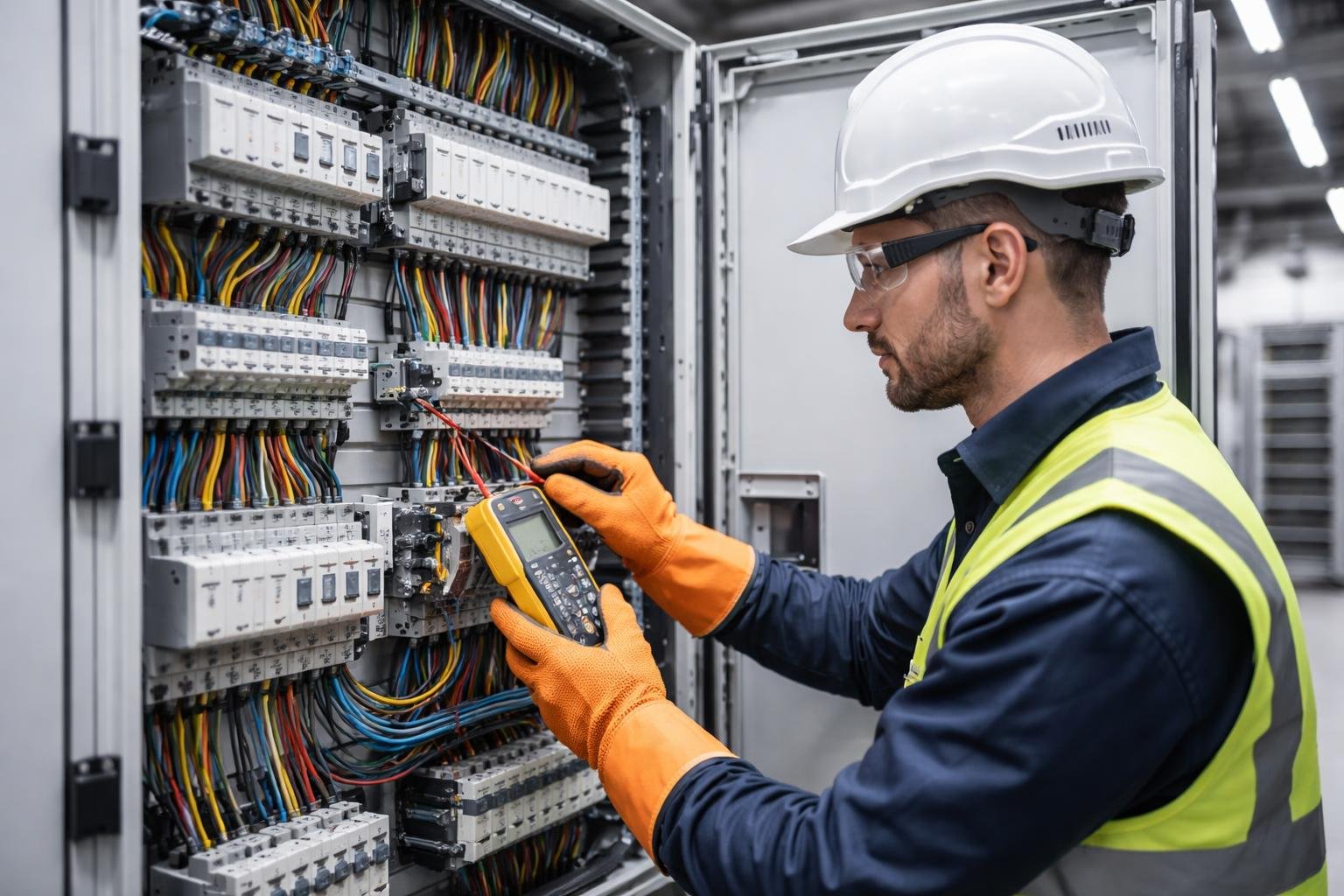
Electrical verification on job sites operates under federal standards, local ordinances, and mandatory permitting processes. These requirements establish minimum safety thresholds and define who can perform verification work.
National Electrical Code Compliance
The National Electrical Code (NEC), published as NFPA 70, is the foundational standard for electrical verification procedures in all 50 states. This code sets baseline requirements for safe electrical design, installation, and inspection practices.
The NEC requires specific testing procedures to confirm de-energization of circuits before work begins. Article 120 mandates workers use approved test equipment to verify circuits are de-energized, not just rely on switch positions or control devices.
The code updates every three years, with new revisions adding enhanced safety protocols for verification tasks. Compliance with NEC standards is mandatory.
States adopt specific editions of the code into law, making adherence a legal requirement. Verification procedures must follow the edition currently enforced in the jurisdiction where work occurs.
Local Authority Jurisdiction
State and municipal authorities oversee electrical verification requirements beyond federal standards. State electrical boards license and regulate electricians, apprentices, and contractors who perform verification work.
These boards set credential requirements and define the scope of practice for different license types. Local jurisdictions may enforce additional requirements through construction industry boards or similar agencies.
Some states require electrician certification through their Division of Labor Standards Enforcement or similar bodies. These certifications verify that workers have specific training in verification procedures and safety protocols.
Authority having jurisdiction (AHJ) interpretations of code requirements can vary between locations. What is acceptable verification in one municipality may not meet standards in another, even when both reference the same NEC edition.
Permit and Registration Policies
Most jurisdictions require permits before conducting electrical verification work. Permit applications usually identify the qualified persons who will perform verification tasks, along with their license or certification numbers.
Registration of electrical contractors with state licensing boards is required in most states before permits are issued. Verification work documentation must be available for inspector review.
This includes records of test equipment calibration, worker qualifications, and verification test results. Some jurisdictions require specific forms or digital submissions through online portals.
Key permit requirements typically include:
- Master or journeyman electrician license numbers
- Scope of verification work planned
- Equipment certification documentation
- Compliance with journeyman-to-apprentice ratios
Contractors must keep registration status current throughout the project. Expired credentials can halt work and trigger enforcement actions.
Steps in the Electrical Job Site Verification Process
Electrical job site verification requires systematic documentation and inspection protocols to ensure safety compliance and project quality. Technicians must verify code adherence, keep detailed records, and confirm all installations meet National Electrical Code standards before energization.
Pre-Departure Verification Checklist
A comprehensive pre-departure checklist is essential for safe electrical work. Qualified persons must verify they have proper test equipment, personal protective equipment (PPE), and current project documentation including up-to-date drawings and panel schedules.
The checklist should confirm all tools are calibrated and rated for the voltage levels on site. Test instruments must be checked as operational before and after each use.
Workers need access to circuit tracers, voltage detectors, and multimeters suitable for their tasks. Documentation requirements include job permits, lockout/tagout devices, and safety ground equipment.
The qualified person must review the scope of work and identify all potential electrical supply sources. This preparation step prevents delays and ensures workers can begin verification immediately upon arrival.
Emergency contact information and site-specific safety procedures must be available. Workers should confirm they have proper authorization and clearance to perform the scheduled work.
Code Compliance Validation
National Electrical Code compliance is the legal and safety baseline for all electrical installations. Inspectors verify that installations meet NEC requirements for conductor sizing, overcurrent protection, grounding systems, and clearance distances.
Circuit breaker panels require verification of proper labeling, ampacity ratings, and correct wire terminations. Ground fault circuit interrupter (GFCI) protection must be tested at required locations using push-button tests and dedicated GFCI testers.
Arc fault circuit interrupter (AFCI) devices need functional verification according to manufacturer specifications. Grounding and bonding systems require special attention during validation.
Electrode connections, equipment grounding conductors, and bonding jumpers must meet NEC specifications for size and installation methods. Inspectors measure ground resistance where required and verify continuity of grounding paths.
Wiring methods must comply with NEC installation requirements for the specific environment. This includes proper support intervals, conduit fill calculations, and protection from physical damage.
Photo Documentation and Metadata
Photographic evidence creates a permanent record of installation quality and code compliance. Images should capture panel interiors, connection points, grounding details, and clearance measurements before covers are installed.
Each photograph should include accurate metadata such as date, time, location coordinates, and the name of the qualified person performing verification. Digital timestamps provide legal documentation for inspection sequences and compliance milestones.
Photos must clearly show details such as wire markings, torque specifications, and label information. Before and after images document the transformation from rough-in to finished installation.
Wide-angle shots establish context while close-ups reveal specific connection methods and component ratings. Inspectors photograph deficiencies alongside corrective actions to show resolution.
Metadata tags should reference specific NEC article numbers and project specification sections. Cloud-based storage systems with backup protocols protect this documentation from loss.
Contractor and Worker Credentials
Electrical job sites require proper verification of contractor registration, tradesperson certifications, and background checks to ensure legal compliance and safety. These credential verifications protect both project owners and workers.
Verifying Contractor Registration
Active contractor registration is essential for legal electrical work. State licensing boards maintain databases where anyone can verify a contractor's current registration status, workers' compensation coverage, and safety violation history.
The verification process typically includes checking:
- Active license status and expiration dates
- Workers' compensation insurance status
- Specialty classifications for electrical work
- Bond information and any claims filed
- Disciplinary actions or license suspensions
Most states require electrical contractors to keep continuous registration and adequate workers' compensation coverage for all employees. When hiring subcontractors, general contractors should request notifications if a subcontractor's registration lapses or their license faces suspension.
State contractor licensing boards provide online tools for credential verification before work begins.
Tradesperson Certification
Individual electrician credentials require separate verification beyond the contractor's license. Journey-level electricians and apprentices must hold valid certifications appropriate to their jurisdiction and tasks.
Verification of tradesperson credentials includes reviewing digital records that display license types, specialty endorsements, and apprenticeship progression. Electrical contractors are responsible for confirming that every worker on site has proper credentials.
Unlicensed electrical work exposes contractors to violations and possible license revocation. Digital credential wallets now allow instant access to licensing history, making verification faster and more reliable.
Background and Insurance Checks
Vetting extends beyond licensing to include insurance coverage and company history. General liability insurance and workers' compensation policies require verification of current coverage limits and expiration dates.
Background checks should examine:
- Previous safety violations with regulatory agencies
- Lawsuit history against surety bonds
- Insurance claim records related to workmanship or accidents
- Business complaint files with state licensing boards
Tracking systems can monitor subcontractor compliance throughout a project, automatically flagging coverage lapses or payment failures.
Technological Tools and Automation
Modern electrical job sites use digital platforms and automated systems to verify work completion, track compliance, and maintain accurate records. These tools reduce manual errors and create verifiable audit trails.
Digital Verification Platforms
Software platforms for electrical contractors centralize job site verification by connecting field crews with office staff in real time. These systems allow electricians to upload photos, submit inspection reports, and document completed work directly from mobile devices.
The platforms automatically organize data by project, date, and crew member. Field management software often includes features for code compliance verification, material tracking, and quality control checkpoints.
Electrical contractors can create custom verification forms that match project requirements or local regulations. When an electrician completes a task, the platform timestamps the entry and stores it in a searchable database.
Key features include:
- Photo documentation with automatic metadata
- Custom inspection forms and checklists
- Real-time synchronization between field and office
- Integration with scheduling and billing systems
Automated Checklists and Approval Workflows
Digital checklists guide electricians through each job phase. This ensures no critical tasks are missed.
The software may require data entry, photos, or measurements before moving to the next step. This structured approach reduces inconsistencies that often occur with paper systems.
Approval workflows send completed work to supervisors or inspectors automatically. When an electrician marks a circuit installation as complete, the system notifies the reviewer and prompts them to verify the work.
If issues are found, the platform documents corrections and creates a traceable record of all changes.
These automated processes help prevent delays from miscommunication or lost paperwork. The system shows who approved each task and when.
GPS and Timestamped Records
Location-based verification adds accountability to job site documentation. Mobile apps capture GPS coordinates when electricians check in, submit reports, or mark tasks complete.
These coordinates confirm that activities happened at the correct location. Timestamps create a record of when specific work was completed or inspected.
Combined with GPS data, this information is useful for dispute resolution, warranty claims, and compliance audits. The data also helps contractors track crew productivity and spot scheduling problems.
Modern platforms sync location and time data with project management systems. This creates complete records without extra manual entry from field staff.
Archiving and Compliance Documentation
Proper archiving of verification records protects electrical contractors from legal disputes. It also ensures they can show compliance when agencies or clients request proof of work quality and safety.
Storing Verification Records
Electrical contractors should keep verification records for at least seven years. Some areas require longer retention for commercial and industrial projects.
Digital storage systems offer searchable databases, cloud backup, and fast retrieval during inspections or audits. These systems are more efficient than paper files.
Records must include specific data to meet compliance requirements. Essential documents include test results, equipment specifications, calibration certificates, signed inspection reports, and photos of installations.
Contractors should organize files by project name, date, and permit number for quick access.
Critical documents to archive:
- Circuit testing and continuity verification results
- Ground fault and insulation resistance measurements
- Panel schedules and as-built drawings
- Safety equipment inspection logs
- Site-specific Job Hazard Analysis forms
Audit Preparation
Regulatory agencies and general contractors expect quick access to verification documentation during audits. Contractors who cannot locate records may face compliance violations, work stoppages, or fines.
A structured filing system separates active projects from completed work. Both categories remain accessible.
Cloud-based project management platforms let field staff upload verification forms immediately after tests. This removes delays between work completion and documentation.
Contractors should conduct internal audits every quarter to find missing documentation before external inspectors arrive. This helps identify gaps and allows time to obtain missing certificates or re-test installations if needed.
Liability Protection
Detailed verification records serve as primary evidence in legal disputes about workmanship and code compliance. Courts and arbitrators use timestamped documentation to confirm facts when conflicts arise between contractors, clients, or other trades.
Documentation shows that electrical systems met National Electrical Code requirements at the time of installation. This protection remains important even years after project completion, as building owners may file claims about alleged defects or safety concerns.
Key liability protections from proper archiving:
- Proof of code-compliant installation methods
- Evidence of approved materials and equipment
- Records showing client approval and sign-off
- Documentation of site conditions and scope changes
Contractors should keep separate files for change orders and scope modifications. These documents define the agreed-upon work and help prevent disputes over unauthorized installations.