Jun 9, 2026

What Is a Hardwired GPS Tracker? 2026 Guide

What Is a Hardwired GPS Tracker? 2026 Guide

A hardwired GPS tracker is a vehicle tracking device permanently wired into a vehicle’s 12V or 24V electrical system to deliver continuous, real-time location and operational data. Unlike plug-in OBD-II devices or portable battery units, a hardwired tracker draws power directly from the vehicle’s battery, meaning it reports location, ignition status, and driver behavior whether the engine is running or not. Devices like the Queclink GV350MG represent the category well, offering multi-input support and always-on connectivity over 4G cellular networks. Motowatchdog builds on this same principle with subscription-free hardwired solutions designed for both commercial fleets and individual vehicle owners who need reliable, continuous monitoring without recurring monthly fees.

What is a hardwired GPS tracker and how does it work?

A hardwired GPS tracker connects directly to a vehicle’s battery and ignition wiring, giving it a permanent, uninterrupted power supply. This direct connection is the defining technical difference between hardwired units and every other tracker category. Always-on reporting means the device transmits data continuously, even when the vehicle is parked overnight or sitting in a lot for days.

The installation process involves tapping into the vehicle’s fuse box or wiring harness, typically connecting three wires: constant power, ground, and an ignition sense wire. This ignition wire tells the tracker whether the engine is on or off, which is critical for generating accurate ignition event logs. Installation takes 15 to 60 minutes per vehicle and usually requires a qualified technician to avoid wiring errors that could affect vehicle electronics.

Once installed, the device collects a wide range of data points:

  • GPS coordinates updated at configurable intervals (typically every 10 to 60 seconds)
  • Ignition on/off events with timestamps
  • Vehicle speed and acceleration patterns
  • Harsh braking, cornering, and acceleration events for driver behavior scoring
  • Auxiliary inputs from external sensors such as door switches, temperature probes, or fuel sensors
  • Cellular signal strength and device health status

The tracker transmits all of this data over a 4G LTE cellular network to a cloud-based telematics platform, where fleet managers or vehicle owners can view it in real time or review historical reports. GPS satellites provide the position fix, while the cellular network handles data delivery. This two-network architecture is standard across the category.

Pro Tip: Install the tracker behind the dashboard or under the seat near the firewall. These locations offer good GPS and cellular signal visibility while keeping the device hidden from drivers or potential thieves.

How does a hardwired GPS tracker compare to wireless and OBD-II trackers?

The key differences between tracker types lie in installation complexity, security, and the range of data each device can access, not in GPS accuracy. Both hardwired and OBD-II trackers use 4G cellular networks and the same GPS satellite infrastructure, so position accuracy is identical. What separates them is everything else.

OBD-II plug-in trackers are fast to deploy. You plug them into the OBD-II port under the dashboard and they start reporting within minutes. However, they are easy to remove. Any driver who knows where the port is can unplug the device in seconds, which makes them a poor choice for high-value fleet security. Hardwired trackers, by contrast, are installed inside the vehicle and are not easily unplugged, giving them significantly higher tamper resistance.
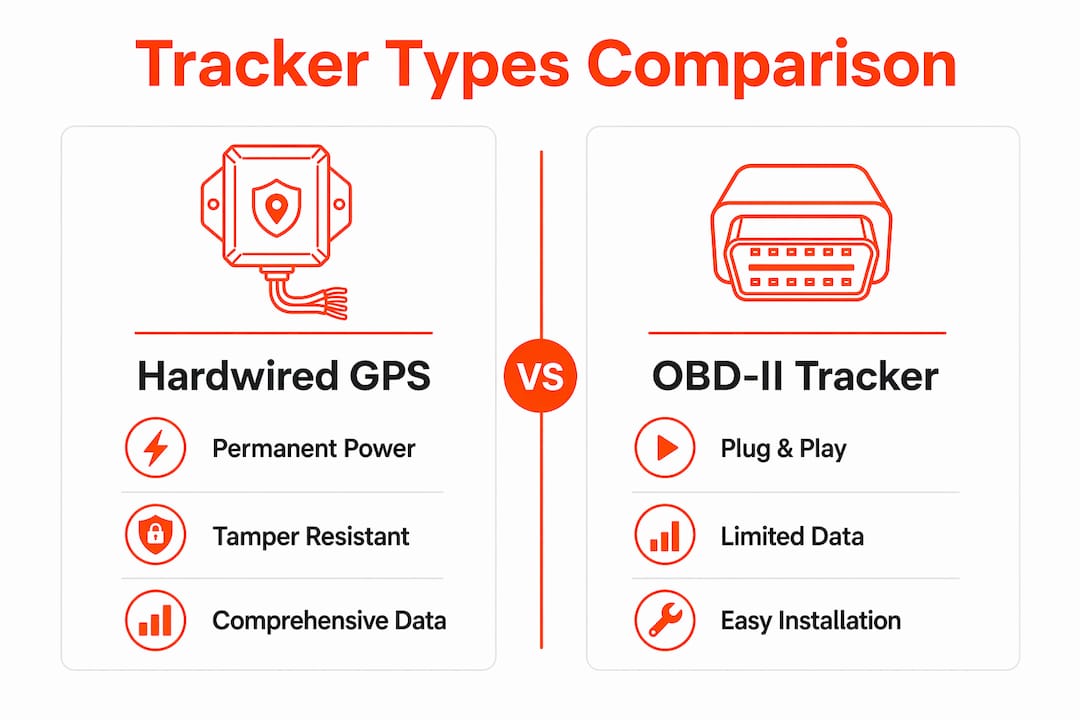
Infographic comparing hardwired and OBD-II GPS trackers

Battery-powered wireless trackers solve the installation problem for assets without a power source, such as trailers, containers, or heavy equipment. But they introduce battery management overhead and have limited reporting frequency to preserve battery life. A hardwired unit reports continuously without any battery drain concern.

Feature Hardwired GPS OBD-II Tracker Battery Wireless
Power source Vehicle battery OBD-II port Internal battery
Tamper resistance High Low Medium
Always-on reporting Yes Yes (while plugged in) Limited (to save battery)
Installation complexity High (technician needed) None None
Engine diagnostics No (without CAN add-on) Yes (native OBD data) No
Best use case Fleet vehicles, high-value assets Light commercial, easy deployment Trailers, unpowered assets

One important limitation to understand: hardwired GPS trackers do not natively provide engine diagnostic trouble codes. Without additional CAN bus integration, they report location and ignition data but not fault codes or fuel consumption from the engine control unit. OBD-II devices have a direct line to that data by design. For fleets that need both security and diagnostics, pairing a hardwired tracker with a separate telematics gateway is the standard solution.

Pro Tip: If your fleet includes both powered vehicles and unpowered trailers, run hardwired units on the vehicles and battery-powered trackers on the trailers. This hybrid fleet approach optimizes cost and functionality across your entire asset pool.

Key features and applications of hardwired GPS trackers for fleet management

Hardwired GPS trackers deliver a feature set that goes well beyond simple location reporting. For fleet managers and asset owners, the most operationally valuable capabilities fall into three categories: security, driver behavior monitoring, and geofence-based alerting.

Fleet manager reviewing GPS tracking data at desk

Security and theft detection are where hardwired trackers genuinely outperform every alternative. Because the device draws continuous power from the vehicle battery, it monitors the vehicle around the clock, including overnight and on weekends when theft risk is highest. If a vehicle moves without an authorized ignition event, the system triggers an unauthorized movement alert immediately. Tamper detection adds another layer: if someone attempts to cut power to the tracker, the device logs the event and sends an alert before losing connectivity.

Driver behavior monitoring gives fleet managers objective data on how vehicles are actually being operated:

  • Speeding alerts when a driver exceeds a set threshold on any road segment
  • Harsh braking events that correlate directly with accident risk and tire wear
  • Rapid acceleration patterns that increase fuel consumption
  • Idle time reporting that identifies fuel waste during stops
  • Trip summaries with start and end times, distance, and route history

This data moves fleet management from reactive problem-solving to data-driven decision-making. A manager reviewing weekly driver scorecards can identify which drivers need coaching before an incident occurs, rather than after.

Geofencing adds a geographic control layer. You define a virtual boundary around a job site, depot, or restricted zone, and the system sends an alert every time a vehicle enters or exits. For construction fleets, this means knowing exactly when equipment leaves a job site after hours. For delivery fleets, it confirms vehicles are staying on approved routes. Platforms like those supported by Motowatchdog allow multiple geofences per account, with customizable alert thresholds and notification methods.

The range of compatible assets extends well beyond standard commercial vans and trucks. Hardwired trackers are deployed on heavy construction equipment, agricultural machinery, marine vessels, generators, and even high-value personal vehicles. Any asset with a 12V or 24V power system is a candidate.

What should you consider when choosing and installing a hardwired GPS tracker?

Choosing the right hardwired tracker requires matching device capabilities to your specific tracking goals before purchasing. Not every device supports every feature, and installation complexity varies by vehicle type.

Follow this decision process before committing to a device:

  1. Define your primary use case. Security and theft recovery require always-on reporting and tamper alerts. Driver behavior monitoring requires accelerometer-based event detection. Geofencing requires a platform with configurable zone management. Confirm the device supports your priority features.
  2. Check vehicle compatibility. Most hardwired trackers work with any 12V or 24V system, but heavy equipment with non-standard wiring may require an adapter harness. Verify compatibility before ordering.
  3. Plan the installation location carefully. Good placement means the device has clear GPS and cellular signal visibility, is protected from heat and moisture, and is concealed from view. Behind the dashboard near the A-pillar or under the rear seat are common choices.
  4. Use a qualified technician. Incorrect wiring can trigger fault codes, drain the battery, or damage vehicle electronics. The 15 to 60 minute installation window assumes a technician who knows the vehicle’s wiring diagram.
  5. Consider warranty implications. Modifying a vehicle’s wiring can affect manufacturer warranty coverage on electrical systems. Use tap connectors rather than cutting wires, and document the installation for warranty purposes.

Maintenance requirements for hardwired trackers are minimal compared to battery-powered devices. There are no batteries to replace and no charging cycles to manage. The primary maintenance task is verifying that wiring connections remain secure during the vehicle’s service intervals. A well-installed hardwired tracker can operate reliably for the full service life of the vehicle.

Pro Tip: Ask your installer to use a dedicated fused circuit from the fuse box rather than tapping into an existing circuit. This protects both the tracker and the vehicle’s electrical system from current spikes.

Key takeaways

A hardwired GPS tracker is the most reliable and tamper-resistant vehicle tracking option available, making it the correct choice for any fleet or asset where continuous monitoring and security are non-negotiable.

Point Details
Always-on power advantage Direct battery connection enables continuous reporting, even when the vehicle is parked or the ignition is off.
Tamper resistance is the key security differentiator Hardwired installation makes the device significantly harder to remove than OBD-II plug-in alternatives.
GPS accuracy is not the differentiator Both hardwired and OBD-II trackers use identical 4G and GPS infrastructure; the differences are in security and data range.
Engine diagnostics require extra hardware Hardwired trackers do not natively read fault codes without a separate CAN bus integration module.
Hybrid deployments maximize fleet coverage Pairing hardwired units on powered vehicles with battery trackers on trailers optimizes both cost and functionality.

Why hardwired trackers are the right foundation for serious fleet management

I have reviewed a lot of tracking deployments over the years, and the pattern is consistent: fleets that start with OBD-II devices for convenience almost always migrate to hardwired units once they experience a theft event or a driver who simply unplugs the tracker. The convenience of plug-in devices is real, but it is a convenience that works against you when security is the actual priority.

The argument I hear most often against hardwired installation is the upfront cost and complexity. That concern is legitimate for a single vehicle. For a fleet of ten or more, the math changes quickly. One recovered vehicle or one prevented theft incident covers the installation cost across the entire fleet. The continuous parked monitoring capability alone, which battery devices cannot reliably provide, justifies the investment for any fleet operating in urban environments with elevated theft risk.

What I find underappreciated is the hybrid approach. Running hardwired units on powered vehicles and battery trackers on trailers is not a compromise. It is the technically correct solution for mixed fleets. Queclink’s own research confirms that hybrid deployments optimize both cost and functionality across different asset types. Treating every asset the same way is where fleet managers leave efficiency on the table.

The future of hardwired telematics is moving toward deeper CAN bus integration, where a single hardwired device captures both location data and engine diagnostics in one unit. That convergence will make the OBD-II versus hardwired debate largely irrelevant within the next few years. For now, understanding what each technology does well is the foundation of a smart tracking strategy.

— Louis

Track every vehicle and asset with Motowatchdog

Motowatchdog delivers subscription-free 4G GPS tracking built on the same always-on, hardwired principles this article covers. There are no monthly fees eating into your fleet budget, and the platform supports real-time monitoring, geofencing alerts, and detailed mileage reporting for both commercial fleets and individual vehicle owners.
https://motowatchdog.com

Over 1,000 businesses rely on Motowatchdog for accurate, continuous vehicle monitoring. The devices support covert, tamper-resistant installation and work across cars, trucks, heavy equipment, and any asset with a 12V or 24V power system. If you are ready to move from reactive tracking to always-on asset visibility, Motowatchdog gives you the hardware and platform to do it without a recurring subscription cost.

FAQ

What is a hardwired GPS tracker used for?

A hardwired GPS tracker is used for continuous, real-time monitoring of vehicles and assets, including location tracking, driver behavior reporting, geofence alerts, and theft detection. It is the preferred solution for commercial fleets and high-value asset owners who need always-on visibility.

How does a hardwired GPS tracker differ from an OBD-II tracker?

The primary differences are tamper resistance, installation complexity, and data range, not GPS accuracy. Both use 4G cellular networks for identical position accuracy, but hardwired units are far harder to remove and support continuous parked monitoring that OBD-II devices cannot guarantee.

Does a hardwired GPS tracker work when the car is off?

Yes. Because it connects directly to the vehicle battery, a hardwired tracker reports continuously regardless of ignition state, enabling after-hours monitoring and unauthorized movement alerts.

Can a hardwired GPS tracker read engine fault codes?

Not natively. Hardwired GPS trackers provide location and ignition data but do not access engine diagnostics without a separate CAN bus integration module paired with the device.

How long does it take to install a hardwired GPS tracker?

Installation typically takes 15 to 60 minutes per vehicle and should be performed by a qualified technician to protect vehicle electronics and maximize tamper resistance through proper wiring and placement.

A hardwired GPS tracker is a vehicle tracking device permanently wired into a vehicle’s 12V or 24V electrical system to deliver continuous, real-time location and operational data. Unlike plug-in OBD-II devices or portable battery units, a hardwired tracker draws power directly from the vehicle’s battery, meaning it reports location, ignition status, and driver behavior whether the engine is running or not. Devices like the Queclink GV350MG represent the category well, offering multi-input support and always-on connectivity over 4G cellular networks. Motowatchdog builds on this same principle with subscription-free hardwired solutions designed for both commercial fleets and individual vehicle owners who need reliable, continuous monitoring without recurring monthly fees.

What is a hardwired GPS tracker and how does it work?

A hardwired GPS tracker connects directly to a vehicle’s battery and ignition wiring, giving it a permanent, uninterrupted power supply. This direct connection is the defining technical difference between hardwired units and every other tracker category. Always-on reporting means the device transmits data continuously, even when the vehicle is parked overnight or sitting in a lot for days.

The installation process involves tapping into the vehicle’s fuse box or wiring harness, typically connecting three wires: constant power, ground, and an ignition sense wire. This ignition wire tells the tracker whether the engine is on or off, which is critical for generating accurate ignition event logs. Installation takes 15 to 60 minutes per vehicle and usually requires a qualified technician to avoid wiring errors that could affect vehicle electronics.

Once installed, the device collects a wide range of data points:

  • GPS coordinates updated at configurable intervals (typically every 10 to 60 seconds)
  • Ignition on/off events with timestamps
  • Vehicle speed and acceleration patterns
  • Harsh braking, cornering, and acceleration events for driver behavior scoring
  • Auxiliary inputs from external sensors such as door switches, temperature probes, or fuel sensors
  • Cellular signal strength and device health status

The tracker transmits all of this data over a 4G LTE cellular network to a cloud-based telematics platform, where fleet managers or vehicle owners can view it in real time or review historical reports. GPS satellites provide the position fix, while the cellular network handles data delivery. This two-network architecture is standard across the category.

Pro Tip: Install the tracker behind the dashboard or under the seat near the firewall. These locations offer good GPS and cellular signal visibility while keeping the device hidden from drivers or potential thieves.

How does a hardwired GPS tracker compare to wireless and OBD-II trackers?

The key differences between tracker types lie in installation complexity, security, and the range of data each device can access, not in GPS accuracy. Both hardwired and OBD-II trackers use 4G cellular networks and the same GPS satellite infrastructure, so position accuracy is identical. What separates them is everything else.

OBD-II plug-in trackers are fast to deploy. You plug them into the OBD-II port under the dashboard and they start reporting within minutes. However, they are easy to remove. Any driver who knows where the port is can unplug the device in seconds, which makes them a poor choice for high-value fleet security. Hardwired trackers, by contrast, are installed inside the vehicle and are not easily unplugged, giving them significantly higher tamper resistance.

Infographic comparing hardwired and OBD-II GPS trackers

Battery-powered wireless trackers solve the installation problem for assets without a power source, such as trailers, containers, or heavy equipment. But they introduce battery management overhead and have limited reporting frequency to preserve battery life. A hardwired unit reports continuously without any battery drain concern.

Feature Hardwired GPS OBD-II Tracker Battery Wireless
Power source Vehicle battery OBD-II port Internal battery
Tamper resistance High Low Medium
Always-on reporting Yes Yes (while plugged in) Limited (to save battery)
Installation complexity High (technician needed) None None
Engine diagnostics No (without CAN add-on) Yes (native OBD data) No
Best use case Fleet vehicles, high-value assets Light commercial, easy deployment Trailers, unpowered assets

One important limitation to understand: hardwired GPS trackers do not natively provide engine diagnostic trouble codes. Without additional CAN bus integration, they report location and ignition data but not fault codes or fuel consumption from the engine control unit. OBD-II devices have a direct line to that data by design. For fleets that need both security and diagnostics, pairing a hardwired tracker with a separate telematics gateway is the standard solution.

Pro Tip: If your fleet includes both powered vehicles and unpowered trailers, run hardwired units on the vehicles and battery-powered trackers on the trailers. This hybrid fleet approach optimizes cost and functionality across your entire asset pool.

Key features and applications of hardwired GPS trackers for fleet management

Hardwired GPS trackers deliver a feature set that goes well beyond simple location reporting. For fleet managers and asset owners, the most operationally valuable capabilities fall into three categories: security, driver behavior monitoring, and geofence-based alerting.

Fleet manager reviewing GPS tracking data at desk

Security and theft detection are where hardwired trackers genuinely outperform every alternative. Because the device draws continuous power from the vehicle battery, it monitors the vehicle around the clock, including overnight and on weekends when theft risk is highest. If a vehicle moves without an authorized ignition event, the system triggers an unauthorized movement alert immediately. Tamper detection adds another layer: if someone attempts to cut power to the tracker, the device logs the event and sends an alert before losing connectivity.

Driver behavior monitoring gives fleet managers objective data on how vehicles are actually being operated:

  • Speeding alerts when a driver exceeds a set threshold on any road segment
  • Harsh braking events that correlate directly with accident risk and tire wear
  • Rapid acceleration patterns that increase fuel consumption
  • Idle time reporting that identifies fuel waste during stops
  • Trip summaries with start and end times, distance, and route history

This data moves fleet management from reactive problem-solving to data-driven decision-making. A manager reviewing weekly driver scorecards can identify which drivers need coaching before an incident occurs, rather than after.

Geofencing adds a geographic control layer. You define a virtual boundary around a job site, depot, or restricted zone, and the system sends an alert every time a vehicle enters or exits. For construction fleets, this means knowing exactly when equipment leaves a job site after hours. For delivery fleets, it confirms vehicles are staying on approved routes. Platforms like those supported by Motowatchdog allow multiple geofences per account, with customizable alert thresholds and notification methods.

The range of compatible assets extends well beyond standard commercial vans and trucks. Hardwired trackers are deployed on heavy construction equipment, agricultural machinery, marine vessels, generators, and even high-value personal vehicles. Any asset with a 12V or 24V power system is a candidate.

What should you consider when choosing and installing a hardwired GPS tracker?

Choosing the right hardwired tracker requires matching device capabilities to your specific tracking goals before purchasing. Not every device supports every feature, and installation complexity varies by vehicle type.

Follow this decision process before committing to a device:

  1. Define your primary use case. Security and theft recovery require always-on reporting and tamper alerts. Driver behavior monitoring requires accelerometer-based event detection. Geofencing requires a platform with configurable zone management. Confirm the device supports your priority features.
  2. Check vehicle compatibility. Most hardwired trackers work with any 12V or 24V system, but heavy equipment with non-standard wiring may require an adapter harness. Verify compatibility before ordering.
  3. Plan the installation location carefully. Good placement means the device has clear GPS and cellular signal visibility, is protected from heat and moisture, and is concealed from view. Behind the dashboard near the A-pillar or under the rear seat are common choices.
  4. Use a qualified technician. Incorrect wiring can trigger fault codes, drain the battery, or damage vehicle electronics. The 15 to 60 minute installation window assumes a technician who knows the vehicle’s wiring diagram.
  5. Consider warranty implications. Modifying a vehicle’s wiring can affect manufacturer warranty coverage on electrical systems. Use tap connectors rather than cutting wires, and document the installation for warranty purposes.

Maintenance requirements for hardwired trackers are minimal compared to battery-powered devices. There are no batteries to replace and no charging cycles to manage. The primary maintenance task is verifying that wiring connections remain secure during the vehicle’s service intervals. A well-installed hardwired tracker can operate reliably for the full service life of the vehicle.

Pro Tip: Ask your installer to use a dedicated fused circuit from the fuse box rather than tapping into an existing circuit. This protects both the tracker and the vehicle’s electrical system from current spikes.

Key takeaways

A hardwired GPS tracker is the most reliable and tamper-resistant vehicle tracking option available, making it the correct choice for any fleet or asset where continuous monitoring and security are non-negotiable.

Point Details
Always-on power advantage Direct battery connection enables continuous reporting, even when the vehicle is parked or the ignition is off.
Tamper resistance is the key security differentiator Hardwired installation makes the device significantly harder to remove than OBD-II plug-in alternatives.
GPS accuracy is not the differentiator Both hardwired and OBD-II trackers use identical 4G and GPS infrastructure; the differences are in security and data range.
Engine diagnostics require extra hardware Hardwired trackers do not natively read fault codes without a separate CAN bus integration module.
Hybrid deployments maximize fleet coverage Pairing hardwired units on powered vehicles with battery trackers on trailers optimizes both cost and functionality.

Why hardwired trackers are the right foundation for serious fleet management

I have reviewed a lot of tracking deployments over the years, and the pattern is consistent: fleets that start with OBD-II devices for convenience almost always migrate to hardwired units once they experience a theft event or a driver who simply unplugs the tracker. The convenience of plug-in devices is real, but it is a convenience that works against you when security is the actual priority.

The argument I hear most often against hardwired installation is the upfront cost and complexity. That concern is legitimate for a single vehicle. For a fleet of ten or more, the math changes quickly. One recovered vehicle or one prevented theft incident covers the installation cost across the entire fleet. The continuous parked monitoring capability alone, which battery devices cannot reliably provide, justifies the investment for any fleet operating in urban environments with elevated theft risk.

What I find underappreciated is the hybrid approach. Running hardwired units on powered vehicles and battery trackers on trailers is not a compromise. It is the technically correct solution for mixed fleets. Queclink’s own research confirms that hybrid deployments optimize both cost and functionality across different asset types. Treating every asset the same way is where fleet managers leave efficiency on the table.

The future of hardwired telematics is moving toward deeper CAN bus integration, where a single hardwired device captures both location data and engine diagnostics in one unit. That convergence will make the OBD-II versus hardwired debate largely irrelevant within the next few years. For now, understanding what each technology does well is the foundation of a smart tracking strategy.

— Louis

Track every vehicle and asset with Motowatchdog

Motowatchdog delivers subscription-free 4G GPS tracking built on the same always-on, hardwired principles this article covers. There are no monthly fees eating into your fleet budget, and the platform supports real-time monitoring, geofencing alerts, and detailed mileage reporting for both commercial fleets and individual vehicle owners.

https://motowatchdog.com

Over 1,000 businesses rely on Motowatchdog for accurate, continuous vehicle monitoring. The devices support covert, tamper-resistant installation and work across cars, trucks, heavy equipment, and any asset with a 12V or 24V power system. If you are ready to move from reactive tracking to always-on asset visibility, Motowatchdog gives you the hardware and platform to do it without a recurring subscription cost.

FAQ

What is a hardwired GPS tracker used for?

A hardwired GPS tracker is used for continuous, real-time monitoring of vehicles and assets, including location tracking, driver behavior reporting, geofence alerts, and theft detection. It is the preferred solution for commercial fleets and high-value asset owners who need always-on visibility.

How does a hardwired GPS tracker differ from an OBD-II tracker?

The primary differences are tamper resistance, installation complexity, and data range, not GPS accuracy. Both use 4G cellular networks for identical position accuracy, but hardwired units are far harder to remove and support continuous parked monitoring that OBD-II devices cannot guarantee.

Does a hardwired GPS tracker work when the car is off?

Yes. Because it connects directly to the vehicle battery, a hardwired tracker reports continuously regardless of ignition state, enabling after-hours monitoring and unauthorized movement alerts.

Can a hardwired GPS tracker read engine fault codes?

Not natively. Hardwired GPS trackers provide location and ignition data but do not access engine diagnostics without a separate CAN bus integration module paired with the device.

How long does it take to install a hardwired GPS tracker?

Installation typically takes 15 to 60 minutes per vehicle and should be performed by a qualified technician to protect vehicle electronics and maximize tamper resistance through proper wiring and placement.

A hardwired GPS tracker is a vehicle tracking device permanently wired into a vehicle’s 12V or 24V electrical system to deliver continuous, real-time location and operational data. Unlike plug-in OBD-II devices or portable battery units, a hardwired tracker draws power directly from the vehicle’s battery, meaning it reports location, ignition status, and driver behavior whether the engine is running or not. Devices like the Queclink GV350MG represent the category well, offering multi-input support and always-on connectivity over 4G cellular networks. Motowatchdog builds on this same principle with subscription-free hardwired solutions designed for both commercial fleets and individual vehicle owners who need reliable, continuous monitoring without recurring monthly fees.

What is a hardwired GPS tracker and how does it work?

A hardwired GPS tracker connects directly to a vehicle’s battery and ignition wiring, giving it a permanent, uninterrupted power supply. This direct connection is the defining technical difference between hardwired units and every other tracker category. Always-on reporting means the device transmits data continuously, even when the vehicle is parked overnight or sitting in a lot for days.

The installation process involves tapping into the vehicle’s fuse box or wiring harness, typically connecting three wires: constant power, ground, and an ignition sense wire. This ignition wire tells the tracker whether the engine is on or off, which is critical for generating accurate ignition event logs. Installation takes 15 to 60 minutes per vehicle and usually requires a qualified technician to avoid wiring errors that could affect vehicle electronics.

Once installed, the device collects a wide range of data points:

  • GPS coordinates updated at configurable intervals (typically every 10 to 60 seconds)
  • Ignition on/off events with timestamps
  • Vehicle speed and acceleration patterns
  • Harsh braking, cornering, and acceleration events for driver behavior scoring
  • Auxiliary inputs from external sensors such as door switches, temperature probes, or fuel sensors
  • Cellular signal strength and device health status

The tracker transmits all of this data over a 4G LTE cellular network to a cloud-based telematics platform, where fleet managers or vehicle owners can view it in real time or review historical reports. GPS satellites provide the position fix, while the cellular network handles data delivery. This two-network architecture is standard across the category.

Pro Tip: Install the tracker behind the dashboard or under the seat near the firewall. These locations offer good GPS and cellular signal visibility while keeping the device hidden from drivers or potential thieves.

How does a hardwired GPS tracker compare to wireless and OBD-II trackers?

The key differences between tracker types lie in installation complexity, security, and the range of data each device can access, not in GPS accuracy. Both hardwired and OBD-II trackers use 4G cellular networks and the same GPS satellite infrastructure, so position accuracy is identical. What separates them is everything else.

OBD-II plug-in trackers are fast to deploy. You plug them into the OBD-II port under the dashboard and they start reporting within minutes. However, they are easy to remove. Any driver who knows where the port is can unplug the device in seconds, which makes them a poor choice for high-value fleet security. Hardwired trackers, by contrast, are installed inside the vehicle and are not easily unplugged, giving them significantly higher tamper resistance.

Infographic comparing hardwired and OBD-II GPS trackers

Battery-powered wireless trackers solve the installation problem for assets without a power source, such as trailers, containers, or heavy equipment. But they introduce battery management overhead and have limited reporting frequency to preserve battery life. A hardwired unit reports continuously without any battery drain concern.

Feature Hardwired GPS OBD-II Tracker Battery Wireless
Power source Vehicle battery OBD-II port Internal battery
Tamper resistance High Low Medium
Always-on reporting Yes Yes (while plugged in) Limited (to save battery)
Installation complexity High (technician needed) None None
Engine diagnostics No (without CAN add-on) Yes (native OBD data) No
Best use case Fleet vehicles, high-value assets Light commercial, easy deployment Trailers, unpowered assets

One important limitation to understand: hardwired GPS trackers do not natively provide engine diagnostic trouble codes. Without additional CAN bus integration, they report location and ignition data but not fault codes or fuel consumption from the engine control unit. OBD-II devices have a direct line to that data by design. For fleets that need both security and diagnostics, pairing a hardwired tracker with a separate telematics gateway is the standard solution.

Pro Tip: If your fleet includes both powered vehicles and unpowered trailers, run hardwired units on the vehicles and battery-powered trackers on the trailers. This hybrid fleet approach optimizes cost and functionality across your entire asset pool.

Key features and applications of hardwired GPS trackers for fleet management

Hardwired GPS trackers deliver a feature set that goes well beyond simple location reporting. For fleet managers and asset owners, the most operationally valuable capabilities fall into three categories: security, driver behavior monitoring, and geofence-based alerting.

Fleet manager reviewing GPS tracking data at desk

Security and theft detection are where hardwired trackers genuinely outperform every alternative. Because the device draws continuous power from the vehicle battery, it monitors the vehicle around the clock, including overnight and on weekends when theft risk is highest. If a vehicle moves without an authorized ignition event, the system triggers an unauthorized movement alert immediately. Tamper detection adds another layer: if someone attempts to cut power to the tracker, the device logs the event and sends an alert before losing connectivity.

Driver behavior monitoring gives fleet managers objective data on how vehicles are actually being operated:

  • Speeding alerts when a driver exceeds a set threshold on any road segment
  • Harsh braking events that correlate directly with accident risk and tire wear
  • Rapid acceleration patterns that increase fuel consumption
  • Idle time reporting that identifies fuel waste during stops
  • Trip summaries with start and end times, distance, and route history

This data moves fleet management from reactive problem-solving to data-driven decision-making. A manager reviewing weekly driver scorecards can identify which drivers need coaching before an incident occurs, rather than after.

Geofencing adds a geographic control layer. You define a virtual boundary around a job site, depot, or restricted zone, and the system sends an alert every time a vehicle enters or exits. For construction fleets, this means knowing exactly when equipment leaves a job site after hours. For delivery fleets, it confirms vehicles are staying on approved routes. Platforms like those supported by Motowatchdog allow multiple geofences per account, with customizable alert thresholds and notification methods.

The range of compatible assets extends well beyond standard commercial vans and trucks. Hardwired trackers are deployed on heavy construction equipment, agricultural machinery, marine vessels, generators, and even high-value personal vehicles. Any asset with a 12V or 24V power system is a candidate.

What should you consider when choosing and installing a hardwired GPS tracker?

Choosing the right hardwired tracker requires matching device capabilities to your specific tracking goals before purchasing. Not every device supports every feature, and installation complexity varies by vehicle type.

Follow this decision process before committing to a device:

  1. Define your primary use case. Security and theft recovery require always-on reporting and tamper alerts. Driver behavior monitoring requires accelerometer-based event detection. Geofencing requires a platform with configurable zone management. Confirm the device supports your priority features.
  2. Check vehicle compatibility. Most hardwired trackers work with any 12V or 24V system, but heavy equipment with non-standard wiring may require an adapter harness. Verify compatibility before ordering.
  3. Plan the installation location carefully. Good placement means the device has clear GPS and cellular signal visibility, is protected from heat and moisture, and is concealed from view. Behind the dashboard near the A-pillar or under the rear seat are common choices.
  4. Use a qualified technician. Incorrect wiring can trigger fault codes, drain the battery, or damage vehicle electronics. The 15 to 60 minute installation window assumes a technician who knows the vehicle’s wiring diagram.
  5. Consider warranty implications. Modifying a vehicle’s wiring can affect manufacturer warranty coverage on electrical systems. Use tap connectors rather than cutting wires, and document the installation for warranty purposes.

Maintenance requirements for hardwired trackers are minimal compared to battery-powered devices. There are no batteries to replace and no charging cycles to manage. The primary maintenance task is verifying that wiring connections remain secure during the vehicle’s service intervals. A well-installed hardwired tracker can operate reliably for the full service life of the vehicle.

Pro Tip: Ask your installer to use a dedicated fused circuit from the fuse box rather than tapping into an existing circuit. This protects both the tracker and the vehicle’s electrical system from current spikes.

Key takeaways

A hardwired GPS tracker is the most reliable and tamper-resistant vehicle tracking option available, making it the correct choice for any fleet or asset where continuous monitoring and security are non-negotiable.

Point Details
Always-on power advantage Direct battery connection enables continuous reporting, even when the vehicle is parked or the ignition is off.
Tamper resistance is the key security differentiator Hardwired installation makes the device significantly harder to remove than OBD-II plug-in alternatives.
GPS accuracy is not the differentiator Both hardwired and OBD-II trackers use identical 4G and GPS infrastructure; the differences are in security and data range.
Engine diagnostics require extra hardware Hardwired trackers do not natively read fault codes without a separate CAN bus integration module.
Hybrid deployments maximize fleet coverage Pairing hardwired units on powered vehicles with battery trackers on trailers optimizes both cost and functionality.

Why hardwired trackers are the right foundation for serious fleet management

I have reviewed a lot of tracking deployments over the years, and the pattern is consistent: fleets that start with OBD-II devices for convenience almost always migrate to hardwired units once they experience a theft event or a driver who simply unplugs the tracker. The convenience of plug-in devices is real, but it is a convenience that works against you when security is the actual priority.

The argument I hear most often against hardwired installation is the upfront cost and complexity. That concern is legitimate for a single vehicle. For a fleet of ten or more, the math changes quickly. One recovered vehicle or one prevented theft incident covers the installation cost across the entire fleet. The continuous parked monitoring capability alone, which battery devices cannot reliably provide, justifies the investment for any fleet operating in urban environments with elevated theft risk.

What I find underappreciated is the hybrid approach. Running hardwired units on powered vehicles and battery trackers on trailers is not a compromise. It is the technically correct solution for mixed fleets. Queclink’s own research confirms that hybrid deployments optimize both cost and functionality across different asset types. Treating every asset the same way is where fleet managers leave efficiency on the table.

The future of hardwired telematics is moving toward deeper CAN bus integration, where a single hardwired device captures both location data and engine diagnostics in one unit. That convergence will make the OBD-II versus hardwired debate largely irrelevant within the next few years. For now, understanding what each technology does well is the foundation of a smart tracking strategy.

— Louis

Track every vehicle and asset with Motowatchdog

Motowatchdog delivers subscription-free 4G GPS tracking built on the same always-on, hardwired principles this article covers. There are no monthly fees eating into your fleet budget, and the platform supports real-time monitoring, geofencing alerts, and detailed mileage reporting for both commercial fleets and individual vehicle owners.

https://motowatchdog.com

Over 1,000 businesses rely on Motowatchdog for accurate, continuous vehicle monitoring. The devices support covert, tamper-resistant installation and work across cars, trucks, heavy equipment, and any asset with a 12V or 24V power system. If you are ready to move from reactive tracking to always-on asset visibility, Motowatchdog gives you the hardware and platform to do it without a recurring subscription cost.

FAQ

What is a hardwired GPS tracker used for?

A hardwired GPS tracker is used for continuous, real-time monitoring of vehicles and assets, including location tracking, driver behavior reporting, geofence alerts, and theft detection. It is the preferred solution for commercial fleets and high-value asset owners who need always-on visibility.

How does a hardwired GPS tracker differ from an OBD-II tracker?

The primary differences are tamper resistance, installation complexity, and data range, not GPS accuracy. Both use 4G cellular networks for identical position accuracy, but hardwired units are far harder to remove and support continuous parked monitoring that OBD-II devices cannot guarantee.

Does a hardwired GPS tracker work when the car is off?

Yes. Because it connects directly to the vehicle battery, a hardwired tracker reports continuously regardless of ignition state, enabling after-hours monitoring and unauthorized movement alerts.

Can a hardwired GPS tracker read engine fault codes?

Not natively. Hardwired GPS trackers provide location and ignition data but do not access engine diagnostics without a separate CAN bus integration module paired with the device.

How long does it take to install a hardwired GPS tracker?

Installation typically takes 15 to 60 minutes per vehicle and should be performed by a qualified technician to protect vehicle electronics and maximize tamper resistance through proper wiring and placement.

What Is a Hardwired GPS Tracker? 2026 Guide