How to start saving money
Lorem ipsum dolor sit amet, consectetur adipiscing elit lobortis arcu enim urna adipiscing praesent velit viverra sit semper lorem eu cursus vel hendrerit elementum morbi curabitur etiam nibh justo, lorem aliquet donec sed sit mi dignissim at ante massa mattis.
- Neque sodales ut etiam sit amet nisl purus non tellus orci ac auctor
- Adipiscing elit ut aliquam purus sit amet viverra suspendisse potent
- Mauris commodo quis imperdiet massa tincidunt nunc pulvinar
- Excepteur sint occaecat cupidatat non proident sunt in culpa qui officia
Why it is important to start saving
Vitae congue eu consequat ac felis placerat vestibulum lectus mauris ultrices cursus sit amet dictum sit amet justo donec enim diam porttitor lacus luctus accumsan tortor posuere praesent tristique magna sit amet purus gravida quis blandit turpis.

How much money should I save?
At risus viverra adipiscing at in tellus integer feugiat nisl pretium fusce id velit ut tortor sagittis orci a scelerisque purus semper eget at lectus urna duis convallis. porta nibh venenatis cras sed felis eget neque laoreet suspendisse interdum consectetur libero id faucibus nisl donec pretium vulputate sapien nec sagittis aliquam nunc lobortis mattis aliquam faucibus purus in.
- Neque sodales ut etiam sit amet nisl purus non tellus orci ac auctor
- Adipiscing elit ut aliquam purus sit amet viverra suspendisse potenti
- Mauris commodo quis imperdiet massa tincidunt nunc pulvinar
- Adipiscing elit ut aliquam purus sit amet viverra suspendisse potenti
What percentege of my income should go to savings?
Nisi quis eleifend quam adipiscing vitae aliquet bibendum enim facilisis gravida neque. Velit euismod in pellentesque massa placerat volutpat lacus laoreet non curabitur gravida odio aenean sed adipiscing diam donec adipiscing tristique risus. amet est placerat in egestas erat imperdiet sed euismod nisi.
“Nisi quis eleifend quam adipiscing vitae aliquet bibendum enim facilisis gravida neque velit euismod in pellentesque”
Do you have any comments? Share them with us on social media
Eget lorem dolor sed viverra ipsum nunc aliquet bibendum felis donec et odio pellentesque diam volutpat commodo sed egestas aliquam sem fringilla ut morbi tincidunt augue interdum velit euismod eu tincidunt tortor aliquam nulla facilisi aenean sed adipiscing diam donec adipiscing ut lectus arcu bibendum at varius vel pharetra nibh venenatis cras sed felis eget.
A GPS tracker is a device that receives signals from navigation satellites and transmits location data to a remote server or app for real-time monitoring. The industry term is “GPS tracking unit,” and it combines two distinct hardware systems: a GPS receiver and communication hardware working together. Manufacturers like CalAmp, ORBCOMM, Queclink, and Teltonika produce specialized units for everything from personal safety to large-scale fleet management. Motowatchdog builds on this same technology to deliver subscription-free tracking for vehicles and assets. Understanding how these systems work helps you choose the right device and get the most from it.
What is a GPS tracker and how does it determine location?
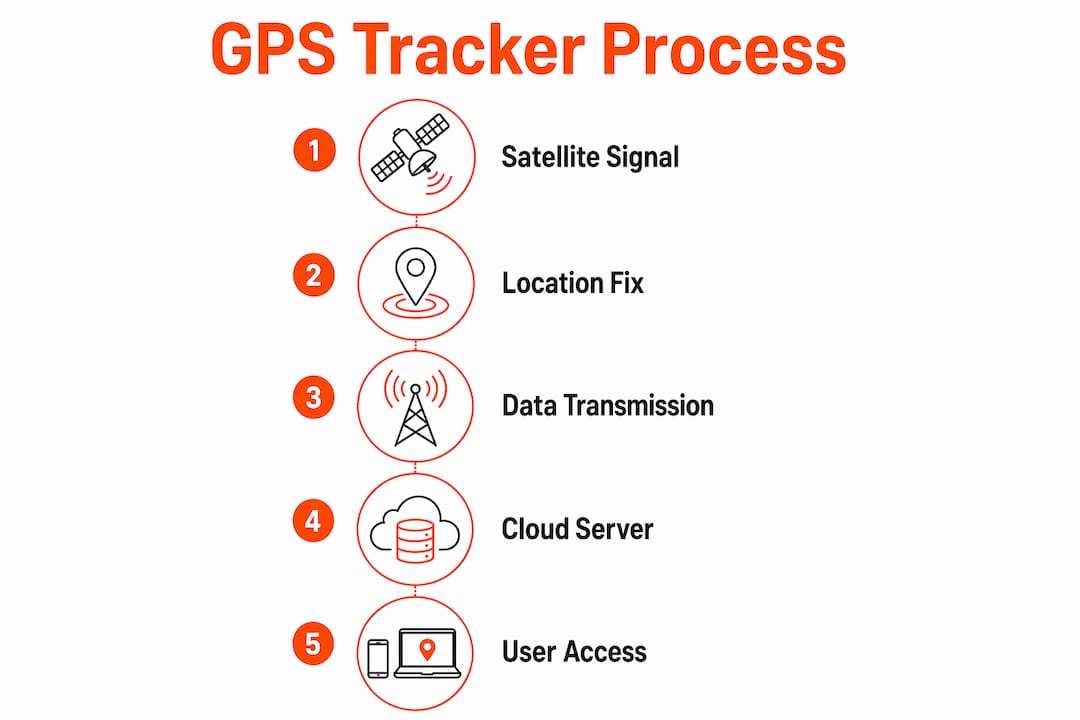
A GPS tracker determines location by receiving signals from multiple satellites orbiting Earth. The underlying system is called the Global Navigation Satellite System, or GNSS, which includes the American GPS constellation along with Russia’s GLONASS and Europe’s Galileo networks.
The core method is called trilateration. A GPS receiver calculates location by measuring the time it takes for signals to arrive from at least four satellites simultaneously. Each satellite carries atomic clocks that broadcast precise time and position data. Small timing errors translate directly into location errors, which is why atomic clock accuracy is non-negotiable in the system.

Once the receiver has a position fix, a separate communication module transmits that data to a cloud server. The communication path uses cellular networks, radio, or satellite modems depending on the device. Without a communication path, the tracker cannot update positions remotely in real time. This two-step process, getting a fix and then transmitting it, is the foundation of every GPS tracking unit on the market.
Pro Tip: A cold GPS start can take 30–90 seconds to acquire satellites. Assisted GPS (AGPS) cuts that to 5–10 seconds by pulling satellite data from a cellular network first. If fast startup matters for your use case, confirm the device supports AGPS before buying.
What are the main types of GPS trackers?
GPS trackers fall into two operating modes and several form factor categories. Knowing the difference saves you from buying the wrong device.
Active vs. passive tracking
Active trackers push location data to a server continuously or at set intervals, giving you a live map view. Passive trackers log location data internally and upload it later when connected to a computer or network. Active tracking gives more immediate visibility. Passive logging extends battery life significantly and suits applications where real-time updates are not required.
Common tracker categories
| Tracker Type | Primary Use | Power Source | Key Advantage |
|---|---|---|---|
| Vehicle / fleet tracker | Cars, trucks, vans | Hardwired or OBD port | Always-on, no battery concern |
| Magnetic GPS tracker | Temporary asset monitoring | Internal battery | No installation required |
| Personal GPS tracker | People, pets, elderly | Rechargeable battery | Compact and portable |
| Asset tracker | Equipment, cargo, trailers | Long-life battery | Extended runtime |
| OBD tracker | Passenger vehicles | OBD-II port power | Plug-and-play setup |
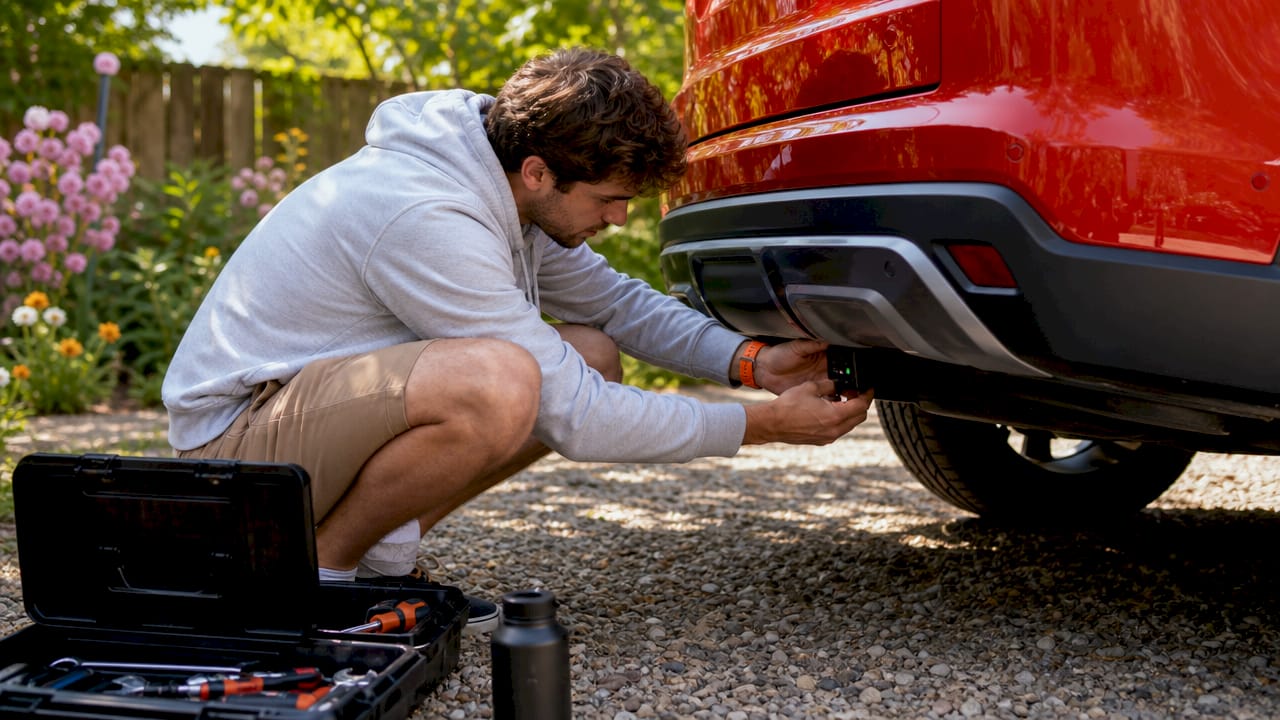
A magnetic GPS tracker integrates positioning, communication, a magnetic mount, and power management into a single unit. You attach it to any metal surface without tools. This makes it popular for temporary vehicle monitoring or covert asset tracking. The tradeoff is that battery life limits continuous operation, and placement on curved or painted surfaces can weaken the magnetic hold.
OBD trackers plug directly into a vehicle’s OBD-II diagnostic port, drawing power from the car and accessing engine data. For a detailed breakdown of that category, the OBD GPS tracker guide from Motowatchdog covers the key differences. Hardwired vehicle trackers connect directly to a vehicle’s electrical system, making them permanent and reliable. The hardwired GPS tracker guide explains installation options and power management in detail.
What key features define a quality GPS tracker?
A quality GPS tracker is an integrated system with four core subsystems: positioning, communication, power management, and mounting. Evaluating each one separately prevents costly mistakes.
Positioning and communication modules
The positioning module determines location accuracy and fix speed. The communication module determines how fast and how far that location data travels. Communication system choice directly affects data transmission speed, power consumption, and device lifecycle. Modern trackers use 4G LTE for fast, reliable updates in urban areas. Low-power IoT protocols suit remote assets where battery life matters more than update frequency.
Power management and update frequency
Battery-powered units offer flexibility in placement but require recharging or replacement. Hardwired units draw from the vehicle and run indefinitely. Active trackers provide dense route data but consume more power. Passive loggers store data locally and upload later, allowing longer runtimes but less immediate visibility. The right balance depends entirely on your use case.
Update frequency is a setting, not a fixed feature. A tracker set to update every 10 seconds drains battery far faster than one set to every 60 seconds. For fleet management, frequent updates improve route accuracy. For long-term asset monitoring, less frequent updates preserve battery life over weeks or months.
Pro Tip: When evaluating a GPS tracker, check the communication network it uses before anything else. A device with excellent positioning hardware but poor cellular coverage in your operating area will underperform. Confirm 4G LTE compatibility and check carrier coverage maps for your region.
Environmental durability and size
Outdoor and vehicle-mounted trackers need an IP67 or higher waterproof rating to survive rain, dust, and temperature swings. Compact form factors matter for personal trackers and covert asset monitoring. A device the size of a matchbox can hide inside equipment or attach under a vehicle without drawing attention.
What are the benefits and challenges of GPS tracking?
GPS tracking delivers measurable value for both individuals and businesses, but it comes with real limitations that affect performance.
Core benefits
- Real-time visibility: Fleet managers see every vehicle on a live map, reducing response times and improving dispatch decisions.
- Theft prevention: A stolen vehicle or asset with an active tracker has a far higher recovery rate than one without.
- Operational efficiency: Mileage logs, route history, and idle time reports replace manual record-keeping entirely.
- Safety monitoring: Families use personal trackers to monitor elderly relatives or children. Businesses use them to verify driver behavior.
- Geofencing alerts: Automatic notifications trigger when a tracked asset enters or leaves a defined area.
Real limitations to plan around
GPS trackers rely on satellite signal visibility. Urban canyons, parking garages, and indoor environments degrade signal quality and reduce accuracy. Advanced trackers compensate by using Wi-Fi or Bluetooth positioning as a backup when satellite signals are blocked.
Cellular coverage is a separate dependency. A tracker with a perfect GPS fix but no cellular signal cannot transmit that data. Remote areas with poor network coverage create gaps in tracking history. For small fleet operations on a budget, understanding these coverage gaps before deployment prevents frustration.
Battery life is the most common source of disappointment. Most users expect continuous tracking for weeks on a single charge. In practice, a tracker updating every 30 seconds in active mode may last only a few days. Setting realistic update intervals and recharging schedules solves this problem before it starts.
The global GPS tracking hardware market was valued at over $2.5 billion in 2022. That scale reflects genuine demand across fleet management, logistics, personal safety, and asset protection. The technology has moved well past early adopters and into standard business practice.
Key Takeaways
A GPS tracker works as an integrated system combining satellite positioning and cellular communication. Neither subsystem alone delivers real-time tracking.
| Point | Details |
|---|---|
| Two-step location process | GPS fixes position via satellites; a separate communication module transmits that data remotely. |
| Active vs. passive modes | Active trackers update in real time but drain battery faster; passive loggers save power with delayed uploads. |
| Magnetic trackers offer flexibility | Magnetic units attach without tools but require battery management and solid mounting surfaces. |
| Update frequency controls battery life | Longer intervals between updates extend battery runtime significantly for asset and personal trackers. |
| Signal limitations are real | Indoor, underground, and urban canyon environments reduce GPS accuracy; advanced units add Wi-Fi or Bluetooth backup. |
Why most people misread what a GPS tracker actually does
People consistently treat GPS trackers as single-function devices. They think “GPS chip equals tracking.” The reality is that the GPS chip only solves half the problem. The communication module solves the other half, and it is often the more expensive and failure-prone component.
I have seen businesses deploy trackers with solid GPS hardware on vehicles that spend most of their time in areas with weak cellular coverage. The devices logged accurate positions but transmitted almost nothing in real time. The fleet manager was looking at a map that was hours behind. That is not a GPS failure. That is a communication planning failure.
The same logic applies to magnetic trackers. The magnet is convenient, but placement matters enormously. A tracker stuck to a curved undercarriage panel with a weak magnetic hold will fall off on rough roads. The positioning module is irrelevant if the device ends up in a ditch. Test the mount before you rely on it.
Update frequency is the setting most buyers ignore and most regret. A tracker set to update every 10 seconds on a vehicle that sits in a parking lot 18 hours a day burns through battery for no reason. Match the update interval to the actual monitoring need. For most fleet vehicles, 30-second to 60-second intervals give excellent route resolution without destroying battery life.
The market growth to over $2.5 billion reflects real adoption, but it also means a lot of undifferentiated hardware is being sold. Focus on the communication network, the update frequency controls, and the mounting solution. Those three factors determine whether a tracker actually works for your situation.
— Louis
Motowatchdog’s subscription-free GPS tracking solution
Motowatchdog delivers 4G GPS tracking for vehicles and assets without monthly subscription fees. That single difference changes the long-term cost calculation for fleet managers and individuals alike.
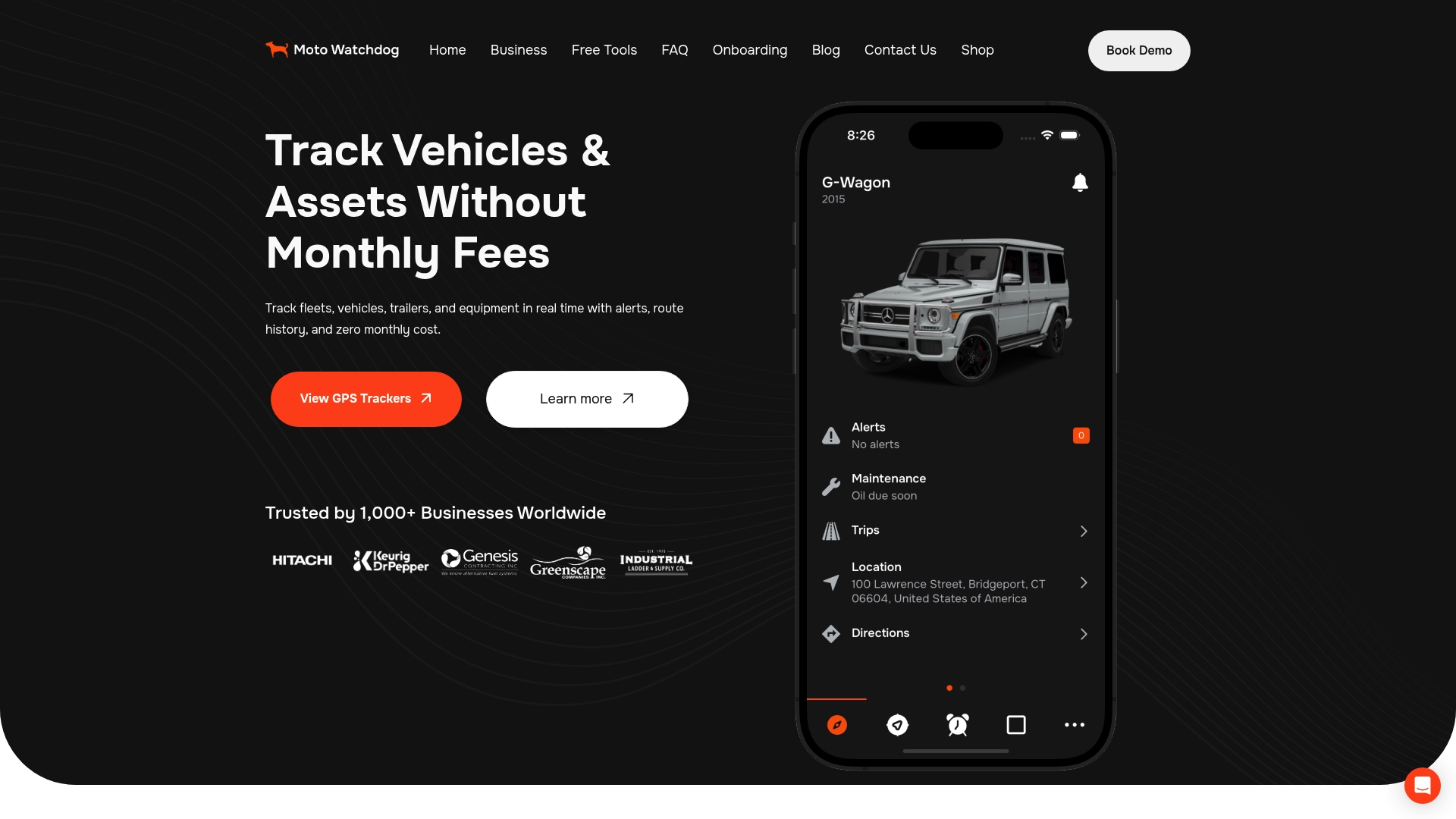
Over 1,000 businesses rely on Motowatchdog for real-time vehicle monitoring, geofencing alerts, and detailed mileage reporting. The platform runs on 4G LTE for reliable data transmission and supports both hardwired and portable configurations. For businesses evaluating subscription-free GPS tracking, Motowatchdog removes the ongoing fee burden while maintaining the real-time visibility that fleet operations require. Visit motowatchdog.com to review device options and find the configuration that fits your vehicles and assets.
FAQ
What is a GPS tracker used for?
A GPS tracker monitors the real-time location of vehicles, people, or assets using satellite signals and cellular communication. Common uses include fleet management, theft prevention, elderly monitoring, and equipment tracking.
How does a battery GPS tracker work?
A battery GPS tracker receives satellite signals to determine position, then transmits that data over a cellular or radio network using its internal battery as the power source. Update frequency and transmission intervals directly control how long the battery lasts between charges.
What is a magnetic GPS tracker?
A magnetic GPS tracker is a self-contained unit with a built-in magnet that attaches to metal surfaces without tools or wiring. It combines a GPS positioning module, communication hardware, and battery into one portable device for temporary or covert tracking.
Can a GPS tracker work indoors?
GPS signal quality degrades significantly indoors, in parking garages, and in dense urban areas. Advanced trackers compensate by using Wi-Fi or Bluetooth positioning as a backup when satellite signals are blocked.
Do GPS trackers require a monthly subscription?
Many GPS trackers require ongoing cellular data subscriptions to transmit location data in real time. Subscription-free options like those from Motowatchdog eliminate recurring fees while maintaining 4G connectivity for real-time monitoring.