How to start saving money
Lorem ipsum dolor sit amet, consectetur adipiscing elit lobortis arcu enim urna adipiscing praesent velit viverra sit semper lorem eu cursus vel hendrerit elementum morbi curabitur etiam nibh justo, lorem aliquet donec sed sit mi dignissim at ante massa mattis.
- Neque sodales ut etiam sit amet nisl purus non tellus orci ac auctor
- Adipiscing elit ut aliquam purus sit amet viverra suspendisse potent
- Mauris commodo quis imperdiet massa tincidunt nunc pulvinar
- Excepteur sint occaecat cupidatat non proident sunt in culpa qui officia
Why it is important to start saving
Vitae congue eu consequat ac felis placerat vestibulum lectus mauris ultrices cursus sit amet dictum sit amet justo donec enim diam porttitor lacus luctus accumsan tortor posuere praesent tristique magna sit amet purus gravida quis blandit turpis.

How much money should I save?
At risus viverra adipiscing at in tellus integer feugiat nisl pretium fusce id velit ut tortor sagittis orci a scelerisque purus semper eget at lectus urna duis convallis. porta nibh venenatis cras sed felis eget neque laoreet suspendisse interdum consectetur libero id faucibus nisl donec pretium vulputate sapien nec sagittis aliquam nunc lobortis mattis aliquam faucibus purus in.
- Neque sodales ut etiam sit amet nisl purus non tellus orci ac auctor
- Adipiscing elit ut aliquam purus sit amet viverra suspendisse potenti
- Mauris commodo quis imperdiet massa tincidunt nunc pulvinar
- Adipiscing elit ut aliquam purus sit amet viverra suspendisse potenti
What percentege of my income should go to savings?
Nisi quis eleifend quam adipiscing vitae aliquet bibendum enim facilisis gravida neque. Velit euismod in pellentesque massa placerat volutpat lacus laoreet non curabitur gravida odio aenean sed adipiscing diam donec adipiscing tristique risus. amet est placerat in egestas erat imperdiet sed euismod nisi.
“Nisi quis eleifend quam adipiscing vitae aliquet bibendum enim facilisis gravida neque velit euismod in pellentesque”
Do you have any comments? Share them with us on social media
Eget lorem dolor sed viverra ipsum nunc aliquet bibendum felis donec et odio pellentesque diam volutpat commodo sed egestas aliquam sem fringilla ut morbi tincidunt augue interdum velit euismod eu tincidunt tortor aliquam nulla facilisi aenean sed adipiscing diam donec adipiscing ut lectus arcu bibendum at varius vel pharetra nibh venenatis cras sed felis eget.
Subscription-free GPS tracking is defined as location monitoring that requires no recurring monthly or annual service fee, relying instead on one-time device purchases, prepaid data, or offline satellite signals. The term “no-subscription GPS” covers a broad range of devices and software models, from the Garmin GPSMAP 67i to open-source platforms like OpenStreetMap and the mhj_maps SDK. Understanding how these systems work helps individuals and small businesses make smarter decisions about vehicle and asset monitoring without locking into long-term contracts. This guide breaks down the technology, the real costs, and the right use cases so you can choose with confidence.
How does subscription-free GPS actually work?
Subscription-free GPS tracking works because GPS satellite signals are broadcast freely to any receiver on Earth. No carrier, no billing cycle, and no activation fee is required to receive your coordinates from the satellite network. The subscription cost that most people associate with GPS comes from a separate layer: the data transmission service that sends your location to a server or a phone in real time.
This distinction matters. A device receives its position for free. Sending that position to someone else costs money, unless you use an alternative method.
The three technical models behind no-fee tracking
Passive GPS stores location data directly on the device. You retrieve the data later by physically connecting the unit to a computer or app. There are no cellular fees because nothing is transmitted live. This model works well for mileage logging, route review, and after-the-fact fleet audits.
Prepaid cellular GPS uses a SIM card with a fixed data allowance purchased upfront. Once the data runs out, you buy more or the device goes offline. This model provides real-time tracking without a monthly contract, though the per-use cost can add up.
Offline and open-source GPS relies on locally stored maps and open data platforms. Tools like the mhj_maps SDK provide routing, geocoding, and map rendering completely free, using OpenStreetMap infrastructure to bypass proprietary map service billing. Developers building fleet apps or custom tracking solutions use this approach to eliminate API costs entirely.
- Passive GPS: no connectivity needed, data retrieved manually
- Prepaid cellular GPS: real-time tracking, pay-as-you-go data
- Offline open-source GPS: free map rendering, no API fees, requires local map storage
- Hybrid devices: GPS navigation free, satellite messaging requires a paid plan
Pro Tip: If your primary need is mileage reporting or post-trip route review, a passive GPS unit covers everything you need at the lowest possible cost. Real-time alerts are not always necessary.
One technical caveat worth knowing: developers building subscription-free tracking apps using Android’s raw LocationManager without Google Play Services face a GPS cold start of 30–60 seconds and lower positional accuracy. That tradeoff is acceptable for many business applications but rules out high-precision use cases like courier dispatch.
Subscription-free vs. subscription GPS: costs and features
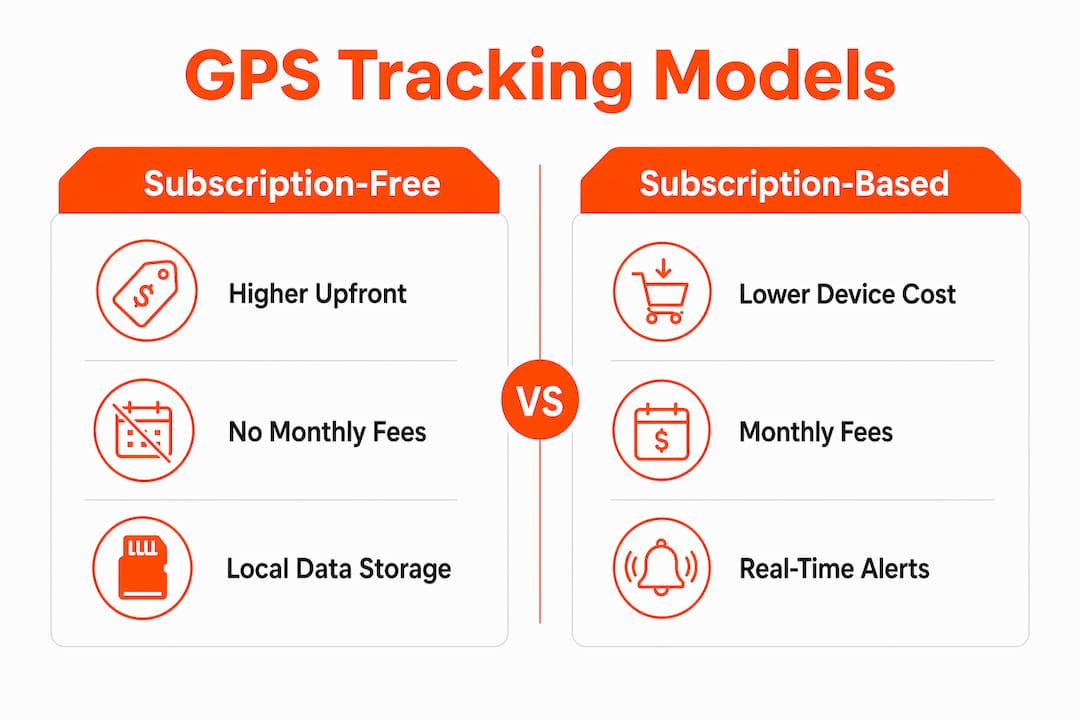
The core financial difference is simple. Subscription-based GPS trackers charge a monthly fee, typically ranging from $10 to $50 per device, in exchange for continuous real-time tracking, cloud storage, and managed alerts. No-subscription GPS products avoid those fees but include either a higher initial device price or manual data management requirements.
Here is a direct comparison of both models across the factors that matter most to fleet managers and individuals:
| Factor | Subscription-Free GPS | Subscription-Based GPS |
|---|---|---|
| Upfront cost | Higher device price, one-time payment | Lower device cost, ongoing monthly fee |
| Real-time tracking | Limited or absent in passive models | Standard feature across most plans |
| Map quality | OpenStreetMap or one-time map packs | Managed, regularly updated map data |
| Geofencing alerts | Available on some 4G prepaid models | Standard on most subscription platforms |
| Battery life | Often longer due to reduced data transmission | Shorter due to continuous cellular activity |
| Best for | Budget-conscious users, small fleets, offline use | Large fleets, real-time dispatch, compliance reporting |
The Garmin GPSMAP 67i is a clear example of how this split works in practice. Its core GPS navigation functions fully without any subscription. The satellite messaging feature, powered by Garmin’s inReach network, requires a paid plan. You get full navigation for free and pay only if you need two-way satellite communication.
Pro Tip: Calculate your total 24-month cost before choosing. A $300 no-subscription device often costs less than a $99 device plus $25 per month over two years, which totals $699.
Battery life is a genuine advantage for no-subscription hardware. Devices that store data locally or transmit only on demand draw far less power than units maintaining a constant cellular connection. For asset trackers placed on trailers, equipment, or remote vehicles, this difference can mean weeks of runtime versus days.
When should you use a subscription-free GPS tracker?
Choosing the right model depends entirely on what you need the data to do. Subscription-free GPS is well suited for offline navigation, remote outdoor activities, and small fleets where real-time alerts are less critical than cost control.
Here are the most practical use cases, ranked by fit:
-
Mileage tracking for tax and compliance. A passive GPS unit records every trip automatically. You download the data weekly and generate reports. No cellular plan is needed, and the IRS-compliant mileage log is complete.
-
Small fleet monitoring on a fixed budget. A contractor running three to five vehicles can place prepaid 4G trackers on each unit, pay once for data, and monitor locations through a free or low-cost app. The types of fleet GPS systems available in 2026 include several purpose-built options for this exact scenario.
-
Asset and equipment tracking. Construction equipment, trailers, and generators sit idle for long periods. A passive or low-transmission tracker with a long battery life covers these assets without burning through a monthly data plan.
-
Hiking and off-grid navigation. Devices like the Garmin GPSMAP 67i handle serious backcountry navigation without any subscription. Community-driven map data from OpenStreetMap supplements device basemaps that may lack topographic detail in remote areas.
-
Personal vehicle monitoring for families. Parents tracking a teen driver or monitoring a family vehicle do not need enterprise-grade real-time alerts. A prepaid tracker with periodic location updates covers the need at a fraction of the subscription cost.
Where subscription-free models fall short is in complex fleet operations. If you need live driver behavior alerts, automatic dispatch updates, or DOT compliance reporting, a managed subscription platform delivers features that no passive or prepaid device can match. Knowing that boundary helps you avoid buying the wrong tool.
What are the most common misconceptions about no-fee GPS?
The biggest misconception is that subscription-free means zero ongoing cost. That is rarely true. No-subscription trackers may not charge monthly fees, but they often require separate purchases for detailed map packs, firmware updates, or additional prepaid data.
Several other misunderstandings trip up buyers regularly:
- “Free GPS means free maps.” Base maps on most devices lack critical topographic or street-level detail. Users often must source detailed map data from OpenStreetMap community maps or pay one-time fees for premium map packs.
- “Satellite communicators are GPS trackers.” Devices like the Garmin inReach Mini 2 are satellite messengers designed for emergency communication. They require subscription plans and lack map screens or standalone navigation. Confusing them with GPS trackers leads to expensive mistakes.
- “No subscription means no real-time tracking.” This is true for passive units but not for prepaid 4G models. Some no-subscription devices deliver live location updates using a data SIM purchased once, with no recurring contract.
- “Open-source GPS is only for developers.” Platforms like the mhj_maps SDK are developer tools, but the apps built on them are consumer-ready. Many free navigation apps you already use run on OpenStreetMap infrastructure.
- “Subscription-free devices have poor accuracy.” GPS accuracy comes from satellite signal quality, not from a subscription. A no-fee device using the same satellite constellation as a subscription tracker delivers the same raw positional accuracy.
Understanding these distinctions protects you from marketing language that uses “subscription-free” as a selling point while burying costs elsewhere in the product terms.
Key takeaways
Subscription-free GPS tracking eliminates monthly fees by shifting costs to upfront hardware, prepaid data, or open-source mapping, making it the right choice for budget-focused individuals and small fleets with non-critical real-time needs.
| Point | Details |
|---|---|
| GPS signals are free | Satellite coordinates cost nothing to receive; subscription fees cover data transmission, not the signal itself. |
| Three core models exist | Passive storage, prepaid cellular, and open-source offline GPS each eliminate recurring fees differently. |
| Upfront costs are higher | No-subscription devices typically cost more upfront but save money over a 12–24 month period. |
| Maps are not always free | Detailed map packs or OpenStreetMap data often require separate sourcing or one-time purchases. |
| Real-time tracking is possible | Prepaid 4G models deliver live location updates without a monthly contract, covering most small fleet needs. |
Why i think most buyers overthink the subscription question
From my experience working with fleet managers and individual buyers, the subscription vs. no-subscription debate gets overcomplicated fast. People spend weeks comparing features they will never use instead of asking one direct question: do I need someone to see this vehicle’s location right now, or do I need to know where it went?
If the answer is “right now,” you need some form of live data transmission, and that costs money one way or another. A prepaid 4G tracker handles it without a contract. If the answer is “where it went,” a passive unit is all you need, and it will cost you almost nothing to run after the initial purchase.
The open-source mapping trend is genuinely underrated. Platforms built on OpenStreetMap and tools like the mhj_maps SDK have closed the quality gap with proprietary map services significantly over the past three years. For most vehicle and asset tracking applications, the map quality is more than adequate. You do not need a $30-per-month subscription to get a reliable map.
My honest recommendation: start with the simplest model that covers your actual use case. A hardwired GPS tracker with prepaid data covers most small business needs cleanly. Scale up only when your operation genuinely demands live dispatch or compliance-grade reporting. Paying for features you do not use is the most common and most avoidable GPS tracking mistake I see.
— Louis
See how Motowatchdog handles GPS tracking without monthly fees
Motowatchdog builds subscription-free 4G GPS tracking solutions specifically for cost-conscious individuals and small businesses. Every device delivers real-time vehicle and asset monitoring without a recurring monthly fee, so your tracking costs stay predictable from day one.
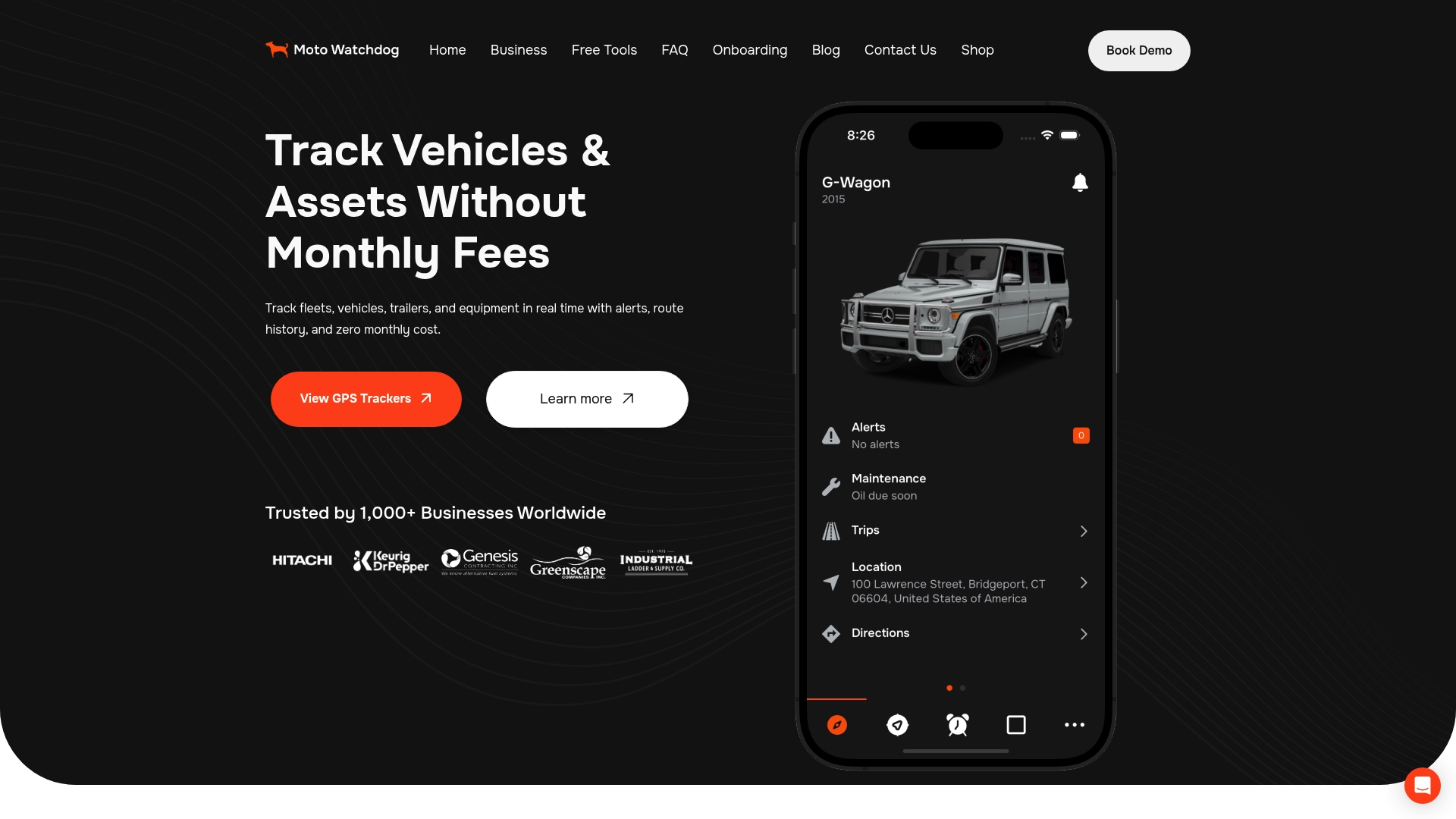
Over 1,000 businesses rely on Motowatchdog for geofencing alerts, long battery life, and detailed mileage reporting that simplifies compliance and tax documentation. Setup is straightforward, and the hardware is built for daily use across diverse fleet types. If you are ready to move from monthly billing to a one-time investment, explore subscription-free 4G tracking at Motowatchdog and find the right device for your vehicles and assets today.
FAQ
What is subscription-free GPS tracking?
Subscription-free GPS tracking is location monitoring that requires no monthly or annual service fee. It relies on one-time device purchases, prepaid data, or offline satellite signals to record and transmit location data.
Does no-subscription GPS still provide real-time tracking?
Some no-subscription GPS devices provide real-time tracking using prepaid cellular data with no monthly contract. Passive models store data locally and require manual download, so real-time visibility depends on the device type you choose.
Are GPS satellite signals really free?
Yes. GPS satellite signals are broadcast freely to any receiver, with no subscription required to receive coordinates. Subscription fees apply only to the data transmission layer that sends your location to a server or another device.
What are the hidden costs of subscription-free GPS?
Subscription-free devices often require separate purchases for detailed map packs, firmware updates, or additional prepaid data allowances. Some devices also charge for premium features like geofencing alerts or cloud storage that subscription plans include by default.
Is subscription-free GPS right for small fleet management?
Subscription-free GPS is well suited for small fleets where budget control matters more than continuous real-time alerts. For fleets requiring live dispatch, driver behavior monitoring, or DOT compliance reporting, a managed subscription platform delivers features that no-fee models cannot match.