How to start saving money
Lorem ipsum dolor sit amet, consectetur adipiscing elit lobortis arcu enim urna adipiscing praesent velit viverra sit semper lorem eu cursus vel hendrerit elementum morbi curabitur etiam nibh justo, lorem aliquet donec sed sit mi dignissim at ante massa mattis.
- Neque sodales ut etiam sit amet nisl purus non tellus orci ac auctor
- Adipiscing elit ut aliquam purus sit amet viverra suspendisse potent
- Mauris commodo quis imperdiet massa tincidunt nunc pulvinar
- Excepteur sint occaecat cupidatat non proident sunt in culpa qui officia
Why it is important to start saving
Vitae congue eu consequat ac felis placerat vestibulum lectus mauris ultrices cursus sit amet dictum sit amet justo donec enim diam porttitor lacus luctus accumsan tortor posuere praesent tristique magna sit amet purus gravida quis blandit turpis.

How much money should I save?
At risus viverra adipiscing at in tellus integer feugiat nisl pretium fusce id velit ut tortor sagittis orci a scelerisque purus semper eget at lectus urna duis convallis. porta nibh venenatis cras sed felis eget neque laoreet suspendisse interdum consectetur libero id faucibus nisl donec pretium vulputate sapien nec sagittis aliquam nunc lobortis mattis aliquam faucibus purus in.
- Neque sodales ut etiam sit amet nisl purus non tellus orci ac auctor
- Adipiscing elit ut aliquam purus sit amet viverra suspendisse potenti
- Mauris commodo quis imperdiet massa tincidunt nunc pulvinar
- Adipiscing elit ut aliquam purus sit amet viverra suspendisse potenti
What percentege of my income should go to savings?
Nisi quis eleifend quam adipiscing vitae aliquet bibendum enim facilisis gravida neque. Velit euismod in pellentesque massa placerat volutpat lacus laoreet non curabitur gravida odio aenean sed adipiscing diam donec adipiscing tristique risus. amet est placerat in egestas erat imperdiet sed euismod nisi.
“Nisi quis eleifend quam adipiscing vitae aliquet bibendum enim facilisis gravida neque velit euismod in pellentesque”
Do you have any comments? Share them with us on social media
Eget lorem dolor sed viverra ipsum nunc aliquet bibendum felis donec et odio pellentesque diam volutpat commodo sed egestas aliquam sem fringilla ut morbi tincidunt augue interdum velit euismod eu tincidunt tortor aliquam nulla facilisi aenean sed adipiscing diam donec adipiscing ut lectus arcu bibendum at varius vel pharetra nibh venenatis cras sed felis eget.
Motowatchdog is the top subscription-free alternative to gpsandtrack.com for North American vehicle and asset tracking. Its HW-200 hardwired tracker and MW-10000 magnetic portable unit both include a built-in 4G LTE SIM with lifetime cellular data on qualifying SKUs, meaning you pay once and track indefinitely. Your first decision is simple: choose hardwired (permanent fleet installs, vehicle power) or magnetic/portable (trailers, equipment, temporary use), then match battery runtime to your monitoring frequency needs.
Table of Contents
- What are the best gpsandtrack.com alternatives for subscription-free tracking?
- Short profiles of each subscription-free tracker category
- How do you choose the right subscription-free tracker for your needs?
- What does subscription-free GPS tracking actually cost over time?
- Installation types, stealth, and the legal boundary in North America
- Why Motowatchdog is the recommended subscription-free pick
- Key Takeaways
- The subscription-free model is more than a pricing preference
- Motowatchdog gives you real-time tracking without the monthly bill
- Useful sources and further reading
What are the best gpsandtrack.com alternatives for subscription-free tracking?
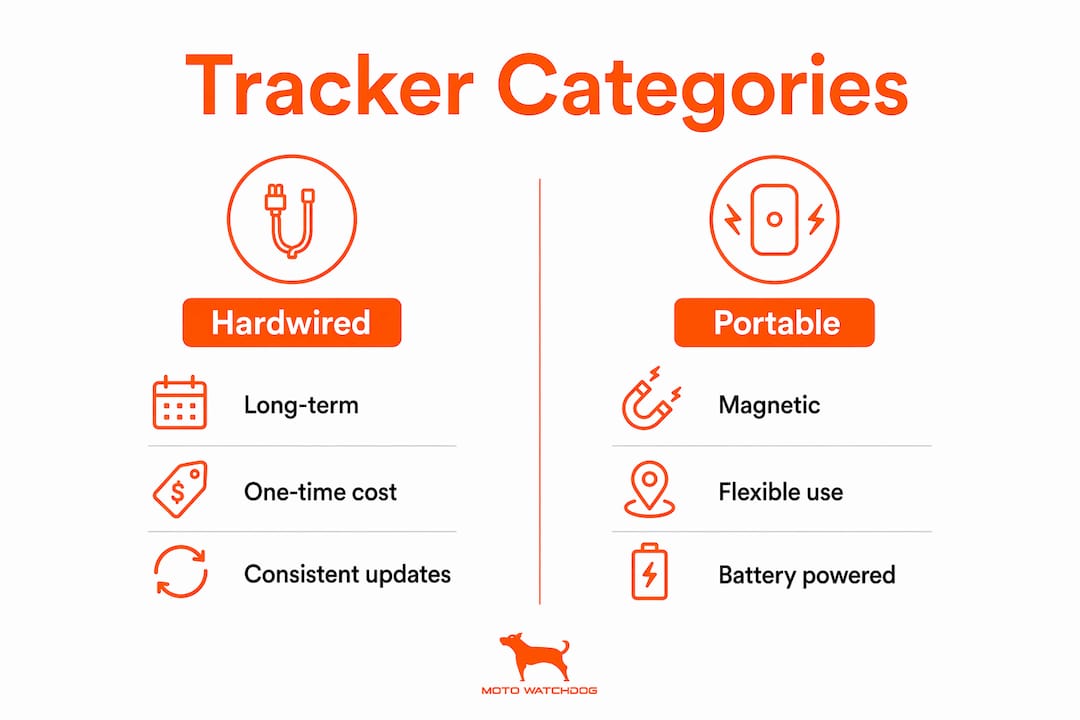
The table below organizes the market into four tracker categories that cover the full range of use cases, from permanent fleet installs to low-cost Bluetooth tags. Columns reflect the decision factors that actually matter at the point of purchase.
| Category | Best for | Price model | Typical device price | Installation | Battery / power | Update frequency | 4G/LTE U.S. coverage | Geofencing & alerts | Fleet management | Stealth / anti-tamper | Waterproof |
|---|---|---|---|---|---|---|---|---|---|---|---|
| Hardwired subscription-free | Permanent fleet, company vehicles | One-time purchase, lifetime data included | $100–$200 | Hardwired to vehicle power | Vehicle power + backup battery | 10 sec configurable | 4G LTE nationwide | Yes, customizable | Yes (mileage, reports, idle) | High (hidden mount, backup battery) | IP54 typical |
| Portable magnetic lifetime | Trailers, equipment, personal cars | One-time purchase, lifetime data included | $80–$160 | Magnetic mount, no wiring | Rechargeable (days to weeks) | 30 sec configurable | 4G LTE / LTE-M | Yes | Basic to moderate | Moderate (removable) | IP54 typical |
| OBD-II plug-and-play | Single vehicles, quick setup | Monthly subscription (most); some lifetime models | $30–$100 | OBD-II port, no tools | Vehicle power via OBD port | 10 sec | 4G LTE | Yes | Moderate | Low (visible port) | Varies |
| Consumer Bluetooth/UWB tags | Keys, bags, short-range asset ID | One-time purchase, no subscription | $25 | Adhesive / keyring | 1–2 years (coin cell) | Crowd-sourced, passive | Bluetooth / UWB only | Basic (zone alerts) | None | Low | IPX4 |
Hardwired subscription-free trackers are the right call for any fleet where vehicles stay in service long-term and you need consistent real-time data without recharging. Portable magnetic units suit trailers, rental equipment, or any asset that moves between owners or job sites. OBD-II devices are fast to deploy but most carry monthly fees; verify the connectivity model before buying. Bluetooth tags like Apple AirTag work well for short-range item recovery but are not a substitute for cellular GPS tracking on vehicles.
For reference, the HW-200 hardwired tracker is listed at $129.99 one-time (with lifetime connectivity) on Motowatchdog’s product page, and portable magnetic models such as the MW-10000 are typically priced from $80 to $160 depending on configuration.
Before committing to any device, check independent field tests and user forums such as Reddit and Facebook groups for real-world accuracy and reliability data.
Short profiles of each subscription-free tracker category
Hardwired subscription-free trackers
These draw power directly from the vehicle’s electrical system, so battery recharging is never a concern. The Motowatchdog HW-200 is a representative example: it includes a built-in 4G LTE SIM with lifetime cellular data, a backup battery for power-cut events, and supports real-time location updates, geofencing, mileage reporting, and maintenance reminders. Professional installation is recommended for the cleanest, most tamper-resistant result.
Pros:
- No battery management; vehicle power keeps the device live
- Backup battery maintains tracking if someone cuts the main power lead
- Best accuracy and update frequency of any category
- Supports full fleet management features (mileage, idle time, reports)
Cons:
- Requires wiring, which adds installation time (typically 30–90 minutes)
- Not easily moved between vehicles
- Higher upfront device cost than OBD-II or Bluetooth options
Typical device price: $100–$200 one-time. Motowatchdog lists the HW-200 at $129.99 with lifetime connectivity included.
Portable magnetic lifetime trackers

The Motowatchdog MW-10000 is a strong example here: a 10,000mAh battery rated for up to 49 days of tracking on a single charge, magnetic mount, and no monthly fees. This category is ideal for trailers, heavy equipment, and any asset that lacks a 12V power source. For GPS tracking of construction assets, portable magnetic units are often the only practical option.
Pros:
- No wiring; attaches in seconds with a magnet
- Long battery life (days to weeks depending on ping frequency)
- Easy to move between assets
- Covert placement possible under chassis or inside equipment
Cons:
- Battery must be recharged periodically
- Update frequency is typically lower than hardwired units at high-ping settings
- Physically removable if discovered
Typical device price: $80–$160 one-time, with lifetime data included on qualifying models such as the MW-10000.
OBD-II plug-and-play devices

OBD-II trackers plug into the diagnostic port found on virtually every vehicle sold in the U.S. after 1996. Setup takes under five minutes and requires no tools. The trade-off is visibility: the port is under the dashboard, and anyone who knows where to look can unplug the device. Most OBD-II trackers on the market carry monthly subscription fees. A small number of lifetime-SIM OBD models exist, but verify the connectivity model carefully before purchasing.
Pros:
- Fastest setup of any cellular GPS category
- Draws vehicle power; no battery management
- Often includes basic diagnostic data (fault codes)
Cons:
- Easily removed or discovered
- Most models require ongoing monthly fees
- Limited stealth for theft-recovery scenarios
Typical device price: $30–$100; subscription fees typically add $10–$25/month on subscription-based models.
Consumer Bluetooth and UWB tags (Apple AirTag category)
Apple AirTag and similar Bluetooth/UWB tags are relatively low cost and require no subscription. They work by pinging nearby Apple or Android devices in the Find My / Find My Device network, which means location updates are crowd-sourced and passive rather than real-time. In a dense urban area, location refresh can be frequent. On a rural job site or in a moving vehicle on a highway, updates may be infrequent or delayed by minutes to hours.
Pros:
- Very low cost, no ongoing fees
- Excellent for keys, bags, and short-range item recovery
- Long coin-cell battery life (1–2 years)
Cons:
- Not a real-time cellular GPS tracker
- Coverage depends entirely on crowd density
- No geofencing alerts, no mileage reporting, no fleet features
- Anti-stalking protections in iOS/Android can alert a tracked person
For vehicle and fleet monitoring where real-time location and theft alerts matter, Bluetooth tags are a complement to cellular GPS, not a replacement.
How do you choose the right subscription-free tracker for your needs?
Start with your primary use case, because it narrows the category immediately. A fleet of service trucks needs hardwired units with full mileage reporting and dispatch tracking integration. A single trailer or piece of rental equipment needs a portable magnetic unit with long battery life. A personal car where you want theft recovery and geofencing alerts can go either way depending on whether you want permanent installation or flexibility.
Stealth vs. battery life vs. update frequency
These three factors pull against each other in predictable ways. Higher update frequency drains battery faster. Deeper stealth (hidden hardwired install) requires more installation effort. Portable units with very long battery life achieve that runtime by pinging less frequently, often every few minutes rather than every 30 seconds. Decide which matters most for your scenario before comparing devices.
Questions to ask before you buy
- Connectivity model: Does “lifetime” mean the life of the device, the life of the company, or a fixed term? Ask the seller to name the carrier and confirm whether the SIM is transferable if you sell the vehicle.
- Warranty and returns: What is the return window? Is there a hardware warranty, and does it cover cellular connectivity failure?
- App features and data ownership: Can you export your trip history? Does the platform sell location data to third parties?
- API and integrations: If you run fleet management software, does the tracker integrate, or does it operate as a standalone app only?
Red flags to watch for
Avoid any seller who cannot name the carrier behind a “lifetime SIM,” refuses to disclose whether coverage is U.S.-only or global, or lists a warranty shorter than 12 months on a device marketed as a long-term investment. Vague language like “no fees ever” without a clear explanation of how connectivity is funded is a warning sign.
When to choose hardwired vs. portable vs. Bluetooth
Hardwired is the right choice when vehicles are company-owned, stay in service for years, and you need consistent real-time data for payroll, compliance, or dispatch. The installation investment pays off quickly when you’re managing five or more vehicles.
Portable magnetic makes sense for assets that don’t have a 12V power source, move between job sites, or are owned by multiple parties. The ability to reposition the tracker in minutes is a genuine operational advantage for equipment rental companies and contractors.
Bluetooth tags belong in a supplemental role: attach one to a toolbox or equipment case for short-range recovery, but don’t rely on them as your primary vehicle monitoring solution.
Pro Tip: If you manage a mixed fleet of vehicles and trailers, consider pairing a hardwired unit on each vehicle with a portable magnetic tracker on each trailer. You get full real-time data on the powered assets and long-battery coverage on unpowered ones, all managed through a single app.
What does subscription-free GPS tracking actually cost over time?
The core claim is straightforward: a subscription-free device costs more upfront but less over any period longer than about 12–18 months compared to a subscription-based alternative.
Consider a concrete scenario. A hardwired subscription-free tracker such as the Motowatchdog HW-200 is priced at $129.99 with lifetime cellular data included, making the total cost $129.99 regardless of how long you use it. A comparable subscription-based tracker priced at $50 with a $15/month plan costs $230 after 12 months and $590 after three years. The crossover point is typically somewhere between months 6 and 12, depending on the device price and the monthly fee.
What “lifetime” typically covers:
- Cellular data for the life of the device (hardware failure ends coverage)
- U.S. domestic coverage only on most North American SKUs
- Single-device, non-transferable SIM in many cases
- No guarantee of coverage if the manufacturer discontinues the product line
Common caveats buyers miss:
- Lifetime SIM may not be transferable if you sell the vehicle or device
- Some “no monthly fee” devices charge for premium app features (geofencing history, API access)
- Region restrictions may limit coverage outside the contiguous U.S.
- Activation terms sometimes require registration within a set period after purchase
The Motowatchdog MW-10000 magnetic tracker, for example, is offered without monthly fees and delivers up to 49 days of tracking on a single charge at standard ping intervals. That runtime figure reflects a real trade-off: longer battery life is achieved by pinging less frequently, which is appropriate for asset monitoring but less suited to real-time vehicle dispatch.
Some subscription-free trackers in the broader market advertise up to 6 years of battery life by reducing pings to once per day. That is useful for long-term asset location but not for real-time theft recovery or fleet dispatch.
Pro Tip: Use a fuel log sheet alongside your GPS data to build a complete cost-per-vehicle picture. Mileage reports from your tracker feed directly into fuel cost analysis, making the ROI case for subscription-free tracking concrete and auditable.
Installation types, stealth, and the legal boundary in North America
| Installation type | Typical install time | Detection risk | Recommended use case | Key trade-off |
|---|---|---|---|---|
| Hardwired (vehicle power) | 30–90 min (professional) | Low (hidden behind panels) | Permanent fleet, company vehicles | Requires wiring; not easily moved |
| Magnetic portable (chassis mount) | Under 3 min | Moderate (physical sweep possible) | Trailers, equipment, temporary use | Must recharge; removable |
| OBD-II plug-in | Under 3 min | High (visible port location) | Quick single-vehicle setup | Easily unplugged; most require subscription |
| Adhesive/concealed mount | 10 min | Low to moderate | Equipment, containers, assets | Adhesive quality determines permanence |
Subscription-free devices that use LTE-M or NB-IoT connectivity offer better signal penetration under vehicle chassis and in parking structures than full-band LTE, while consuming significantly less power. This makes them well-suited for deep-hidden installs where battery longevity matters. “Deep sleep” modes, where the device wakes only to transmit a burst of location data before returning to low-power state, extend battery life dramatically and reduce the radio-frequency signature that RF sweep tools detect.
Tracking a vehicle you own or a company vehicle driven by an employee is generally legal across North American jurisdictions. Tracking a vehicle you do not own, or tracking another person without their knowledge or consent, is regulated by state and federal law. The National Conference of State Legislatures maintains a current summary of state statutes on private use of location tracking devices. Always confirm the applicable rules for your jurisdiction before deploying any tracker on a vehicle you do not own outright.
Pro Tip: For hardwired installs, the area behind the rear seat or inside a door panel near the rear axle offers a strong GPS signal path while remaining out of sight during casual interior inspections. Avoid mounting directly on the firewall, where metal interference can degrade signal quality.
For fleet operators concerned about vehicle theft prevention, a hardwired unit with a backup battery is the most reliable configuration: cutting the main power lead does not disable the tracker.
Why Motowatchdog is the recommended subscription-free pick
Motowatchdog earns the top recommendation among gpsandtrack.com alternatives because it combines lifetime-prepaid 4G LTE connectivity on qualifying SKUs, a device lineup that covers both hardwired and portable use cases, and a companion app with the fleet management features that individual owners and small fleets actually need.
Key product highlights:
- HW-200 hardwired tracker: $129.99 one-time, built-in 4G LTE SIM with lifetime cellular data, backup battery for power-cut events, real-time location updates, geofencing, mileage reporting, and maintenance reminders
- MW-10000 magnetic portable tracker: $80–$160 one-time, no monthly fees, 10,000mAh battery rated for up to 49 days on a single charge, magnetic chassis mount, 4G LTE coverage across North America
- Fleet management features: Trip history, idle time tracking, mileage reports, multi-device management, push notifications, and sharing features
- App and integrations: Mobile app management for both iOS and Android; geofencing alerts configurable by zone and time
- Warranty and returns: Device warranty and return policy listed on product pages; verify current terms at purchase
Many businesses rely on Motowatchdog’s accuracy for real-time vehicle and asset monitoring, citing the combination of no recurring fees and reliable 4G LTE coverage as the primary reasons for choosing the platform over subscription-based alternatives.
Motowatchdog is the right fit for fleet managers, contractors, equipment rental companies, and families who want reliable real-time tracking without a monthly bill. The one scenario where another category makes more sense: if you need only short-range item recovery for a keyring or laptop bag, a Bluetooth tag is cheaper and sufficient. For anything vehicle-sized or larger, the cellular GPS categories are the appropriate choice.
For service truck tracking and field operations, the HW-200’s hardwired design and full fleet reporting make it the most practical long-term option in the subscription-free category.
Key Takeaways
Subscription-free GPS trackers cost more upfront than subscription-based devices but deliver lower total cost of ownership over any period beyond roughly 12–18 months, making them the smarter long-term choice for fleets and individuals alike.
| Point | Details |
|---|---|
| Top recommended pick | Motowatchdog (HW-200 and MW-10000) offers lifetime 4G LTE data with no monthly fees on qualifying SKUs. |
| Choose by installation type | Hardwired suits permanent fleet installs; magnetic portable suits trailers, equipment, and temporary deployments. |
| Battery life trade-off | The MW-10000 delivers up to 49 days on a single charge by reducing ping frequency — right for asset monitoring, less so for real-time dispatch. |
| Verify “lifetime” claims | Confirm the carrier, transferability, and regional coverage before purchasing any device marketed as subscription-free. |
| Legal and consent check | Tracking a vehicle you do not own requires consent in most U.S. states; review NCSL state statutes before deploying. |
The subscription-free model is more than a pricing preference
The conventional wisdom in GPS tracking has long been that subscription-based platforms are the “professional” choice and no-fee devices are a compromise. That framing is outdated. The real distinction is not between professional and consumer grade. It is between devices where the manufacturer has prepaid connectivity and built it into the hardware price, and devices where connectivity is billed separately as an ongoing service.
For a fleet manager running 10 service trucks, the math is not subtle. Twelve months of subscription fees across 10 vehicles at even a modest monthly rate adds up to a meaningful operating expense, year after year, with no end date. A one-time device purchase with lifetime connectivity converts that recurring cost into a capital expense that depreciates on a predictable schedule.
Where subscription platforms still make sense is in scenarios requiring advanced telematics, driver behavior scoring, or deep integrations with enterprise ERP systems. Those platforms justify their monthly fees with features that go well beyond location tracking. But for the majority of small fleets, contractors, and individuals who need to know where their vehicles and assets are in real time, the subscription-free category delivers everything required at a fraction of the long-term cost.
The gap between what subscription platforms promise and what most buyers actually use is wider than the industry acknowledges. Most fleet managers use location tracking, geofencing alerts, and mileage reports. All three are available in subscription-free devices. The rest of the feature set often goes unused.
Motowatchdog gives you real-time tracking without the monthly bill
Paying a subscription fee every month for GPS tracking is a choice, not a requirement. Motowatchdog’s subscription-free devices give you the same real-time 4G LTE coverage, geofencing alerts, and mileage reporting that subscription platforms charge ongoing fees for, at a single upfront price.
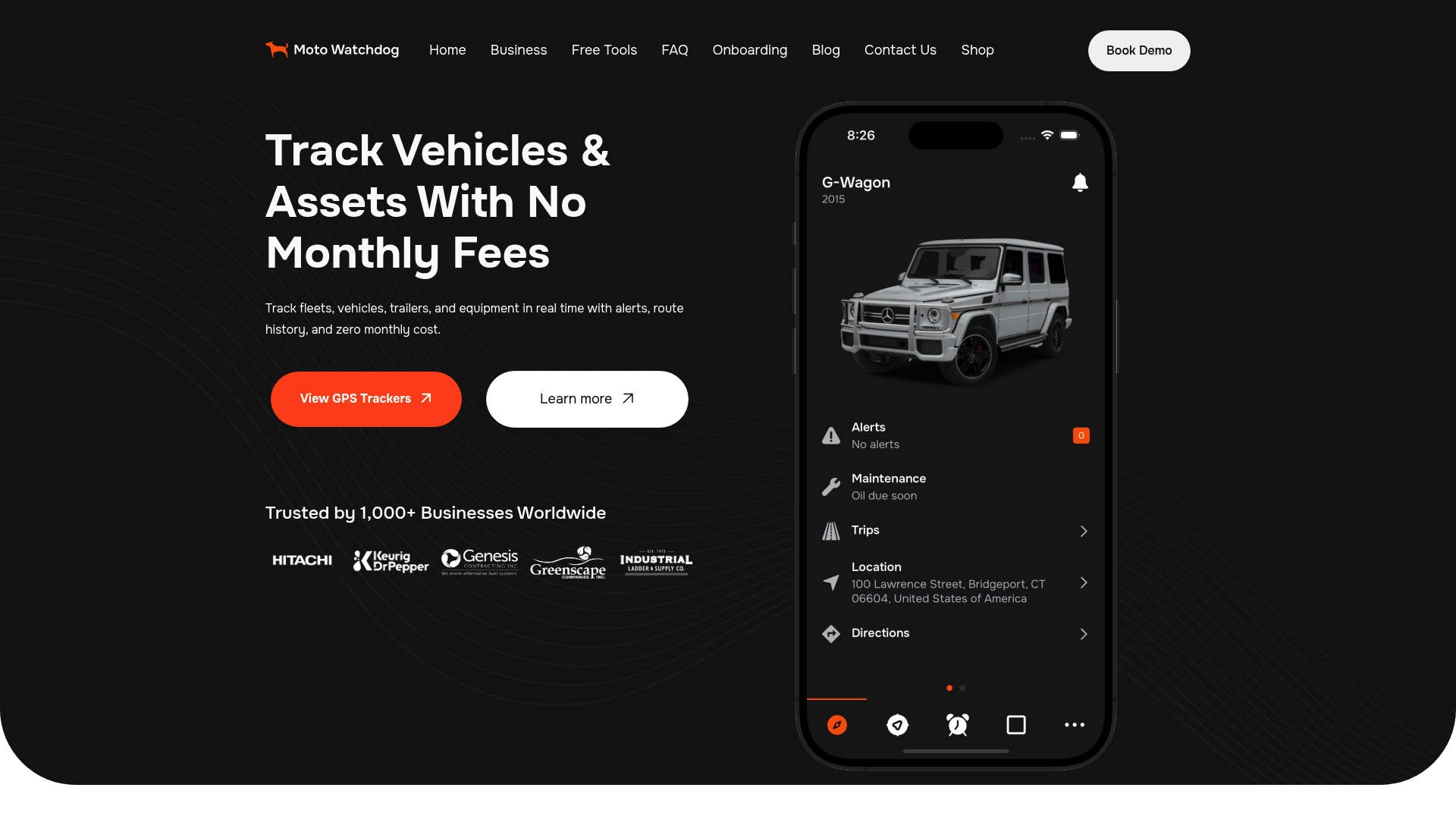
- Lifetime cellular data on qualifying SKUs, including the HW-200 hardwired tracker at $129.99 and the MW-10000 magnetic portable tracker at $80–$160
- Hardwired and portable options to cover company vehicles, trailers, equipment, and personal assets
- Full fleet features including geofencing, push notifications, trip history, idle time tracking, and mileage reports, all managed through the mobile app
Visit Motowatchdog to see current device pricing, confirm warranty terms, and choose the right tracker for your fleet or personal vehicle.
Useful sources and further reading
Device specifications, warranty terms, and connectivity details change. Always verify the current spec sheet on the product page before purchasing.
- Motowatchdog HW-200 Hardwired GPS Tracker product page — full specs, pricing, and lifetime connectivity details for the hardwired SKU
- Motowatchdog MW-10000 Magnetic GPS Tracker product page — battery life specs, no-subscription pricing, and mounting details for the portable SKU
- NCSL: Private Use of Location Tracking Devices — State Statutes — current state-by-state legal summary for vehicle tracking consent requirements in the U.S.
- Car and Driver: Best Car GPS Trackers, Tested — independent field testing and editorial reviews for accuracy and reliability benchmarks across the GPS tracker category