How to start saving money
Lorem ipsum dolor sit amet, consectetur adipiscing elit lobortis arcu enim urna adipiscing praesent velit viverra sit semper lorem eu cursus vel hendrerit elementum morbi curabitur etiam nibh justo, lorem aliquet donec sed sit mi dignissim at ante massa mattis.
- Neque sodales ut etiam sit amet nisl purus non tellus orci ac auctor
- Adipiscing elit ut aliquam purus sit amet viverra suspendisse potent
- Mauris commodo quis imperdiet massa tincidunt nunc pulvinar
- Excepteur sint occaecat cupidatat non proident sunt in culpa qui officia
Why it is important to start saving
Vitae congue eu consequat ac felis placerat vestibulum lectus mauris ultrices cursus sit amet dictum sit amet justo donec enim diam porttitor lacus luctus accumsan tortor posuere praesent tristique magna sit amet purus gravida quis blandit turpis.

How much money should I save?
At risus viverra adipiscing at in tellus integer feugiat nisl pretium fusce id velit ut tortor sagittis orci a scelerisque purus semper eget at lectus urna duis convallis. porta nibh venenatis cras sed felis eget neque laoreet suspendisse interdum consectetur libero id faucibus nisl donec pretium vulputate sapien nec sagittis aliquam nunc lobortis mattis aliquam faucibus purus in.
- Neque sodales ut etiam sit amet nisl purus non tellus orci ac auctor
- Adipiscing elit ut aliquam purus sit amet viverra suspendisse potenti
- Mauris commodo quis imperdiet massa tincidunt nunc pulvinar
- Adipiscing elit ut aliquam purus sit amet viverra suspendisse potenti
What percentege of my income should go to savings?
Nisi quis eleifend quam adipiscing vitae aliquet bibendum enim facilisis gravida neque. Velit euismod in pellentesque massa placerat volutpat lacus laoreet non curabitur gravida odio aenean sed adipiscing diam donec adipiscing tristique risus. amet est placerat in egestas erat imperdiet sed euismod nisi.
“Nisi quis eleifend quam adipiscing vitae aliquet bibendum enim facilisis gravida neque velit euismod in pellentesque”
Do you have any comments? Share them with us on social media
Eget lorem dolor sed viverra ipsum nunc aliquet bibendum felis donec et odio pellentesque diam volutpat commodo sed egestas aliquam sem fringilla ut morbi tincidunt augue interdum velit euismod eu tincidunt tortor aliquam nulla facilisi aenean sed adipiscing diam donec adipiscing ut lectus arcu bibendum at varius vel pharetra nibh venenatis cras sed felis eget.
A GPS tracker has two lifespans: how long the battery runs before it needs power, and how many years the device keeps working. For fleets and equipment rental, both matter, but the first is the one that costs you labor. Most quality tracker hardware is built to last roughly 3 to 7 years, while battery life between charges ranges from days to a year or more depending on the design and how often the unit reports. Choose the power setup that fits each asset, and you rarely need to touch a tracker after install. Our Moto Watchdog trackers include lifetime 4G data with no monthly fee, so the device’s working life is not tied to a subscription that can end first.
TL;DR
- Plan on 3 to 7 years of useful life from good tracker hardware, limited mainly by battery wear and cellular network changes.
- Portable battery trackers often run from about 10 days to 3 weeks per charge at standard reporting, and long-life designs run for months.
- Hardwired units draw from the vehicle, so they run as long as the vehicle battery does.
- Reporting frequency, cold weather and weak cell coverage are the biggest drains. You control the first one.
- Match the power type to the asset: hardwired for daily-use trucks, long-battery magnetic units for trailers and equipment that sit.
Table of Contents
- Two lifespans: battery runtime and device life
- Battery life by tracker type
- What shortens battery life
- How to read a battery-life claim
- How to extend a tracker’s operating time
- Can a tracker drain the vehicle battery?
- When to recharge, replace or retire a tracker
- Match the tracker to the asset
- Our long-battery trackers for fleets and rental equipment
- Our view on tracker lifespan
- FAQ
- Sources
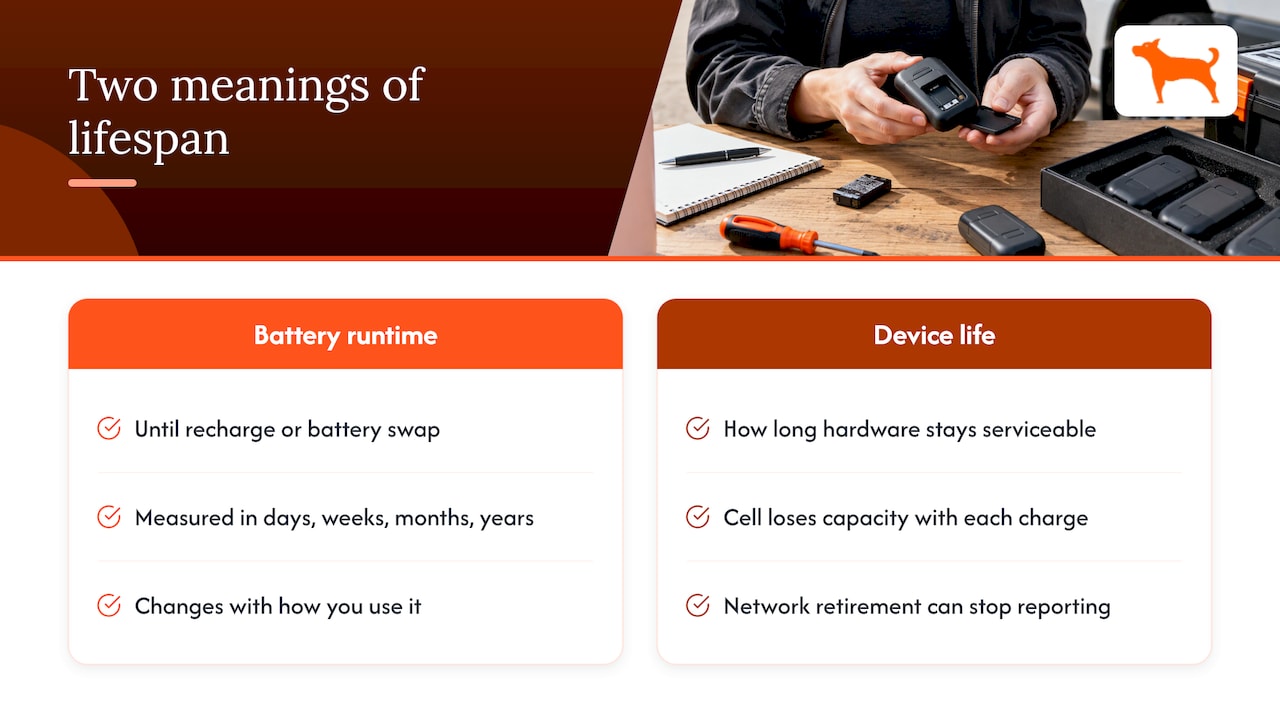
Two lifespans: battery runtime and device life
People search “how long do GPS trackers last” and get answers that mix two different things.
Battery runtime is how long a tracker operates before it needs a recharge or a new battery. It is measured in days, weeks, months or years, and it changes with how you use the unit.
Device life is how long the hardware stays serviceable. A rechargeable lithium-ion cell loses capacity with every charge cycle, so a unit that ran for weeks when new will run for less after a few years of service. The other limit is the cellular network the tracker uses. When carriers retire older network generations, trackers built on them stop reporting even if the hardware is fine. Both limits are named in the 3 to 7 year range quoted above.
For a fleet manager the practical question is simple: how many times per year will someone have to visit this asset to charge or swap something, and when will I have to replace the whole unit? Everything below is about driving both numbers down.
Battery life by tracker type
Power design sets the baseline. Here is how the main types compare for fleet and rental use.
| Tracker type | Typical runtime | Best for |
|---|---|---|
| Hardwired (vehicle power) | Runs while the vehicle battery works, with a small internal backup of about 12 to 24 hours | Trucks, vans, daily-use vehicles |
| OBD-II plug-in | Same as hardwired, powered through the diagnostic port | Light-duty vehicles with an accessible port |
| Rechargeable portable | About 10 days to 3 weeks per charge at standard reporting | Short-term tracking, vehicles that move often |
| Long-life battery (magnetic or sealed) | Months to a year or more, depending on the reporting interval | Trailers, generators, attachments, idle equipment |
| Non-rechargeable asset tracker | Up to 5 years, with sparse reporting | Assets that need an occasional location check |
The runtime ranges for hardwired backup, portable units and non-rechargeable asset trackers come from this lifespan guide. Treat them as typical figures, not promises: any single unit depends on its settings.
Why heavy equipment is a different case
An excavator, a skid steer or a rental trailer may sit on a yard for weeks, then work hard for a day, then travel on a lowboy. A hardwired unit on equipment that is often powered down can be fine if it ties into a battery that stays charged, but many rental assets have no easy power source or get their batteries disconnected between rentals. That is where a long-life battery tracker makes sense. You attach it once and the asset reports for a long time without anyone touching it.
Our lineup reflects that split. The MW-20000 magnetic tracker is built around a 1-year battery, the MW-10000 is a compact long-battery magnetic unit, and the MW-1700 has a 1-month battery for assets you check more often.
What shortens battery life
Three factors do most of the damage. Knowing them lets you set up trackers so they last.
Reporting frequency. Every position fix and every cellular transmission uses power. A tracker that reports every 10 seconds will run down far faster than one that reports every few hours. Rental assets in a yard rarely need live updates. They need a reliable location and an alert if the asset leaves.
Weak cellular coverage. When a tracker struggles to find a network, it keeps boosting its radio. One lifespan guide estimates that poor coverage can cut battery life by 30 to 50 percent. Rural job sites, quarries and metal-clad buildings are the usual culprits.
Cold weather. Battery chemistry slows in the cold. The same guide suggests expecting a 20 to 40 percent drop in runtime in sub-zero conditions. If you run equipment through northern winters, plan on the lower number for those months.
Other contributors are extra features that run constantly, such as always-on motion sensing, and heat from direct sun on a mounting spot.
How to read a battery-life claim
A headline such as “up to 1 year” is the best case under specific settings. Before you compare two trackers, ask what reporting interval the figure assumes.
- Find the reporting interval behind the number. A year of battery at one update a day is not a year at one update a minute.
- Separate standby from active tracking. A tracker can last months on standby and only days in continuous live mode.
- Check the power type. “Unlimited” runtime on a hardwired unit means it depends on the vehicle’s battery.
- Think about your climate and coverage. Take the claim and reduce it for cold and for weak signal, as above.
- Count what comes with it. A device with long battery life but a monthly data plan still carries a recurring cost. With lifetime 4G data included, as ours has, the battery is the only thing to plan around.
For your planning, use the claim as a ceiling and set your service interval comfortably below it.
How to extend a tracker’s operating time
These steps apply across a mixed fleet and cost nothing beyond a few minutes at setup.
- Match the update rate to the asset. Set daily-use trucks to frequent updates and parked rental equipment to infrequent ones. Use geofence alerts to catch unexpected movement instead of watching a live feed.
- Place the unit where it can see the sky and the network. Mount magnetic units on a flat steel surface with open exposure where you can. Avoid burying them under heavy metal that blocks the signal.
- Keep the unit out of extreme heat and cold when possible. A shaded spot on a trailer frame beats the dashboard of a truck in July.
- Use multi-device management to track battery status. One dashboard for every unit means you can spot a low battery before an asset goes dark. Our app supports unlimited vehicles and users on one dashboard.
- Schedule service with your maintenance calendar. Add tracker checks to the same reminders you use for oil changes and inspections, so the battery never becomes a surprise.
Can a tracker drain the vehicle battery?
This matters for any hardwired install. A healthy parked vehicle draws a small parasitic current of about 20 to 50 mA, and a tracker adds to that. The risk shows up when a hardwired unit is connected to a constant live feed rather than an ignition-switched circuit on a vehicle that sits for weeks. A fully charged 12-volt battery at rest reads around 12.6 volts, which gives you a quick baseline to check.
Size matters too. Large truck and RV batteries tolerate small draws better than a small car battery, and a daily driver’s charging system makes up the draw on every drive. The vehicles to think about are those that sit for two or three weeks at a time, such as seasonal equipment haulers and backup units. For those, a self-powered magnetic tracker with its own battery avoids the question entirely, because it takes nothing from the vehicle.
When to recharge, replace or retire a tracker
Recharge on a schedule, not on a warning. For rechargeable units, set a recurring reminder based on the runtime you see in your own conditions, and shorten it for winter.
Replace the battery or unit when runtime falls well below what it was in its first year. Rechargeable lithium-ion cells wear gradually, so a unit that now needs charging twice as often as when new is near the end of its useful life.
Retire the device when it is past the typical 3 to 7 year window and its network support or battery condition no longer meets your needs. Keep a simple log with the install date for each unit so you can plan replacements in batches rather than asset by asset.
Watch for silent failures. A tracker that has stopped reporting looks the same on a map as one that is parked. Set an alert for units that have not checked in for a set time.
Match the tracker to the asset
A quick way to decide for a rental or contractor fleet:
- Daily-use trucks and vans: hardwired or plug-in, for continuous power and frequent updates.
- Trailers and attachments: a long-battery magnetic unit, installed once and left alone.
- Heavy equipment in storage between rentals: a long-battery unit with geofence alerts so you know the moment something leaves the yard.
- High-value assets you check on occasionally: the longest battery you can get, at a sparse reporting interval.
Our long-battery trackers for fleets and rental equipment
For trailers, equipment and anything without a power source, our magnetic trackers give you real-time location, customizable geofencing and alerts, trip and mileage reports and idle-time tracking from one mobile app, with no monthly fees and no activation fees. Lifetime 4G data is included, so there is no plan to renew. Trackers start from $124.99 one-off. The MW-20000 carries a 1-year battery, and the MW-1700 a 1-month battery for assets you want to check on more often. Browse the Moto Watchdog tracker lineup and match each unit to the asset it will ride on.

For larger operations, our business page lists API access for connecting tracker data to your own systems.
Our view on tracker lifespan
Lifespan should not be a subscription question. A tracker that works but needs a monthly plan is only as durable as your willingness to keep paying for it. We built Moto Watchdog around one-time hardware pricing and lifetime 4G data, so the device’s useful life is set by the hardware, not by a billing cycle.
For a fleet, we think the right approach is to match the power type to the job. Put a long-battery magnetic tracker on the assets that sit, and let the geofence do the watching. You get an alert when something moves, instead of a battery that burns through its charge reporting a parked trailer every few seconds.
We also think the best battery is the one nobody thinks about. Fewer site visits, fewer dead units, and one dashboard for unlimited vehicles and users: that is what a tracker is supposed to deliver.
Louis
FAQ
How long do GPS trackers last?
Good tracker hardware typically lasts 3 to 7 years, limited by battery wear and changes in cellular networks. Battery runtime between charges is a separate figure and ranges from days to a year or more depending on the design and reporting frequency.
How long does a GPS tracker battery last on a charge?
Portable rechargeable trackers commonly run about 10 days to 3 weeks on standard reporting. Long-life magnetic designs run for months or a year when set to infrequent updates. Hardwired units run as long as the vehicle’s battery is working.
Can a GPS tracker drain my vehicle battery?
A hardwired tracker adds a small draw, which matters most on a vehicle that sits for weeks and is wired to a constant live feed. Wiring to an ignition-switched circuit or using a self-powered magnetic tracker avoids the issue. Check your battery at rest: a fully charged 12-volt battery reads about 12.6 volts.
Does cold weather affect a tracker’s battery?
Yes. Cold slows battery chemistry, and one lifespan guide suggests planning for a 20 to 40 percent reduction in runtime in sub-zero conditions. Reduce your reporting frequency in winter to stretch the charge.
How do I know when to replace a tracker?
Replace it when runtime drops well below its first-year performance, when it passes the 3 to 7 year window, or when it no longer reports reliably. A check-in alert and an install-date log make this easy to manage across a fleet.