How to start saving money
Lorem ipsum dolor sit amet, consectetur adipiscing elit lobortis arcu enim urna adipiscing praesent velit viverra sit semper lorem eu cursus vel hendrerit elementum morbi curabitur etiam nibh justo, lorem aliquet donec sed sit mi dignissim at ante massa mattis.
- Neque sodales ut etiam sit amet nisl purus non tellus orci ac auctor
- Adipiscing elit ut aliquam purus sit amet viverra suspendisse potent
- Mauris commodo quis imperdiet massa tincidunt nunc pulvinar
- Excepteur sint occaecat cupidatat non proident sunt in culpa qui officia
Why it is important to start saving
Vitae congue eu consequat ac felis placerat vestibulum lectus mauris ultrices cursus sit amet dictum sit amet justo donec enim diam porttitor lacus luctus accumsan tortor posuere praesent tristique magna sit amet purus gravida quis blandit turpis.

How much money should I save?
At risus viverra adipiscing at in tellus integer feugiat nisl pretium fusce id velit ut tortor sagittis orci a scelerisque purus semper eget at lectus urna duis convallis. porta nibh venenatis cras sed felis eget neque laoreet suspendisse interdum consectetur libero id faucibus nisl donec pretium vulputate sapien nec sagittis aliquam nunc lobortis mattis aliquam faucibus purus in.
- Neque sodales ut etiam sit amet nisl purus non tellus orci ac auctor
- Adipiscing elit ut aliquam purus sit amet viverra suspendisse potenti
- Mauris commodo quis imperdiet massa tincidunt nunc pulvinar
- Adipiscing elit ut aliquam purus sit amet viverra suspendisse potenti
What percentege of my income should go to savings?
Nisi quis eleifend quam adipiscing vitae aliquet bibendum enim facilisis gravida neque. Velit euismod in pellentesque massa placerat volutpat lacus laoreet non curabitur gravida odio aenean sed adipiscing diam donec adipiscing tristique risus. amet est placerat in egestas erat imperdiet sed euismod nisi.
“Nisi quis eleifend quam adipiscing vitae aliquet bibendum enim facilisis gravida neque velit euismod in pellentesque”
Do you have any comments? Share them with us on social media
Eget lorem dolor sed viverra ipsum nunc aliquet bibendum felis donec et odio pellentesque diam volutpat commodo sed egestas aliquam sem fringilla ut morbi tincidunt augue interdum velit euismod eu tincidunt tortor aliquam nulla facilisi aenean sed adipiscing diam donec adipiscing ut lectus arcu bibendum at varius vel pharetra nibh venenatis cras sed felis eget.
Subscription-free GPS tracking is defined as a vehicle monitoring model where fleet managers pay once for hardware and access location data without recurring monthly charges. The goal to eliminate fleet GPS monthly fees is achievable right now, using a combination of no-subscription devices, efficient data protocols, and smart configuration. Subscription fees for GPS fleet tracking typically range from $10 to $50 per vehicle per month. At fleet scale, that adds up to thousands of dollars annually per vehicle. Understanding the trade-offs between cost savings and operational data richness is the first step toward making an informed switch.
What are the common sources of monthly GPS fees?
Monthly GPS fees are not a single charge. They bundle several cost layers that fleet managers rarely see itemized on a single invoice.
The main components include:
- Hardware lease fees: Some vendors charge monthly for the device itself rather than selling it outright.
- Cellular data plans: Each tracker consumes data to transmit location updates. Vendors often bundle this into a per-vehicle monthly fee.
- Cloud software access: Dashboards, reporting tools, and alert systems typically sit behind a software-as-a-service subscription.
- Data overages: Plans that cap data usage charge extra when devices exceed their monthly allotment.
- Support and firmware updates: Premium tiers often include technical support and automatic updates as part of the monthly cost.
The cellular data component is the most overlooked cost driver. Subscription data, not hardware, is the primary cost driver in cellular GPS, and it can exceed $900 per unit over three years. That figure makes a strong financial case for auditing what you actually pay for before committing to any long-term contract.
Billing traps compound the problem. Many vendors force fleet managers onto 50MB or higher data plans per device, even when the tracker only needs a fraction of that capacity. Inefficient protocols and bloated data formats push customers toward unnecessarily large plans. A 20-vehicle fleet paying $30 per vehicle per month spends $7,200 per year on GPS subscriptions alone. Cutting that figure to zero is a realistic target with the right approach.

Which GPS technologies allow no monthly fleet GPS fees?
Subscription-free GPS trackers fall into three broad categories, each suited to different fleet needs.
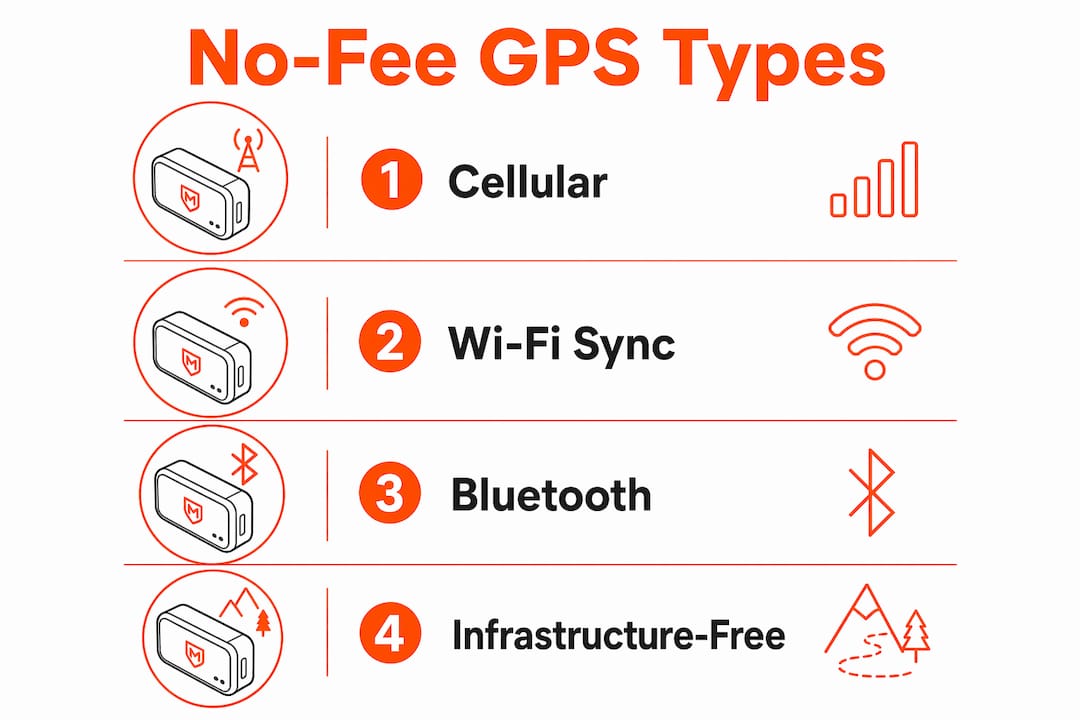
One-time purchase cellular trackers use a SIM card and cellular network but are sold with lifetime data included in the upfront price. Motowatchdog operates on this model, offering real-time 4G tracking without recurring charges. These devices suit fleets that need live location data but want to avoid monthly billing cycles.
Wi-Fi sync trackers store location data locally and upload it when the device connects to a known Wi-Fi network. They work well for assets that return to a fixed location, such as a depot or job site, at the end of each day. The limitation is that live tracking between sync points is not available.
Bluetooth and infrastructure-free trackers use networks like Apple’s Find My to report location without a cellular subscription. Using Bluetooth trackers on Apple’s Find My network can reduce three-year asset tracking costs by over 70% compared to cellular GPS. That saving is significant, but these devices lack live telemetry and are best suited for non-critical assets like trailers, equipment, or storage containers.
The right category depends on three factors: how frequently you need location updates, whether the asset is mobile or stationary for long periods, and whether compliance regulations apply to the vehicle.
Pro Tip: For mixed fleets, consider a tiered approach. Use one-time purchase cellular trackers on powered vehicles and Bluetooth trackers on non-powered assets like trailers. This combination cuts recurring costs without sacrificing live tracking where it matters most.
A lifetime GPS tracker guide can help you evaluate which device type fits each asset class in your fleet.
How to optimize GPS data usage to cut fleet tracking expenses
Reducing data consumption is the most direct way to lower or eliminate monthly data costs on cellular GPS plans. The key is configuring devices to transmit only what is necessary, when it is necessary.
-
Switch to binary HEX encoding and UDP protocols. Properly engineered GPS devices using binary HEX encoding and UDP protocols can reduce data usage to under 30MB per month per device. JSON-based formats and TCP protocols use significantly more bandwidth for the same location data.
-
Enable intelligent reporting intervals. Configure devices to report more frequently during movement and less frequently when stationary. A tracker pinging every 10 seconds while parked wastes data. Switching to a heartbeat ping every 5 minutes during idle periods cuts consumption dramatically.
-
Activate cornering and event-based algorithms. Firmware with cornering algorithms reduces redundant data points by up to 60%. Instead of sending a location update every fixed interval, the device sends an update only when direction or speed changes meaningfully.
-
Audit each device’s actual monthly data consumption. Pull SIM card usage reports from your carrier and compare them against what each device should theoretically use. Gaps between actual and expected usage often reveal firmware misconfiguration or vendor-side data bloat.
-
Negotiate SIM-only plans based on real usage. Once you know your actual data consumption per device, you can approach carriers with evidence. A device using 20MB per month does not need a 50MB plan. Negotiating down to a usage-matched plan reduces costs even if you keep a cellular subscription temporarily.
Pro Tip: Request a data usage breakdown by device from your current GPS vendor before signing any renewal. Vendors rarely volunteer this information, but it is your data and you are entitled to it. The numbers often reveal that you are paying for two to three times the data your fleet actually uses.
What are the trade-offs when eliminating monthly GPS fees?
Switching to no-fee models delivers real savings, but fleet managers need to understand what changes operationally before making the move.
The core trade-offs include:
- Update frequency: Subscription-based platforms typically offer updates every 10–30 seconds. No-fee models may update every few minutes or only at sync points, depending on the device type.
- Driver behavior monitoring: Live data on harsh braking, acceleration, and idling requires continuous cellular connectivity. Most no-fee models do not support this level of telematics.
- Engine diagnostics: OBD-II data streams, including fault codes and fuel consumption metrics, generally require a subscription-tier device with a persistent data connection.
- Historical data storage: Cloud-based subscription platforms store months or years of trip history. No-fee devices may store data locally with limited retention unless you manage your own server.
The compliance dimension is non-negotiable for many fleets. The FMCSA mandates Electronic Logging Devices for commercial motor vehicles, and ELD-compliant devices typically come with subscription services offering richer telematics. If your fleet operates commercial motor vehicles subject to Hours of Service rules, a no-fee device alone will not satisfy the ELD mandate.
No-fee GPS models are best suited for fleets where asset location is the primary need and real-time driver behavior data is secondary. When compliance, live diagnostics, or sub-minute tracking intervals are required, a subscription service may still be the right tool for those specific vehicles.
Real-time tracking provides immediate operational benefits like fuel efficiency monitoring and driver behavior analysis, which no-monthly-fee models may not fully deliver. The decision is not all-or-nothing. Many fleet managers apply no-fee solutions to non-regulated assets and maintain subscriptions only where compliance or live telemetry is legally required.
Step-by-step guide to transition your fleet to no-subscription GPS tracking
A structured transition protects operational continuity and prevents the common mistake of switching devices before understanding current costs and needs.
-
Audit your current GPS expenses. Pull invoices for the past 12 months. Separate hardware costs, data plan costs, software fees, and overage charges by vehicle. This gives you a baseline to measure savings against.
-
Classify your fleet by compliance and tracking requirements. Identify which vehicles fall under FMCSA ELD rules. Separate non-regulated assets, trailers, and equipment from regulated commercial vehicles. No-fee solutions apply cleanly to the non-regulated group.
-
Select the appropriate no-subscription GPS solution for each asset class. Use one-time purchase cellular trackers for powered vehicles needing live location. Use Bluetooth or Wi-Fi sync trackers for non-powered assets. Motowatchdog’s subscription-free 4G devices cover the live-tracking category without monthly charges.
-
Install and configure devices for data efficiency. Follow a fleet hardwiring guide for powered vehicle installations. Configure reporting intervals, enable cornering algorithms, and verify firmware settings before deployment.
-
Monitor performance for the first 30 days. Compare location accuracy, update frequency, and data consumption against your pre-switch baseline. Address any gaps in coverage or configuration before canceling existing subscriptions.
The table below summarizes the transition steps and their primary focus areas:
| Step | Focus Area | Key Action |
|---|---|---|
| 1. Expense audit | Financial baseline | Itemize all GPS-related costs by vehicle |
| 2. Fleet classification | Compliance mapping | Separate ELD-regulated from non-regulated assets |
| 3. Device selection | Technology match | Match tracker type to asset tracking requirements |
| 4. Installation and configuration | Data efficiency | Set reporting intervals and enable smart firmware |
| 5. Performance monitoring | Operational continuity | Validate accuracy and adjust settings as needed |
For fleet managers running smaller operations, a small fleet tracking guide covers budget-specific strategies that apply directly to this transition process.
Key Takeaways
Eliminating monthly GPS fees requires matching the right no-subscription device to each asset class, configuring data transmission efficiently, and separating ELD-regulated vehicles from those where no-fee solutions apply cleanly.
| Point | Details |
|---|---|
| Monthly fees stack up fast | GPS subscriptions can exceed $900 per unit over three years, making audits a priority. |
| No-fee device categories exist | One-time cellular, Wi-Fi sync, and Bluetooth trackers each suit different asset types. |
| Data configuration drives savings | UDP protocols and cornering algorithms can cut data usage by up to 60%. |
| Compliance limits no-fee adoption | FMCSA ELD mandates require subscription-grade telematics for regulated commercial vehicles. |
| Tiered fleet approach works best | Apply no-fee trackers to non-regulated assets and retain subscriptions only where legally required. |
What I’ve learned from fleets that actually cut their GPS costs
Fleet managers who successfully eliminate recurring GPS fees share one habit: they audit before they act. The ones who switch devices without first pulling their actual data consumption reports often end up paying for the same inefficiency in a different form.
The most common mistake I see is treating GPS tracking as a single category. A refrigerated trailer parked at a distribution center three nights a week has completely different tracking needs than a service van making 15 stops a day. Applying the same subscription plan to both is where the waste lives. Separating assets by operational profile before selecting any device is the move that actually changes the numbers.
The technology argument for no-fee solutions is stronger in 2026 than it has ever been. One-time purchase 4G trackers now deliver update frequencies and geofencing capabilities that were subscription-only features two years ago. The gap between subscription and no-fee performance has narrowed considerably for standard location tracking use cases.
My honest advice: run a 30-day pilot on your lowest-risk asset class before committing to a full fleet transition. The data from that pilot will tell you more than any vendor comparison chart. If the no-fee device performs within acceptable parameters on those assets, scale from there with confidence.
— Louis
Motowatchdog’s subscription-free GPS tracking for fleets
Motowatchdog offers a subscription-free 4G GPS solution built specifically for fleet managers who need real-time vehicle and asset monitoring without monthly charges. The one-time device cost covers lifetime data access, geofencing alerts, and detailed mileage reporting. Over 1,000 businesses rely on Motowatchdog for accurate, no-fee tracking across diverse fleet types.
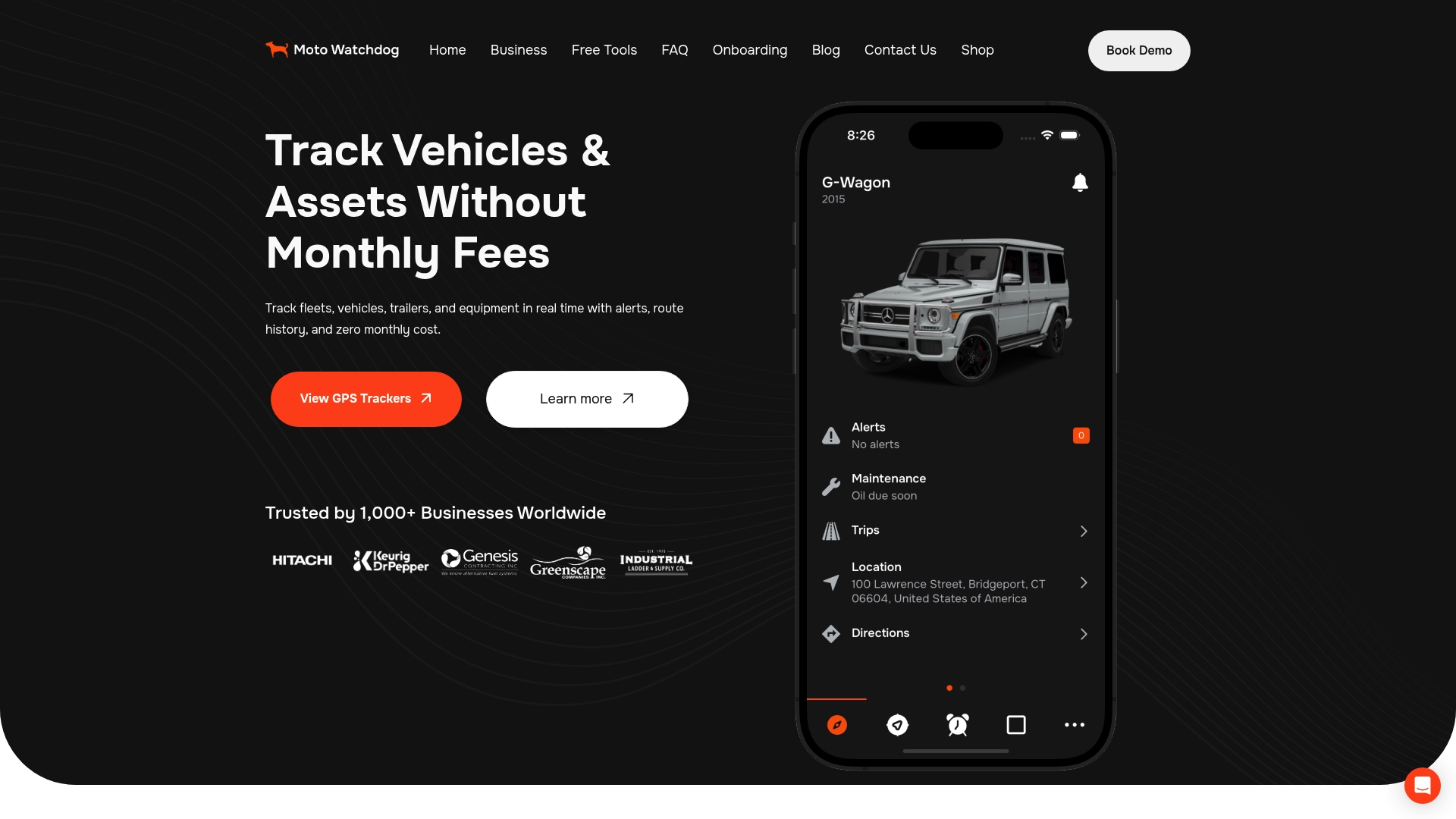
The platform scales from single-vehicle operations to multi-asset fleets without adding per-vehicle monthly fees as your fleet grows. Setup is straightforward, and the device works immediately after installation. For fleet managers ready to move away from recurring GPS charges, Motowatchdog provides a direct path to no-fee fleet tracking with the live location capabilities your operation requires.
FAQ
What does it cost to eliminate GPS monthly fees?
The primary cost is a one-time hardware purchase for a no-subscription GPS tracker. After that, there are no recurring monthly charges, making the total three-year cost significantly lower than subscription-based alternatives.
Can no-fee GPS trackers meet FMCSA ELD requirements?
Most no-fee GPS devices do not meet FMCSA ELD compliance requirements for commercial motor vehicles. Fleet managers must retain ELD-compliant subscription devices for regulated vehicles while applying no-fee solutions to non-regulated assets.
How much data does a GPS tracker actually use per month?
A properly configured GPS tracker using binary HEX encoding and UDP protocols uses under 30MB per month per device. Most fleets overpay because vendors default to inefficient data formats that inflate consumption.
What types of assets are best suited for no-fee GPS tracking?
Non-powered assets like trailers, equipment, and storage containers are ideal candidates. Vehicles that do not require live driver behavior monitoring or ELD compliance also work well with subscription-free tracking solutions.
How long does it take to transition a fleet to no-subscription GPS?
A structured transition typically takes 30–60 days, including the audit phase, device selection, installation, and a performance monitoring period before canceling existing subscriptions.