How to start saving money
Lorem ipsum dolor sit amet, consectetur adipiscing elit lobortis arcu enim urna adipiscing praesent velit viverra sit semper lorem eu cursus vel hendrerit elementum morbi curabitur etiam nibh justo, lorem aliquet donec sed sit mi dignissim at ante massa mattis.
- Neque sodales ut etiam sit amet nisl purus non tellus orci ac auctor
- Adipiscing elit ut aliquam purus sit amet viverra suspendisse potent
- Mauris commodo quis imperdiet massa tincidunt nunc pulvinar
- Excepteur sint occaecat cupidatat non proident sunt in culpa qui officia
Why it is important to start saving
Vitae congue eu consequat ac felis placerat vestibulum lectus mauris ultrices cursus sit amet dictum sit amet justo donec enim diam porttitor lacus luctus accumsan tortor posuere praesent tristique magna sit amet purus gravida quis blandit turpis.

How much money should I save?
At risus viverra adipiscing at in tellus integer feugiat nisl pretium fusce id velit ut tortor sagittis orci a scelerisque purus semper eget at lectus urna duis convallis. porta nibh venenatis cras sed felis eget neque laoreet suspendisse interdum consectetur libero id faucibus nisl donec pretium vulputate sapien nec sagittis aliquam nunc lobortis mattis aliquam faucibus purus in.
- Neque sodales ut etiam sit amet nisl purus non tellus orci ac auctor
- Adipiscing elit ut aliquam purus sit amet viverra suspendisse potenti
- Mauris commodo quis imperdiet massa tincidunt nunc pulvinar
- Adipiscing elit ut aliquam purus sit amet viverra suspendisse potenti
What percentege of my income should go to savings?
Nisi quis eleifend quam adipiscing vitae aliquet bibendum enim facilisis gravida neque. Velit euismod in pellentesque massa placerat volutpat lacus laoreet non curabitur gravida odio aenean sed adipiscing diam donec adipiscing tristique risus. amet est placerat in egestas erat imperdiet sed euismod nisi.
“Nisi quis eleifend quam adipiscing vitae aliquet bibendum enim facilisis gravida neque velit euismod in pellentesque”
Do you have any comments? Share them with us on social media
Eget lorem dolor sed viverra ipsum nunc aliquet bibendum felis donec et odio pellentesque diam volutpat commodo sed egestas aliquam sem fringilla ut morbi tincidunt augue interdum velit euismod eu tincidunt tortor aliquam nulla facilisi aenean sed adipiscing diam donec adipiscing ut lectus arcu bibendum at varius vel pharetra nibh venenatis cras sed felis eget.
Tracking a car you own or lease is legal in every U.S. state and the District of Columbia. Tracking someone else’s vehicle without their knowledge or consent is a crime in most states, and law enforcement generally needs a warrant before attaching a device to any vehicle. That’s the short version. The longer version depends heavily on which state you’re in, who owns the vehicle, and whether the person being tracked has given consent.
Three things determine where you stand:
- The federal baseline: United States v. Jones established that police attaching a GPS device to a car counts as a Fourth Amendment search, and 18 U.S.C. §3117 governs how courts authorize tracking devices for federal investigations.
- State variation: At least 26 states and D.C. criminalize unauthorized location tracking, but they do it through different legal mechanisms, from standalone device statutes to stalking-law add ons.
- Common exceptions: Owners tracking their own vehicles, parents monitoring minors, and many commercial fleet arrangements with proper notice are lawful nearly everywhere.
Key Takeaways
Car GPS tracking is legal when you own or lease the vehicle, but tracking someone else’s car without consent is a crime in most states and always requires attention to that state’s specific statute.
| Point | Details |
|---|---|
| Ownership settles most cases | Tracking a vehicle you own or lease is legal in all 50 states and D.C. |
| Federal law binds police, not private citizens | Jones and 18 U.S.C. §3117 govern law enforcement; private conduct falls to state statutes. |
| States use four legal models | Device statutes, broad bans, stalking prongs, and gap states each treat unauthorized tracking differently. |
| Notice protects employers and lessors | Written consent and documented acknowledgment reduce both criminal and civil exposure. |
| Motowatchdog supports lawful tracking | Its no-subscription devices offer owner-controlled access and geofencing suited to documented, consent-based fleet and personal use. |
Table of Contents
- Is Car GPS Tracking Legal? The Federal Baseline
- How State Laws Vary on Vehicle Tracking
- Car GPS Tracking Laws by State: A Quick Reference
- Is It Legal to Track a Car in These Common Situations?
- What Happens If You Track Someone Illegally?
- How to Stay Legal: Consent Language and Compliance Steps
- How to Tell If a GPS Tracker Is on Your Car
- Can Police Track My Car Without a Warrant?
- Why This Matters Beyond the Legal Fine Print
- A Compliant Way to Track Vehicles Without the Legal Guesswork
- Frequently Asked Questions
- Sources
Is Car GPS Tracking Legal? The Federal Baseline
The U.S. Supreme Court settled a major piece of this question in 2012. In United States v. Jones, the Court ruled that when police physically attach a GPS device to a car and use it to monitor movement, that action is a “search” under the Fourth Amendment. Before Jones, some agencies argued that tracking a car on public roads didn’t require a warrant because there’s no reasonable expectation of privacy in public movement. The Court disagreed, at least where the government physically installs hardware on your property. Practically, this means federal and state law enforcement now need a warrant, backed by probable cause, before slapping a tracker on a suspect’s vehicle in most circumstances.
That ruling sits alongside 18 U.S.C. §3117, the federal statute that defines what a “tracking device” is for legal purposes and authorizes courts to issue orders permitting law enforcement to use one. The statute doesn’t ban tracking outright. It sets the procedural rules federal agents follow when they want a court’s blessing to install one, including how long an order lasts and how it applies across jurisdictions. Federal legislative history around the statute also clarifies that courts can authorize tracking device use across jurisdictional lines when a proper order is in place, which matters for multi-state investigations.
Here’s the distinction that trips people up: federal law is built almost entirely around constraining government action. It says very little about what happens when your neighbor, your ex, or a business puts a tracker on a private vehicle. That gap is filled by state law, and state law varies enormously in how it treats private tracking.
- Federal rules (Jones, §3117) primarily bind law enforcement and require warrants or court orders for government tracking.
- State statutes primarily govern private citizens, employers, and businesses, and they differ on what counts as illegal installation or use.
- A device that’s perfectly legal for an employer to install on a company truck may be a criminal offense if installed on an ex-spouse’s personal car in the same state.
Pro Tip: If you’re a fleet manager operating across state lines, don’t assume the rule in your home state applies everywhere your vehicles travel. Check the tracking statute in every state where a vehicle is registered or regularly operated, since notice requirements for lessees and employees are not uniform.
How State Laws Vary on Vehicle Tracking
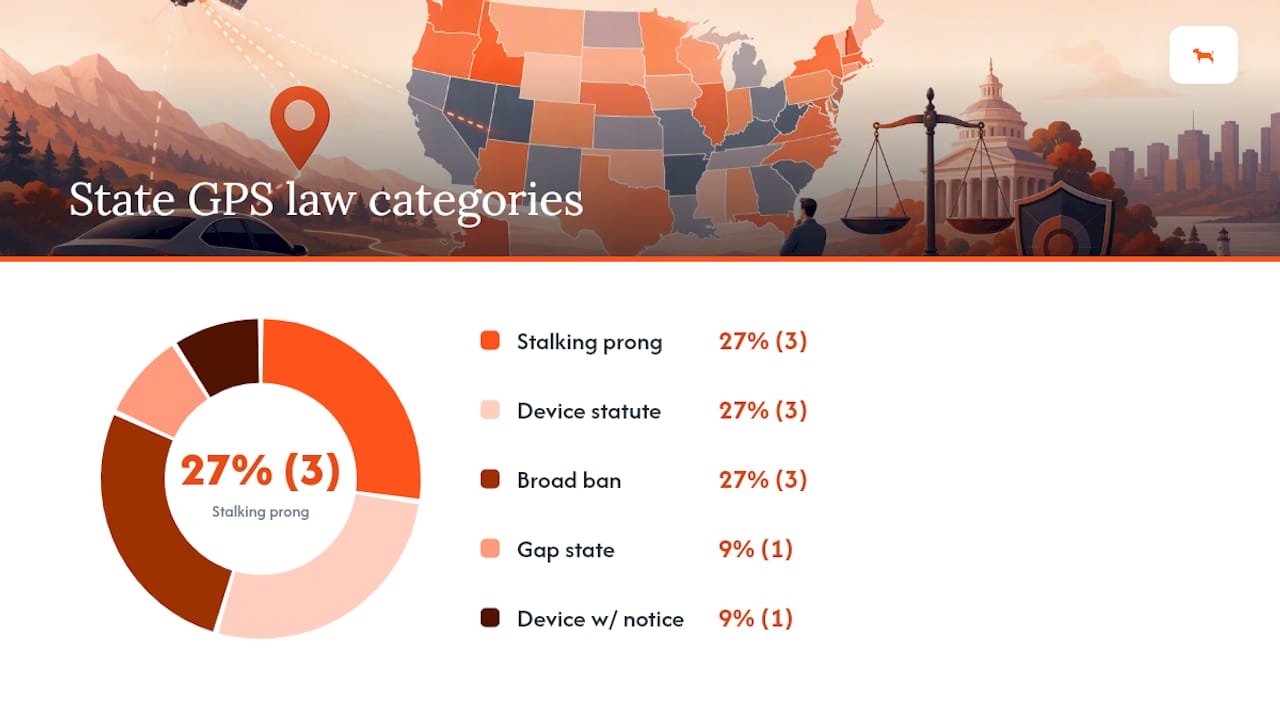
Once you move past the federal baseline, the real complexity starts. States don’t use one shared framework. Instead, you’ll generally run into four categories of law, and knowing which one applies to your state tells you almost everything you need to know.
Standalone device statutes make it a specific crime to install or use a tracking device on a vehicle without the owner’s knowledge and consent, regardless of intent. Michigan’s statute (MCL 750.539l) is a clean example: it’s a misdemeanor to install a tracker on someone’s vehicle without their knowledge and consent, and the law creates civil liability for damages caused by unlawful use, separate from any criminal charge.
Device statutes with built-in exceptions work similarly but spell out who’s exempt. Kentucky’s KRS 508.152 criminalizes unauthorized tracking device installation but explicitly carves out owners, emergency services, and lessees who’ve received proper notice. This model is common and tends to be the most fleet-friendly, since it recognizes legitimate commercial uses upfront rather than leaving them to court interpretation.
Broad electronic-tracking bans go further than vehicles alone. States including California, Florida, Hawaii, Louisiana, Minnesota, New Hampshire, and Virginia prohibit electronic tracking of a person without consent across a wider range of contexts, not just car installation. If you’re in one of these states, the analysis isn’t limited to “is this a car tracker” but extends to any electronic means of monitoring someone’s location.
Stalking-prong states don’t have a dedicated tracking statute at all. Instead, they fold unauthorized GPS use into existing stalking or harassment laws. New York is a common example of this approach. The practical effect is that prosecutors have to fit the tracking conduct into a stalking framework, which can require showing a pattern of behavior or intent to cause fear, rather than treating a single unauthorized installation as an automatic offense.
- Device statutes (MI-style): installation itself is the crime, exceptions listed explicitly.
- Broad bans (CA-style): any non-consensual electronic tracking is covered, not just vehicles.
- Stalking prongs (NY-style): tracking becomes illegal when it fits a harassment or stalking pattern.
- Gap states: no tracking-specific statute exists, so cases rely on general privacy torts or other criminal statutes.
An NCSL analysis of state tracking legislation flags a common misconception worth correcting: in many states, unauthorized installation alone is a standalone crime. You don’t need to prove the target felt afraid or that a stalking pattern existed. The device going onto someone else’s car without consent is enough.
Car GPS Tracking Laws by State: A Quick Reference
Because the statutory approach differs so much by state, it helps to see how your state’s law is structured before you assume anything about your situation. The summary below groups states by statutory category, cites a controlling statute where one exists, and adds a short practical note. These are simplified summaries, not full legal analysis. Always check the linked statute for exact language, and talk to an attorney if your situation involves ownership disputes, divorce proceedings, or a protective order.
| State | Statutory category | Practical note |
|---|---|---|
| Alabama | Stalking prong | No dedicated device statute; tracking may support a stalking or harassment charge. |
| Alaska | Gap state | No tracking-specific statute identified; relies on general privacy or stalking law. |
| Arizona | Device statute | Unauthorized installation on another’s vehicle is separately criminalized. |
| Arkansas | Stalking prong | Tracking without consent can factor into harassment or stalking charges. |
| California | Broad ban | Prohibits electronic tracking of a person without consent across contexts, not just vehicles. |
| Colorado | Device statute | Installing a tracker without consent is a specific offense with owner exceptions. |
| Connecticut | Device statute with employer notice rules | Employers generally must give notice before tracking employee vehicles. |
| Delaware | Stalking prong | Non-consensual tracking can support stalking-related charges. |
| Florida | Broad ban | Electronic tracking of a person without consent is broadly restricted. |
| Georgia | Device statute | Unauthorized tracker installation on another’s vehicle is a specific crime. |
| Hawaii | Broad ban | Non-consensual electronic tracking is prohibited across a wide range of situations. |
| Idaho | Gap state | No tracking-specific statute identified; general criminal or privacy law applies. |
| Illinois | Device statute | Installing a tracking device without consent is a specific offense. |
| Indiana | Device statute | Owner exception applies; unauthorized installation on another’s car is criminalized. |
| Iowa | Stalking prong | Tracking without consent may support harassment or stalking charges. |
| Kansas | Gap state | No dedicated tracking statute identified; relies on general privacy law. |
| Kentucky | Device statute with exceptions | KRS 508.152 exempts owners, emergency services, and notified lessees. |
| Louisiana | Broad ban with penalty statute | R.S. 14:323 prohibits tracking devices without consent and sets penalties. |
| Maine | Device statute | Unauthorized installation on a vehicle is a specific criminal offense. |
| Maryland | Device statute | Owner exception applies; installing without consent is criminalized. |
| Massachusetts | Stalking prong | Tracking without consent can support stalking or harassment charges. |
| Michigan | Device statute | MCL 750.539l criminalizes unauthorized installation and creates civil liability. |
| Minnesota | Broad ban | Electronic tracking without consent is prohibited across multiple contexts. |
| Mississippi | Gap state | No tracking-specific statute identified; general criminal law applies. |
| Missouri | Device statute | Installing a tracker on another’s vehicle without consent is a specific offense. |
| Montana | Gap state | No dedicated tracking statute; stalking or privacy law may apply instead. |
| Nebraska | Stalking prong | Tracking without consent may factor into stalking or harassment charges. |
| Nevada | Device statute | Owner exception applies; unauthorized use on another’s vehicle is criminalized. |
| New Hampshire | Broad ban | Electronic tracking of a person without consent is broadly restricted. |
| New Jersey | Device statute with employee notice rules | Employers face specific notice obligations for tracking employee vehicles. |
| New Mexico | Gap state | No tracking-specific statute identified; general privacy tort may apply. |
| New York | Stalking prong | Unauthorized tracking can support a stalking charge under state law. |
| North Carolina | Device statute | Installing a tracker without consent on another’s vehicle is criminalized. |
| North Dakota | Gap state | No dedicated tracking statute identified. |
| Ohio | Device statute | Owner exception applies; unauthorized installation is a specific offense. |
| Oklahoma | Stalking prong | Tracking without consent may support harassment or stalking charges. |
| Oregon | Device statute | Unauthorized tracking device installation is criminalized with owner exceptions. |
| Pennsylvania | Device statute | Installing a tracker on another’s vehicle without consent is a specific crime. |
| Rhode Island | Gap state | No tracking-specific statute identified; general privacy law may apply. |
| South Carolina | Stalking prong | Tracking without consent may factor into stalking charges. |
| South Dakota | Gap state | No dedicated tracking statute identified. |
| Tennessee | Device statute | Owner exception applies; unauthorized installation is criminalized. |
| Texas | Device statute | Installing a tracker without consent on another’s vehicle is a specific offense. |
| Utah | Device statute | Owner exception applies; unauthorized use is criminalized. |
| Vermont | Gap state | No tracking-specific statute identified. |
| Virginia | Broad ban | Electronic tracking of a person without consent is broadly prohibited. |
| Washington | Device statute | Unauthorized tracker installation on another’s vehicle is a specific crime. |
| West Virginia | Gap state | No dedicated tracking statute identified. |
| Wisconsin | Device statute | Owner exception applies; unauthorized installation is criminalized. |
| Wyoming | Gap state | No tracking-specific statute identified. |
| District of Columbia | Included in NCSL count | Counted among jurisdictions with tracking-related restrictions. |
Treat every row above as a starting point, not a finish line. Statutes get amended, and “gap states” sometimes have relevant case law even without a dedicated tracking statute. When money, custody, or a criminal charge is on the line, read the actual statute linked here or talk to a lawyer licensed in that state.
Is It Legal to Track a Car in These Common Situations?
Most real-world tracking questions come down to a handful of recurring scenarios. Here’s how to think through each one.
- Employer-owned vehicles: Generally legal to track, since the employer owns the asset. Many states still require written notice to the employee driving it.
- Your own personal car: Legal everywhere. You own it, you can monitor it.
- A car with joint title (spouses): Murkier. Joint ownership doesn’t automatically grant unilateral tracking rights, especially once a divorce filing or protective order exists.
- Parents tracking a minor’s car: Generally legal, treated similarly to an owner exception, though the analysis can shift once the child turns 18.
- Lenders and repossession tracking: Usually lawful when disclosed in loan documents, since it relates to collateral the lender has a legal interest in.
- Leased vehicles: Legal for the lessor, but many statutes (Kentucky’s included) require notifying the lessee that a tracker is installed.
Before assuming a scenario is safe, run through this checklist:
- Who legally owns or leases the vehicle, and does your name appear on the title or lease?
- Was written notice or consent given to the driver, and can you document it?
- Which state’s law governs, based on where the vehicle is registered and primarily operated?
- Does a protective order, restraining order, or active divorce filing affect the situation?
Employee notice deserves special attention. Several states, New Jersey and Connecticut among them, impose specific notice obligations on employers who track vehicles used for work, even when the company owns the vehicle outright. Skipping that notice step doesn’t necessarily make the tracking illegal everywhere, but it does expose the employer to civil liability risk that proper documentation would have avoided.
What Happens If You Track Someone Illegally?
Penalties for unauthorized tracking split into two tracks: criminal charges and civil lawsuits, and they aren’t mutually exclusive. A single act of unauthorized tracking can trigger both at once.
On the criminal side, penalties range from misdemeanors to felonies depending on the state and the circumstances. A first offense under a device statute is often charged as a misdemeanor. Aggravating factors push it higher: violating an existing protective order, being a repeat offender, or combining tracking with other stalking conduct can escalate charges to a felony in many states.
- Misdemeanor charges are common for a first, isolated unauthorized installation.
- Felony charges become more likely when tracking accompanies a protective-order violation or a documented stalking pattern.
- Louisiana’s tracking statute sets specific penalty tiers, illustrating how one state structures escalating consequences.
On the civil side, victims of unauthorized tracking can often sue for invasion of privacy, and in more severe cases, intentional infliction of emotional distress. Michigan’s statute explicitly creates civil liability for damages tied to unlawful tracking device use, separate from criminal prosecution. Some states allow compensatory damages, and a smaller number permit enhanced or treble damages for particularly egregious conduct. If you’re on the receiving end of a lawsuit like this as a business, insurance may not cover intentional tort claims, which makes the compliance steps below worth taking seriously before installing anything.
How to Stay Legal: Consent Language and Compliance Steps
The safest path through all this variation is simple in principle: get consent in writing, document it, and don’t collect more location data than you need. Here’s what that looks like in practice.
For employees driving company vehicles, a short written acknowledgment covers most bases:
For lessees in a leased vehicle, a similar notice satisfies the disclosure requirements found in statutes like Kentucky’s:
A solid employer or lessor policy should define a few things clearly: the business purpose for tracking, when monitoring is active (all the time, or only during work hours), how long location data is retained, who has access to it, and how the employee or lessee acknowledges the policy in writing. You can adapt the fleet compliance approach covered in this guide to GPS and fleet safety if you’re building a policy from scratch.
Pro Tip: Collect only the location data you actually need for your stated purpose, and set an automatic deletion window, such as 90 days, rather than storing indefinite history. Minimal retention reduces your exposure if a former employee or lessee ever challenges the tracking in court.
How to Tell If a GPS Tracker Is on Your Car
If you suspect someone has placed a tracker on your vehicle without your knowledge, work through these steps in order:
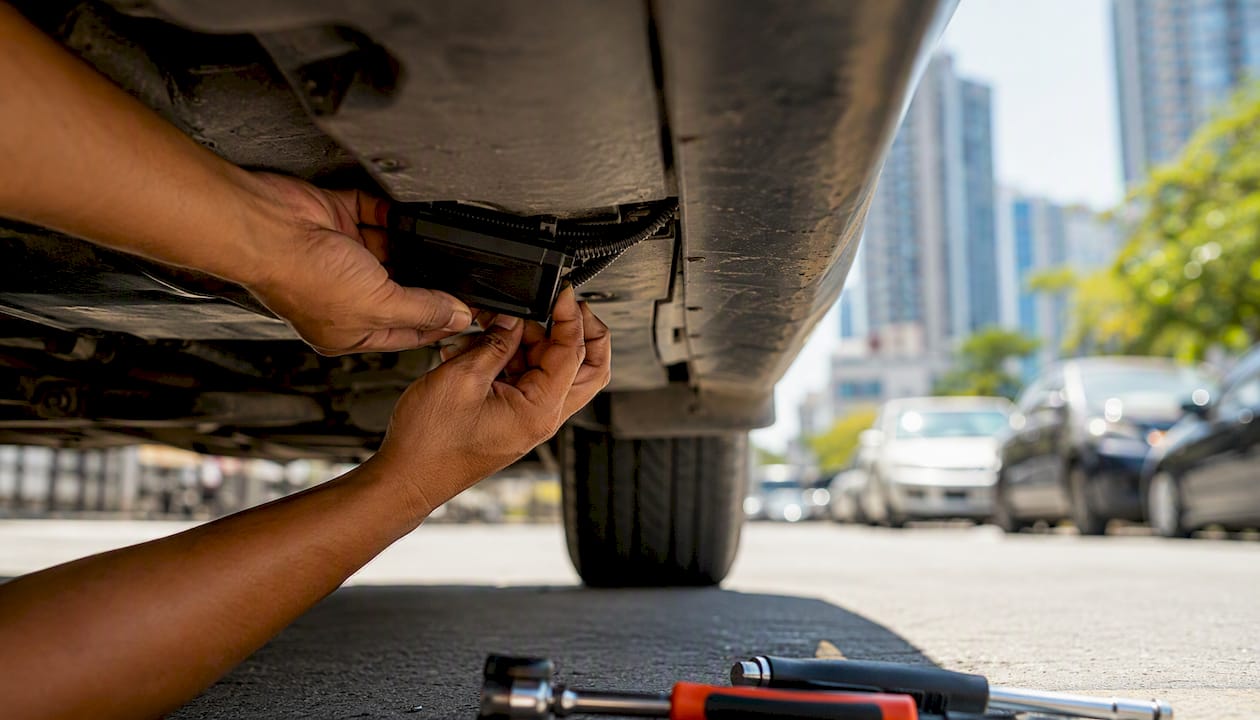
- Do a physical sweep. Check wheel wells, the underbody near the frame rails, inside bumpers, and under the dashboard. Magnetic trackers often attach to metal surfaces in hard-to-see spots.
- Check the interior. Look under seats, in the glovebox, and inside any factory storage compartments for anything that doesn’t belong.
- Scan for wireless signals. A Bluetooth or RF detector can pick up signals from active devices, though hardwired trackers with no wireless broadcast won’t show up this way.
- Check your OBD port. Some trackers plug directly into the OBD-II port under the dashboard rather than hiding externally.
- Photograph anything you find, in place, before touching it. Note the time, location, and any visible serial numbers or brand markings.
If you find a device, don’t destroy it. Preserving it as evidence matters if you decide to involve police or pursue a civil claim. Contact local law enforcement to report the discovery, and if the situation involves an ex-partner, domestic violence, or a protective order, reach out to a victim-advocacy organization for guidance on safety planning before confronting anyone.
Can Police Track My Car Without a Warrant?
Generally, no. Under Jones, physically attaching a GPS device to a vehicle to monitor its movement counts as a Fourth Amendment search, which means police typically need a warrant backed by probable cause before installing one.
- Exigent circumstances, like an active threat to life, can allow warrantless tracking in narrow situations.
- Historical cell-site location data, addressed in the separate Carpenter v. United States decision, follows its own warrant framework distinct from physically attached devices.
- Evidence gathered from a warrantless GPS installation, absent a valid exception, risks being suppressed in court, which is a major reason law enforcement agencies now build warrant applications around Jones before deploying trackers in investigations.
Why This Matters Beyond the Legal Fine Print
Owners and fleet managers usually come to this question from a practical place: they want to recover a stolen vehicle, keep drivers safe, or check on a teenager, not study statutory taxonomy. But the patchwork of state law means good intentions don’t protect you from a bad outcome if you skip the notice step.
I’d argue the businesses that get burned aren’t the ones tracking maliciously. They’re the ones that assumed “we own the truck” settled the question, without checking whether their state requires written notice to the driver. That single document is cheap insurance against a lawsuit that costs far more than the tracker itself.
A Compliant Way to Track Vehicles Without the Legal Guesswork
Motowatchdog gives fleet owners and families a way to track vehicles with none of the ongoing subscription costs that come with most competing devices, and no recurring bill to justify to an insurance adjuster or an accountant. That matters here because compliance involves ongoing responsibilities around data retention, access control, and notice, and a device built with those realities in mind makes the job easier from day one.
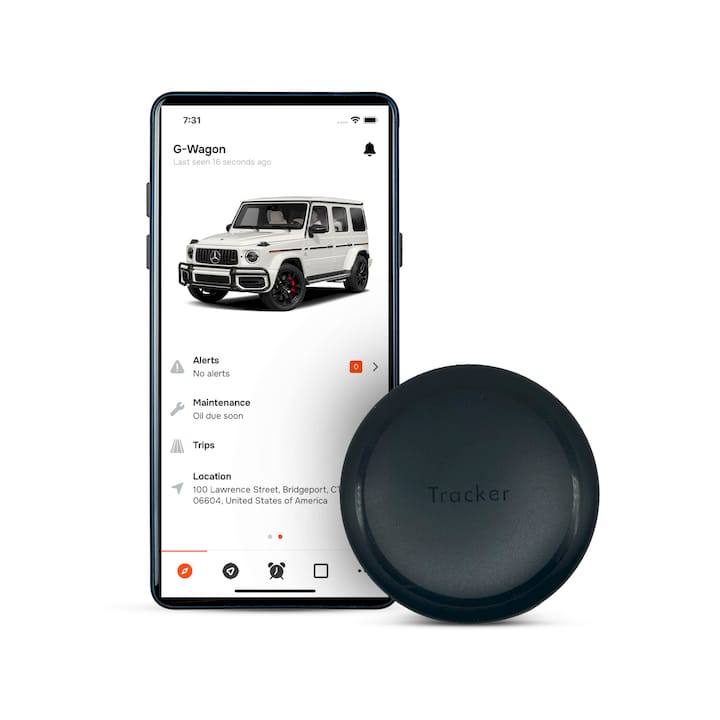
Motowatchdog’s hardware supports the compliance practices this article covers directly: owner-controlled access so you decide who sees location data, customizable geofencing so you’re collecting relevant information rather than a nonstop feed, and long battery life that reduces how often a device needs handling, which matters if you’re documenting installation for a lessee or employee acknowledgment. Pair the hardware with the subscription-free GPS overview for businesses to see how the no-fee model fits fleet budgets specifically.
None of this replaces legal advice. If your situation involves a custody dispute, a business partnership disagreement, or anything with real legal stakes, talk to an attorney licensed in your state before installing anything. For straightforward ownership situations, like tracking your own vehicle, a company truck, or a leased asset with proper notice, check out Motowatchdog’s GPS tracking devices and get a device set up the same day it arrives.
Frequently Asked Questions
Is it legal to put a GPS tracker on my own car? Yes. Tracking a vehicle you own or lease is legal in every U.S. state, since ownership generally establishes your right to monitor the asset.
Is car GPS tracking legal if I’m tracking a family member’s vehicle? It depends on ownership and the relationship. Parents tracking a minor’s car are generally covered by an owner-style exception, but tracking an adult family member’s separately owned vehicle without their consent can violate state law.
Can my employer legally track my work vehicle? Usually yes, if the employer owns the vehicle, but states like New Jersey and Connecticut require written notice to the employee before tracking begins.
What should I do if I find a GPS tracker on my car? Photograph it in place, avoid damaging it, and contact local law enforcement. If the situation involves a partner, ex-partner, or domestic violence concern, reach out to a victim-advocacy resource for safety guidance first.
Do I need a lawyer to know if my tracking situation is legal? For straightforward ownership cases, no. For anything involving joint ownership, divorce, custody, or a protective order, consulting an attorney licensed in your state is worth the cost given the criminal and civil exposure involved.
This article is general information, not a substitute for advice from a qualified lawyer. Consult a qualified legal professional about your own circumstances before acting on anything here.
Sources
- Private Use of Location Tracking Devices: State Statutes
- 18 U.S. Code § 3117 - Mobile tracking devices | LII / Legal Information Institute
- GPS Tracking Laws by State: Is It Legal to Put a Tracker on a Car? (2026) | Recording Law