
How to start saving money
Lorem ipsum dolor sit amet, consectetur adipiscing elit lobortis arcu enim urna adipiscing praesent velit viverra sit semper lorem eu cursus vel hendrerit elementum morbi curabitur etiam nibh justo, lorem aliquet donec sed sit mi dignissim at ante massa mattis.
- Neque sodales ut etiam sit amet nisl purus non tellus orci ac auctor
- Adipiscing elit ut aliquam purus sit amet viverra suspendisse potent
- Mauris commodo quis imperdiet massa tincidunt nunc pulvinar
- Excepteur sint occaecat cupidatat non proident sunt in culpa qui officia
Why it is important to start saving
Vitae congue eu consequat ac felis placerat vestibulum lectus mauris ultrices cursus sit amet dictum sit amet justo donec enim diam porttitor lacus luctus accumsan tortor posuere praesent tristique magna sit amet purus gravida quis blandit turpis.

How much money should I save?
At risus viverra adipiscing at in tellus integer feugiat nisl pretium fusce id velit ut tortor sagittis orci a scelerisque purus semper eget at lectus urna duis convallis. porta nibh venenatis cras sed felis eget neque laoreet suspendisse interdum consectetur libero id faucibus nisl donec pretium vulputate sapien nec sagittis aliquam nunc lobortis mattis aliquam faucibus purus in.
- Neque sodales ut etiam sit amet nisl purus non tellus orci ac auctor
- Adipiscing elit ut aliquam purus sit amet viverra suspendisse potenti
- Mauris commodo quis imperdiet massa tincidunt nunc pulvinar
- Adipiscing elit ut aliquam purus sit amet viverra suspendisse potenti
What percentege of my income should go to savings?
Nisi quis eleifend quam adipiscing vitae aliquet bibendum enim facilisis gravida neque. Velit euismod in pellentesque massa placerat volutpat lacus laoreet non curabitur gravida odio aenean sed adipiscing diam donec adipiscing tristique risus. amet est placerat in egestas erat imperdiet sed euismod nisi.
“Nisi quis eleifend quam adipiscing vitae aliquet bibendum enim facilisis gravida neque velit euismod in pellentesque”
Do you have any comments? Share them with us on social media
Eget lorem dolor sed viverra ipsum nunc aliquet bibendum felis donec et odio pellentesque diam volutpat commodo sed egestas aliquam sem fringilla ut morbi tincidunt augue interdum velit euismod eu tincidunt tortor aliquam nulla facilisi aenean sed adipiscing diam donec adipiscing ut lectus arcu bibendum at varius vel pharetra nibh venenatis cras sed felis eget.
Only the miles you drive for business purposes, client visits, trips between job sites, or travel to a temporary work location, qualify for a mileage deduction; ordinary commuting does not. You can claim these miles using either the standard mileage rate or the actual expense method, but both require you to know your business-use percentage. The one requirement that makes or breaks a claim is contemporaneous recordkeeping: a log that captures the date, miles driven, destination, and business purpose at or near the time of each trip.
TL;DR:
- Only miles driven for business purposes, such as client visits or between work sites, qualify for a deduction, while commuting from home to a regular office does not.
- Maintaining a contemporaneous log with date, destination, miles driven, and business purpose is essential to substantiate your mileage claim and prevent IRS scrutiny.
- The standard mileage rate simplifies recordkeeping but may be less beneficial than the actual expense method if your vehicle has high fixed costs or depreciation.
- Using GPS trackers can automate trip recording, providing timestamped, location-tagged data that strengthens your record’s credibility.
- Reconstructed or delayed logs increase audit risk; building a daily habit of trip tagging and monthly exporting is the most effective way to ensure compliance.
Table of Contents
- What Counts as Business Mileage Versus Personal Driving
- Standard Mileage Rate Versus Actual Expenses: Which Method Wins
- Building a Mileage Log That Actually Holds Up
- Doing the Math: Two Worked Examples and a Year-End Checklist
- Where the Mileage Deduction Goes on Your Tax Return
- Common Mistakes That Trigger IRS Scrutiny
- Where GPS Devices Fit Into IRS-Ready Recordkeeping
- What Most Mileage Advice Gets Wrong
- Try Moto Watchdog for Contemporaneous Mileage Records
- Sources
- FAQ
What Counts as Business Mileage Versus Personal Driving
The IRS distinguishes clearly between miles driven for business and miles driven for personal reasons, and the line is stricter than most self-employed people expect. Business mileage generally includes:
- Driving from your office or home office to meet a client or attend a job site.
- Traveling between two work locations during the same business day, such as moving from one client site to another.
- Trips to a temporary work location outside your usual business area, even if your main office is elsewhere.
- Errands made specifically for business purposes, such as picking up supplies or equipment.
- Travel to a bank, post office, or supplier when the trip serves the business directly.
Commuting from home to a regular place of business is not deductible, regardless of distance. There is one meaningful exception: if your home qualifies as your principal place of business, meaning you run your operation primarily from a home office that meets IRS criteria, trips from home to a job site or client location can count as business mileage rather than commuting.
Parking fees and tolls incurred on business trips are deductible separately from whichever mileage method you use, so keep those receipts even if you never touch actual vehicle expenses.
Standard Mileage Rate Versus Actual Expenses: Which Method Wins
Choosing a deduction method shapes what records you keep and how much math you do at tax time, so it is worth understanding both before you commit for the year.
The standard mileage rate is a single per-mile figure that the IRS updates annually, and it is meant to substitute for tracking every individual vehicle cost. You multiply your total business miles by that year’s rate and the result is your deduction. It works well if you drive a lot for business, want simpler records, or lease your vehicle. There is a catch: if you use the standard rate in the first year a vehicle is placed in business service, you generally must stick with it or switch to actual expenses using straight-line depreciation later, per IRS guidance on the standard mileage rate and depreciation.
The actual expense method requires you to total real costs and allocate them by your business-use percentage. Categories typically include:
- Fuel, oil, and routine maintenance.
- Insurance premiums and registration fees.
- Depreciation or lease payments.
- Repairs and tires.
This method tends to produce a larger deduction for newer, more expensive vehicles or those with high fixed costs, but it demands far more paperwork.
There is no shortcut around comparing both. Calculating the deduction under each method for the same year, using your actual mileage log, is the most reliable way to see which one yields the bigger write-off.
Building a Mileage Log That Actually Holds Up
An IRS-compliant log needs five fields for every trip: the date, starting and ending odometer readings or total miles, the destination, the business purpose, and the miles driven. Miss any one of these consistently and the log loses credibility if it is ever questioned.
Several tracking formats exist, each with tradeoffs:
- A paper diary is simple and costs nothing, but it is easy to forget and hard to reconstruct if pages go missing.
- A spreadsheet gives you more structure and searchability, though it still depends on manual entry after each trip.
- Smartphone mileage apps automate detection and timestamp entries, which strengthens the contemporaneous record, but battery drain and manual trip classification remain common complaints.
- GPS device exports, including data pulled from vehicle trackers, generate timestamped, location-tagged records automatically and can be exported as CSV or PDF files for a bookkeeper.
A practical workflow looks like this: tag each trip as business or personal as soon as it happens, sync the data weekly with your bookkeeping software, and export a dated report monthly rather than waiting until tax season. This habit alone prevents most of the reconstruction problems that raise audit flags. Keep parking and toll receipts in the same file as your monthly export, and retain proof of vehicle ownership or your lease agreement, since a preparer or an auditor may ask for it alongside the mileage records themselves.
Pro Tip: Export your trip log the same day you drive it whenever possible: same-day exports are the strongest evidence that your records are contemporaneous rather than assembled later.
Doing the Math: Two Worked Examples and a Year-End Checklist
Say you drove 8,000 business miles last year. Using the current standard mileage rate published by the IRS, you multiply your total business miles by that year’s published rate to arrive at your deduction; check the current notice before filing, since the rate changes annually.
The IRS updates the standard mileage rate every year, and using an outdated figure is one of the most common errors self-employed filers make when estimating their deduction.
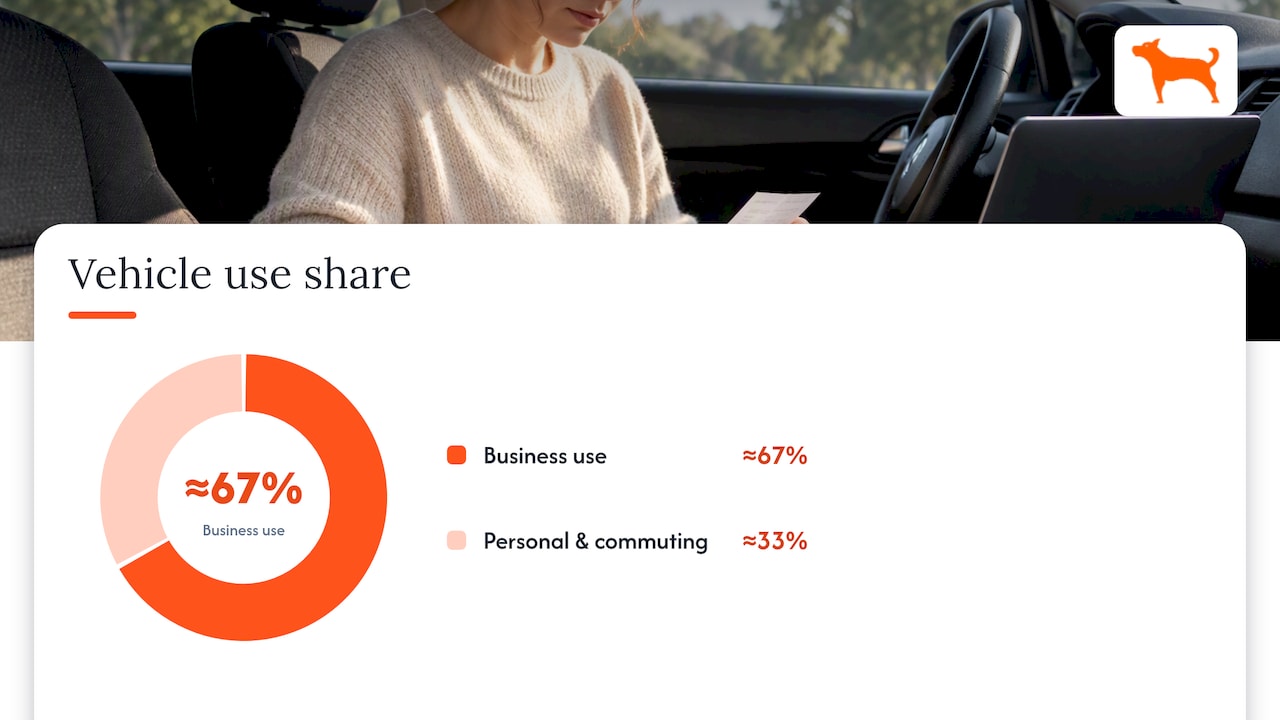
Now say your actual vehicle costs for the year totaled several thousand dollars across fuel, insurance, maintenance, and depreciation, and your mileage log shows the vehicle was used around two-thirds for business. Under the actual expense method, you would deduct the business percentage of your total vehicle expenses.
Before filing, run through this checklist:
- Reconcile your starting and ending odometer readings against your logged trip totals.
- Export your full-year mileage report as a CSV or PDF for your records.
- Total your business miles separately from personal and commuting miles.
- Attach parking and toll receipts to the corresponding trip entries.
- Save a backup copy of your trip reports before you file.
Where the Mileage Deduction Goes on Your Tax Return
Self-employed individuals report vehicle expenses on Schedule C, using either the standard mileage calculation or the actual expense totals from your records. If you are an employee claiming unreimbursed vehicle expenses under a specific arrangement, Form 2106 instructions outline when that form applies and what fields it requires, including how to handle a vehicle whose business use changed mid-year.
When you hand records to a tax preparer, provide:
- Your complete mileage log, exported and organized by month.
- Receipts for parking, tolls, and any actual vehicle expenses you are claiming.
- Proof of vehicle ownership or your lease agreement.
Retain these same documents for your own files in case the IRS requests substantiation later. It is worth consulting a tax professional directly if your situation involves multiple vehicles, a business that switched from part-time to full-time use during the year, or a vehicle with prior depreciation claims, since the interaction between depreciation and the standard mileage rate has specific limits that are easy to miscalculate.
Common Mistakes That Trigger IRS Scrutiny
Reconstructed logs, built weeks or months after the fact, are one of the fastest ways to lose credibility with an auditor. Vague purpose entries like “business errand” carry far less weight than specific ones like “delivered materials to job site, 123 Main Street.” Round numbers across every trip, such as consistently logging exactly 20 miles, also draw suspicion because real driving rarely lines up that neatly.
Auditors look for records that were created close to the time of travel and that include enough detail to verify independently. The fix is immediate: start a contemporaneous log today, export dated reports regularly, and attach receipts as they come in rather than searching for them later.
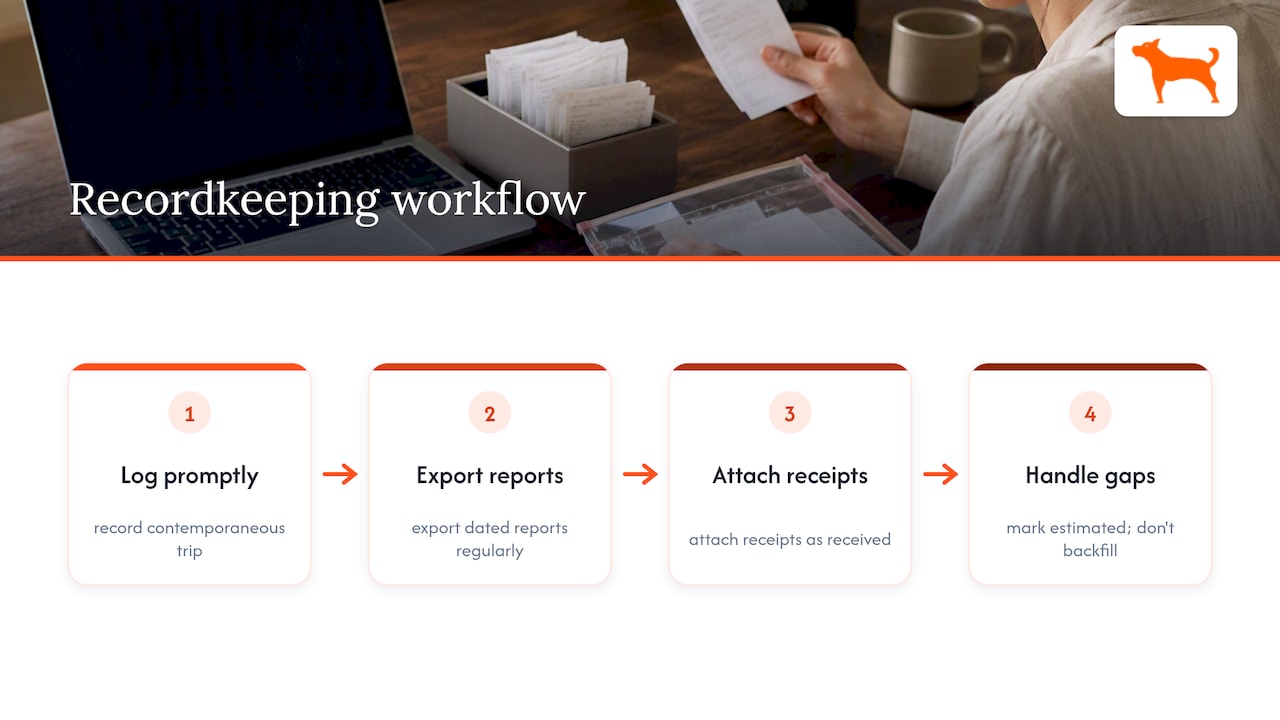
Pro Tip: If your current log has gaps, do not try to backfill exact mileage from memory: note the trip as estimated and begin precise tracking from today’s date forward.
Where GPS Devices Fit Into IRS-Ready Recordkeeping
A device built to support mileage substantiation should export records with date and time, start and end points, total miles, a labeled business purpose field, and a device identifier tying the trip to a specific vehicle. GPS trackers with subscription-free export capabilities, geofence tagging that flags when a vehicle enters a client site or job location, long battery life for devices left in a vehicle between trips, and exportable trip notes that pair with a CSV or PDF report for a bookkeeper are available.
What Most Mileage Advice Gets Wrong
Most guidance on this topic treats recordkeeping as a formality, something to tidy up before filing rather than a habit to build from day one. That framing is backwards. The taxpayers who run into trouble are rarely the ones who miscalculated the deduction; they are the ones who tried to reconstruct a year of driving from memory in March.
The standard mileage rate versus actual expense decision gets outsized attention online, but for most self-employed drivers the bigger risk sits earlier: whether the underlying log exists at all, and whether it was created close to the time of travel. A perfectly chosen method built on a reconstructed log still fails under scrutiny.
If you take one thing from this guide, prioritize the daily habit over the annual calculation. Tag trips as they happen, export monthly, and let the math sort itself out once the data is solid. The deduction only matters if the record behind it holds up.
— Louis
Try Moto Watchdog for Contemporaneous Mileage Records
A GPS tracker that logs every trip automatically removes the weakest link in most mileage claims: memory. Moto Watchdog devices record the date, time, start and end points, and total distance for each drive without a monthly subscription fee, which means the export you hand your preparer in December looks the same as the one you would have generated in January.

A practical way to test this before committing further: install one tracker on your primary business vehicle for 30 days, export the trip data, and compare it against whatever manual log or app you currently use.
- Check whether the exported fields match what your preparer asks for each year.
- Confirm geofence tags correctly flag client sites or job locations.
- Compare the device’s battery performance against how often you actually drive.
If the comparison holds up, browse Moto Watchdog’s trackers to find a device suited to your vehicle and business.
This article is general information, not a substitute for advice from a qualified financial advisor. Consult a qualified financial professional about your own circumstances before acting on anything here.
FAQ
What Is the Difference Between Personal and Business Mileage?
Business mileage covers driving for work purposes, such as client visits or travel between job sites, while personal mileage includes commuting and any driving unrelated to your business. Only business miles are deductible, and the IRS requires records showing date, destination, purpose, and distance to substantiate the split.
What Is the $2,500 Expense Rule?
This question refers to a de minimis safe harbor for expensing certain business property rather than a mileage rule, and it does not appear in IRS mileage guidance. Mileage deductions are governed separately through the standard mileage rate or actual expense method described in IRS Topic 510.
What Is the $75 Rule for IRS Expense Records?
There is no specific dollar threshold tied to mileage recordkeeping in current IRS mileage guidance. Regardless of expense size, the IRS expects contemporaneous records of date, mileage, destination, and business purpose for every trip you deduct, as outlined in IRS Topic 510.
Can a Business Owner Deduct Mileage Driving To and From Work?
Generally no: driving from home to a regular place of business is considered commuting and is not deductible. An exception applies when your home qualifies as your principal place of business, in which case trips from home to job sites or client locations can count as deductible business mileage.
Which Mileage Tracking Method Is Best for Self-Employed Filers?
The best method depends on your vehicle costs and how much you drive for business: the standard mileage rate simplifies recordkeeping, while the actual expense method often yields a larger deduction for costlier vehicles. Comparing both using your own mileage log for the same year, as described under IRS Topic 510, is the most reliable way to decide.