

How to start saving money
Lorem ipsum dolor sit amet, consectetur adipiscing elit lobortis arcu enim urna adipiscing praesent velit viverra sit semper lorem eu cursus vel hendrerit elementum morbi curabitur etiam nibh justo, lorem aliquet donec sed sit mi dignissim at ante massa mattis.
- Neque sodales ut etiam sit amet nisl purus non tellus orci ac auctor
- Adipiscing elit ut aliquam purus sit amet viverra suspendisse potent
- Mauris commodo quis imperdiet massa tincidunt nunc pulvinar
- Excepteur sint occaecat cupidatat non proident sunt in culpa qui officia
Why it is important to start saving
Vitae congue eu consequat ac felis placerat vestibulum lectus mauris ultrices cursus sit amet dictum sit amet justo donec enim diam porttitor lacus luctus accumsan tortor posuere praesent tristique magna sit amet purus gravida quis blandit turpis.

How much money should I save?
At risus viverra adipiscing at in tellus integer feugiat nisl pretium fusce id velit ut tortor sagittis orci a scelerisque purus semper eget at lectus urna duis convallis. porta nibh venenatis cras sed felis eget neque laoreet suspendisse interdum consectetur libero id faucibus nisl donec pretium vulputate sapien nec sagittis aliquam nunc lobortis mattis aliquam faucibus purus in.
- Neque sodales ut etiam sit amet nisl purus non tellus orci ac auctor
- Adipiscing elit ut aliquam purus sit amet viverra suspendisse potenti
- Mauris commodo quis imperdiet massa tincidunt nunc pulvinar
- Adipiscing elit ut aliquam purus sit amet viverra suspendisse potenti
What percentege of my income should go to savings?
Nisi quis eleifend quam adipiscing vitae aliquet bibendum enim facilisis gravida neque. Velit euismod in pellentesque massa placerat volutpat lacus laoreet non curabitur gravida odio aenean sed adipiscing diam donec adipiscing tristique risus. amet est placerat in egestas erat imperdiet sed euismod nisi.
“Nisi quis eleifend quam adipiscing vitae aliquet bibendum enim facilisis gravida neque velit euismod in pellentesque”
Do you have any comments? Share them with us on social media
Eget lorem dolor sed viverra ipsum nunc aliquet bibendum felis donec et odio pellentesque diam volutpat commodo sed egestas aliquam sem fringilla ut morbi tincidunt augue interdum velit euismod eu tincidunt tortor aliquam nulla facilisi aenean sed adipiscing diam donec adipiscing ut lectus arcu bibendum at varius vel pharetra nibh venenatis cras sed felis eget.
A no-subscription asset tracker is a GPS or low-power location device that reports location without a recurring monthly plan. You pay once for the device and any included data, then track indefinitely. The core difference from subscription models is financial structure: no monthly invoice, no contract, no cancellation risk.
This model suits owners who need periodic location checks rather than minute-by-minute telemetry. Think parked trailers, stored construction equipment, seasonal vehicles, or small business fleets where daily confirmation of asset location is enough. If you need live driver behavior data or 30-second update intervals, a subscription plan will serve you better.
Three quick trade-offs to weigh before going further:
- Upfront cost vs. features: You pay more at purchase, but the total 3-year cost is typically lower than a subscription plan for low-update-rate assets.
- Update frequency: Most no-subscription devices report every few minutes to every few hours depending on connectivity type (prepaid cellular, Bluetooth, LoRa, or satellite) and power mode.
- Coverage: Cellular-based units cover most of North America; Bluetooth tags require a nearby reader; LoRa and satellite fill remote gaps but at higher device cost.
Table of Contents
- What is a no-subscription asset tracker and how does it connect?
- What types of no-subscription trackers are there, and which use cases do they fit?
- What are the real costs and trade-offs compared to subscription trackers?
- Is it legal to use a no-subscription asset tracker in North America?
- How do you choose the right subscription-free tracker for your needs?
- How does Motowatchdog fit the subscription-free tracker category?
- Key Takeaways
- Why the conventional wisdom on subscription trackers gets it backwards
- Motowatchdog makes subscription-free tracking straightforward
- Useful sources and further reading
What is a no-subscription asset tracker and how does it connect?
No-subscription trackers rely on one of four connectivity models, and the choice determines everything from update speed to battery life.

Prepaid cellular with lifetime data is the most common approach for North American buyers. The device ships with a SIM and a data plan baked into the purchase price. Motowatchdog’s lifetime GPS tracker works this way: 4G coverage, location pushed to an app or web portal, no separate carrier bill. Update intervals typically range from 1 minute to 60 minutes depending on the power mode selected. When the device sleeps to conserve battery, it stores location points and uploads them in a batch when it wakes. That store-and-forward behavior is normal and expected.
Bluetooth tags (like Tile or Apple AirTag) work only within Bluetooth range of a compatible reader, usually 30–100 feet. They are best for luggage, small tools, or items that move through crowded areas where other devices can relay their signal. Geographic coverage is crowd-dependent and unreliable in rural areas.
LoRa/LPWAN devices transmit over long-range, low-power radio networks. Coverage in North America is growing but still patchy outside major metro areas. They excel at multi-year battery life because transmissions are tiny and infrequent. A pallet tracker on a rail yard or a water meter in a rural field is a natural fit.
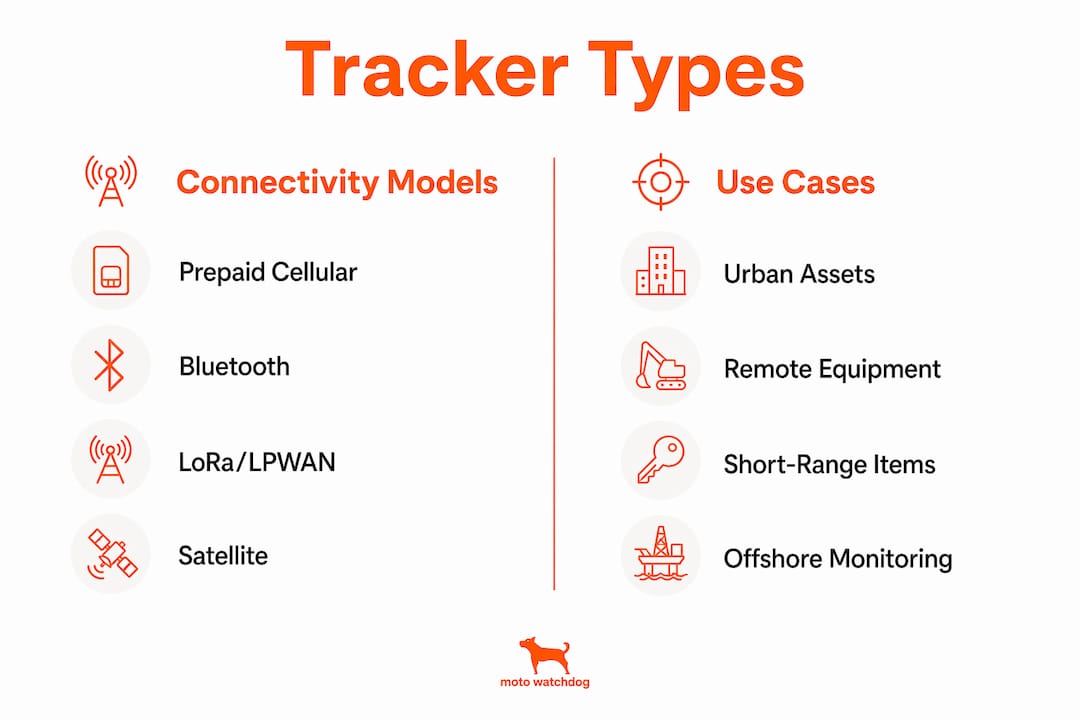
Satellite trackers work anywhere on Earth with a clear sky view. They are the right choice for remote equipment, offshore assets, or anything that leaves cellular coverage regularly. Device and activation costs are higher, but no subscription model exists for some satellite services.
Two quick scenarios illustrate how connectivity choice plays out in practice. A flatbed trailer parked at a job site for weeks at a time needs only a daily location ping. A prepaid cellular unit in sleep mode handles that easily on a single charge lasting months. A shipping container moving through multiple ports needs reliable coverage across carriers and borders. Satellite or a roaming prepaid SIM is the practical answer there.
What types of no-subscription trackers are there, and which use cases do they fit?
The device category is broader than most buyers realize. Matching the right hardware type to the asset profile prevents the most common mistakes.
- Magnetic asset tags (battery-powered cellular): Attach to metal surfaces with industrial magnets. Best for trailers, dumpsters, generators, and heavy equipment. Battery life ranges from 6 months to 3 years depending on reporting frequency. Replaceable AA or lithium cells keep maintenance simple. Motowatchdog’s small equipment GPS guide covers mounting and battery expectations in detail.
- Long-life standalone cellular units: Larger form factor, higher capacity battery, designed for assets that rarely move. Reporting intervals can be set to daily or weekly to maximize battery life. Common on construction equipment, agricultural machinery, and stored vehicles.
- Bluetooth tags: Compact, inexpensive, and best for items that stay near people or infrastructure. Poor fit for remote or stationary assets.
- Hardwired vehicle/OBD units with lifetime data: Draw power directly from the vehicle, so battery is never a concern. Hardwired GPS trackers are ideal for work trucks, vans, and any vehicle in regular use. OBD plug-in versions are faster to install but limited to the OBD port location and vehicle power cycles.
- LoRa/LPWAN devices: Multi-year battery life, very low data overhead. Best for assets in fixed corridors (rail, pipeline, utility) where LoRa gateways exist.
Where no-subscription models are a poor fit: high-frequency fleet telematics requiring driver behavior scoring, insurance telematics programs that demand 10-second updates, or any use case where a live dispatch team needs real-time vehicle positions during active routes.
What are the real costs and trade-offs compared to subscription trackers?
Lower ongoing cost is the headline advantage, but the full picture requires looking at total cost of ownership over a realistic horizon.

| Dimension | No-Subscription Tracker | Subscription Tracker |
|---|---|---|
| Battery life | 6 months to 3+ years (asset type dependent) | Often hardwired or recharged frequently |
| Update frequency | 1 min to daily (configurable) | 10 sec to 1 min (real-time capable) |
| Connectivity type | Prepaid cellular, Bluetooth, LoRa, satellite | Cellular (active monthly plan) |
| Weather/mounting durability | IP67 rated units available; magnetic or hardwired | Similar; varies by vendor |
| One-time cost + maintenance | — | $30 device + $10–$30/month per unit |
| Coverage and accuracy | Nationwide 4G where available; GPS accuracy 3–10 meters | Same GPS accuracy; carrier-dependent coverage |
A concrete illustration: an individual owner tracking one trailer pays roughly $100–$150 for a no-subscription cellular unit. Over three years, the only added cost is an occasional battery replacement. A comparable subscription device at $15/month runs $540 in fees alone over the same period, plus the device cost. For a small business tracking ten pieces of equipment, that gap multiplies significantly. Motowatchdog’s guide to eliminating fleet GPS fees walks through this math for fleet operators.
The trade-offs are real, though. No-subscription devices typically offer:
Advantages:
- No monthly fees, predictable budget over any time horizon
- Long battery life options for low-movement assets
- Simpler vendor relationship with no contract lock-in
Disadvantages:
- Less frequent updates limit usefulness for active route monitoring
- Recovery support (stolen asset response) is often self-managed
- Coverage gaps in areas where the prepaid carrier has no signal
- Smaller vendor support teams compared to large subscription platforms
The trade-off between basic location reporting and advanced telematics is the central decision variable most buyers face. If hourly or daily location is enough, the subscription-free model wins on cost almost every time.
Is it legal to use a no-subscription asset tracker in North America?
Placing a tracker on property you own is generally legal across the U.S. Placing one on someone else’s vehicle without informed consent is usually illegal and can result in criminal charges under state stalking or surveillance statutes.
The central legal factor is consent, and ownership is more complicated than it first appears. A short checklist before placing any tracker:
- Title/ownership: Is the asset in your name or your business’s name? Co-ownership complicates consent requirements.
- Lease terms: Leased vehicles may restrict tracker installation. Check the lease agreement.
- Employee notice: Employer-owned vehicles may be tracked, but employees should receive written notice. Several states require it explicitly.
- Third-party consent: Tracking a family member’s vehicle you own is generally permitted; tracking a partner’s vehicle you do not own is not.
- State-specific rules: California, Texas, and Illinois have stricter consent statutes than federal baseline. Federal and state GPS tracking laws interact, and state law often sets the higher bar.
For business fleets, best practice is a written acceptable-use policy, documented employee acknowledgment, and a data retention policy that keeps location records only as long as operationally necessary. Keep location data stored securely and limit access to personnel with a legitimate need.
This article is general information, not legal advice. Confirm current rules with a qualified attorney or your state’s primary legal authority for your specific situation.
How do you choose the right subscription-free tracker for your needs?
Start with update frequency, coverage area, mounting method, battery life, and warranty support. Those five criteria eliminate most mismatches before you spend a dollar.
Work through these questions before selecting a device:
- How often do I actually need a location update? Daily is enough for stored equipment; hourly works for most slow-moving assets.
- Where will the asset travel? Domestic cellular coverage, remote off-grid areas, or international routes each point to a different connectivity type.
- Is remote recovery support required? If a stolen asset response team matters, verify the vendor offers it without a subscription.
- How often can I realistically replace or recharge the battery? Monthly access is very different from quarterly or annual.
- What mounting surface does the asset have? Metal surfaces suit magnetic mounts; non-metal assets need adhesive or bracket options.
- Does the asset draw vehicle power? If yes, a hardwired or OBD unit removes battery concerns entirely. See the OBD GPS tracker guide for specifics.
- What is the warranty period and what does it cover? Look for at least a one-year hardware warranty and documented support channels.
- Is the vendor’s app or portal included in the device price? Some vendors charge separately for platform access even on “no-subscription” hardware.
- What is the device’s IP rating? Assets exposed to rain, mud, or pressure washing need IP67 or better.
- Does the vendor have documented coverage claims for my region? Ask for a coverage map, not just a general “nationwide” claim.
Pro Tip: Log your asset’s actual movement for one week before buying. Most owners discover their equipment moves far less frequently than they assumed, which means a lower update rate is perfectly adequate and a longer battery life becomes the priority.
Warranty and support expectations for no-subscription vendors vary widely. Larger vendors typically offer 12-month hardware warranties and email or chat support. Smaller vendors may offer longer warranties as a differentiator. Always confirm whether firmware updates are included and whether the app will continue to function if the vendor changes its data platform.
How does Motowatchdog fit the subscription-free tracker category?
Motowatchdog provides subscription-free 4G GPS tracking with lifetime data included in the device purchase. No monthly plan, no carrier bill, no contract. That single fact resolves the most common objection buyers have when evaluating the category.
The features that map directly to the buyer checklist above:
- Connectivity: 4G cellular with lifetime data included at purchase
- Geofencing: Customizable geofencing alerts notify you when an asset enters or leaves a defined zone
- Battery life: Long battery-life options designed for assets that move infrequently
- Mounting: Magnetic mounting options for metal surfaces; construction equipment and work truck configurations available
- Coverage: Nationwide 4G coverage across North America
- Use cases: Documented product pages for construction equipment, work trucks, and general asset tracking
More than 1,000 businesses rely on Motowatchdog for fleet and asset monitoring. Customer feedback on the platform consistently highlights ease of setup and confidence in location accuracy, which matters most for small business owners who cannot afford a dedicated telematics administrator. The 2026 guide to switching from subscription GPS walks through the transition process for businesses moving off a legacy subscription platform.
For businesses evaluating a multi-device deployment, the fleet hardwiring guide covers installation planning and power options across a mixed fleet.
Key Takeaways
No-subscription asset trackers deliver predictable long-term cost by replacing recurring monthly fees with a single device purchase that includes lifetime data, making them the practical choice for any asset where hourly or daily location updates are sufficient.
| Point | Details |
|---|---|
| Core definition | A no-subscription tracker reports location with no monthly fee; data is included in the one-time device price. |
| Best-fit scenario | Low-movement assets like trailers, stored equipment, and parked vehicles where daily or hourly updates are enough. |
| Key trade-off | Lower 3-year cost than subscription plans, but fewer real-time features and self-managed recovery support. |
| Legal requirement | Only track assets you own or have documented consent to monitor; state laws in California, Texas, and Illinois set stricter consent rules. |
| Motowatchdog option | Motowatchdog offers subscription-free 4G GPS tracking with lifetime data, geofencing, and long battery-life options trusted by 1,000+ businesses. |
Why the conventional wisdom on subscription trackers gets it backwards
Most fleet technology guides treat subscription GPS as the default and frame no-subscription devices as the budget compromise. That framing is backwards for a significant share of real-world use cases.
The assumption embedded in subscription-first advice is that you need continuous telemetry. For a delivery van running eight routes a day, that is true. For a trailer that moves twice a month, a generator that sits at a job site for six weeks, or a piece of excavation equipment that rarely leaves the yard, continuous telemetry is waste. You are paying for data you will never look at.
The smarter question is not “subscription or no-subscription?” but “what update frequency does this specific asset actually require?” Answer that honestly and the cost math usually resolves itself. Assets that move infrequently almost always belong on a no-subscription device. Assets in active daily use often justify a subscription plan’s richer feature set.
The other underestimated factor is organizational complexity. Every subscription line is a vendor relationship, a billing cycle, and a cancellation risk. A business tracking 20 pieces of equipment on subscription plans is managing 20 monthly invoices and 20 potential service interruptions. Consolidating low-movement assets onto lifetime-data devices reduces that overhead meaningfully, even if the per-device upfront cost is higher.
Motowatchdog makes subscription-free tracking straightforward
Paying monthly for GPS coverage on assets that barely move is a cost most businesses accept without questioning it. Motowatchdog is built specifically for the owner who wants reliable 4G location data, geofencing alerts, and long battery life without a recurring bill attached to every device.
Over 1,000 businesses have moved their asset tracking to Motowatchdog’s subscription-free platform and kept it there because the math is simple: one purchase, lifetime data, no surprises on the monthly statement. Whether you are tracking a single trailer or a fleet of construction equipment, the setup is straightforward and the coverage is nationwide. Visit Motowatchdog to view device options and find the right fit for your assets.
Useful sources and further reading
These sources back the claims in this article and offer deeper detail on legal, technical, and cost questions:
- No Subscription GPS Tracker — Motowatchdog: Product page detailing Motowatchdog’s lifetime-data offering, features, and device specifications. Start here for technical specs.
- Is It Legal to Put a Tracker on a Car? (LegalOverview): Concise U.S. legal summary covering ownership, consent, and state-level variation. Consult this before placing any tracker on a shared or leased vehicle.
- GPS Tracking Laws by State — FreightWaves Checkpoint: State-by-state breakdown of GPS tracking statutes and federal law interaction. Useful for fleet managers operating across multiple states.
- Are GPS Trackers Legal? Guide for US — Trak-4: Covers consent scenarios including co-ownership, leased vehicles, and employer/employee contexts. Practical for HR and fleet policy writers.
- GPS Tracker Without Subscription: Best Options & Real Costs — PAJ GPS: Industry analysis of the subscription vs. no-subscription trade-off, including feature limitations and long-term cost comparisons.
- Eliminate Fleet GPS Monthly Fees — Motowatchdog Blog: Practical guide for small business fleet managers calculating the cost of switching from subscription to lifetime-data devices.
- What Is a Lifetime GPS Tracker (No Fee) — Motowatchdog Blog: Technical explainer on how lifetime-data devices work, device lifecycle expectations, and buyer considerations.

