
How to start saving money
Lorem ipsum dolor sit amet, consectetur adipiscing elit lobortis arcu enim urna adipiscing praesent velit viverra sit semper lorem eu cursus vel hendrerit elementum morbi curabitur etiam nibh justo, lorem aliquet donec sed sit mi dignissim at ante massa mattis.
- Neque sodales ut etiam sit amet nisl purus non tellus orci ac auctor
- Adipiscing elit ut aliquam purus sit amet viverra suspendisse potent
- Mauris commodo quis imperdiet massa tincidunt nunc pulvinar
- Excepteur sint occaecat cupidatat non proident sunt in culpa qui officia
Why it is important to start saving
Vitae congue eu consequat ac felis placerat vestibulum lectus mauris ultrices cursus sit amet dictum sit amet justo donec enim diam porttitor lacus luctus accumsan tortor posuere praesent tristique magna sit amet purus gravida quis blandit turpis.

How much money should I save?
At risus viverra adipiscing at in tellus integer feugiat nisl pretium fusce id velit ut tortor sagittis orci a scelerisque purus semper eget at lectus urna duis convallis. porta nibh venenatis cras sed felis eget neque laoreet suspendisse interdum consectetur libero id faucibus nisl donec pretium vulputate sapien nec sagittis aliquam nunc lobortis mattis aliquam faucibus purus in.
- Neque sodales ut etiam sit amet nisl purus non tellus orci ac auctor
- Adipiscing elit ut aliquam purus sit amet viverra suspendisse potenti
- Mauris commodo quis imperdiet massa tincidunt nunc pulvinar
- Adipiscing elit ut aliquam purus sit amet viverra suspendisse potenti
What percentege of my income should go to savings?
Nisi quis eleifend quam adipiscing vitae aliquet bibendum enim facilisis gravida neque. Velit euismod in pellentesque massa placerat volutpat lacus laoreet non curabitur gravida odio aenean sed adipiscing diam donec adipiscing tristique risus. amet est placerat in egestas erat imperdiet sed euismod nisi.
“Nisi quis eleifend quam adipiscing vitae aliquet bibendum enim facilisis gravida neque velit euismod in pellentesque”
Do you have any comments? Share them with us on social media
Eget lorem dolor sed viverra ipsum nunc aliquet bibendum felis donec et odio pellentesque diam volutpat commodo sed egestas aliquam sem fringilla ut morbi tincidunt augue interdum velit euismod eu tincidunt tortor aliquam nulla facilisi aenean sed adipiscing diam donec adipiscing ut lectus arcu bibendum at varius vel pharetra nibh venenatis cras sed felis eget.
Trip classification rules are the written standards that decide whether each vehicle trip counts as business, commute, personal or an exception that needs review. For a U.S. fleet, the rules should match what the IRS expects on every business trip: date, miles, destination and business purpose, recorded at or near the time of travel. Below you get the categories, the record details, the commuting line, the special case of heavy equipment rental, and a review routine you can adopt.
TL;DR
- Use four top-level categories: Business, Commute, Personal and Mixed/Exception. Split Business into operational purposes such as delivery, pickup, service and inspection.
- Every business trip record needs the date, miles, destination and business purpose, made at or near the time of the trip.
- Travel from home to a regular workplace is commuting. Travel between job sites, yards and customers is generally business.
- Fix misclassified trips at closeout or inside a written deadline, then run a regular manager exception review.
- A GPS tracker with trip and mileage reporting captures the raw facts automatically, so your rules are applied to data rather than memory.
Table of Contents
- Why trip classification rules matter
- The four categories to start with
- What every business trip record must contain
- Commuting versus business travel
- Rules for vehicles with no personal use
- Classifying heavy equipment rental trips
- Putting a number on business miles
- Setting your review cadence
- Perspective: why we build trackers that classify without a subscription
- How a GPS tracker supports each rule
- Sample policy language to adapt
- Track every truck and trailer with Motowatchdog
- FAQ
- Sources
Why trip classification rules matter
When a vehicle is used for both business and personal purposes, only the business-use portion is deductible, according to IRS Publication 463. That single sentence is the reason classification exists. If you cannot show which miles were business, you cannot defend them.
For 2026, the IRS set the business standard mileage rate at 72.5 cents per mile for all miles of business use. On a fleet of 20 trucks, a few thousand unclassified miles per vehicle turns into real money, either in deductions you cannot support or in reimbursements you cannot explain.
Clear rules also help operations. When dispatchers, drivers and the office use the same labels, reports about cost per job, idle time and utilization mean the same thing to everyone.
The four categories to start with
Keep the top level short so drivers and dispatchers apply it the same way every time:
- Business: travel that serves the company’s operations.
- Commute: travel between an employee’s home and a regular place of work.
- Personal: travel for non-business reasons.
- Mixed/Exception: anything that does not fit cleanly and needs a manager’s decision.
This structure follows the substantiation facts in Publication 463, which keeps the date, mileage, destination and purpose at the center of every record.
Subcategories inside Business
Business is where the detail belongs. For a contractor or rental fleet, a workable list looks like this:
- Delivery
- Pickup or return
- Service call
- Inspection
- Maintenance or shop run
- Customer or supplier visit
- Interoffice or yard-to-yard travel
- Training
- Approved errands (parts, fuel, supplies)
Resist adding more than a dozen. Every extra label gives a driver another chance to choose the wrong one, and reports get harder to read.
What every business trip record must contain
For each business use, keep the date, the miles, the destination or place, and the business purpose. Make the record at or near the time of travel. Publication 463 treats contemporaneous records as stronger evidence than statements prepared later.
In practice, a good record set has four layers:
| Layer | What it holds | Why it matters |
|---|---|---|
| Trip facts | Date, start and end location, miles | Proves the trip happened |
| Purpose | Category plus a short reason or job reference | Supports the business-use claim |
| Vehicle totals | Beginning and end-of-year odometer readings | Lets you reconcile business, commuting and personal miles |
| Review trail | Who corrected what and when | Shows the process is controlled |
The IRS guidance centers on the substantiated trip facts. Recording an odometer reading per trip goes beyond that, but it is a strong internal control, and it is easy when a device logs it for you.
Tolls and parking are separate. The IRS notes that parking fees and tolls tied to business use may generally be deducted separately under either the standard mileage or actual expense method, so capture them against the trip.
Single-record shortcuts
Not every stop needs its own entry. Under Regulation 1.274-5T©(1), uses that form a single use, such as a round trip or uninterrupted business use, may be accounted for by one record. A stop for lunch between two business stops is a de minimis personal use and does not interrupt the business use.
The same regulation gives a shortcut for established delivery routes. A taxpayer whose only business use is making deliveries to customers on an established route may record total miles for the year, the length of the route once, and the date of each trip at or near the time. If your fleet runs fixed routes, build that into the rules.
Commuting versus business travel
This is the line fleets get wrong most often. Travel between home and a regular workplace is commuting, even over a long distance. The RSM tax team explains that, under IRS and court holdings, an employee’s tax home is the regular place of work, not the personal residence.
A regular workplace is where an employee works or performs services consistently. Under Rev. Rul. 99-7, as summarized in a mobile workforce guide from a CPA firm, a location is treated as regular when the employee works there longer than one year. Mileage to that site is commuting, and reimbursing it is taxable compensation.
Turn that into three questions your rules can ask for each trip:
- Does the trip start or end at the employee’s home?
- Is the other end a regular workplace, or a temporary site?
- Did the employee stop at a business location first?
A driver who leaves home and goes straight to a yard where they work every day is commuting. A driver who leaves the yard for a customer site, then returns, is on business travel. A job site that lasts more than a year changes the answer, so the rules should tell dispatchers to flag long-running projects.
Rules for vehicles with no personal use
The simplest fleet to classify is one where personal use is prohibited. Under Regulation 1.274-5T©(1), a written policy that prohibits personal use except de minimis use can satisfy an employer’s substantiation requirements when these conditions hold:
- The vehicle is owned or leased by the employer and used for business.
- It is kept on the employer’s premises when not in use.
- No employee using it lives at the premises.
- The employer reasonably believes no other personal use occurs.
- The conditions can be verified.
The last point is where location data earns its place. A policy you cannot verify is a policy you cannot rely on. Time-stamped location history, geofence alerts when a vehicle leaves an approved area, and after-hours movement notices give you a way to confirm that the vehicle stayed where the policy says it did.
Policy for vehicles that might have personal use
Some roles need take-home vehicles. For those, the rules should state in writing:
- Who is authorized for personal use, and under what conditions.
- How commuting is classified and whether it is reimbursed or reported as compensation.
- Whether family members or third parties may drive.
- Any geographic boundaries.
- How drivers tag a trip as personal, and by when.
The goal is a split you can reconcile at year end: business miles, commuting miles and other personal miles that add up to the odometer total.
Classifying heavy equipment rental trips
Equipment rental fleets generate trip types that office-based fleets never see. The categories in this section should be built into your Business subcategories so that dispatch can apply them without debate.
| Trip type | Suggested category | Record the reference |
|---|---|---|
| Delivering a machine on a lowboy or flatbed | Business: Delivery | Rental contract or order number |
| Picking up a returned machine | Business: Pickup | Return ticket |
| Driving a service truck to a breakdown | Business: Service | Work order |
| Moving equipment between yards | Business: Interoffice or yard transfer | Transfer ticket |
| Driving to the shop for repairs | Business: Maintenance | Shop work order |
| Employee driving home from the yard | Commute | None |
| Fuel or parts run | Business: Approved errand | Receipt |
Tie trips to contracts and work orders
A purpose line like “delivery” is accurate but thin. Adding the rental contract or work order number gives an auditor, an insurer or a customer disputing a delivery charge a direct link from the trip to the paperwork. Make the reference part of the closeout step rather than something the office reconstructs later.
Vehicles where no personal use applies
The mobile workforce guide cited above notes that construction equipment such as cranes, derricks and forklifts, along with delivery trucks, flatbed trucks and cargo trucks over 14,000 pounds, are qualified nonpersonal-use vehicles. None of an employee’s use of them is considered personal. The same guide advises that heavy-duty trucks equipped with cranes, welding rigs or diagnostic tools should not be used for personal errands.
For your rules, that means those vehicles can carry a default Business classification, with exceptions flagged only when movement falls outside approved hours or areas.
Personal conveyance and commercial vehicles
If drivers operate vehicles under federal hours-of-service rules, personal conveyance needs its own line in the policy. The FMCSA defines it as moving a commercial motor vehicle for personal use while off duty. A fleet payments guide explains that the use must not benefit the business financially. If there is a financial benefit, it cannot be classified as personal, and hours-of-service and ELD rules apply.
Put that test into your exception category: any trip tagged as personal conveyance that ends at a customer, a yard or a job site goes to a manager for review.
Putting a number on business miles
There are two common ways to value business use. The standard mileage rate is 72.5 cents per mile for 2026, as set in Notice 2026-10. The alternative is actual expenses. IRS Topic 510 says actual vehicle expenses must be divided between business and personal use, and lists gas, oil, repairs, tires, insurance, registration, licenses, depreciation and lease payments as potentially allocable costs.
A worked example shows why the split matters. Suppose a service truck logs 18,000 miles in a year, 16,200 of them business. Business use is 90 percent. Under the actual expense method, 90 percent of eligible costs is allocable to business. Under the standard rate, the 16,200 business miles are what you multiply. Either way, the quality of the classification drives the result.

Rate and method choices depend on the vehicle and the business, so confirm them with your CPA before adopting them in policy. Publication 463 and Topic 510 are the controlling IRS references.
Setting your review cadence
The IRS does not set one universal review interval. Publication 463 requires timely, adequate records but leaves the schedule to you. That means your policy should define it in writing. A cadence that works for most fleets:
- At closeout: the driver or dispatcher confirms the category and job reference at the end of the trip or shift.
- Weekly: a manager reviews every trip in the Mixed/Exception category and anything unclassified.
- Monthly: reconcile trip mileage against work orders and fuel records.
- Year end: reconcile logged miles with beginning and end-of-year odometer readings.
Prompt entry beats year-end reconstruction. Records made close to the time of travel carry more weight than statements prepared later, so the policy should name a submission deadline and an escalation step for trips that miss it.
Perspective: why we build trackers that classify without a subscription
Most trip classification problems are data problems. Drivers forget stops, odometer notes get lost, and the office rebuilds the year from memory in March. We built our trackers so the facts are captured automatically: location, trip start and end, mileage and idle time.
We also think a fleet should not pay a monthly fee for the right to see its own records. Our trackers come with lifetime 4G data included, with no monthly or recurring fees, no activation fees and no add-on charges for features. Unlimited vehicles and users share one dashboard, so a rental yard can add a truck, a trailer or a skid steer to the same view without renegotiating a plan.
Good rules plus good data is the combination that works. Write the policy, set geofences around your yards and job sites, and let trip reporting do the logging so your people can focus on the work.
Louis
How a GPS tracker supports each rule
A tracker does not replace a written policy. It supplies the facts that the policy asks for. Here is how Motowatchdog features map to the rules above:
- Trip and mileage reporting: supplies the date, start and end points and distance for each trip, the core of a business-use record.
- Geofencing and alerts: mark yards, customer sites and job sites, and push notifications flag movement outside approved areas or hours.
- Idle time tracking: shows time on site versus time running, which helps with job costing on equipment hauls.
- Maintenance reminders: link service trips to scheduled work.
- Multi-device management: lets one manager see trucks, trailers and equipment on one dashboard.
- Sharing features: let an owner, dispatcher or customer see a delivery in progress.
You still apply the category and the business purpose. The device gives you the timestamped trip to attach them to.
Sample policy language to adapt
Use this as a starting point and have your CPA or counsel review it before adoption.
- Scope: This policy applies to all company-owned or leased vehicles, trailers and equipment fitted with a GPS tracker.
- Categories: Every trip is classified as Business, Commute, Personal or Mixed/Exception. Business trips carry a subcategory and a job, contract or work order reference.
- Personal use: Personal use is prohibited except de minimis use, such as a short stop between business stops, unless a manager approves it in writing.
- Commuting: Travel between home and a regular workplace is classified as Commute.
- Timing: Trips are classified at closeout and no later than the end of the next business day.
- Review: Managers review exceptions weekly and reconcile mileage to work orders monthly.
- Verification: Location data may be used to verify compliance with this policy.
Track every truck and trailer with Motowatchdog
If your rules depend on knowing where each vehicle went and when, start with the device that records it. Motowatchdog trackers cover vehicles, fleets, trailers, equipment and personal assets, with real-time location, geofencing, trip and mileage reports and a mobile app. They are a one-time purchase, starting from $124.99, with no monthly fees.
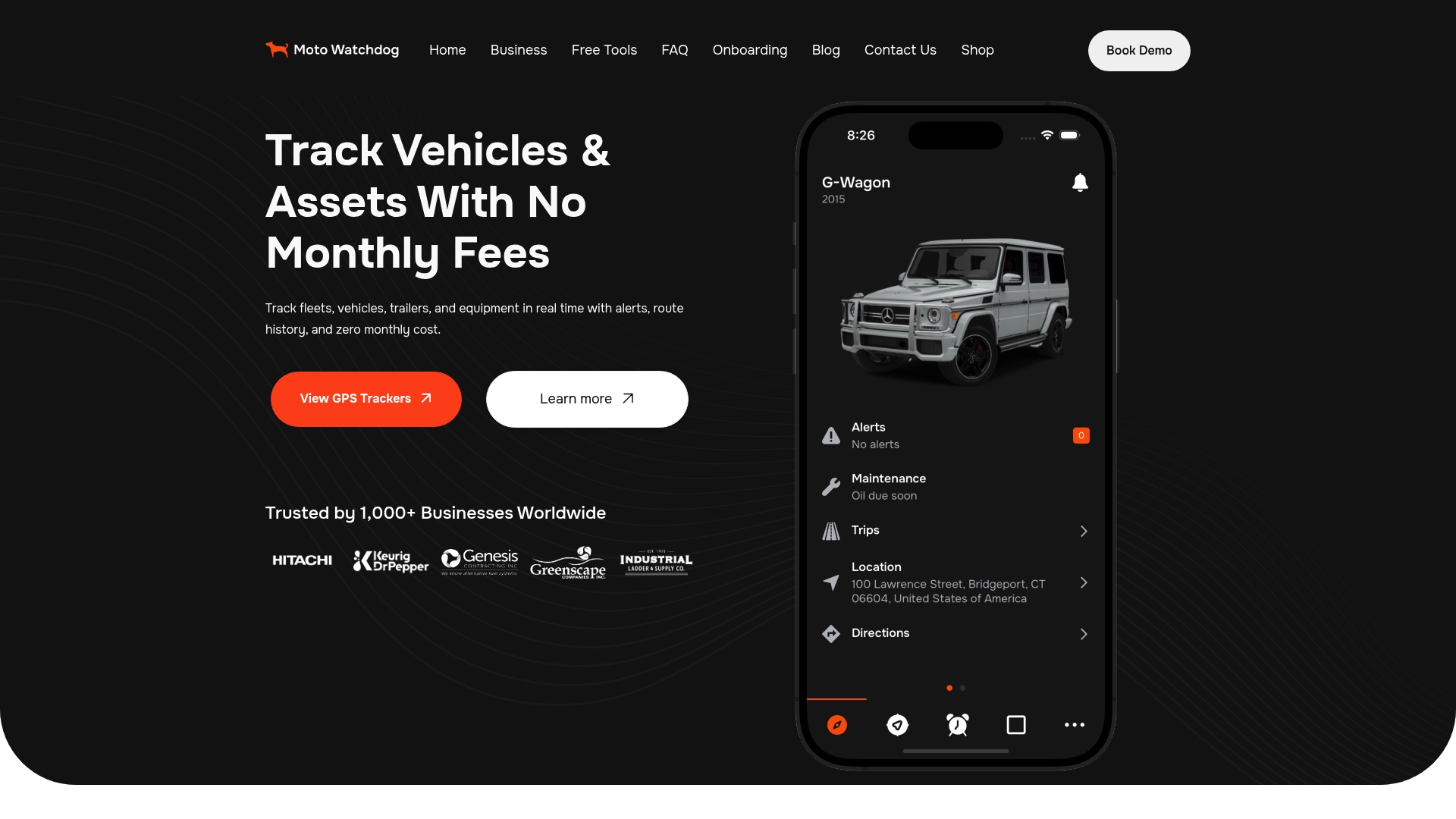
Fleet managers and heavy equipment rental companies can compare the GPS trackers for fleets and equipment and pick the right device for each asset type.
FAQ
How many trip categories should a fleet use?
Start with four: Business, Commute, Personal and Mixed/Exception. Then break Business into the operational purposes your teams actually perform, such as delivery, pickup, service and inspection. Keeping the list under about a dozen labels makes consistent use much easier.
Is driving from home to a job site a business trip?
It depends on whether the site is a regular workplace. Travel between home and a regular workplace is commuting, even over a long distance. A temporary site, generally one where the employee will not work for more than a year, is treated differently, so confirm the facts with your tax advisor.
What details must a mileage record include?
For each business use, record the date, the miles, the destination or place and the business purpose, made at or near the time of travel. Publication 463 also supports keeping beginning and end-of-year odometer readings to reconcile business, commuting and personal miles.
How often should we review trip classifications?
The IRS sets no single interval, so define one in your policy. A practical routine is classification at closeout, a weekly exception review and monthly reconciliation against work orders. Correct errors promptly rather than reconstructing them at year end.
Can we ban personal use to simplify classification?
Yes, and many fleets do. A written policy prohibiting personal use except de minimis use can satisfy substantiation requirements when the conditions in Regulation 1.274-5T©(1) are met, including that the conditions can be verified. Location history helps you do that.
Sources
- IRS Publication 463 (2025), Travel, Gift, and Car Expenses
- IRS Topic no. 510, Business use of car
- IRS Notice 2026-10, 2026 Standard Mileage Rates
- Reg. Section 1.274-5T©(1), Bradford Tax Institute
- Mobile Workforce Guidelines, CICPAC version (2025)
- RSM: Tax issues arise when employers pay employee business travel expenses
- Coast: Personal Conveyance, A Complete Guide for Fleet Managers