
How to start saving money
Lorem ipsum dolor sit amet, consectetur adipiscing elit lobortis arcu enim urna adipiscing praesent velit viverra sit semper lorem eu cursus vel hendrerit elementum morbi curabitur etiam nibh justo, lorem aliquet donec sed sit mi dignissim at ante massa mattis.
- Neque sodales ut etiam sit amet nisl purus non tellus orci ac auctor
- Adipiscing elit ut aliquam purus sit amet viverra suspendisse potent
- Mauris commodo quis imperdiet massa tincidunt nunc pulvinar
- Excepteur sint occaecat cupidatat non proident sunt in culpa qui officia
Why it is important to start saving
Vitae congue eu consequat ac felis placerat vestibulum lectus mauris ultrices cursus sit amet dictum sit amet justo donec enim diam porttitor lacus luctus accumsan tortor posuere praesent tristique magna sit amet purus gravida quis blandit turpis.

How much money should I save?
At risus viverra adipiscing at in tellus integer feugiat nisl pretium fusce id velit ut tortor sagittis orci a scelerisque purus semper eget at lectus urna duis convallis. porta nibh venenatis cras sed felis eget neque laoreet suspendisse interdum consectetur libero id faucibus nisl donec pretium vulputate sapien nec sagittis aliquam nunc lobortis mattis aliquam faucibus purus in.
- Neque sodales ut etiam sit amet nisl purus non tellus orci ac auctor
- Adipiscing elit ut aliquam purus sit amet viverra suspendisse potenti
- Mauris commodo quis imperdiet massa tincidunt nunc pulvinar
- Adipiscing elit ut aliquam purus sit amet viverra suspendisse potenti
What percentege of my income should go to savings?
Nisi quis eleifend quam adipiscing vitae aliquet bibendum enim facilisis gravida neque. Velit euismod in pellentesque massa placerat volutpat lacus laoreet non curabitur gravida odio aenean sed adipiscing diam donec adipiscing tristique risus. amet est placerat in egestas erat imperdiet sed euismod nisi.
“Nisi quis eleifend quam adipiscing vitae aliquet bibendum enim facilisis gravida neque velit euismod in pellentesque”
Do you have any comments? Share them with us on social media
Eget lorem dolor sed viverra ipsum nunc aliquet bibendum felis donec et odio pellentesque diam volutpat commodo sed egestas aliquam sem fringilla ut morbi tincidunt augue interdum velit euismod eu tincidunt tortor aliquam nulla facilisi aenean sed adipiscing diam donec adipiscing ut lectus arcu bibendum at varius vel pharetra nibh venenatis cras sed felis eget.
Yes, subscription-free GPS trackers are a practical choice for excavators when you need one-time cost certainty and real-time location data. Motowatchdog delivers exactly that: a one-time hardware purchase with no recurring monthly fees, real-time monitoring, geofencing alerts, engine runtime tracking, and a mobile app built for fleet managers. The key caveats are worth knowing upfront:
- Best fit: Low-movement assets, short-term rentals, or fleets where capital expense budgets are tighter than operating budgets
- Acceptable trade-off: Prepaid embedded SIMs shift connectivity costs into the hardware price rather than eliminating them; prepaid SIMs typically cover one to three years of connectivity built into the device price
- When to reconsider: High-theft-risk fleets or operations requiring deep OEM engine diagnostics may benefit from full subscription telematics
- Connectivity standard to require: LTE Cat-M1 and NB-IoT reduce power consumption and are the preferred radio technologies for asset trackers across North America
Pro Tip: Before purchasing, confirm the device lists specific LTE band support for your region. A tracker that works in Dallas may have dead zones on a remote Montana site.
Table of Contents
- Why construction managers choose no-subscription GPS for excavators
- Must-have features for no-subscription excavator GPS devices
- How does connectivity work for no-fee trackers in North America?
- What does three-year ownership actually cost?
- How to install a GPS tracker on an excavator
- What data should you expect and require?
- How construction teams use these features day to day
- North America legal and privacy checklist for employee-operated excavators
- Vendor evaluation checklist: questions that reveal real quality
- Why Motowatchdog works for excavator fleets
- Key Takeaways
- The case for getting the pilot right before scaling
- Get Motowatchdog for your excavator fleet
Why construction managers choose no-subscription GPS for excavators
The procurement logic is straightforward. Monthly subscription fees for telematics platforms can add up quickly across a fleet, and many construction managers prefer to treat GPS hardware as a capital expense rather than an ongoing operating cost. For rental companies running short-term deployments, a one-time purchase avoids the awkward math of paying monthly fees on equipment that sits idle between contracts.
That said, the most common misconception is that “no subscription” means zero data cost. It does not. Prepaid embedded-SIM devices simply move the carrier cost into the upfront hardware price and a fixed coverage window. When that window expires, you either renew data or replace the device. Plan for that cycle from day one.
Pro Tip: Ask vendors to specify the prepaid data window in months, not vague terms like “lifetime.” A two-year embedded SIM on a five-year excavator means you will face a renewal decision mid-asset-life.
Operational trade-offs also matter. Passive trackers store location history locally and lack reliable theft alerts; active cellular trackers deliver immediate movement alerts and are far better for recovery. For excavators, active LTE tracking is the minimum acceptable standard.
Must-have features for no-subscription excavator GPS devices
Not every GPS tracker marketed for heavy equipment actually meets excavator-class requirements. Here is the prioritized checklist:
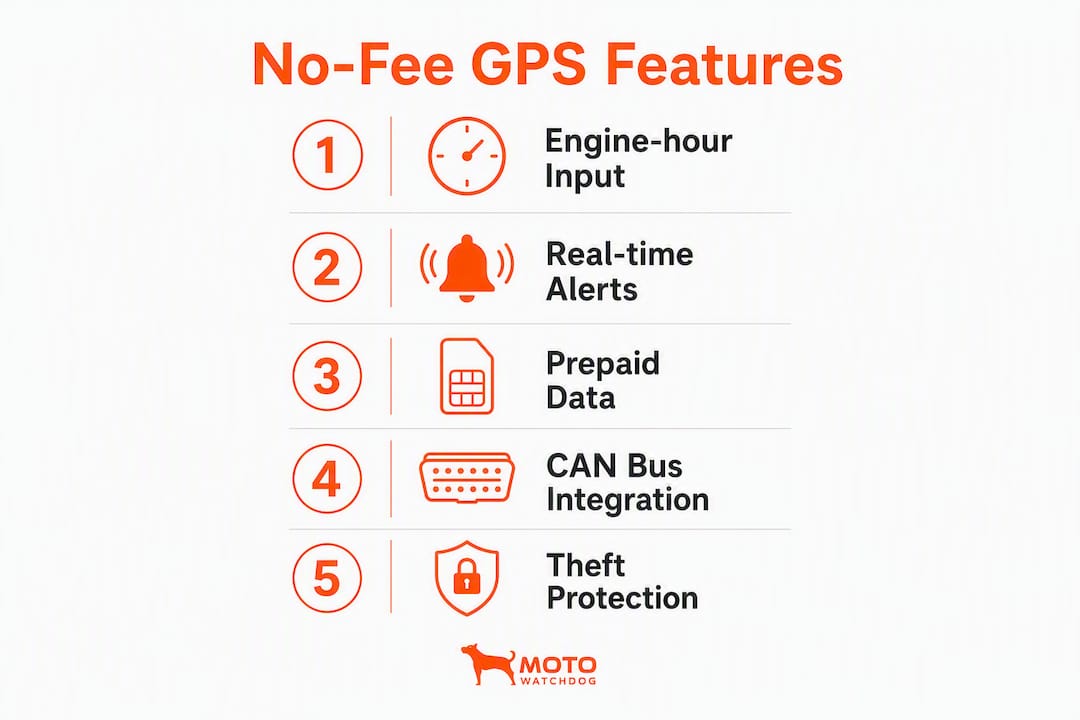
- Real-time location updates and geofencing — configurable alerts when a machine leaves a job-site boundary
- Engine-hour capture — via CAN bus or dedicated engine-hour input; engine hours are the primary PM scheduling metric for excavators, not mileage
- Hardwired 12/24V power input with tamper-resistant battery backup
- IP67 or higher rating with vibration tolerance for excavator-class shock loads
- Exportable data — CSV download or REST API for job-costing and CMMS integration
- Multi-user access — role-based dashboard access for managers, supervisors, and billing staff
| Feature | Why it matters for excavators |
|---|---|
| Engine-hour input (CAN bus) | Triggers PM intervals at 250/500/1,000/2,000 hours accurately |
| Geofencing alerts | Confirms machine stays on the billed job site |
| IP67+ ruggedization | Survives hydraulic spray, mud, and vibration |
| CSV/API export | Feeds CMMS and invoice verification workflows |
| 12/24V hardwired power | Eliminates battery swap downtime on powered equipment |
Industry experts confirm that no-subscription devices lacking real-time updates and engine diagnostics function as consumer-grade tools, not heavy-equipment telematics.
How does connectivity work for no-fee trackers in North America?
LTE Cat-M1 and NB-IoT are the right radio technologies for asset GPS trackers. Both protocols reduce power consumption compared with full LTE and maintain wide coverage across North American carrier networks. Satellite connectivity is an option for very remote sites but adds cost and latency that most job sites do not need.
Pro Tip: Run a SIM card coverage check on your three most remote job sites before committing to a device. Most major carriers publish interactive coverage maps for LTE Cat-M1 specifically.
Bluetooth and UWB tags (AirTag-style devices) are not substitutes. They rely on crowdsourced phone networks and have ranges of tens to a few hundred feet — useful for tool cribs, not outdoor excavator recovery.
| Technology | Range | Battery impact | Best use case |
|---|---|---|---|
| LTE Cat-M1 | Nationwide | Low | Primary choice for excavators |
| NB-IoT | Nationwide | Very low | Low-update-frequency assets |
| Satellite | Global | High | Extremely remote sites only |
| Bluetooth/UWB | Tens to hundreds of feet | Very low | Indoor tool tracking only |
Confirm the vendor lists specific LTE band numbers (e.g., Band 12, Band 13) compatible with AT&T, T-Mobile, and Verizon’s IoT networks before purchasing.
What does three-year ownership actually cost?
Three-year total cost of ownership is where subscription-free devices often win on paper, but the math requires honesty about hidden costs. Three-year TCO comparisons show that prepaid and subscription models can diverge by thousands of dollars for a small group of assets.
| Cost element | Prepaid/no-subscription | Subscription model |
|---|---|---|
| Hardware (per device) | Higher upfront | Lower upfront |
| Data renewal (Year 2–3) | Possible renewal cost | Included |
| Installation labor | One-time | One-time |
| Feature depth | Location + basic alerts | Full engine diagnostics |
- Year 1: Hardware purchase covers device and prepaid connectivity; installation labor is the main added cost.
- Year 2: No fees if the prepaid window covers 24 months; confirm this in writing before purchase.
- Year 3: Budget for data renewal or device replacement if the prepaid window expires.
Statistic callout: Fleets that shift from manual tracking to digital management report lower failure rates and better utilization — the financial case for any tracking investment, subscription or not.
For a five-excavator pilot, a no-subscription approach at $200–$300 per device avoids $75–$200 per month in subscription fees across the fleet. At 24 months, that is a meaningful capital preservation. Read more about lifetime GPS tracker claims before committing to any “no-fee forever” promise.
How to install a GPS tracker on an excavator
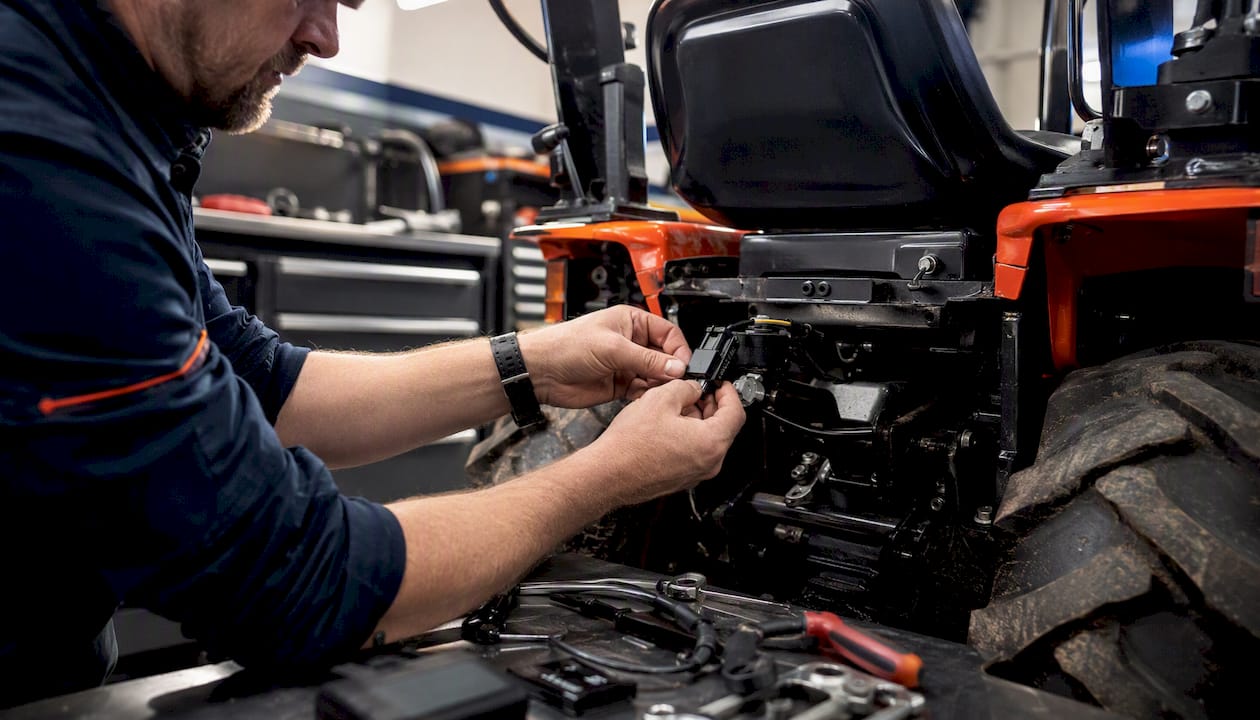
Hardwired installation is the right choice for excavators. Battery-only mounts work for trailers and low-power assets, but an excavator’s 12V or 24V system provides reliable, uninterrupted power and eliminates battery swap downtime.
- Choose a mounting zone inside the cab or under a panel — away from hydraulic lines and direct heat sources
- Use anti-vibration mounting hardware (rubber grommets or foam-lined brackets) to absorb excavator-class shock
- Route cables away from hydraulic hoses to prevent abrasion; use split loom conduit and cable ties rated for high-temperature environments
- Connect to a switched 12V/24V circuit so the tracker powers on with the ignition
- Test signal strength at the mounting location before finalizing; metal cab structures can attenuate GPS signal
- Seal all external connectors with weatherproof tape or heat-shrink tubing
A qualified technician completes a hardwired install in one to two hours. DIY installs are feasible for experienced mechanics but require a multimeter and basic wiring knowledge. The hardwiring guide for fleet managers covers wiring diagrams and circuit selection in detail.
Pro Tip: Mount the GPS antenna on a flat metal surface for best signal. Avoid mounting inside enclosed metal boxes — the Faraday effect will kill your fix rate.
What data should you expect and require?
Construction asset management requires precise location, condition, and usage history for maintenance, replacement decisions, and safety compliance. Your tracker should deliver all three.
Minimum data requirements for excavator fleets:
- Live location updated at configurable intervals (1–5 minutes for active sites)
- Engine hours logged per session and cumulative
- Movement and geofence breach alerts via push notification or SMS
- Downloadable location history (CSV) covering at least 90 days
- API access for CMMS or fleet software integration
Pro Tip: Request a sample CSV export from the vendor before purchasing. If the file lacks engine-hour columns or timestamps, the device will not support PM scheduling workflows.
Engine hours from the CAN bus are the reliable trigger for PM intervals at 250, 500, 1,000, and 2,000 hours. Mileage-based scheduling mis-triggers PMs for excavators that move short distances but run hard. For fleet GPS data integration examples, Motowatchdog’s published resources show how CSV exports connect to common CMMS platforms.
How construction teams use these features day to day
Heavy equipment asset management is moving toward performance-based measures, where engine hours and availability drive utilization and lifecycle decisions. Trackers make that shift practical.
Geofence-based billing: Set a geofence around each job site. When the machine exits, you get an alert and a timestamped record. That record supports invoice disputes and confirms billable hours.
Theft alert workflow:
- Movement alert fires outside business hours
- Manager receives push notification with live location
- Location shared with local law enforcement within minutes
- Recovery rate improves significantly versus passive-only devices
Runtime-triggered PM: Engine hours accumulate automatically, and the system alerts the maintenance coordinator to schedule service before machine failure intervals.
Pro Tip: Run a 60–90 day pilot on one representative excavator before fleet-wide deployment. Validate that engine hours match the machine’s onboard hour meter within 2–3% before relying on the data for PM scheduling.
North America legal and privacy checklist for employee-operated excavators
Tracking employee-operated equipment requires documentation. The legal framework varies by state and province, but the practical steps are consistent across North America.
- Written monitoring policy: Document that company equipment is subject to GPS tracking; include this in the employee handbook
- Employee notice: Provide written notice before deploying trackers on equipment operators regularly use
- Data retention schedule: Define how long location history is stored (90–180 days is typical for business purposes) and who can access it
- Role-based access controls: Limit dashboard access to managers with a legitimate business need; do not share raw location data broadly
- Off-hours tracking: Where feasible, limit active tracking to business hours on equipment that operators take home
Pro Tip: Keep a signed acknowledgment on file for each employee who operates tracked equipment. That document is your first line of defense in any privacy dispute.
Vendor evaluation checklist: questions that reveal real quality
Procurement questions to ask every vendor before signing:
- Which specific LTE bands does the device support, and which North American carriers are certified?
- How are engine hours captured — CAN bus, engine-hour input wire, or estimated from ignition?
- What is the prepaid data window, and what does renewal cost?
- What data export formats are available (CSV, REST API, SFTP)?
- What are the warranty terms and RMA process for field failures?
- Can you provide references from construction or rental fleets with 10+ excavators?
Red flags to watch for:
- “Lifetime data” claims with no technical explanation of how the SIM is funded
- Engine hours listed as a feature but delivered only as estimated ignition time
- No multi-user access or role-based permissions
- Data retention under 60 days with no export option
- No published LTE band list
Pro Tip: Ask for the IMEI number format and confirm the device is carrier-unlocked. A locked SIM tied to one carrier is a coverage risk on remote North American job sites.
Why Motowatchdog works for excavator fleets
Motowatchdog maps directly to the procurement checklist above. Over 1,000 businesses rely on Motowatchdog devices for real-time asset monitoring with no monthly fees.
- One-time purchase model: Transparent pricing with no recurring subscription
- Real-time location and geofencing: Configurable alerts for site boundaries and unauthorized movement
- Engine runtime tracking: Idle time and runtime data exportable for PM scheduling and billing
- Rugged hardware: Built for powered equipment with hardwired 12/24V installation support
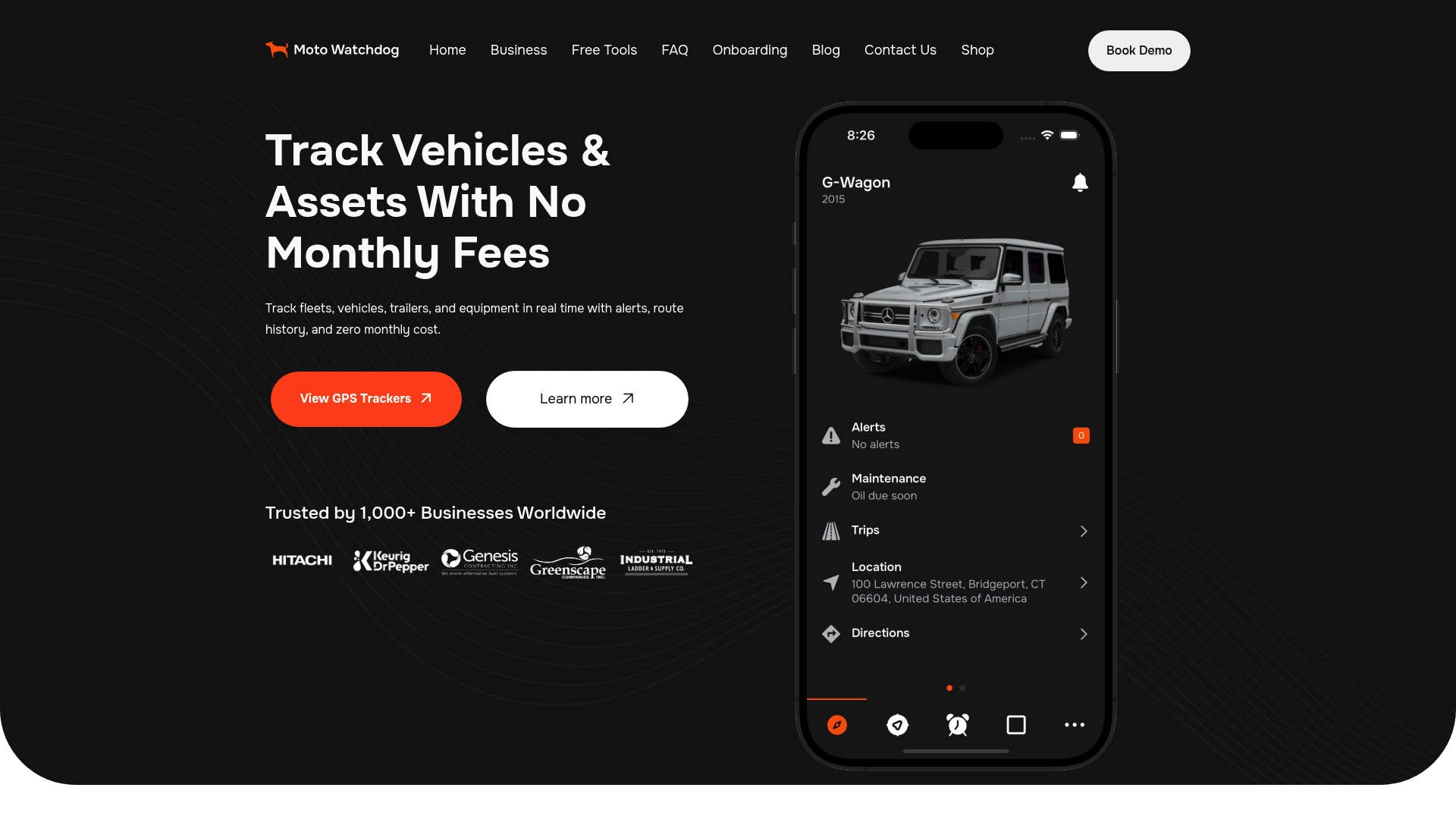
- Mobile app management: Multi-device dashboard with push notifications and trip history
- Exportable data: CSV downloads for job-costing, billing verification, and CMMS integration
- Customer support: Warranty coverage and support channels backed by a track record across 1,000+ business deployments
Pro Tip: Start with one Motowatchdog device on your highest-utilization excavator. Verify engine-hour accuracy against the onboard meter at 30 and 60 days, then scale to the full fleet with confidence.
For installation support, Motowatchdog’s subscription-free GPS guide covers the full buyer checklist and setup process.
Key Takeaways
Subscription-free GPS trackers are a viable, cost-effective choice for excavator fleets when devices support engine-hour capture, LTE Cat-M1 connectivity, and hardwired power.
| Point | Details |
|---|---|
| Confirm LTE band support | Require a published band list compatible with AT&T, T-Mobile, or Verizon IoT networks before purchasing. |
| Engine hours beat mileage | Require CAN bus or dedicated engine-hour input; mileage-based scheduling mis-triggers PMs on excavators. |
| Prepaid SIMs shift, not eliminate, costs | Budget for data renewal or device replacement when the prepaid window expires, typically within one to three years. |
| Run a 60–90 day pilot first | Validate engine-hour accuracy against the onboard meter before fleet-wide deployment. |
| Motowatchdog fits the checklist | One-time purchase, real-time tracking, engine runtime data, and CSV export with no monthly fees across 1,000+ business deployments. |
The case for getting the pilot right before scaling
The most common mistake construction managers make with subscription-free GPS is treating the purchase as a set-and-forget decision. It is not. The device choice determines what data you can extract, and the data determines whether your PM intervals are accurate, your billing is defensible, and your theft recovery is fast enough to matter.
What actually separates a useful excavator tracker from a consumer-grade location ping is engine-hour ingestion. Excavators have hydraulic-specific failure modes tied to operating hours, not distance. A tracker that logs ignition time as a proxy for engine hours will drift from the machine’s actual meter within weeks of deployment. That drift compounds into mis-scheduled PMs and, eventually, unplanned downtime that costs far more than any subscription fee.
The pilot approach works because it forces you to validate the data before you depend on it. Thirty days of side-by-side comparison between the tracker’s engine-hour log and the machine’s onboard meter tells you everything you need to know about whether the device is fit for your fleet. If the numbers align within 2–3%, you have a reliable tool. If they diverge, you know before you have committed to 20 units.
Motowatchdog’s published installation resources and fleet tracking guides give construction managers a practical starting point without requiring a telematics consultant.
Get Motowatchdog for your excavator fleet
Motowatchdog gives construction managers and rental companies a direct path to subscription-free excavator tracking without the complexity of enterprise telematics contracts. One-time hardware purchase, real-time location, engine runtime data, and geofencing alerts — all managed from a mobile app with no monthly invoice.
For a pilot deployment, start with one to three devices on your highest-utilization excavators. Motowatchdog ships directly to your location, and the installation process is documented for both professional technicians and experienced mechanics. Warranty coverage and customer support are included with every purchase.
Visit Motowatchdog’s GPS tracking store to review current device options, confirm LTE band compatibility for your region, and place your first order. Support is available to help you match the right SKU to your excavator class and power configuration.