

How to start saving money
Lorem ipsum dolor sit amet, consectetur adipiscing elit lobortis arcu enim urna adipiscing praesent velit viverra sit semper lorem eu cursus vel hendrerit elementum morbi curabitur etiam nibh justo, lorem aliquet donec sed sit mi dignissim at ante massa mattis.
- Neque sodales ut etiam sit amet nisl purus non tellus orci ac auctor
- Adipiscing elit ut aliquam purus sit amet viverra suspendisse potent
- Mauris commodo quis imperdiet massa tincidunt nunc pulvinar
- Excepteur sint occaecat cupidatat non proident sunt in culpa qui officia
Why it is important to start saving
Vitae congue eu consequat ac felis placerat vestibulum lectus mauris ultrices cursus sit amet dictum sit amet justo donec enim diam porttitor lacus luctus accumsan tortor posuere praesent tristique magna sit amet purus gravida quis blandit turpis.

How much money should I save?
At risus viverra adipiscing at in tellus integer feugiat nisl pretium fusce id velit ut tortor sagittis orci a scelerisque purus semper eget at lectus urna duis convallis. porta nibh venenatis cras sed felis eget neque laoreet suspendisse interdum consectetur libero id faucibus nisl donec pretium vulputate sapien nec sagittis aliquam nunc lobortis mattis aliquam faucibus purus in.
- Neque sodales ut etiam sit amet nisl purus non tellus orci ac auctor
- Adipiscing elit ut aliquam purus sit amet viverra suspendisse potenti
- Mauris commodo quis imperdiet massa tincidunt nunc pulvinar
- Adipiscing elit ut aliquam purus sit amet viverra suspendisse potenti
What percentege of my income should go to savings?
Nisi quis eleifend quam adipiscing vitae aliquet bibendum enim facilisis gravida neque. Velit euismod in pellentesque massa placerat volutpat lacus laoreet non curabitur gravida odio aenean sed adipiscing diam donec adipiscing tristique risus. amet est placerat in egestas erat imperdiet sed euismod nisi.
“Nisi quis eleifend quam adipiscing vitae aliquet bibendum enim facilisis gravida neque velit euismod in pellentesque”
Do you have any comments? Share them with us on social media
Eget lorem dolor sed viverra ipsum nunc aliquet bibendum felis donec et odio pellentesque diam volutpat commodo sed egestas aliquam sem fringilla ut morbi tincidunt augue interdum velit euismod eu tincidunt tortor aliquam nulla facilisi aenean sed adipiscing diam donec adipiscing ut lectus arcu bibendum at varius vel pharetra nibh venenatis cras sed felis eget.
Low signal GPS tracking is defined as the technology that enables GPS devices to maintain accurate location data even when satellite signals are weak, partially blocked, or heavily obstructed. This capability is critical for asset and vehicle monitoring in environments where standard GPS struggles: urban canyons, parking garages, dense tree cover, and tunnels. The industry standard term for this field is “weak signal GPS tracking,” though “low signal GPS tracking” describes the same core challenge. Understanding what is low signal GPS tracking, how it works, and where it falls short gives fleet managers and individuals the knowledge to choose the right solution and place devices correctly from day one.
What is low signal GPS tracking and how does it work?
GPS signal strength is measured in Carrier-to-Noise Density (C/N₀) units expressed in dB-Hz. Signals above 45 dB-Hz are excellent, while readings below 25 dB-Hz are generally unusable for reliable location. Most modern GPS receivers need at least 30 dB-Hz to hold a stable lock. That threshold is the line between a tracker that works and one that goes silent.
Standard GPS receivers fail below that threshold because they cannot extract a clean position from a noisy signal. Advanced low signal GPS technology solves this by using algorithms that squeeze usable data from signals most receivers would discard. Two methods stand out:
- Neural-network discriminators: These algorithms learn to distinguish genuine satellite signals from noise, improving detection even at very low signal levels.
- Cognitive dual-stage acquisition: This two-phase method first searches broadly for a signal, then refines the lock with a focused, high-sensitivity pass.
- Block Coherent Integration (BCI): This technique extends the time a receiver listens to a signal before making a position calculation, pulling more data from a weak source.
- Multi-GNSS constellations: Devices that combine GPS (American), GLONASS (Russian), and Galileo (European) satellites have more signals to work with, reducing the chance of a complete loss.
Advanced algorithms like neural-network discriminators can extract location data from signals as low as 18.5 dB-Hz, improving positioning detection probability by up to 32%. That is a meaningful gain for any fleet operating in dense urban areas.
A weighted Kalman Filter adds another layer of accuracy. A pseudorange dynamic filtering model using this approach reduces 3D positioning errors by over 50% under weak signal conditions compared to standard methods. For a fleet manager tracking assets in a city center, that difference translates directly into fewer missed stops and more reliable geofence alerts.

Pro Tip: When evaluating GPS trackers, ask specifically whether the device supports multi-GNSS and what its minimum acquisition sensitivity is in dB-Hz. A device rated for acquisition at 20 dB-Hz or lower will outperform a standard unit in urban and indoor environments.
What causes low GPS signal, and how do trackers cope?
Physical obstructions cause the vast majority of GPS signal problems. Metal, concrete, and urban canyons block satellite signals, and few firmware solutions can overcome a complete physical blockage. The Faraday cage effect is a common culprit inside vehicles: metal body panels, roof liners, and trunk lids all attenuate the signal before it reaches the tracker antenna.
Common locations where signal drops are predictable:
- Underground parking garages and basement loading docks
- Tunnels and covered bridges
- Dense forest or heavy tree canopy
- Inside shipping containers or metal cargo boxes
- Glove boxes, center consoles, and trunks inside vehicles
Experts consistently find that GPS signal problems almost always result from local environmental obstructions, not satellite availability. The satellites are almost always overhead. The problem is what stands between the device and the sky.
Placement is the single most effective fix available without changing hardware. Devices placed near windshields or rear decks with a clear sky view maintain a 4-satellite GPS lock far more reliably than units hidden in trunks or glove boxes. For assets that move through predictable dead zones, passive trackers store positional data locally and upload it once connectivity is restored. This approach keeps logs complete even when a vehicle spends hours underground.
Pro Tip: For vehicles that regularly enter tunnels or underground facilities, pair a real-time tracker with a passive logging backup. The passive unit fills the gaps the real-time device cannot cover.
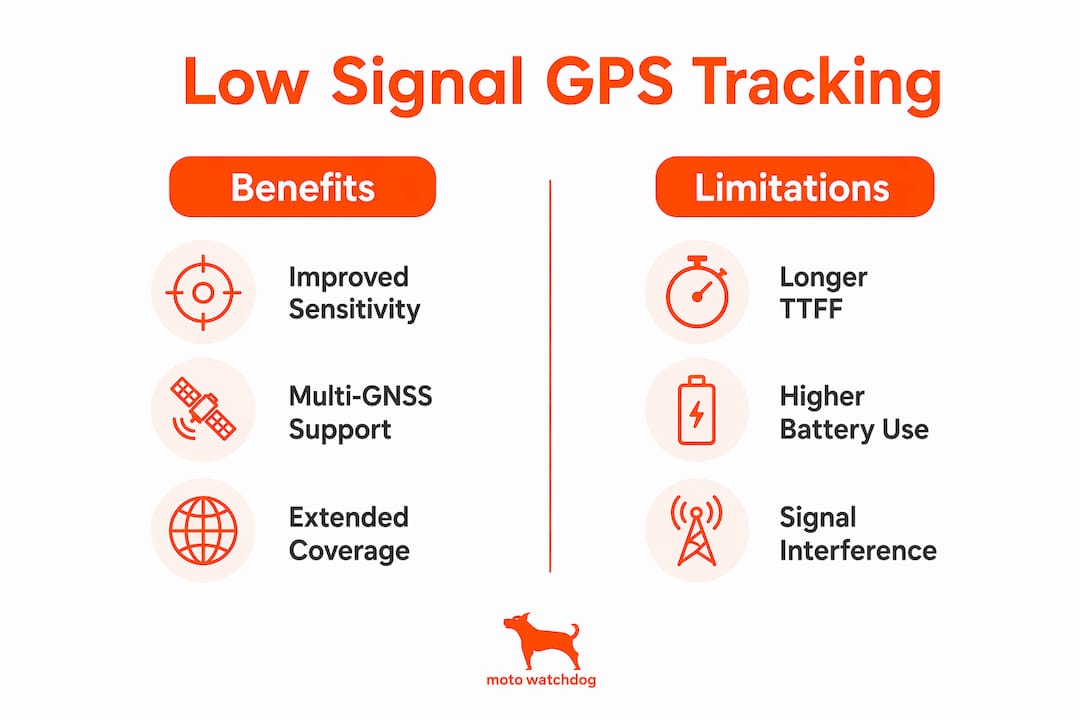
Benefits and limitations of low signal GPS tracking
Low signal GPS technology delivers real advantages for asset and vehicle monitoring, but it also has hard limits that no algorithm can overcome.
Core benefits
Improved sensitivity means a tracker stays active in environments where a standard unit would go dark. Multi-GNSS support increases the number of visible satellites, which directly improves position accuracy and reduces the chance of a complete fix loss. For businesses monitoring vehicles in cities, this means fewer gaps in trip history and more reliable arrival and departure timestamps.
Real-world limitations
| Limitation | Practical Impact |
|---|---|
| Increased Time to First Fix (TTFF) | Weak signal modes require longer listening time before a position is calculated, slowing initial lock. |
| Higher battery consumption | Weak signal modes reduce battery performance because devices must listen longer to acquire a fix. |
| Absolute physical blockage | No algorithm recovers a signal inside a sealed metal container or deep underground. |
| Reduced accuracy in severe multipath | Urban canyons cause signal reflections that degrade position accuracy even with advanced filtering. |
The battery tradeoff deserves specific attention. A tracker running in high-sensitivity mode to cope with weak signals draws more power than one operating in clear conditions. For battery-powered asset trackers, this means shorter intervals between charges or battery replacements. Fleet managers should factor this into their maintenance schedules.
Hybrid approaches close the gap where GPS alone fails. Dead reckoning uses accelerometers and gyroscopes to estimate position between GPS fixes. Wi-Fi triangulation provides coarse location inside buildings. LPWAN (Low Power Wide Area Network) connectivity keeps data flowing in areas where cellular coverage is thin. No single technology covers every scenario, but combining two or three covers most real-world use cases.
How does low signal GPS tracking affect data transmission?
GPS signal acquisition and cellular data upload are two separate processes. A tracker can hold a solid GPS fix and still appear offline if the cellular network is too weak to transmit data. Users often mistake cellular upload failure for GPS tracking failure. Separating these two issues is the first step in any troubleshooting process.
Diagnosing connectivity problems follows a clear sequence:
- Move the device to an open outdoor area with a clear sky view and check whether a GPS fix appears. If it does, the GPS hardware is working.
- Check cellular signal strength in the same location. If cellular is weak, the tracker has a fix but cannot report it.
- Review stored trip history after the device reconnects. Passive logging devices will show data from the dead zone once they upload.
- Check whether the SIM card or cellular plan covers the region where the device operates. Coverage gaps are common in rural areas.
- Update device firmware. Manufacturers regularly release updates that improve both GPS sensitivity and cellular reconnection logic.
Technologies like LPWAN and Wi-Fi triangulation serve as backup communication channels when cellular coverage fails. LPWAN networks cover large geographic areas with low power consumption, making them well suited for asset trackers on equipment that sits idle for long periods. Wi-Fi triangulation works indoors where both GPS and cellular are weak, using nearby router signals to estimate location. Understanding GPS tracking for fleet safety requires knowing which communication layer is failing before assuming the GPS hardware is at fault.
Pro Tip: Before concluding a tracker is broken, drive it to an open parking lot and wait two minutes. If a fix appears and data uploads, the problem is environmental, not hardware.
Key Takeaways
Low signal GPS tracking works by combining advanced signal processing algorithms, multi-GNSS satellite data, and hybrid positioning techniques to maintain location accuracy where standard GPS receivers fail.
| Point | Details |
|---|---|
| Signal threshold matters | GPS receivers need at least 30 dB-Hz to hold a reliable lock; below 25 dB-Hz is typically unusable. |
| Algorithms extend capability | Neural-network discriminators and block coherent integration improve detection probability by up to 32% in weak signal conditions. |
| Placement is the top fix | Positioning devices near windshields with a clear sky view is the most effective single improvement for signal quality. |
| GPS and cellular are separate | A tracker can have a GPS fix but appear offline due to cellular failure; always diagnose both independently. |
| Passive logging fills gaps | Passive trackers store data locally and upload it later, keeping records complete through tunnels and underground facilities. |
Why device placement beats every algorithm
After working through the technical details of weak signal GPS tracking, the most important lesson is surprisingly simple: placement beats processing power. I have seen businesses invest in high-sensitivity multi-GNSS devices and then mount them inside metal toolboxes, completely negating every algorithmic advantage the hardware offers.
The second most common mistake is blaming the GPS when the real problem is cellular. A fleet manager calls in frustrated because a tracker “stopped working” in a warehouse district. The device has a perfect GPS fix. The cellular carrier has no tower within range. These are different problems with different solutions, and conflating them wastes time and money.
My recommendation for businesses evaluating subscription-free GPS options is to start with placement testing before assuming you need a hardware upgrade. Mount the device in three locations on the same vehicle and compare fix quality over a week. The data will tell you more than any spec sheet. For assets that regularly enter dead zones, passive logging is not a compromise. It is the right tool for the job. Pair it with a real-time tracker for assets that spend most of their time in open environments, and you cover both scenarios without overspending.
Multi-GNSS capability is worth paying for. A device that pulls from GPS, GLONASS, and Galileo simultaneously has a fundamentally better chance of maintaining a fix in a city center than a GPS-only unit. Firmware updates matter too. Manufacturers push sensitivity improvements through software, and an outdated device is leaving performance on the table.
— Louis
Reliable GPS tracking without monthly fees
Motowatchdog builds GPS trackers for businesses and individuals who need dependable location monitoring without the burden of ongoing subscription costs. Over 1,000 businesses rely on Motowatchdog for real-time vehicle and asset monitoring, and the platform supports multi-network 4G connectivity to reduce the cellular dead zones that cause trackers to go silent.
For fleet managers dealing with weak signal environments, Motowatchdog devices support geofencing alerts, long battery life, and detailed trip history that uploads automatically once connectivity is restored. If you are ready to solve your tracking challenges without paying monthly fees, visit Motowatchdog’s GPS tracker page to review current device options and find the right fit for your vehicles and assets.
FAQ
What is low signal GPS tracking?
Low signal GPS tracking is the technology that allows GPS devices to determine and maintain location accuracy when satellite signals are weak or obstructed. It relies on advanced signal processing algorithms, multi-GNSS satellite data, and hybrid positioning methods to function where standard GPS receivers fail.
What dB-Hz level does a GPS tracker need to work?
Most modern GPS receivers require at least 30 dB-Hz to maintain a reliable lock, with signals below 25 dB-Hz generally unusable. Advanced low signal trackers can acquire a fix at levels as low as 18.5 dB-Hz using neural-network and block coherent integration techniques.
Why does my GPS tracker lose signal in parking garages?
Metal structures and concrete create a Faraday cage effect that blocks satellite signals from reaching the tracker antenna. No GPS device can maintain a satellite fix inside a sealed underground structure; passive logging trackers are the recommended solution for these environments.
Is GPS signal loss the same as cellular signal loss?
No. GPS signal loss and cellular signal loss are separate issues. A tracker can hold a perfect GPS fix but appear offline because the cellular network is too weak to transmit data; always test both independently before diagnosing a hardware problem.
How can I improve GPS signal on my tracker?
Device placement near a windshield or rear deck with a clear sky view is the most effective improvement. Keeping firmware updated and choosing a multi-GNSS capable device also significantly improves performance in weak signal environments.

