How to start saving money
Lorem ipsum dolor sit amet, consectetur adipiscing elit lobortis arcu enim urna adipiscing praesent velit viverra sit semper lorem eu cursus vel hendrerit elementum morbi curabitur etiam nibh justo, lorem aliquet donec sed sit mi dignissim at ante massa mattis.
- Neque sodales ut etiam sit amet nisl purus non tellus orci ac auctor
- Adipiscing elit ut aliquam purus sit amet viverra suspendisse potent
- Mauris commodo quis imperdiet massa tincidunt nunc pulvinar
- Excepteur sint occaecat cupidatat non proident sunt in culpa qui officia
Why it is important to start saving
Vitae congue eu consequat ac felis placerat vestibulum lectus mauris ultrices cursus sit amet dictum sit amet justo donec enim diam porttitor lacus luctus accumsan tortor posuere praesent tristique magna sit amet purus gravida quis blandit turpis.

How much money should I save?
At risus viverra adipiscing at in tellus integer feugiat nisl pretium fusce id velit ut tortor sagittis orci a scelerisque purus semper eget at lectus urna duis convallis. porta nibh venenatis cras sed felis eget neque laoreet suspendisse interdum consectetur libero id faucibus nisl donec pretium vulputate sapien nec sagittis aliquam nunc lobortis mattis aliquam faucibus purus in.
- Neque sodales ut etiam sit amet nisl purus non tellus orci ac auctor
- Adipiscing elit ut aliquam purus sit amet viverra suspendisse potenti
- Mauris commodo quis imperdiet massa tincidunt nunc pulvinar
- Adipiscing elit ut aliquam purus sit amet viverra suspendisse potenti
What percentege of my income should go to savings?
Nisi quis eleifend quam adipiscing vitae aliquet bibendum enim facilisis gravida neque. Velit euismod in pellentesque massa placerat volutpat lacus laoreet non curabitur gravida odio aenean sed adipiscing diam donec adipiscing tristique risus. amet est placerat in egestas erat imperdiet sed euismod nisi.
“Nisi quis eleifend quam adipiscing vitae aliquet bibendum enim facilisis gravida neque velit euismod in pellentesque”
Do you have any comments? Share them with us on social media
Eget lorem dolor sed viverra ipsum nunc aliquet bibendum felis donec et odio pellentesque diam volutpat commodo sed egestas aliquam sem fringilla ut morbi tincidunt augue interdum velit euismod eu tincidunt tortor aliquam nulla facilisi aenean sed adipiscing diam donec adipiscing ut lectus arcu bibendum at varius vel pharetra nibh venenatis cras sed felis eget.
GPS is accurate enough for mileage tracking in almost every real-world scenario, typically landing within a few percent of true distance. The technology carries a well-documented bias toward overestimating distance, driven by positional noise and how devices connect the dots between GPS fixes. For fleet managers and individuals alike, the practical takeaway is simple: GPS mileage is reliable for reporting, billing, and audits when the device samples frequently and the environment cooperates.
TL;DR:
- GPS overestimates mileage primarily due to path zigzagging caused by positional noise, especially when sampling infrequently or on winding routes.
- Short, frequent GPS fixes reduce overestimation bias more effectively than increasing hardware accuracy, with sampling intervals of 1 to 5 seconds ideal for urban routes.
- Multipath interference, signal blockages, and satellite geometry are common causes of sudden trip anomalies, which can lead to distorted mileage reports.
- Cross-checking GPS mileage with odometer readings every 3 to 6 months helps identify and minimize inaccuracies, especially in challenging environments.
- Prioritizing GPS devices with high sampling rates, dual-frequency support, accelerometer-based dead reckoning, and thorough verification makes mileage reporting more reliable.
Table of Contents
- How Accurate Is GPS Mileage Tracking, Really?
- Why GPS Overestimates Distance: The Ranacher Effect
- What Causes GPS Errors on the Road
- Sampling Rate and Gap-Filling: The Hidden Lever
- GPS or Odometer? How Fleets Should Reconcile the Two
- Building an Accuracy-First GPS Setup
- How Moto Watchdog Applies These Accuracy Standards
- The Bottom Line on GPS Mileage Accuracy
- What This Data Actually Tells Fleet Managers
- Sources
- FAQ
How Accurate Is GPS Mileage Tracking, Really?
The Federal Aviation Administration states that standard GPS positional accuracy is approximately 7.0 meters, 95% of the time, for users near the Earth’s surface [FAA GPS accuracy]. That figure comes from FAA guidance on how GPS works, and it’s the number most fleet telematics companies quietly build their marketing around. In everyday driving conditions, most consumer and fleet-grade devices land somewhere in the 3 to 15-meter range depending on satellite geometry, receiver quality, and what’s blocking the sky overhead.
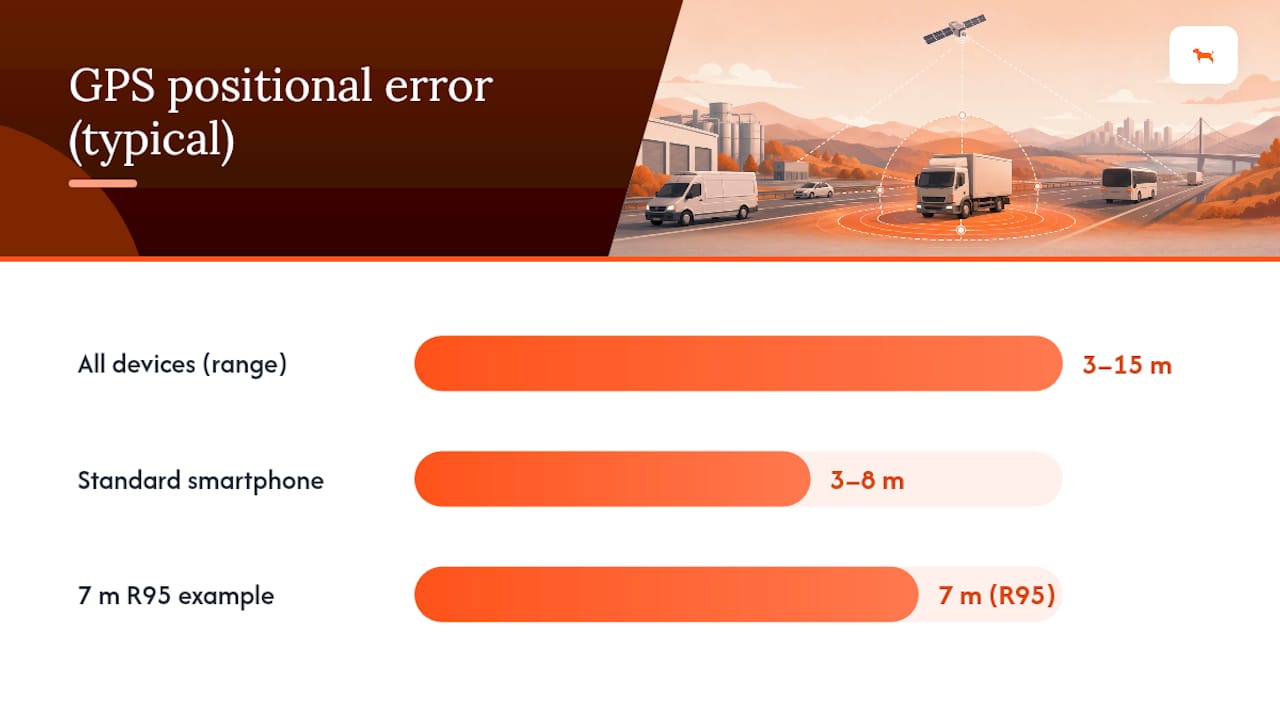
That range sounds abstract until you convert it to mileage. A 7-meter positional error, applied inconsistently across thousands of GPS fixes on a 50-mile route, rarely adds up to more than a fraction of a percent of total distance. The error that actually matters for mileage tracking isn’t the static positional accuracy figure. It’s how that noise interacts with sampling rate and path shape, which we’ll unpack in the next section.
Device class changes the baseline substantially:
- Standard smartphone GPS (single-frequency): typically 3 to 8 meters in open conditions, worse in cities.
- Dual-frequency smartphone chips, now common in newer phones, cut that error roughly in half by correcting for atmospheric delay.
- Consumer handheld GPS units built for hiking or marine use often perform similarly to phones but hold a lock longer in weak-signal areas.
- Dedicated fleet trackers designed for vehicle mileage reporting usually pair GPS with an accelerometer, which helps fill gaps and smooth out noisy readings.
- ELD devices, mandated for commercial trucking logs, prioritize consistent sampling and audit trail integrity over raw positional precision.
GPS accuracy in plain numbers: a device with 7 meter R95 accuracy, sampling once per second on a straight highway, will report mileage within roughly half a percent of the true distance. The same device on a winding mountain road, sampling only once every 30 seconds, can overstate mileage by several percents. The hardware barely changed. The sampling policy did all the damage.
Why GPS Overestimates Distance: The Ranacher Effect
GPS doesn’t just make random errors that cancel out over a trip. It systematically overestimates distance, and researchers Ranacher and colleagues proved exactly why in a widely cited paper published in the International Journal of Geographical Information Science.
Here’s the intuition without the calculus. A moving vehicle’s true path is smooth. But GPS records a series of discrete points, each with its own small positional error. When you connect those noisy points with straight lines, the connected path is jagged rather than smooth. A jagged line between two points is always longer than the smooth path it’s approximating. That’s the entire mechanism.
The Ranacher paper formalizes this with a formula that relates the observed distance to the true distance (d0), the variance of GPS positional error (denoted Vargps), and a correlation term © describing how similar consecutive errors are to each other. When errors are highly correlated, meaning one noisy reading tends to echo the next, the zigzag effect shrinks and overestimation drops. When errors are independent of one fix to the next, the zigzag gets worse and overestimation grows.
Controlled experiments cited in the research found that short reference distances tend to be overestimated by GPS measurements, with the magnitude of overestimation decreasing as the reference distance increases. Small distances showed proportionally larger overestimation than long ones, because the zigzag effect matters more relative to a short baseline.
An IEEE Spectrum explainer summarizing this work makes the practical point well: the bias shrinks as sampling frequency rises, because tighter spacing between fixes leaves less room for the path to wander off the true route. That’s why:
- Short, frequent city trips show the overestimation effect most clearly.
- Long highway hauls dilute the bias into a rounding error.
- Devices sampling once every few seconds outperform devices sampling once a minute, even with identical hardware.
What Causes GPS Errors on the Road
Multipath interference is the most common culprit behind sudden mileage anomalies. When a GPS signal bounces off a building, bridge, or dense tree canopy before reaching the receiver, the device calculates a position based on a delayed, reflected signal rather than the direct one. In dense urban canyons, this can shift a reported position by 10 to 50 meters, which shows up in trip reports as phantom detours or oddly long straight stretches.
Satellite geometry plays a quieter but equally real role. Geometric Dilution of Precision, or GDOP, describes how the physical spread of visible satellites affects positional accuracy. When satellites cluster together in the sky, rather than spreading evenly, even a technically “locked” GPS fix carries more error than usual. Drivers rarely notice GDOP directly. Fleet managers notice it as unexplained mileage drift on certain routes at certain times of day.
Signal loss creates a different problem entirely: no data at all. Tunnels, parking garages, and dense downtown cores can knock a device offline for seconds or minutes. Some trackers also intentionally power down GPS radios between fixes to save battery, creating short “dark periods” by design.
Four factors most often explain a mileage discrepancy:
- Multipath reflection off buildings, overpasses, or heavy foliage.
- Poor satellite geometry (GDOP), especially in valleys or near tall structures.
- Signal blackout in tunnels, garages, or steel-frame buildings.
- Hardware and firmware quality, including antenna design and how aggressively the device filters noisy readings.
Pro Tip: If one vehicle in your fleet consistently reports higher mileage than its sibling trucks on identical routes, check its parking location first. A tracker that spends nights in a covered garage rebuilds its satellite lock every morning, and that reacquisition period is where the worst multipath errors tend to hide.
Sampling Rate and Gap-Filling: The Hidden Lever
Sampling frequency changes recorded mileage more than almost any other single factor, and it’s the one variable most buyers never think to ask about before purchasing a tracker.
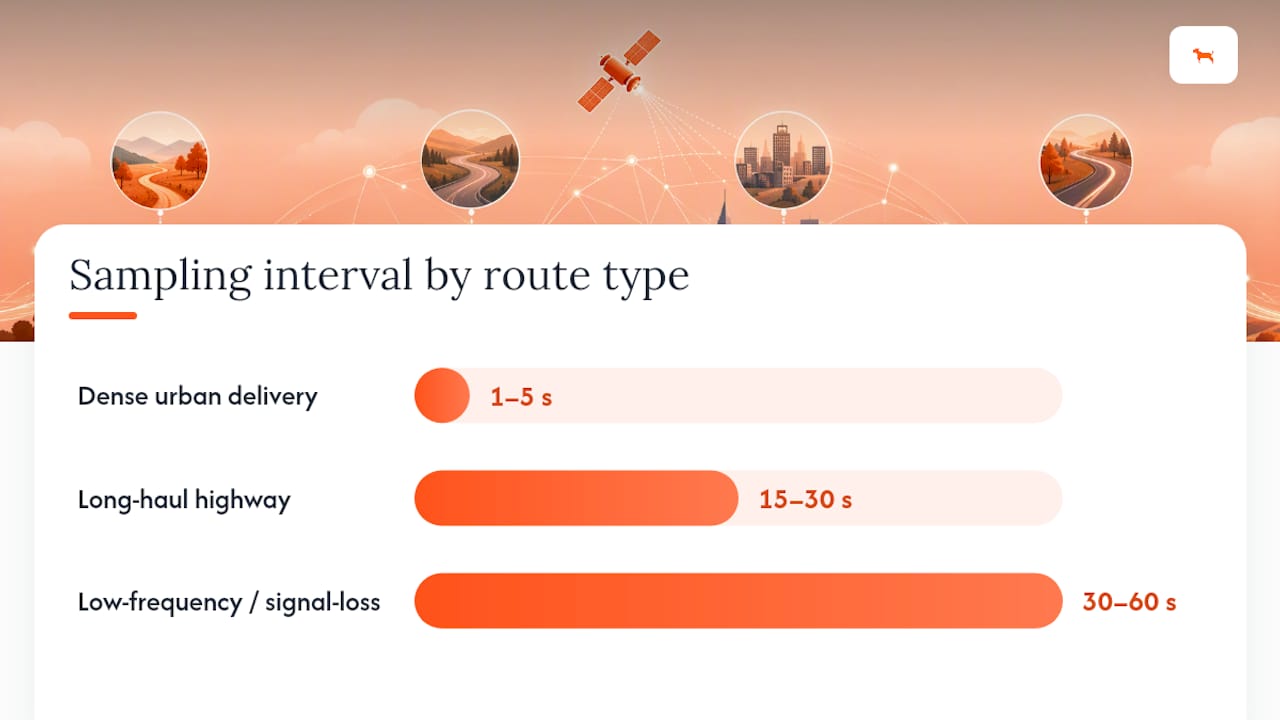
High-frequency sampling, taking a position fix every one to five seconds, minimizes the interpolation error described in the Ranacher research. It also does something less obvious: it exposes raw measurement noise more visibly, because every small jitter in the signal gets recorded as a discrete point rather than smoothed away by a long gap. Low-frequency sampling, one fix every 30 to 60 seconds, does the opposite. It smooths out noise but systematically underestimates distance on winding or stop-and-go routes, because straight-line interpolation between distant points cuts corners the vehicle actually drove around.
Sampling frequency versus route type, at a glance:
- Dense urban delivery routes benefit most from sub-5-second sampling, since frequent turns amplify interpolation shortcuts.
- Long-haul highway routes tolerate 15 to 30 second sampling without meaningful mileage drift, since the path is mostly straight.
- Mixed-use fleets (construction, utility, service vehicles) need adaptive sampling that speeds up in low-speed, high-turn zones.
Devices increasingly use accelerometer-assisted dead reckoning to handle “dark periods,” those stretches where GPS signal drops entirely. A patented error-correction method describes using an onboard accelerometer to detect that a vehicle is still moving even without a GPS fix, then reconstructing the likely path using map data once the signal returns. This is also how devices without external power handle tracking during signal loss, a common scenario for trailers and towed equipment that lack a vehicle’s constant electrical connection.
For state-line mileage allocation under IFTA, sampling rate and data completeness matter more than raw positional accuracy in meters. A device that samples frequently near a state border will allocate miles correctly even if its absolute position is off by a few meters. A device that samples rarely can misallocate an entire segment of a trip to the wrong state, regardless of how tight its positional accuracy is on paper.
GPS or Odometer? How Fleets Should Reconcile the Two
Odometers measure wheel rotations, which sounds simple until you account for tire wear, incorrect tire size after a replacement, and mechanical calibration drift over the life of a vehicle. None of those failure modes affect GPS. But GPS has its own blind spots: it needs continuous power and a clear sky view, neither of which an odometer requires.
The Federal Highway Administration’s guidance on recording vehicle movement frames this as a tradeoff rather than a clear winner. GPS-based tracking is the more robust method for continuous, automated mileage logging. OBD-II and odometer readings serve as a useful cross-check precisely because they fail differently than GPS does, catching errors GPS would otherwise miss.
Practical reconciliation looks like this for most fleets:
- Use GPS as the primary mileage source for trip reporting, since it runs continuously without driver input.
- Cross-check against the odometer at fixed intervals rather than trusting either source blindly.
- Flag discrepancies above a few percent for investigation rather than automatic correction, since either source could be the one that’s wrong.
- Keep both records for any audit-facing mileage, since auditors value corroborating evidence over a single data source.
IFTA auditors generally evaluate whether reported mileage is reasonable given the route, rather than enforcing a razor-thin meter-level threshold. Industry practice treats a modest total-mileage variance as within normal tolerance, but the auditor’s real question is whether your numbers hold up against independent evidence like fuel receipts, toll records, and GPS logs together.
Building an Accuracy-First GPS Setup
Getting defensible mileage numbers starts before you ever mount a device. It starts with what you buy and how you configure it.
Prioritize these device features when evaluating any GPS tracker for mileage reporting:
- WAAS support or dual-frequency GNSS. Background research suggests WAAS-augmented receivers can hold accuracy in the 1 to 3-meter range under good conditions, a meaningful step up from unaugmented single-frequency units.
- High sampling capability, ideally adjustable so you can tighten intervals for urban routes and relax them for highway miles without buying separate hardware.
- An onboard accelerometer, which detects motion during GPS dark periods and prevents the “parked but still logging miles” errors that plague accelerometer-free devices.
- A quality antenna and enclosure, since cheap antennas are disproportionately vulnerable to multipath interference in exactly the urban conditions where accuracy matters most.
Match your sampling policy to your routes rather than using one setting for the entire fleet. Delivery vehicles running dense city loops need frequent fixes to avoid corner-cutting interpolation. Long-haul trucks can run coarser sampling without meaningful mileage drift, since highway routes are mostly straight lines anyway.
Verification is where most fleets fall short, not procurement. Run a known test route, ideally one with a certified distance, and compare it against the device’s reported mileage before trusting it for reporting. Then reconcile GPS mileage against odometer readings every 3 to 6 months, a cadence recommended by industry documentation on GPS versus odometer mileage. Document the reconciliation method itself, not just the results, since auditors want to see a consistent process rather than a one-time spot check.
Pro Tip: Run your test route twice, once during rush hour traffic and once at night. If the mileage numbers differ by more than a percent or two on an identical route, the discrepancy is almost certainly multipath interference from other vehicles and structures, not a hardware defect.
How Moto Watchdog Applies These Accuracy Standards
Moto Watchdog builds its trackers around the same features this article recommends: long battery life that supports consistent sampling without draining power mid-route, detailed trip and mileage reports that simplify reconciliation, and accelerometer-based motion detection that helps account for movement during signal gaps. These aren’t abstract specifications. They’re the specific hardware choices that separate a defensible mileage log from a disputed one.
Many businesses rely on Moto Watchdog for tracking accuracy, including contractor fleets, equipment rental operations, and families monitoring personal vehicles. The full tracker lineup is built without monthly subscription fees, and every device includes lifetime data coverage as part of the one-time purchase.
What sets the accuracy conversation apart for fleet operators specifically:
- No recurring fees mean fleets can deploy trackers across every vehicle without mileage-tracking costs scaling with fleet size.
- Detailed mileage reporting is built into the companion app, simplifying the reconciliation habit this article recommends.
- Multi-device management through a single dashboard supports the route-by-route sampling adjustments larger fleets need.
- Businesses managing employee tracking programs get documentation practices that hold up when mileage records face scrutiny.
The Bottom Line on GPS Mileage Accuracy
| Factor | What matters | Action |
|---|---|---|
| Baseline accuracy | ~7 m R95 standard GPS | Expect sub-1% error on straight routes |
| Systematic bias | GPS tends to overestimate | Worse on short, twisty trips |
| Sampling rate | Bigger lever than hardware | Match rate to route type |
| Verification | Prevents disputes | Reconcile with odometer every 3 to 6 months |
| Best practice | Pair, don’t choose | Use GPS primary, odometer as cross-check |
GPS mileage tracking is reliable enough to build business decisions and tax filings on, provided the device samples frequently and someone checks the numbers periodically. Pair GPS with odometer readings whenever a mileage figure faces external scrutiny, whether from an insurer, an auditor, or a customer disputing a billed trip.
What This Data Actually Tells Fleet Managers
The conventional advice on GPS mileage accuracy fixates on positional accuracy in meters, and that’s largely the wrong number to obsess over. A device advertising 3 meter accuracy instead of 7 meters will make almost no practical difference to your monthly mileage report. Sampling rate does far more damage or good than the marketing specs on a product page ever suggest.
The Ranacher research deserves more attention than it gets in fleet management circles, because it explains something that confuses a lot of managers: why two devices on the same route can report slightly different mileage even when both are working correctly. That’s not a defect. It’s a mathematical property of how any GPS system connects discrete points into a continuous path.
If you take one thing from this article, prioritize sampling policy and verification habits over chasing marginal hardware accuracy improvements. A mid-tier tracker with frequent sampling and a disciplined 3 to 6 month reconciliation routine will produce more defensible records than a premium device nobody ever double-checks against an odometer.
— Louis
Sources
- FAA — How GPS works (positional accuracy guidance)
- Ranacher et al., Why GPS makes distances bigger than they are (International Journal of Geographical Information Science)
- FHWA — Methods of recording vehicle movement (chapter summary)
- US11703353B2 — Error correction for GPS-based mileage tracking (patent)
- IEEE Spectrum — Why every GPS overestimates distance traveled
FAQ
Is a GPS more accurate than a phone?
A dedicated GPS tracker and a modern smartphone often use comparable underlying GPS technology, but dedicated trackers usually add accelerometer support and continuous power, which improves consistency during signal gaps that phones typically handle worse.
How accurate is Google Maps mileage?
Google Maps and similar smartphone mapping apps rely on standard smartphone GPS chips, which generally fall in the 3 to 8 meter accuracy range in open conditions, with more error likely in dense urban areas due to multipath interference.
Is GPS 100% accurate?
No GPS system is 100% accurate. Standard civilian GPS delivers roughly 7 meter positional accuracy 95% of the time according to the FAA, and distance measurements carry a documented systematic bias toward overestimation.
Which mileage tracker app is the most accurate?
Accuracy depends more on sampling frequency and accelerometer support than on any single app’s branding. Look for a device or app that allows frequent sampling on turn-heavy routes and includes motion detection during signal loss, rather than judging accuracy by advertised meter specs alone.