
How to start saving money
Lorem ipsum dolor sit amet, consectetur adipiscing elit lobortis arcu enim urna adipiscing praesent velit viverra sit semper lorem eu cursus vel hendrerit elementum morbi curabitur etiam nibh justo, lorem aliquet donec sed sit mi dignissim at ante massa mattis.
- Neque sodales ut etiam sit amet nisl purus non tellus orci ac auctor
- Adipiscing elit ut aliquam purus sit amet viverra suspendisse potent
- Mauris commodo quis imperdiet massa tincidunt nunc pulvinar
- Excepteur sint occaecat cupidatat non proident sunt in culpa qui officia
Why it is important to start saving
Vitae congue eu consequat ac felis placerat vestibulum lectus mauris ultrices cursus sit amet dictum sit amet justo donec enim diam porttitor lacus luctus accumsan tortor posuere praesent tristique magna sit amet purus gravida quis blandit turpis.

How much money should I save?
At risus viverra adipiscing at in tellus integer feugiat nisl pretium fusce id velit ut tortor sagittis orci a scelerisque purus semper eget at lectus urna duis convallis. porta nibh venenatis cras sed felis eget neque laoreet suspendisse interdum consectetur libero id faucibus nisl donec pretium vulputate sapien nec sagittis aliquam nunc lobortis mattis aliquam faucibus purus in.
- Neque sodales ut etiam sit amet nisl purus non tellus orci ac auctor
- Adipiscing elit ut aliquam purus sit amet viverra suspendisse potenti
- Mauris commodo quis imperdiet massa tincidunt nunc pulvinar
- Adipiscing elit ut aliquam purus sit amet viverra suspendisse potenti
What percentege of my income should go to savings?
Nisi quis eleifend quam adipiscing vitae aliquet bibendum enim facilisis gravida neque. Velit euismod in pellentesque massa placerat volutpat lacus laoreet non curabitur gravida odio aenean sed adipiscing diam donec adipiscing tristique risus. amet est placerat in egestas erat imperdiet sed euismod nisi.
“Nisi quis eleifend quam adipiscing vitae aliquet bibendum enim facilisis gravida neque velit euismod in pellentesque”
Do you have any comments? Share them with us on social media
Eget lorem dolor sed viverra ipsum nunc aliquet bibendum felis donec et odio pellentesque diam volutpat commodo sed egestas aliquam sem fringilla ut morbi tincidunt augue interdum velit euismod eu tincidunt tortor aliquam nulla facilisi aenean sed adipiscing diam donec adipiscing ut lectus arcu bibendum at varius vel pharetra nibh venenatis cras sed felis eget.
Subscription-free fleet tracking is defined as GPS vehicle monitoring that requires no recurring monthly fees, giving fleet managers full asset visibility at a fixed, one-time hardware cost. The fleet tracking benefits no subscription model delivers go beyond simple cost savings. You gain data ownership, operational control, and accountability without being locked into vendor contracts. Solutions like Motowatchdog, Drivestream, and open-source platforms like NexusLogistics prove that real-time fleet visibility does not require a monthly invoice.
1. fleet tracking benefits no subscription: the financial case
Eliminating monthly subscription fees is the most direct financial benefit of no-subscription GPS tracking. A standard subscription-based fleet telematics platform charges per vehicle per month, and those fees compound fast across a 10- or 20-vehicle fleet.

The savings extend beyond the obvious. Open-source routing platforms like TrackKit allow businesses to avoid paying $2,100 monthly for 10,000 routes by self-hosting at roughly $5 per month on a VPS. That is a cost difference that changes the financial math for small and mid-sized fleets entirely.
Key financial advantages of no-fee vehicle tracking include:
- No per-vehicle monthly charges: One-time hardware purchase covers the full lifecycle cost.
- No contract lock-in: You are not penalized for scaling down or switching hardware.
- No telecom complexity: Devices like Motowatchdog include built-in 4G connectivity, removing the need to manage separate SIM plans.
- Predictable budgeting: Fixed hardware costs make fleet expense forecasting straightforward.
Pro Tip: When evaluating total cost of ownership, factor in hardware replacement cycles and any optional data plan costs. A $150 OBD tracker with zero monthly fees almost always outperforms a $30 device with a $25 monthly subscription over a two-year period.
2. how no-subscription GPS trackers handle real-time tracking
No-subscription GPS trackers fall into three main categories, and each handles real-time data differently. Understanding the distinction helps you match technology to your actual fleet needs.
| Tracker Type | Connectivity Model | Real-Time Updates | Best For |
|---|---|---|---|
| OBD plug-in with built-in SIM | Integrated 4G cellular | Yes, continuous | Small to mid-size fleets |
| App-based smartphone GPS | Mobile data via driver’s phone | Yes, dependent on signal | Owner-operators, small fleets |
| Magnetic or RF passive tracker | No live connection | No, data syncs manually | Asset recovery, low-cost monitoring |
| Self-hosted open-source platform | Local server or VPS | Configurable | Large fleets with IT resources |
Motowatchdog uses integrated SIM and 4G data built directly into its OBD tracker, which activates on installation with no monthly billing. That means real-time updates, speeding alerts, and geofencing are available from day one without any SIM setup or activation process.
App-based solutions like Drivestream take a different approach. Drivestream’s zero-cost platform delivers real-time vehicle location, trip histories, geofencing, and automated timesheets through a mobile-first interface. The trade-off is dependence on the driver’s phone and data connection.
Passive magnetic trackers offer the lowest cost but sacrifice live visibility. They work well for theft recovery and asset monitoring where periodic data sync is sufficient.
Pro Tip: For fleets under 15 vehicles, an OBD device with built-in connectivity gives you the best balance of real-time visibility and zero ongoing cost. For larger fleets with IT staff, a self-hosted platform gives you more control over data architecture.
3. operational advantages beyond cost savings
Cost reduction is the entry point. The deeper advantages of tracking your fleet without a subscription involve data ownership, privacy, and operational clarity.
Full data ownership is the most undervalued benefit. Subscription-based telematics platforms store your fleet data on their servers. When you cancel, that data often disappears or becomes inaccessible. With self-hosted or device-local solutions, your operational history stays with you permanently.
Operational advantages include:
- No third-party cloud dependency: Platforms like NexusLogistics use local servers and tooling to support fleet maps and AI-assisted fleet intelligence without any third-party cloud integration.
- Reduced data sharing risk: Your vehicle locations, driver behavior data, and route histories are not monetized by a vendor.
- Customizable infrastructure: Open-source tracking stacks allow you to configure alerts, reporting formats, and integrations to match your specific workflow.
- Increased operational mindfulness: Manual data interaction creates better awareness of fleet operations compared to automated systems that generate reports nobody reads. Managers who engage directly with data make better decisions.
Fleet managers increasingly prefer modular, self-hosted architectures to avoid vendor lock-in and maintain complete control over operational data. That preference reflects a broader shift in how businesses think about data sovereignty, not just software costs.
4. hidden costs and real challenges to expect
No-subscription fleet tracking is not without trade-offs. Knowing the challenges upfront helps you build a realistic implementation plan.
The most common hidden cost is labor. Self-hosting a tracking platform shifts all software and hardware maintenance onto your team. Server updates, security patches, and bug fixes require continuous IT involvement. For a fleet manager without a dedicated IT resource, that overhead can quickly offset the subscription savings.
Other practical challenges include:
- Limited automated alerts: Passive and semi-automated systems require manual review. You will not receive instant notifications the way fully managed subscription platforms deliver them.
- Interface complexity: Open-source platforms like Routario offer powerful customization but lack the polished user experience of commercial telematics dashboards.
- Slower data updates: Some no-fee trackers sync data in batches rather than streaming continuously, which limits live visibility during active routes.
- Scaling friction: A solution that works well for five vehicles may require significant reconfiguration at 25 vehicles.
The honest evaluation question is this: does your fleet size and internal capability justify self-hosting, or does a plug-and-play device like Motowatchdog give you 90% of the benefit at a fraction of the complexity? For most fleets under 20 vehicles, the plug-and-play OBD approach wins on practicality.
5. best no-subscription GPS trackers by fleet size
Selecting the right no-fee vehicle tracking solution depends on fleet size, technical capacity, and how much real-time visibility you actually need.
1. Motowatchdog OBD tracker
Motowatchdog is the strongest plug-and-play option for small to mid-size fleets. The device includes built-in 4G cellular connectivity that activates on installation with no monthly fees, no SIM setup, and no activation hassle. Features include real-time location updates, speeding alerts, and geofencing. Over 1,000 businesses rely on Motowatchdog for daily fleet accountability. Learn more about hardwired GPS tracker options if you need a more permanent installation.
2. drivestream app-based fleet tracking
Drivestream delivers a zero-cost, mobile-first solution that fuses vehicle GPS with workforce time clocks. It provides trip histories, geofencing, and automated timesheets at no cost to the business. The trade-off is reliance on driver smartphones, which introduces variability based on device quality and data signal.
3. magnetic passive trackers
Magnetic trackers attach to any metal surface and record location data for later retrieval. They carry the lowest upfront cost and require no connectivity plan. The limitation is clear: no live tracking. These devices suit asset monitoring, equipment yards, and theft recovery scenarios where periodic location checks are sufficient.
4. NexusLogistics self-hosted platform
NexusLogistics is an open-source fleet management stack that runs entirely on local servers. It supports fleet mapping and AI-assisted fleet intelligence without any third-party cloud integration. This solution suits larger fleets with dedicated IT staff who want complete data sovereignty and full customization. The setup complexity is high, but the long-term cost is minimal.
| Solution | Upfront Cost | Monthly Fee | Real-Time Tracking | Best Fleet Size |
|---|---|---|---|---|
| Motowatchdog OBD | Medium | None | Yes | 1–50 vehicles |
| Drivestream App | None | None | Yes (phone-dependent) | 1–20 vehicles |
| Magnetic Passive Tracker | Low | None | No | Any size, passive use |
| NexusLogistics Self-Hosted | Low (VPS) | ~$5/month VPS | Configurable | 20+ vehicles with IT |
For fleets on a tight budget, the small fleet tracking guide from Motowatchdog covers additional options and cost-saving strategies worth reviewing before you commit to a platform.
Key takeaways
Subscription-free fleet tracking delivers the strongest return when you match the right technology to your fleet size, technical capacity, and real-time visibility requirements.
| Point | Details |
|---|---|
| Eliminate recurring fees | No-subscription models replace monthly charges with a one-time hardware investment. |
| Match technology to fleet size | OBD plug-ins suit fleets under 50 vehicles; self-hosted platforms fit larger operations with IT staff. |
| Own your data | Self-hosted and device-local solutions keep fleet data off third-party servers permanently. |
| Account for hidden labor costs | Self-hosting adds IT maintenance overhead that can offset subscription savings for smaller teams. |
| Test before scaling | Deploy one or two devices first to validate tracking quality and workflow fit before fleet-wide rollout. |
Why i think most fleet managers overlook the real value here
The conversation about no-subscription GPS tracking almost always centers on cost. That framing is too narrow. The more interesting benefit is what happens to your decision-making when you actually engage with your fleet data instead of letting an automated dashboard summarize it for you.
I have seen fleet managers run expensive telematics subscriptions for years and still not know their average idle time per vehicle or which routes consistently run long. The reports existed. Nobody read them. Manual data interaction forces engagement. That engagement produces better operational awareness than any automated alert system.
My honest recommendation is to start with a hybrid approach. Use a plug-and-play OBD device like Motowatchdog for real-time visibility and automated alerts, then build a simple manual review habit around the data it generates. You get the automation where it matters and the mindfulness where it counts.
The trend toward modular, no-subscription tracking architectures is not a budget compromise. It is a smarter way to build a fleet management system that you actually control. Test one device on your highest-mileage vehicle first. The results will tell you everything you need to know before you scale.
— Louis
See how Motowatchdog removes the monthly fee problem
Fleet managers who want real-time GPS tracking without subscription fees have a direct solution in Motowatchdog. The OBD plug-in activates instantly with built-in 4G connectivity, delivers live location updates, geofencing alerts, and speeding notifications, and charges nothing beyond the hardware purchase.
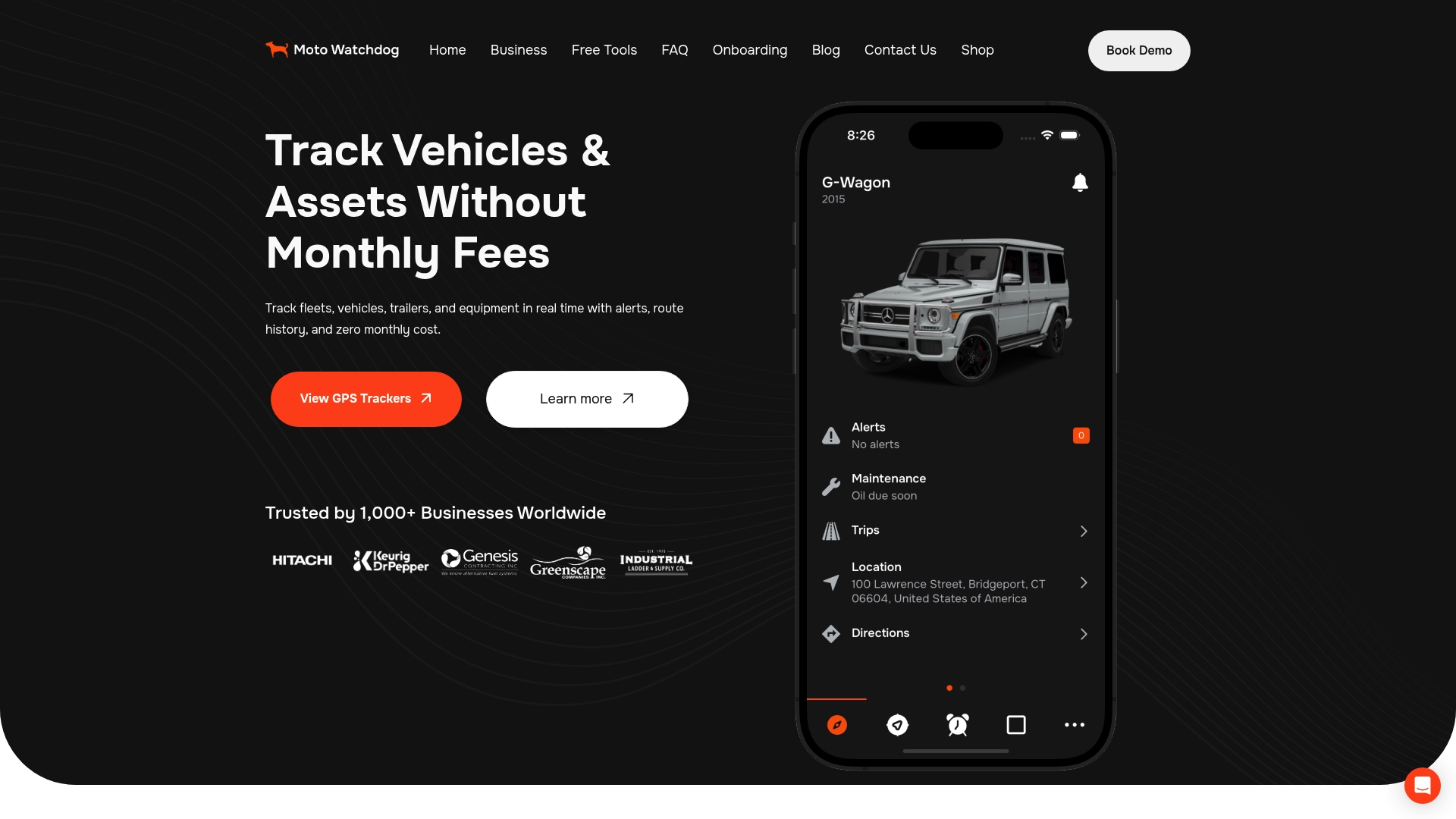
Motowatchdog serves over 1,000 businesses that need reliable fleet accountability without the overhead of monthly billing cycles. Installation takes minutes, and the device scales from a single vehicle to a full commercial fleet. Visit Motowatchdog’s subscription-free GPS tracking page to review device specifications, pricing, and customer results before making your decision.
FAQ
What is subscription-free fleet tracking?
Subscription-free fleet tracking is GPS vehicle monitoring that requires no recurring monthly fees. Hardware is purchased once, and tracking functions operate without ongoing billing.
Do no-subscription GPS trackers still offer real-time updates?
Yes. Devices like Motowatchdog include built-in 4G cellular that provides real-time location updates, geofencing, and alerts without any monthly data plan.
What are the hidden costs of self-hosted fleet tracking?
The primary hidden cost is IT labor. Self-hosting a tracking platform requires ongoing server maintenance, security updates, and technical troubleshooting that adds real operational overhead.
Is free fleet tracking reliable enough for commercial use?
App-based solutions like Drivestream and OBD devices like Motowatchdog are used by thousands of commercial fleets. Reliability depends on device quality and connectivity, not whether a subscription is attached.
How do i choose between OBD and self-hosted tracking?
OBD plug-ins suit fleets under 50 vehicles that need immediate, low-effort deployment. Self-hosted platforms suit larger operations with dedicated IT staff who prioritize full data ownership and custom configurations.