

How to start saving money
Lorem ipsum dolor sit amet, consectetur adipiscing elit lobortis arcu enim urna adipiscing praesent velit viverra sit semper lorem eu cursus vel hendrerit elementum morbi curabitur etiam nibh justo, lorem aliquet donec sed sit mi dignissim at ante massa mattis.
- Neque sodales ut etiam sit amet nisl purus non tellus orci ac auctor
- Adipiscing elit ut aliquam purus sit amet viverra suspendisse potent
- Mauris commodo quis imperdiet massa tincidunt nunc pulvinar
- Excepteur sint occaecat cupidatat non proident sunt in culpa qui officia
Why it is important to start saving
Vitae congue eu consequat ac felis placerat vestibulum lectus mauris ultrices cursus sit amet dictum sit amet justo donec enim diam porttitor lacus luctus accumsan tortor posuere praesent tristique magna sit amet purus gravida quis blandit turpis.

How much money should I save?
At risus viverra adipiscing at in tellus integer feugiat nisl pretium fusce id velit ut tortor sagittis orci a scelerisque purus semper eget at lectus urna duis convallis. porta nibh venenatis cras sed felis eget neque laoreet suspendisse interdum consectetur libero id faucibus nisl donec pretium vulputate sapien nec sagittis aliquam nunc lobortis mattis aliquam faucibus purus in.
- Neque sodales ut etiam sit amet nisl purus non tellus orci ac auctor
- Adipiscing elit ut aliquam purus sit amet viverra suspendisse potenti
- Mauris commodo quis imperdiet massa tincidunt nunc pulvinar
- Adipiscing elit ut aliquam purus sit amet viverra suspendisse potenti
What percentege of my income should go to savings?
Nisi quis eleifend quam adipiscing vitae aliquet bibendum enim facilisis gravida neque. Velit euismod in pellentesque massa placerat volutpat lacus laoreet non curabitur gravida odio aenean sed adipiscing diam donec adipiscing tristique risus. amet est placerat in egestas erat imperdiet sed euismod nisi.
“Nisi quis eleifend quam adipiscing vitae aliquet bibendum enim facilisis gravida neque velit euismod in pellentesque”
Do you have any comments? Share them with us on social media
Eget lorem dolor sed viverra ipsum nunc aliquet bibendum felis donec et odio pellentesque diam volutpat commodo sed egestas aliquam sem fringilla ut morbi tincidunt augue interdum velit euismod eu tincidunt tortor aliquam nulla facilisi aenean sed adipiscing diam donec adipiscing ut lectus arcu bibendum at varius vel pharetra nibh venenatis cras sed felis eget.
Fleet managers who hesitate to adopt GPS tracking often do so based on beliefs that don’t hold up under scrutiny. The most common fleet tracking misconceptions center on five core fears: that systems are too expensive, too complicated, slow to pay off, invasive to employees, and identical across vendors. All five are wrong, and the gap between perception and reality costs businesses real money every year.
Here is a quick look at where the myths break down:
- “It’s too expensive” — GPS tracking typically pays for itself through fuel savings and efficiency gains, often within months of deployment.
- “ROI takes years” — Operational improvements in routing, driver behavior, and maintenance usually deliver measurable returns within the first few months.
- “Employees will revolt” — Resistance is usually concentrated among workers who were already misusing company time, not the broader workforce.
- “All systems are the same” — Modern platforms differ widely in geofencing, alerts, reporting depth, and integration with dispatch or maintenance software.
- “Small fleets don’t need it” — Theft prevention, route efficiency, and customer service improvements benefit a three-vehicle operation just as much as a 300-vehicle one.
Dispelling these misunderstandings about fleet tracking is not just an academic exercise. Every month a fleet runs without real-time visibility is a month of preventable fuel waste, unverified driver behavior, and missed maintenance windows.
Table of Contents
- 1. Is fleet tracking really too complicated and expensive to implement?
- 2. How long does fleet tracking actually take to deliver ROI?
- 3. Does fleet tracking invade employee privacy and cause pushback?
- 4. Are all GPS tracking systems really the same?
- 5. Do small fleets actually benefit from GPS tracking?
- 6. What Motowatchdog customers say about employee acceptance
- 7. What are the real limitations of GPS tracking technology?
- 8. Is your fleet tracking data actually secure and compliant?
- 9. Can fleet tracking actually lower your insurance premiums?
- 10. Do you really need special hardware and a complex installation?
- Key Takeaways
- Motowatchdog gives your fleet real-time visibility without monthly fees
1. Is fleet tracking really too complicated and expensive to implement?
Modern GPS fleet tracking systems are sophisticated under the hood, but that complexity is largely invisible to the end user. The right vendor handles configuration, alert setup, and ongoing support, so your team interacts with a clean dashboard rather than raw telemetry data. As one industry source puts it, good vendor support makes adoption straightforward and mitigates the complexity concerns that stop many fleet managers from moving forward.
On cost, the framing matters. GPS tracking is not a pure expense; it is an investment with measurable returns through reduced fuel consumption, fewer unauthorized vehicle uses, and lower maintenance costs from proactive diagnostics. Subscription-free models, like those Motowatchdog offers, remove the recurring monthly fee entirely, which changes the math significantly for small and mid-sized fleets.
Common cost and complexity concerns that modern systems address:
- Hardware installation — most plug-and-play OBD-II devices take minutes per vehicle, with no professional installer required
- Software learning curve — cloud-based dashboards are designed for fleet managers, not IT specialists
- Ongoing fees — subscription-free options eliminate the per-vehicle monthly charges that inflate total cost of ownership
- Scalability — systems built for three vehicles can grow to thirty without a platform change
- Vendor support — reputable providers offer onboarding assistance and live support to handle edge cases
The real complexity risk is choosing the wrong vendor. A provider that disappears after the sale leaves you managing a system you never fully understood. Vetting support quality before signing is as important as comparing hardware specs.
2. How long does fleet tracking actually take to deliver ROI?
Fleet tracking ROI arrives faster than most fleet managers anticipate, sometimes within the first few months of deployment. The gains come from multiple directions at once: fuel savings from optimized routing, reduced idle time, fewer unauthorized trips, and lower wear-and-tear from better maintenance scheduling.
The table below shows where improvements typically appear and how quickly they tend to materialize.
| Benefit area | Typical time to measurable impact |
|---|---|
| Fuel cost reduction | within a few months |
| Driver behavior improvement | within the first months |
| Unauthorized vehicle use reduction | immediate |
| Maintenance cost savings | within several months |
| Customer service improvements | within a few months |
Fuel economy alone is a strong early signal. The U.S. Department of Energy notes that aggressive driving habits like speeding and hard braking can lower fuel economy by 15–30% on the highway. GPS tracking surfaces exactly those behaviors, giving fleet managers the data to address them before they compound into serious costs.
Beyond fuel, tracking also improves driver behavior, routing decisions, and vehicle maintenance schedules, meaning the ROI picture is broader than most initial projections account for.
Pro Tip: Set a baseline for fuel spend and idle time in your first week with a new tracking system. That baseline becomes your ROI benchmark, and the contrast after 90 days is usually the clearest evidence you can show stakeholders.
3. Does fleet tracking invade employee privacy and cause pushback?
Privacy concerns around GPS tracking are legitimate when the technology is misapplied, but vehicle tracking during work hours sits on solid legal ground in the United States. The critical distinction is between tracking a company-owned vehicle during work hours, which is generally permissible, and tracking an employee’s personal phone around the clock, which raises real compliance issues.

Tracking employee smartphones introduces both privacy exposure and reliability problems. Apps can be disabled, phones can be turned off, and off-duty tracking creates legal risk. Vehicle-based tracking avoids all of that. The data belongs to the company, covers only work hours and company assets, and gives drivers a clear boundary between their professional and personal time.
As for employee resistance, the pattern is consistent across fleets of every size:
- High-performing drivers rarely object because tracking validates their good habits
- Resistance concentrates among workers who were already cutting corners or misusing work hours
- Transparent communication about what is tracked, and why, reduces pushback significantly
- Framing tracking as a fairness tool, not a surveillance tool, shifts the conversation
Pro Tip: Hold a brief team meeting before rollout to explain exactly what data the system collects and what it does not. Drivers who understand the scope of tracking accept it far more readily than those who imagine worst-case scenarios.
The accountability angle is worth emphasizing. When every driver operates under the same visibility standards, top performers are no longer competing against colleagues who game the system. That fairness argument resonates with the workforce you actually want to keep.
4. Are all GPS tracking systems really the same?
The belief that GPS tracking systems are interchangeable is one of the more costly misunderstandings about fleet tracking. Hardware quality, software depth, alert configurability, and integration capability vary widely across the market, and those differences have direct operational consequences.

Customizable alerts, geofencing, and integrations with dispatch or maintenance platforms are what separate a useful system from a basic dot-on-a-map solution. A system that can trigger a maintenance alert when a vehicle hits a mileage threshold, or automatically notify a dispatcher when a driver leaves a designated zone, does fundamentally different work than one that only shows current location.
Key differentiators to evaluate when comparing systems:
- Geofencing — the ability to define zones and receive alerts when vehicles enter or exit
- Custom reporting — mileage logs, driver scorecards, idle time reports, and exception alerts
- Integration depth — connections to dispatch software, fuel card systems, and maintenance platforms
- Hardware options — hardwired devices for permanent installs versus plug-and-play for flexibility
- Data export — the ability to pull raw data into your own reporting tools or accounting software
Choosing based on price alone, without evaluating these features, often leads to a second purchase within 18 months. The right question is not “what does this cost?” but “what does this system let me do that I cannot do today?”
5. Do small fleets actually benefit from GPS tracking?
Small fleets benefit from GPS tracking, and the return per vehicle can actually be higher than in large operations because every asset carries more proportional weight. Small fleet tracking options have expanded considerably, with affordable hardware and flexible pricing structures that make deployment practical for operations running as few as two or three vehicles.
The benefits are concrete, not theoretical:
- Theft recovery — a stolen vehicle without tracking is often a total loss; with tracking, recovery rates improve substantially
- Route efficiency — even a single driver saving 20 minutes per day adds up to hours of recovered productivity each week
- Customer service — accurate ETAs and proof-of-delivery data improve client relationships without adding administrative work
- Insurance documentation — GPS data provides verifiable records in the event of an accident or disputed claim
- Maintenance scheduling — mileage-based alerts prevent the deferred maintenance that shortens vehicle life
The notion that tracking is only worth the investment at scale reflects an older cost structure. With subscription-free hardware options now available, the break-even point for a small fleet is much lower than it was even five years ago.
6. What Motowatchdog customers say about employee acceptance
Many businesses rely on Motowatchdog for real-time vehicle monitoring, and the pattern around employee acceptance is consistent with what the broader industry observes. Resistance, when it appears, tends to come from a specific subset of the workforce rather than from employees broadly.
Motowatchdog customers consistently highlight two things in their feedback: the ease of initial setup and the speed at which the data becomes useful. The geofencing alert system, in particular, gets cited as a feature that resolves disputes quickly because the record is objective. When a driver claims they were at a job site and the data confirms it, that is a win for the driver. When the data shows otherwise, the conversation becomes straightforward.
Key features that address the most common employee-related pain points:
- Real-time location visibility that eliminates “where is my driver?” calls
- Mileage logs that automate reimbursement calculations and remove disputes
- Geofence alerts that notify managers of after-hours vehicle use without requiring manual monitoring
- Driver behavior reports that create a fair, data-based performance record for every team member
The accountability framing matters more than most fleet managers initially realize. Tracking is not surveillance for its own sake. It is the infrastructure for fair performance management.
7. What are the real limitations of GPS tracking technology?
GPS tracking is genuinely powerful, but it has technical boundaries that fleet managers should understand before deployment. Satellite signal quality is the primary constraint. Vehicles operating in dense urban canyons, underground parking structures, or heavily forested areas may experience reduced accuracy or temporary signal loss. The technology works on line-of-sight principles between the device and orbiting satellites, so physical obstructions affect performance.
Battery-powered tracking devices face a different trade-off. Longer battery life typically means less frequent location updates, while real-time tracking draws more power. Hardwired devices avoid this constraint entirely by drawing from the vehicle’s electrical system, but they require a more involved installation. Cellular connectivity is a second dependency: GPS devices that transmit data over cellular networks will have gaps in coverage wherever cell service is weak, which matters for fleets operating in rural areas.
None of these limitations make tracking impractical. They do mean that hardware selection should account for the specific operating environment of your fleet, not just the feature list on a spec sheet.
8. Is your fleet tracking data actually secure and compliant?
Data security concerns around fleet tracking are understandable, but the risk profile is often mischaracterized. The real exposure is not in the GPS data itself. Location and mileage records are not sensitive in the way that financial or health data are. The actual security considerations involve how data is stored, who has access to it, and whether the vendor’s infrastructure meets reasonable standards for encryption and access control.
On the compliance side, the Federal Motor Carrier Safety Administration’s Electronic Logging Device rule requires commercial motor vehicles subject to hours-of-service regulations to use certified ELD devices. GPS tracking systems that include ELD functionality must meet FMCSA certification standards, which sets a clear compliance baseline for regulated fleets. For fleets not subject to ELD mandates, the compliance question shifts to state-level data privacy laws and internal data governance policies.
The practical steps for managing data security are straightforward: choose a vendor that uses encrypted data transmission, limit dashboard access to personnel who need it, and review your vendor’s data retention and deletion policies before signing. Fleet tracking data export practices also matter, since data pulled into third-party tools carries its own security obligations.
9. Can fleet tracking actually lower your insurance premiums?
GPS tracking data gives insurance carriers something they value: documented evidence of driver behavior. Fleets that can demonstrate consistent safe driving through telematics records, including speed compliance, hard braking frequency, and after-hours vehicle use, present a lower risk profile than fleets that offer only self-reported information. Several commercial auto insurers in the United States offer premium discounts for fleets that participate in telematics programs, though the specific discount structure varies by carrier and fleet size.
Beyond premium reductions, GPS records serve as objective evidence in accident investigations and liability disputes. A timestamped location record showing a vehicle’s speed and position at the moment of an incident can resolve a disputed claim far faster than witness accounts alone. That documentation value is separate from any premium benefit and applies to every insured fleet regardless of carrier.
The insurance conversation is worth having with your broker before deployment, not after. Some carriers require advance notice to apply telematics discounts, and the data collection period needed to qualify for a rate adjustment varies.
10. Do you really need special hardware and a complex installation?
The belief that fleet tracking requires expensive proprietary hardware and professional installation stops many fleet managers from even requesting a quote. The reality is that most modern tracking devices fall into two categories: OBD-II plug-in devices that connect to the vehicle’s diagnostic port in under a minute, and hardwired units that offer more permanence and tamper resistance but require a basic electrical connection.
OBD-II devices work on virtually every vehicle manufactured after 1996, which covers the vast majority of active commercial fleets in the United States. No drilling, no wiring, no downtime. A driver can self-install one before their first route of the day. Hardwired devices take longer but are still a straightforward job for anyone comfortable with basic automotive electrical work, and many vendors provide clear installation guides.
The “special hardware” myth often traces back to older enterprise systems that did require custom installations and proprietary networks. That model still exists at the high end of the market, but it is not representative of what most fleet managers actually need. Subscription-free devices, in particular, are designed for self-installation because removing the monthly fee model also removes the vendor’s incentive to lock you into a managed hardware program.
Key Takeaways
Fleet managers who act on accurate information rather than fleet tracking myths consistently see faster ROI, better driver accountability, and lower operating costs than those who delay based on unfounded concerns.
| Point | Details |
|---|---|
| ROI arrives quickly | Fuel savings, reduced idle time, and behavior improvements often show measurable returns within the first few months. |
| Employee resistance is targeted | Pushback concentrates among underperforming workers; most drivers accept tracking when it is explained clearly. |
| Systems differ significantly | Geofencing, custom alerts, and software integrations vary widely and directly affect operational value. |
| Small fleets benefit too | Theft recovery, route efficiency, and insurance documentation deliver real returns even for two-to-three vehicle operations. |
| Motowatchdog removes the fee barrier | Subscription-free GPS tracking from Motowatchdog eliminates monthly per-vehicle charges, lowering the break-even point for any fleet size. |
Motowatchdog gives your fleet real-time visibility without monthly fees
Most fleet tracking solutions solve the visibility problem and then add a recurring subscription that compounds every month. Motowatchdog takes a different approach: pay once for hardware, get real-time GPS tracking without an ongoing fee attached to every vehicle in your fleet.
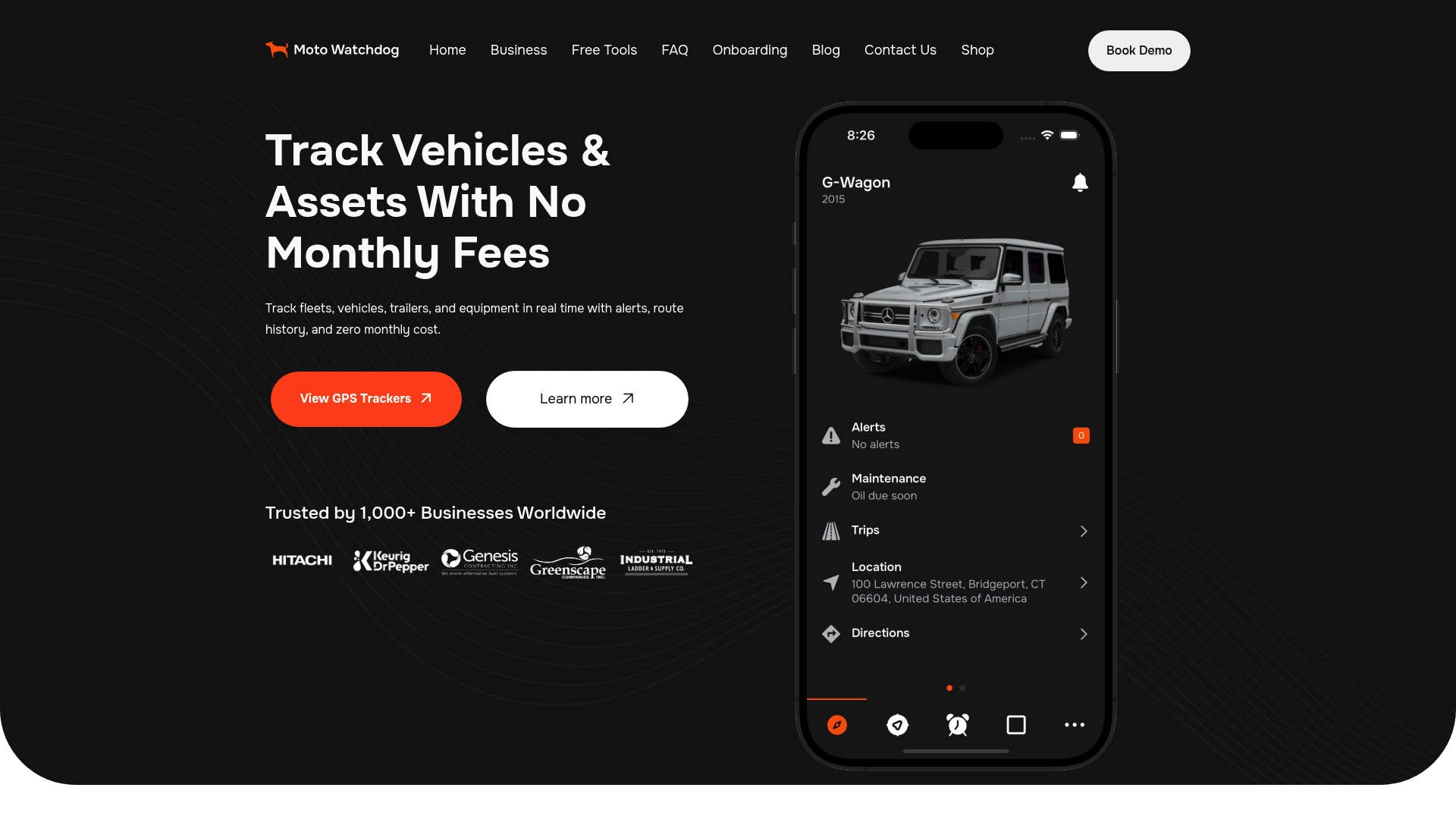
For fleet managers who have been holding off because of cost concerns, that structure changes the calculation entirely. Motowatchdog serves over 1,000 businesses with customizable geofencing alerts, detailed mileage reporting, and long-battery-life devices built for real-world commercial use. Setup is self-install, the interface is built for fleet managers rather than IT teams, and support is available when you need it. Whether you run three vehicles or thirty, the subscription-free GPS model means your tracking costs stay flat as your fleet grows. See Motowatchdog’s hardware options and get your fleet covered today at motowatchdog.com.

