

How to start saving money
Lorem ipsum dolor sit amet, consectetur adipiscing elit lobortis arcu enim urna adipiscing praesent velit viverra sit semper lorem eu cursus vel hendrerit elementum morbi curabitur etiam nibh justo, lorem aliquet donec sed sit mi dignissim at ante massa mattis.
- Neque sodales ut etiam sit amet nisl purus non tellus orci ac auctor
- Adipiscing elit ut aliquam purus sit amet viverra suspendisse potent
- Mauris commodo quis imperdiet massa tincidunt nunc pulvinar
- Excepteur sint occaecat cupidatat non proident sunt in culpa qui officia
Why it is important to start saving
Vitae congue eu consequat ac felis placerat vestibulum lectus mauris ultrices cursus sit amet dictum sit amet justo donec enim diam porttitor lacus luctus accumsan tortor posuere praesent tristique magna sit amet purus gravida quis blandit turpis.

How much money should I save?
At risus viverra adipiscing at in tellus integer feugiat nisl pretium fusce id velit ut tortor sagittis orci a scelerisque purus semper eget at lectus urna duis convallis. porta nibh venenatis cras sed felis eget neque laoreet suspendisse interdum consectetur libero id faucibus nisl donec pretium vulputate sapien nec sagittis aliquam nunc lobortis mattis aliquam faucibus purus in.
- Neque sodales ut etiam sit amet nisl purus non tellus orci ac auctor
- Adipiscing elit ut aliquam purus sit amet viverra suspendisse potenti
- Mauris commodo quis imperdiet massa tincidunt nunc pulvinar
- Adipiscing elit ut aliquam purus sit amet viverra suspendisse potenti
What percentege of my income should go to savings?
Nisi quis eleifend quam adipiscing vitae aliquet bibendum enim facilisis gravida neque. Velit euismod in pellentesque massa placerat volutpat lacus laoreet non curabitur gravida odio aenean sed adipiscing diam donec adipiscing tristique risus. amet est placerat in egestas erat imperdiet sed euismod nisi.
“Nisi quis eleifend quam adipiscing vitae aliquet bibendum enim facilisis gravida neque velit euismod in pellentesque”
Do you have any comments? Share them with us on social media
Eget lorem dolor sed viverra ipsum nunc aliquet bibendum felis donec et odio pellentesque diam volutpat commodo sed egestas aliquam sem fringilla ut morbi tincidunt augue interdum velit euismod eu tincidunt tortor aliquam nulla facilisi aenean sed adipiscing diam donec adipiscing ut lectus arcu bibendum at varius vel pharetra nibh venenatis cras sed felis eget.
GPS tracking on attachments prevents theft, speeds recovery, and delivers the utilization and engine-hour data fleet managers need to cut waste and plan maintenance. The construction equipment industry loses an estimated $400 million per year to equipment theft, with only around one-fifth of stolen items ever recovered. Attachments — buckets, forks, hydraulic hammers, compactors, and trailers — are disproportionately at risk because they detach from machines, move between sites, and often sit unattended overnight.
The immediate benefits of tracking attachments with GPS include:
- Faster theft recovery — real-time location data lets you direct law enforcement to a stolen attachment within hours, not days
- Fewer replacement purchases — knowing where every attachment is eliminates panic buys when a crew can’t locate a tool
- Improved dispatch accuracy — dispatchers can confirm which attachment is at which site before sending a truck
- Predictive maintenance windows — movement and machine-pairing data serve as run-time proxies that trigger service intervals before failures occur
Start with rugged battery-powered or subscription-free cellular trackers assigned by serial ID to your highest-value attachments. Then expand to low-cost Bluetooth Low Energy (BLE) or LoRa tags for site-level visibility across the rest of your inventory.
Table of Contents
- Why do attachments need their own GPS tracking?
- What tracker types work best for attachments?
- How should you mount trackers on attachments?
- How does GPS tracking change daily operations?
- What should you expect to pay for attachment trackers?
- What are the legal and privacy rules for tracking in North America?
- What questions should you ask vendors before buying?
- Key Takeaways
- The case for treating attachments as first-class fleet assets
- Motowatchdog offers subscription-free GPS tracking for attachment fleets
- Useful sources
Why do attachments need their own GPS tracking?
Powered machines — excavators, skid steers, wheel loaders — increasingly ship with OEM telematics like John Deere’s JDLink built in. Attachments get no such treatment. A hydraulic thumb or a plate compactor has no onboard power source, no CAN bus, and no factory data connection. That gap creates real operational blind spots.
Attachments are detached, repositioned, and left at job sites far more often than the machines that carry them. A bucket might move between three sites in a week while the excavator it fits stays at one location. Without dedicated tracking, that bucket is invisible to your fleet software the moment it leaves the machine.
Industry research shows workers spend roughly 10% of the workday searching for tools and attachments when no visibility system is in place. Across a crew of ten, that’s a full person-day of lost productivity every single day.
The cost drivers compound quickly: downtime from searching, emergency rentals when an attachment can’t be found, and outright replacement purchases after theft. Attachment characteristics — small footprint, no power source, and high wear exposure — also mean they need tracker hardware specifically designed for the environment, not a repurposed vehicle OBD device.
- Attachments lack OEM telematics, creating dispatch and maintenance gaps
- Frequent detachment and site transfers increase theft and loss exposure
- No onboard power source requires battery-powered or energy-harvesting tracker designs
- Small size and impact exposure demand rugged, tamper-resistant housings
What tracker types work best for attachments?
Attachment-tracking technologies fall into five categories, each with a distinct use-case sweet spot. Matching the right technology to the attachment type is the single biggest factor in controlling total cost of ownership.
Hardwired / harnessed trackers draw power from a machine’s electrical system and suit permanently mounted powered attachments — think powered sweepers or cold planers that stay on one machine for extended periods. Installation is more complex, but battery replacement is never a concern. A solid reference for this approach is Motowatchdog’s GPS tracker fleet hardwiring guide.

Battery-powered cellular trackers are the workhorse choice for high-value detachable items. They report location anywhere a cellular network reaches, making them the best option when an attachment could end up anywhere in a metro area or across state lines after theft.
Telematics-proxy solutions piggyback attachment data through the host machine’s telematics system. They work well when an attachment stays paired to one machine most of the time, but lose visibility the moment the attachment is separated.
BLE tags with gateway readers excel at dense site detection. A gateway mounted on a machine or at a yard entrance reads nearby BLE tags and reports their presence. Battery life stretches to years, and per-tag cost is low — making this the right call for large inventories of lower-value tools.
LoRa (Long Range) devices offer long-range, low-power communication across large yards or rural sites where cellular coverage is spotty. They sacrifice real-time precision for coverage and battery longevity.
| Tracker Type | Coverage | Battery Life | Typical Update Frequency | Best For |
|---|---|---|---|---|
| Hardwired cellular | Nationwide | N/A (wired) | Real-time to 1 min | Powered, permanently mounted attachments |
| Battery cellular | Nationwide | 6 months | Multiple times/day to hourly | High-value detachable items, theft-risk assets |
| Telematics proxy | Machine-dependent | N/A (machine power) | Per machine report cycle | Attachments paired long-term to one machine |
| BLE tag + gateway | Site/yard range | 1–3 years | On gateway pass or scheduled | Dense tool inventories, low-value items |
| LoRa | Long-range, low-power | 2–5 years | Hourly to daily | Large yards, rural sites, low-theft-risk assets |

Devices can be configured to report anywhere from multiple times per day to once every few seconds, depending on the use case. Higher frequency burns battery faster — a trade-off that directly affects your replacement schedule and TCO.
How should you mount trackers on attachments?
Placement is where many programs fail. A tracker buried under steel plating loses GPS signal. One bolted to an obvious external surface gets removed by a thief in under a minute. The goal is concealment without compromising antenna line-of-sight.
Mounting methods by situation:
- Weld tabs provide the most permanent, tamper-resistant base for steel attachments — weld a recessed tab inside a structural cavity and bolt the tracker housing to it
- Bolted enclosures work on attachments with existing bolt patterns; use tamper-resistant fasteners (Torx or spanner-head) to raise the effort required for removal
- Epoxy or adhesive pads suit smooth surfaces where welding isn’t practical, but require a UV-resistant, vibration-rated adhesive rated for outdoor construction environments
- Locking housings add a physical deterrent layer and are worth the cost on any attachment valued above $5,000
Position the antenna toward open sky whenever possible. When the tracker must sit inside a cavity, use a short external antenna routed through a protected grommet to a location with sky exposure. Avoid mounting directly adjacent to hydraulic lines or heat sources.
Operational checklist after installation:
- Assign the device serial number to the attachment’s asset record in your fleet software
- Confirm firmware is current before deployment
- Send a test ping and verify the reported location against the physical location
- Set a geofence boundary and confirm the alert fires when the attachment crosses it
- Log the battery installation date and set a calendar reminder for the replacement interval
Pro Tip: On high-theft-risk attachments, install a secondary low-cost BLE tag in a separate hidden location in addition to the primary cellular tracker. If a thief finds and removes one device, the second still reports location when the attachment passes a gateway.
How does GPS tracking change daily operations?
The operational payoff from tracking attachments with GPS shows up in four distinct areas, each with a measurable impact on the bottom line.

Theft prevention and recovery is the most immediate benefit. When assets are known to be tracked, organized theft rings tend to move on to softer targets. When theft does occur, real-time location data lets you work with law enforcement to recover the attachment quickly — before it crosses state lines or gets stripped. Given that only about one-fifth of stolen equipment is recovered without tracking, the math on a single prevented replacement purchase often pays for an entire year of tracker hardware.
Utilization and rental management becomes data-driven rather than guesswork. GPS movement data reveals which attachments sit idle for weeks at a time. That visibility lets you right-size your fleet, reallocate underused items to higher-demand sites, or return rental attachments before the next billing cycle instead of paying for idle days.
Maintenance and lifecycle planning improves when attachment movement and machine-pairing data serve as run-time proxies. Work-tool locators commonly provide both location and usage metrics that help rental and fleet managers plan maintenance and reduce unplanned downtime. Knowing an attachment has logged a certain number of operating hours triggers wear-part inspections before a failure sidelines a crew.
Dispatch accuracy is a quieter but equally valuable gain. Dispatchers eliminate time-consuming phone calls and guesswork when they can see exactly which attachment is at which site. Crews arrive with the right tool, not a substitute that costs an extra mobilization trip.
What should you expect to pay for attachment trackers?
Hardware and recurring costs vary significantly by technology type. Understanding the full five-year total cost of ownership (TCO) — not just the sticker price — is the right frame for procurement decisions.
| Category | Typical Hardware Cost | Expected Battery Life | Approx. Monthly Recurring Cost |
|---|---|---|---|
| Rugged battery cellular | — | 6 months | $5 (cellular data plan) |
| BLE tag (with gateway) | $10 per tag | 1–3 years | Near zero (gateway data only) |
| LoRa device | $30 per unit | 2–5 years | Near zero to low |
| Hardwired cellular | $100 per unit | N/A (wired) | $5 (cellular data plan) |
Subscription models typically bundle cellular data, cloud storage, and reporting software into a monthly per-device fee. For a fleet of 50 attachments, that recurring cost adds up fast. A subscription-free GPS model eliminates the monthly data fee entirely, which can meaningfully reduce TCO for large attachment fleets.
For small operations managing costs carefully, the small fleet tracking guide covers practical approaches to deploying trackers without overextending the budget.
Pro Tip: Calculate five-year TCO by adding hardware cost, battery replacements (at the manufacturer’s stated interval), and cumulative subscription fees. Then subtract the estimated recovered value from one prevented theft or avoided emergency rental. For most fleets, the net TCO is positive within the first year.
What are the legal and privacy rules for tracking in North America?
Tracking attachments is generally straightforward from a legal standpoint because you are tracking company-owned assets, not individuals. The complexity arises when location data is tied to employee behavior or when devices are placed on equipment that employees take home.
State statutes vary on private use of location-tracking devices, and several states have broader prohibitions or employee-notice requirements. The National Conference of State Legislatures (NCSL) maintains a current summary of these statutes — it is the right first stop before deploying any tracking program.
Practical rules that hold across most jurisdictions:
- Track assets, not people — configure reports around attachment location, not individual employee movement
- Publish a written tracking policy and have employees acknowledge it before deployment
- Limit access to location history to personnel with a legitimate operational need
- Define a retention period for location data (90–180 days is common) and delete records beyond it
This article provides general guidance. Consult qualified legal counsel for your specific situation and jurisdiction before implementing a tracking program. Reviewing how GPS affects fleet safety and compliance is also a useful starting point for building a defensible policy.
What questions should you ask vendors before buying?
A structured evaluation prevents expensive mistakes. Use this checklist to score vendors during procurement or RFPs.
Pass/fail criteria (require a clear yes before proceeding):
- Does the device report at the interval your operation requires (multiple times per day for rental, hourly for standard fleet)?
- Is battery life documented under real-world conditions, not lab conditions?
- Does the device send a tamper alert if removed or the housing is opened?
- Does geofencing support custom polygon boundaries, not just radius circles?
- Can the device be paired to a machine asset ID in your fleet software?
- Is there a documented firmware update process that does not require physical retrieval of the device?
Integration questions:
- What export formats are available (CSV, JSON, API)?
- Does the platform offer a REST API with documented endpoints for your ERP or rental management system?
- Review fleet GPS data integration examples to understand what a well-integrated setup looks like before evaluating vendor claims.
Service and support:
- What is the warranty period, and does it cover theft or physical damage to the device?
- What is the device replacement policy if a tracker is stolen along with the attachment?
- Is on-site installation support available, or is the program entirely self-install?
Effective heavy truck parts inventory management follows similar procurement discipline — the same structured vendor evaluation approach applies directly to attachment tracker sourcing.
Key Takeaways
Tracking attachments with GPS pays for itself through theft prevention, reduced search time, and maintenance data — start with high-value detachable items and match tracker technology to the specific use case.
| Point | Details |
|---|---|
| Prioritize high-value items first | Deploy cellular trackers on your most expensive detachable attachments before expanding to lower-value tools. |
| Match technology to use case | Use battery cellular for theft-risk assets, BLE tags for dense site inventories, and LoRa for large rural yards. |
| Calculate five-year TCO | Factor hardware, battery replacements, and subscription fees against one prevented theft or avoided rental to confirm ROI. |
| Enforce serial-ID assignment | Every tracker must be registered to a specific attachment asset record before it leaves the yard. |
| Motowatchdog subscription-free option | Motowatchdog eliminates monthly data fees, making it a practical choice when recurring cost is a key constraint for large fleets. |
The case for treating attachments as first-class fleet assets
Most fleet managers track their machines and ignore their attachments. That gap is where the money leaks out. A $15,000 hydraulic hammer sitting untracked at a remote site is a theft target, a maintenance unknown, and a dispatch mystery — all at once.
The conventional wisdom is that GPS tracking is for vehicles. The more accurate view is that GPS tracking is for anything valuable enough that losing it costs more than the tracker. For most attachment fleets, that threshold is crossed at a few thousand dollars of replacement value — well within the range of a standard bucket or fork set.
What surprises most managers who deploy attachment trackers for the first time is not the theft recovery. It is the utilization data. Seeing that 30% of your attachment inventory sits idle for three or more weeks at a stretch changes how you think about fleet size, rental decisions, and capital allocation. That visibility is worth the hardware cost on its own, independent of any theft event.
The pilot approach works best: tag 10–20 high-value attachments, run for 90 days, and measure search time saved, rental avoided, and any recovery events. The data from that pilot makes the business case for full deployment far more convincing than any vendor presentation.
Motowatchdog offers subscription-free GPS tracking for attachment fleets
No monthly fees, no recurring data charges — that is the concrete difference Motowatchdog brings to attachment tracking. For a fleet of 50 attachments on a standard cellular subscription plan, monthly fees accumulate into a significant annual line item. Motowatchdog’s subscription-free 4G GPS tracking eliminates that cost entirely, giving fleet managers predictable hardware-only TCO from day one.
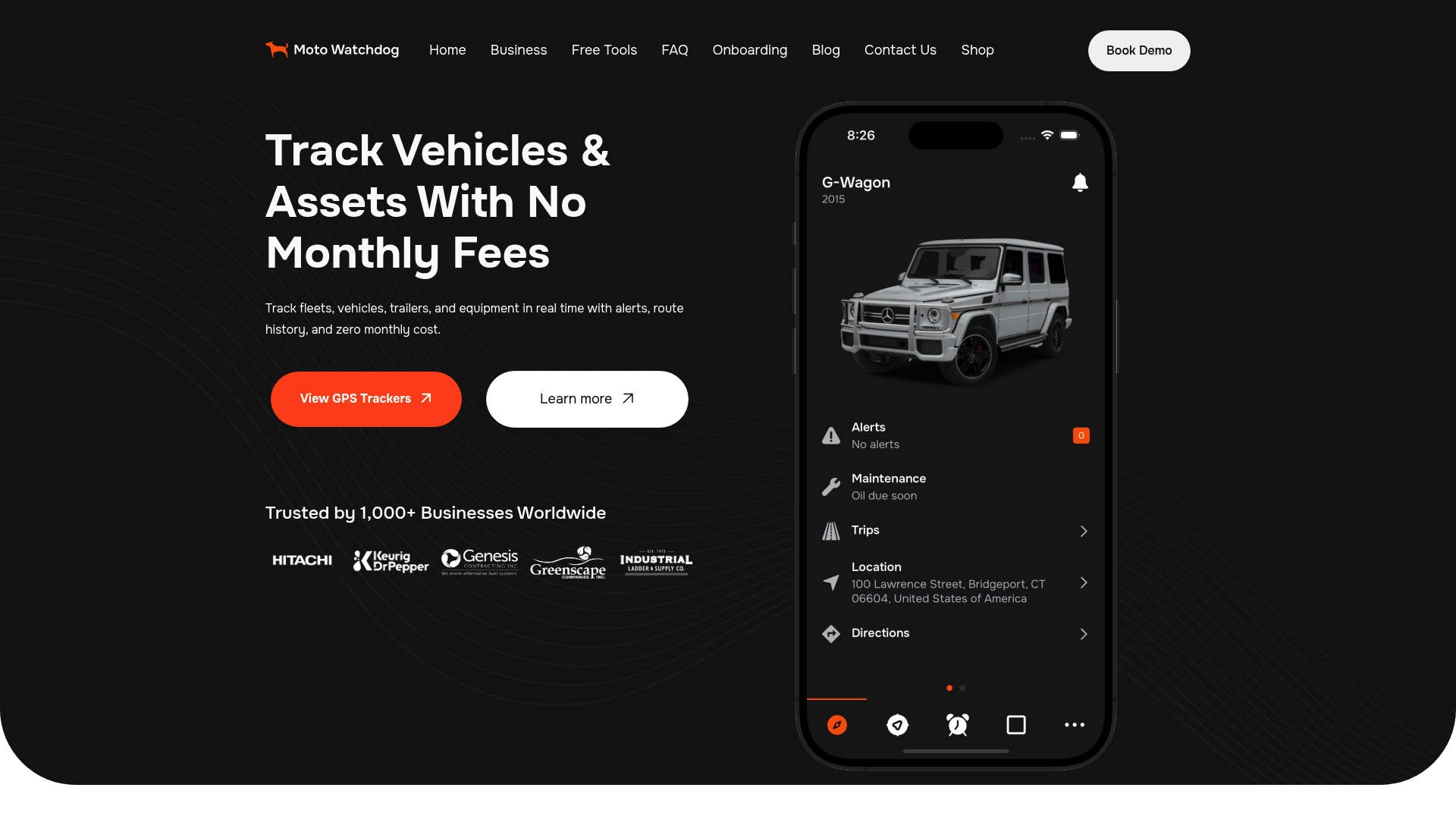
The platform supports customizable geofencing alerts, long battery life designed for detached assets, and a straightforward setup process that over 1,000 businesses have already used to protect vehicles and equipment. For attachment tracking specifically, the combination of rugged hardware and no recurring fees makes fleet expansion simple — add devices as your inventory grows without recalculating a monthly budget line. Visit motowatchdog.com to review device specs and start a pilot for your highest-value attachments.
Useful sources
- NCSL: Private Use of Location Tracking Devices — State Statutes — consult for state-by-state legal requirements before deploying any tracking program
- For Construction Pros: Prevent Lost and Stolen Construction Tools and Attachments — industry theft statistics and productivity data
- For Construction Pros: Rental Attachment Telematics and Asset Management — technology comparison and reporting interval guidance
- For Construction Pros: 3 Reasons To Add Tracking Devices To Your Work Tools — maintenance and run-hour tracking use cases
- Motowatchdog: Subscription-Free 4G GPS Tracking — product specs, device options, and purchase information
- Motowatchdog: What Is a Lifetime GPS Tracker? — explains subscription-free tracker models and warranty considerations
- Motowatchdog: Fleet GPS Data Integration Examples — API and export options for connecting tracker data to fleet management systems

