How to start saving money
Lorem ipsum dolor sit amet, consectetur adipiscing elit lobortis arcu enim urna adipiscing praesent velit viverra sit semper lorem eu cursus vel hendrerit elementum morbi curabitur etiam nibh justo, lorem aliquet donec sed sit mi dignissim at ante massa mattis.
- Neque sodales ut etiam sit amet nisl purus non tellus orci ac auctor
- Adipiscing elit ut aliquam purus sit amet viverra suspendisse potent
- Mauris commodo quis imperdiet massa tincidunt nunc pulvinar
- Excepteur sint occaecat cupidatat non proident sunt in culpa qui officia
Why it is important to start saving
Vitae congue eu consequat ac felis placerat vestibulum lectus mauris ultrices cursus sit amet dictum sit amet justo donec enim diam porttitor lacus luctus accumsan tortor posuere praesent tristique magna sit amet purus gravida quis blandit turpis.

How much money should I save?
At risus viverra adipiscing at in tellus integer feugiat nisl pretium fusce id velit ut tortor sagittis orci a scelerisque purus semper eget at lectus urna duis convallis. porta nibh venenatis cras sed felis eget neque laoreet suspendisse interdum consectetur libero id faucibus nisl donec pretium vulputate sapien nec sagittis aliquam nunc lobortis mattis aliquam faucibus purus in.
- Neque sodales ut etiam sit amet nisl purus non tellus orci ac auctor
- Adipiscing elit ut aliquam purus sit amet viverra suspendisse potenti
- Mauris commodo quis imperdiet massa tincidunt nunc pulvinar
- Adipiscing elit ut aliquam purus sit amet viverra suspendisse potenti
What percentege of my income should go to savings?
Nisi quis eleifend quam adipiscing vitae aliquet bibendum enim facilisis gravida neque. Velit euismod in pellentesque massa placerat volutpat lacus laoreet non curabitur gravida odio aenean sed adipiscing diam donec adipiscing tristique risus. amet est placerat in egestas erat imperdiet sed euismod nisi.
“Nisi quis eleifend quam adipiscing vitae aliquet bibendum enim facilisis gravida neque velit euismod in pellentesque”
Do you have any comments? Share them with us on social media
Eget lorem dolor sed viverra ipsum nunc aliquet bibendum felis donec et odio pellentesque diam volutpat commodo sed egestas aliquam sem fringilla ut morbi tincidunt augue interdum velit euismod eu tincidunt tortor aliquam nulla facilisi aenean sed adipiscing diam donec adipiscing ut lectus arcu bibendum at varius vel pharetra nibh venenatis cras sed felis eget.
Small equipment GPS is defined as a compact, battery-powered device that uses satellite signals and cellular networks to deliver real-time location tracking for tools, machinery, trailers, and other assets. The industry term for the broader technology is GNSS (Global Navigation Satellite System) tracking, and small equipment GPS represents its most portable, field-ready form. The global GPS tracking market is projected to reach $4.76 billion by 2027, growing from $2.5 billion in 2022 at over 13% annually. That growth reflects how widely businesses and individuals now depend on location visibility to protect and manage physical assets. Whether you run a construction crew, manage a rental fleet, or simply want to protect expensive tools, understanding how this technology works is the first step toward using it effectively.
What is small equipment GPS and how does it work?
Small equipment GPS works by receiving signals from multiple GNSS satellites and using a process called trilateration to calculate the device’s exact position. The receiver measures the time it takes for signals to arrive from at least four satellites, then uses those time differences to pinpoint latitude, longitude, and altitude. This calculation happens inside the tracker itself, typically within seconds of powering on.
Once the position is calculated, the device needs a way to send that data to you. Real-time GPS trackers use GSM cellular modules or embedded eSIMs to transmit location data over cellular networks to cloud servers. You then access that data through a mobile app or web platform. This is why most trackers require a cellular data plan: the satellite signal tells the device where it is, but the cellular connection is what gets that information to your phone.

Not every tracker operates in real time. Passive GPS loggers store location history internally and only upload data when connected to a computer or Wi-Fi. Real-time trackers are more useful for theft recovery and live fleet monitoring, while passive loggers work well for mileage reporting and route auditing.
Assisted GPS (also called A-GPS) improves accuracy in challenging environments by supplementing satellite signals with cellular tower data or Wi-Fi positioning. A tracker inside a metal equipment shed or an urban canyon with tall buildings may struggle to lock onto satellites alone. A-GPS closes that gap, often cutting the time to first fix from several minutes down to a few seconds.
Pro Tip: If your equipment spends time indoors or in covered storage, choose a tracker that explicitly supports A-GPS or hybrid positioning. Pure satellite-only devices can lose signal entirely in those conditions.
Key components inside a typical small equipment GPS tracker:
- GNSS receiver: Captures satellite signals and calculates position
- GSM or LTE cellular module: Transmits location data to servers
- Battery or hardwire power input: Powers the device in the field
- Onboard memory: Stores location logs when cellular signal is unavailable
- Accelerometer (on many models): Detects motion to trigger alerts or conserve battery
What are the benefits and practical applications of small equipment GPS?
Small equipment GPS trackers serve a wide range of use cases including personal safety, asset theft prevention, fleet management, and tool tracking. Each of those categories represents a real operational problem that location visibility solves directly.

Theft prevention is the most immediate benefit. Construction equipment theft costs the American industry hundreds of millions of dollars each year, and most stolen equipment is never recovered because there is no way to locate it after the fact. A GPS tracker changes that equation entirely. Law enforcement can act on a precise location rather than a vague description, and recovery rates rise significantly when a tracker is installed.
Operational efficiency is the second major benefit, and it compounds over time. When a site manager can see exactly where every piece of equipment is located, dispatching becomes faster and equipment sits idle less often. A crew that spends 20 minutes searching for a misplaced generator or compressor every morning loses meaningful productivity across a full work season.
Practical applications where small equipment tracking delivers measurable results:
- Construction sites: Track excavators, compactors, generators, and trailers across multiple job sites
- Tool management: Monitor high-value hand tools and power equipment in shared tool cribs
- Vehicle trailers: Confirm trailer location when a cab drops and leaves without checking in
- Rental fleets: Verify equipment returns and locate unreturned assets automatically
- Personal valuables: Protect motorcycles, ATVs, boats, and recreational vehicles
Geofencing adds another layer of control. You define a geographic boundary around a job site or storage yard, and the tracker sends an alert the moment equipment crosses that line. This works for both theft detection and unauthorized use during off-hours.
Pro Tip: Set geofence alerts to trigger after business hours rather than all day. Daytime movement is expected. A 2 a.m. alert from a piece of equipment that should be parked is the signal that actually matters.
For businesses managing dispersed equipment, the small fleet tracking benefits extend to maintenance scheduling. When a tracker logs engine hours or mileage, service intervals become data-driven rather than guesswork. That shift prevents both over-servicing and costly breakdowns from deferred maintenance.
What factors should you consider when choosing a small equipment GPS tracker?
The right tracker depends on how and where your equipment operates. A device that works perfectly for a landscaping trailer may be a poor fit for a tracked excavator or an indoor tool crib. Four factors determine whether a tracker will perform reliably in your specific environment.
Battery life and power source
Battery life is the most practical constraint for equipment that does not have a constant power supply. Entry-level field devices often deliver 1–2 weeks of battery life at standard reporting intervals. Devices with extended battery modes can last several months by reporting only when motion is detected. Hardwired trackers eliminate battery concerns entirely but require installation time and are not practical for tools or trailers without a power connection.
Accuracy and signal reliability
GPS accuracy in open-sky conditions typically falls within 3–5 meters for consumer-grade devices. Durability, size, and mounting options directly affect how reliably a device maintains signal in real-world conditions. A tracker mounted inside a metal equipment box will perform worse than one mounted on the exterior. Devices with A-GPS handle signal-challenged environments better than satellite-only units.
Subscription model vs. subscription-free options
Cellular data subscription fees are often misunderstood. They are not arbitrary charges. They are the cost of the cellular data connection that transmits location to your device. Standard subscription-based trackers charge monthly fees that range from a few dollars to $30 or more per device. For a fleet of 20 pieces of equipment, that adds up quickly.
Subscription-free GPS trackers remove ongoing fees by using patented technology or alternative connectivity methods. This model appeals to budget-conscious businesses that need reliable tracking without a recurring line item on the monthly budget.
Durability and environmental rating
Equipment operates in rain, dust, mud, and extreme temperatures. Look for an IP67 or IP68 rating, which confirms the device is dust-tight and water-resistant. Magnetic mounts work well for metal equipment frames. Adhesive or bolt-on mounts are better for non-metallic surfaces or applications where a magnet could shift during transport.
How does the GPS tracker market look in 2026?
The GPS tracking device market is growing at a pace that reflects genuine demand, not hype. The projected market size of $4.76 billion by 2027 represents a near-doubling from the 2022 baseline of $2.5 billion. That growth is driven by falling hardware costs, wider 4G LTE coverage, and the increasing integration of GPS trackers with IoT fleet management platforms.
Miniaturization is the most significant hardware trend. Trackers that once required a housing the size of a deck of cards now fit in a form factor closer to a matchbox. Smaller size means more mounting options and easier concealment on equipment, which improves both security and installation flexibility.
Battery technology has advanced alongside miniaturization. Motion-triggered reporting, where the device only transmits when it detects movement, has extended practical battery life dramatically. A tracker in sleep mode on parked equipment can now last months between charges rather than days.
“The shift toward subscription-free models reflects a maturing market where buyers are no longer willing to pay indefinitely for connectivity they do not always need.”
Cellular connectivity is moving from 2G and 3G networks, which are being shut down across the United States, to 4G LTE and emerging 5G infrastructure. Businesses buying trackers today should confirm that any device they purchase operates on 4G LTE at minimum. A tracker built on a deprecated network will stop working when that network goes offline.
Privacy and data security are becoming more prominent considerations as GPS data becomes more detailed and more valuable. Businesses should review how tracker vendors store location data, who has access to it, and whether data is encrypted in transit.
Key takeaways
Small equipment GPS is the most direct tool available for protecting physical assets and improving operational visibility across job sites, fleets, and storage facilities.
| Point | Details |
|---|---|
| Core technology | GPS satellites calculate position; cellular networks transmit that data to your device in real time. |
| Subscription clarity | Cellular fees cover data transmission costs, not arbitrary charges. Subscription-free options exist. |
| Top applications | Construction equipment, tool management, trailers, rental fleets, and personal valuables all benefit directly. |
| Buying criteria | Prioritize battery life, IP rating, A-GPS support, and network compatibility (4G LTE minimum). |
| Market trajectory | The GPS tracking market is projected to reach $4.76 billion by 2027, driven by miniaturization and IoT integration. |
Why I think most buyers overlook the most important detail
After years of watching businesses evaluate GPS trackers, I keep seeing the same mistake. Buyers focus almost entirely on price and update frequency, then discover six months later that the device they chose loses signal every time equipment moves into a covered area or a metal building.
The specification that actually predicts real-world performance is A-GPS support combined with a current-generation cellular module. A tracker with A-GPS and 4G LTE will outperform a cheaper satellite-only device in almost every practical scenario, including the ones that matter most: theft recovery at night, locating equipment inside a warehouse, and maintaining signal in dense urban job sites.
The subscription question deserves more transparency than most vendors provide. Subscription-free GPS tracking is a real and growing category, not a marketing gimmick. But buyers should ask exactly how connectivity is handled before assuming “no subscription” means no cellular costs at all. Some devices shift the cost to a one-time fee. Others use alternative networks. Understanding the model before you buy prevents frustration later.
My honest advice: test any tracker in the actual environment where your equipment operates before committing to a fleet-wide purchase. A device that performs well in an open parking lot may fail completely in the conditions your equipment actually faces every day.
— Louis
Motowatchdog’s subscription-free approach to small equipment tracking
Businesses and individuals who want reliable asset tracking without monthly fees have a direct option in Motowatchdog. Over 1,000 businesses rely on Motowatchdog’s accuracy for real-time monitoring of vehicles and equipment.
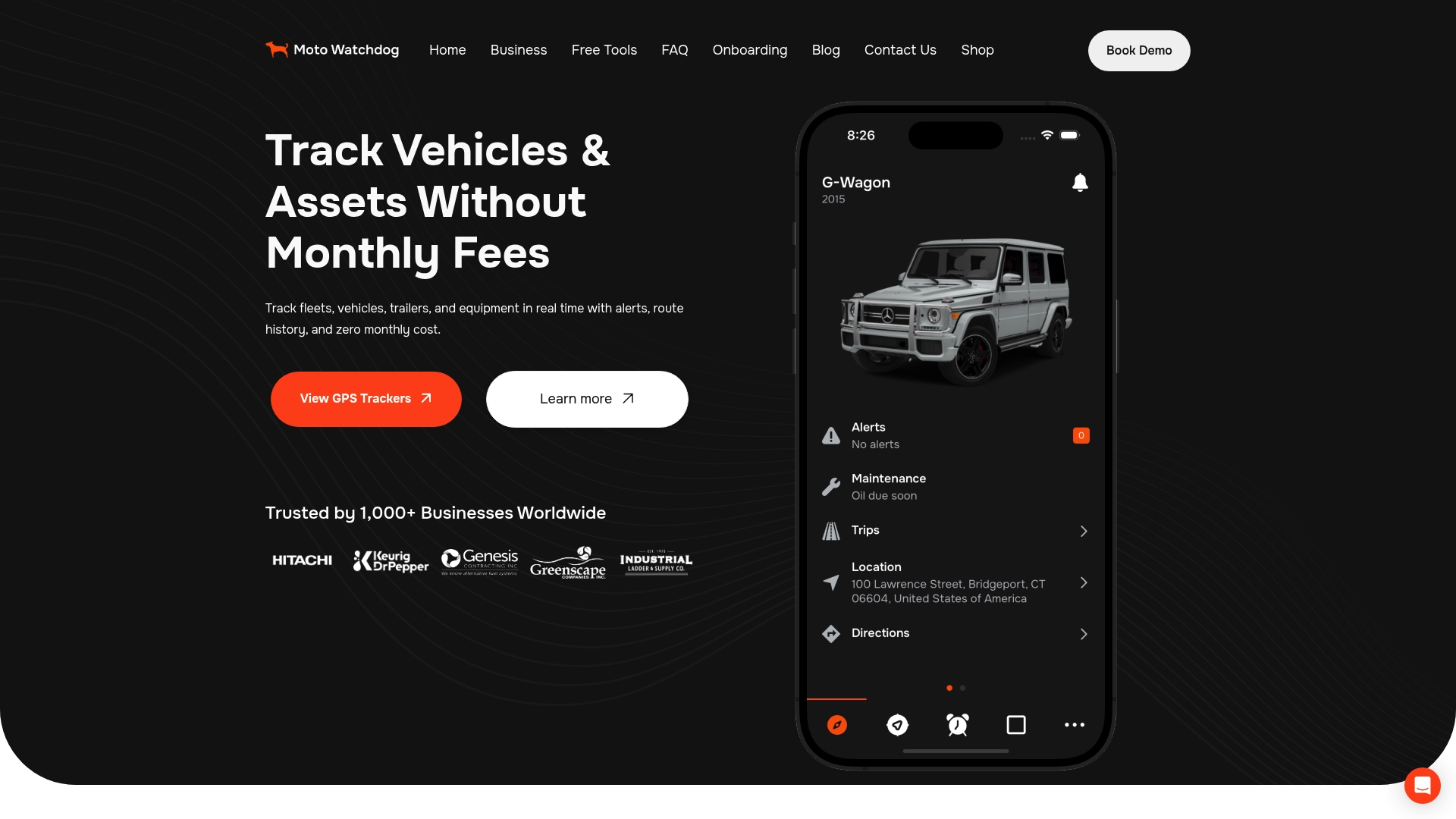
Motowatchdog’s 4G GPS tracking solution runs on current LTE networks, supports geofencing alerts, and delivers detailed mileage tracking without a recurring subscription. Installation is straightforward, and the platform is built for both fleet managers and individuals who need dependable location visibility. If you are evaluating the best GPS for machinery or tools, Motowatchdog offers a practical starting point with no ongoing fee commitment.
FAQ
What is small equipment GPS used for?
Small equipment GPS is used to track the real-time location of tools, machinery, trailers, and other physical assets. Common applications include theft prevention, fleet management, and tool accountability on construction sites.
How does a small GPS tracker transmit location data?
The tracker calculates its position using satellite signals, then sends that data to a cloud server via a GSM or LTE cellular module. Users access the location through a mobile app or web platform.
Why do most GPS trackers require a subscription?
Subscription fees cover cellular data costs, which are necessary to transmit location from the tracker to the user in real time. They are connectivity costs, not arbitrary charges.
What is the difference between real-time and passive GPS tracking?
Real-time trackers transmit location continuously via cellular networks, enabling live monitoring and theft alerts. Passive trackers store location data internally and upload it later, which works for mileage logging but not for live recovery.
What should I look for in a GPS tracker for machinery?
Prioritize 4G LTE compatibility, an IP67 or higher durability rating, A-GPS support for indoor accuracy, and a battery life suited to your equipment’s power situation. Durability and mounting options are critical for field reliability.