

How to start saving money
Lorem ipsum dolor sit amet, consectetur adipiscing elit lobortis arcu enim urna adipiscing praesent velit viverra sit semper lorem eu cursus vel hendrerit elementum morbi curabitur etiam nibh justo, lorem aliquet donec sed sit mi dignissim at ante massa mattis.
- Neque sodales ut etiam sit amet nisl purus non tellus orci ac auctor
- Adipiscing elit ut aliquam purus sit amet viverra suspendisse potent
- Mauris commodo quis imperdiet massa tincidunt nunc pulvinar
- Excepteur sint occaecat cupidatat non proident sunt in culpa qui officia
Why it is important to start saving
Vitae congue eu consequat ac felis placerat vestibulum lectus mauris ultrices cursus sit amet dictum sit amet justo donec enim diam porttitor lacus luctus accumsan tortor posuere praesent tristique magna sit amet purus gravida quis blandit turpis.

How much money should I save?
At risus viverra adipiscing at in tellus integer feugiat nisl pretium fusce id velit ut tortor sagittis orci a scelerisque purus semper eget at lectus urna duis convallis. porta nibh venenatis cras sed felis eget neque laoreet suspendisse interdum consectetur libero id faucibus nisl donec pretium vulputate sapien nec sagittis aliquam nunc lobortis mattis aliquam faucibus purus in.
- Neque sodales ut etiam sit amet nisl purus non tellus orci ac auctor
- Adipiscing elit ut aliquam purus sit amet viverra suspendisse potenti
- Mauris commodo quis imperdiet massa tincidunt nunc pulvinar
- Adipiscing elit ut aliquam purus sit amet viverra suspendisse potenti
What percentege of my income should go to savings?
Nisi quis eleifend quam adipiscing vitae aliquet bibendum enim facilisis gravida neque. Velit euismod in pellentesque massa placerat volutpat lacus laoreet non curabitur gravida odio aenean sed adipiscing diam donec adipiscing tristique risus. amet est placerat in egestas erat imperdiet sed euismod nisi.
“Nisi quis eleifend quam adipiscing vitae aliquet bibendum enim facilisis gravida neque velit euismod in pellentesque”
Do you have any comments? Share them with us on social media
Eget lorem dolor sed viverra ipsum nunc aliquet bibendum felis donec et odio pellentesque diam volutpat commodo sed egestas aliquam sem fringilla ut morbi tincidunt augue interdum velit euismod eu tincidunt tortor aliquam nulla facilisi aenean sed adipiscing diam donec adipiscing ut lectus arcu bibendum at varius vel pharetra nibh venenatis cras sed felis eget.
What is multi-site equipment tracking, and why does it matter?
Multi-site equipment tracking is the centralized method of monitoring, managing, and maintaining equipment and assets across multiple locations from one unified platform. Instead of relying on separate spreadsheets at each job site or warehouse, a single register gives every authorized user a real-time view of where each asset is, who has it, and what condition it is in.
The assets covered range widely: vehicles, trailers, power tools, generators, compressors, and heavy machinery. Centralized asset registers show where assets are across all locations, replacing isolated local systems that leave managers guessing.
Key components of a multi-site tracking system include:
- Centralized dashboard with site filtering and cross-site reporting
- Role-based access controls (RBAC) so each location manager sees only what is relevant to their site
- Audit trails that log every equipment transfer with timestamps and custody notes
- Real-time availability filters showing which assets are in use, in transit, or available
Table of Contents
- Key features that make multi-site asset management work
- How subscription-free GPS tracking supports multi-site equipment management
- Why Motowatchdog stands out for multi-site tracking
- Data security and privacy in multi-site tracking systems
- How multi-site tracking integrates with your existing software
- Cost considerations beyond the subscription fee
- Key Takeaways
- Motowatchdog gives you multi-site tracking without the monthly bill
Key features that make multi-site asset management work
The operational value of multi-site equipment tracking comes from a set of tightly integrated features working together.
- RBAC permissions: Operations leadership gets full visibility across all locations; site managers see only their assigned assets. This prevents data overload while maintaining accountability.
- Movement logging: Every transfer between sites is recorded with a timestamp, the user who initiated it, and condition notes. The result is a complete chain of custody that holds up during audits.
- Cross-site reporting: Filter by location, asset type, or date range to generate reports that reveal utilization patterns and scheduling conflicts before they become costly delays.
- Real-time availability: Know instantly which equipment is free at which site, so you can redeploy underutilized assets rather than rent duplicates.
Spreadsheets and siloed lists create the visibility problems that multi-site systems solve: misallocated equipment, double-bookings, and the time lost making phone calls to find a single generator. A centralized dashboard eliminates that friction.
How subscription-free GPS tracking supports multi-site equipment management
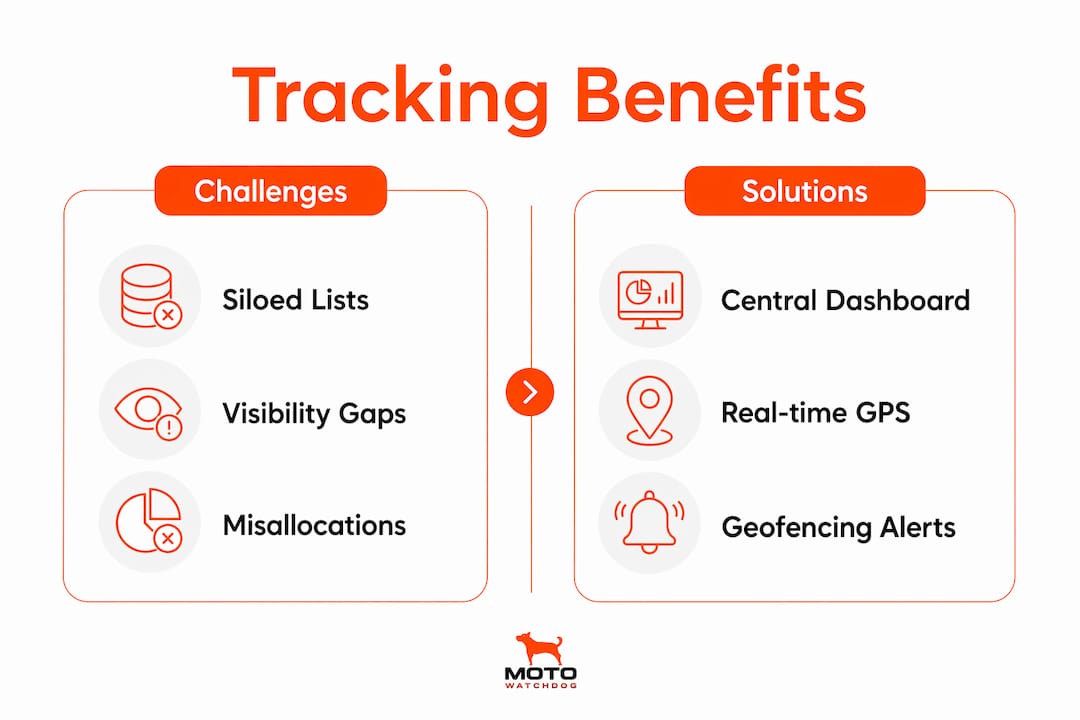
GPS hardware adds a physical layer to software-based tracking, broadcasting an asset’s precise location continuously. The cost model matters as much as the technology. Subscription-free GPS devices use prepaid cellular data or lifetime data plans bundled with the hardware, so there is no recurring monthly fee eating into your budget.
Motowatchdog’s MW-20000 tracker, for example, operates on 4G LTE with no monthly fees and includes international coverage. For North American businesses managing assets across multiple states or provinces, that coverage consistency matters. Key GPS features that directly support multi-location inventory management include:
- Customizable geofencing alerts that notify you when equipment leaves or enters a defined zone
- Up to 20,000mAh battery capacity, supporting months of usage per charge on a single device
- Mileage reporting that simplifies billing, tax records, and maintenance scheduling
- Offline sync capability for field teams working in areas with uneven connectivity
Pro Tip: When evaluating GPS options for multi-site use, compare prepaid or lifetime data plans against monthly subscription fees at scale. The difference compounds quickly across a fleet of 20 or more devices.
For a deeper look at how businesses are cutting costs with no-fee tracking, the subscription-free GPS guide covers the practical tradeoffs in detail.
Why Motowatchdog stands out for multi-site tracking
Over 1,000 businesses rely on Motowatchdog’s GPS tracking accuracy to monitor fleets and report mileage. That adoption reflects a straightforward value proposition: reliable hardware, no ongoing fees, and features built for real operational demands.

The MW-20000’s magnetic mount lets you attach it to any metal surface in seconds, making it practical for trailers, generators, and vehicles alike. Its stealth design keeps the device discreet, which matters when tracking high-value equipment in unsecured locations. Customer testimonials consistently highlight ease of setup and satisfaction with the subscription-free cost structure, two factors that matter most to budget-conscious fleet managers and small business owners.
Geofencing alerts are fully customizable, so you can define boundaries around each job site and receive an immediate notification if equipment moves without authorization. Combined with detailed mileage and fleet reporting, Motowatchdog gives multi-site operators the data they need without the overhead of a monthly billing cycle.
Data security and privacy in multi-site tracking systems
Tracking equipment across multiple sites means collecting and transmitting location data continuously, which creates real security obligations. Any system you deploy should encrypt data in transit and at rest, and access should be governed by the same RBAC principles that control who sees which assets.
Privacy considerations extend to employees who operate tracked vehicles or carry tracked tools. Clear written policies about what is monitored, when, and why are standard practice in North America and help avoid legal exposure under state and provincial privacy regulations. Audit logs themselves must be protected: a tampered custody record is worse than no record at all.
When evaluating vendors, ask specifically about data retention policies, breach notification procedures, and whether location data is shared with third parties.
How multi-site tracking integrates with your existing software
A tracking system that lives in isolation creates its own data silo. The most useful platforms connect to the software you already run: ERP systems, project management tools, maintenance scheduling platforms, and accounting software.
Integration typically happens through APIs or CSV exports. Real-time API connections push asset location and status data into your ERP automatically; CSV exports work for teams that need periodic reports rather than live feeds. For construction and field service businesses, connecting equipment tracking to project management software means job site managers can see asset availability directly in the tools they use every day, without switching platforms.
Check whether a platform supports webhook notifications, which can trigger automated workflows when an asset changes location or status.
Cost considerations beyond the subscription fee
Eliminating the monthly subscription fee is a meaningful saving, but it is not the only cost to account for. Hardware purchase price, installation time, and device replacement cycles all factor into the total cost of ownership.
Battery-powered magnetic trackers like the MW-20000 require periodic recharging, which adds a small labor cost at scale. Hardwired devices avoid that but require professional installation. For a practical breakdown of how to budget GPS tracking across a small fleet, the small fleet tracking guide walks through the numbers by fleet size.
Maintenance costs for the software platform itself vary: cloud-based systems typically include updates automatically, while on-premise deployments require IT resources. Factor in training time for site managers learning the system, particularly when rolling out RBAC configurations across multiple locations.
Key Takeaways
Multi-site equipment tracking solves the visibility problem that spreadsheets and siloed local systems cannot: knowing where every asset is, who has it, and whether it is available, across every location you operate.
| Point | Details |
|---|---|
| Centralized visibility | One dashboard with site filtering replaces isolated spreadsheets and eliminates asset misallocation. |
| RBAC and audit trails | Role-based access and timestamped movement logs maintain accountability across every location. |
| Subscription-free GPS value | Prepaid or lifetime data plans avoid recurring fees that compound quickly across larger fleets. |
| Security and integration | Encrypt data in transit, enforce access controls, and connect tracking to your ERP or project tools via API. |
| Motowatchdog’s approach | Over 1,000 businesses use Motowatchdog’s no-fee GPS hardware for accurate multi-site fleet and asset monitoring. |
Motowatchdog gives you multi-site tracking without the monthly bill
No monthly fee means the cost of tracking 10 assets is the same in month 24 as it is in month one. That is the concrete advantage Motowatchdog delivers over subscription-based platforms, and it is why fleet managers and business owners managing equipment across multiple sites keep choosing it.
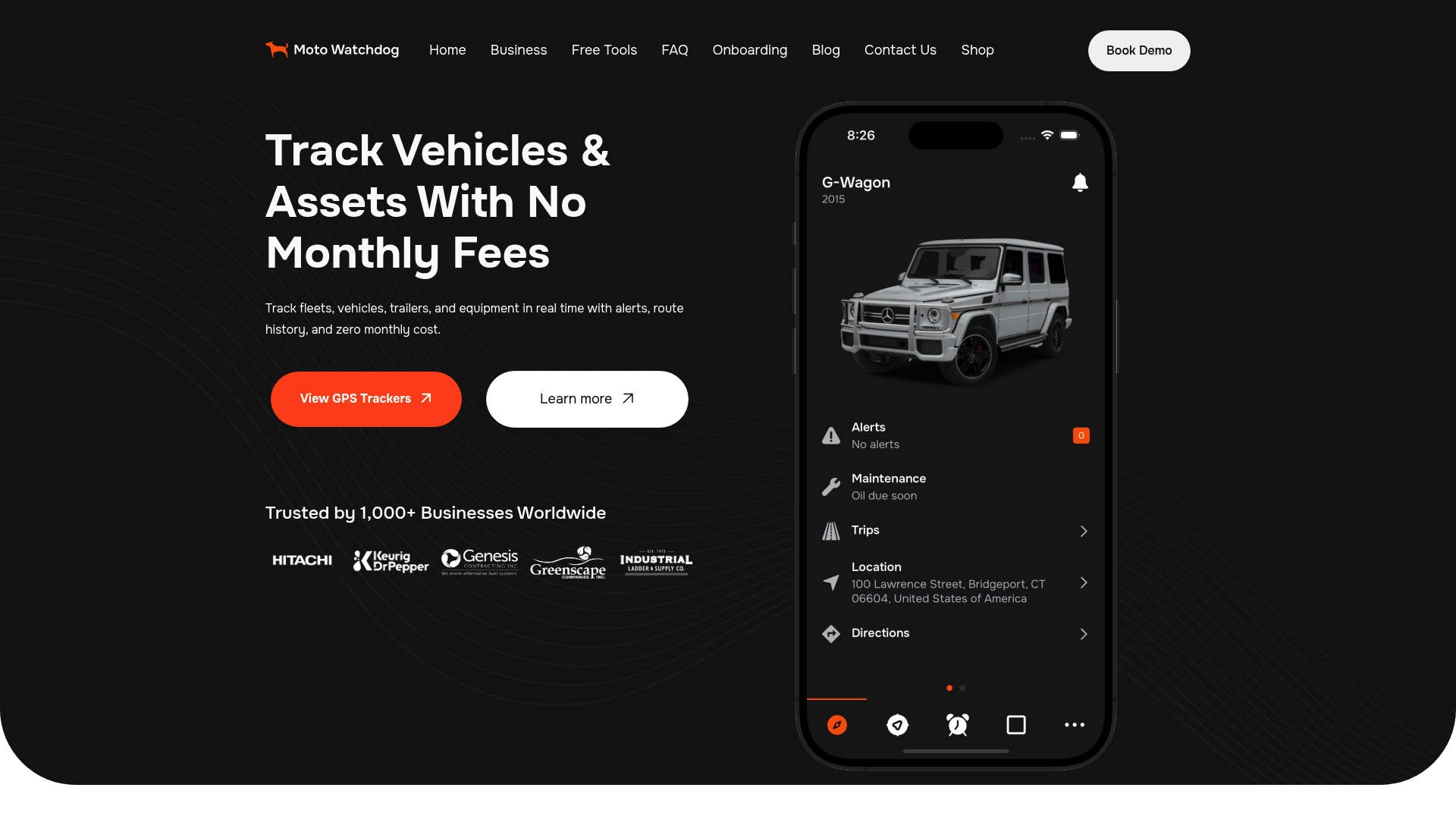
The MW-20000 attaches magnetically to any vehicle or piece of equipment, runs for months on a single charge, and sends customizable geofencing alerts the moment an asset moves outside a defined boundary. Setup takes minutes, not days. For businesses that need reliable multi-site asset visibility without locking into a recurring contract, Motowatchdog’s subscription-free GPS tracking is the direct path to that outcome. Visit the site to see device options and get started today.

