

How to start saving money
Lorem ipsum dolor sit amet, consectetur adipiscing elit lobortis arcu enim urna adipiscing praesent velit viverra sit semper lorem eu cursus vel hendrerit elementum morbi curabitur etiam nibh justo, lorem aliquet donec sed sit mi dignissim at ante massa mattis.
- Neque sodales ut etiam sit amet nisl purus non tellus orci ac auctor
- Adipiscing elit ut aliquam purus sit amet viverra suspendisse potent
- Mauris commodo quis imperdiet massa tincidunt nunc pulvinar
- Excepteur sint occaecat cupidatat non proident sunt in culpa qui officia
Why it is important to start saving
Vitae congue eu consequat ac felis placerat vestibulum lectus mauris ultrices cursus sit amet dictum sit amet justo donec enim diam porttitor lacus luctus accumsan tortor posuere praesent tristique magna sit amet purus gravida quis blandit turpis.

How much money should I save?
At risus viverra adipiscing at in tellus integer feugiat nisl pretium fusce id velit ut tortor sagittis orci a scelerisque purus semper eget at lectus urna duis convallis. porta nibh venenatis cras sed felis eget neque laoreet suspendisse interdum consectetur libero id faucibus nisl donec pretium vulputate sapien nec sagittis aliquam nunc lobortis mattis aliquam faucibus purus in.
- Neque sodales ut etiam sit amet nisl purus non tellus orci ac auctor
- Adipiscing elit ut aliquam purus sit amet viverra suspendisse potenti
- Mauris commodo quis imperdiet massa tincidunt nunc pulvinar
- Adipiscing elit ut aliquam purus sit amet viverra suspendisse potenti
What percentege of my income should go to savings?
Nisi quis eleifend quam adipiscing vitae aliquet bibendum enim facilisis gravida neque. Velit euismod in pellentesque massa placerat volutpat lacus laoreet non curabitur gravida odio aenean sed adipiscing diam donec adipiscing tristique risus. amet est placerat in egestas erat imperdiet sed euismod nisi.
“Nisi quis eleifend quam adipiscing vitae aliquet bibendum enim facilisis gravida neque velit euismod in pellentesque”
Do you have any comments? Share them with us on social media
Eget lorem dolor sed viverra ipsum nunc aliquet bibendum felis donec et odio pellentesque diam volutpat commodo sed egestas aliquam sem fringilla ut morbi tincidunt augue interdum velit euismod eu tincidunt tortor aliquam nulla facilisi aenean sed adipiscing diam donec adipiscing ut lectus arcu bibendum at varius vel pharetra nibh venenatis cras sed felis eget.
LTE-M is a low-power cellular technology that lets small, battery-powered devices, such as trackers on trailers, excavators and rental equipment, send data over the same 4G network carriers already run. It is built for devices that move, sleep most of the day and report small amounts of data. For a fleet, the useful question is not only which radio standard a tracker uses. It is whether the tracker reports reliably where your assets work, for how long on one battery, and what you pay in connectivity fees after the purchase. Our trackers start from $124.99 as a one-time purchase, with lifetime 4G data included and no monthly fees.
TL;DR
- LTE-M (also called LTE Cat-M1) is a low-power wide-area technology that reuses existing LTE base stations, so devices connect directly to a cellular network.
- It supports handover between towers, so it suits trucks, trailers and machinery that move. NB-IoT does not handle movement as well.
- NB-IoT wins on deep indoor coverage and tiny, stationary sensors. LTE-M wins on mobility, speed and firmware updates.
- Before choosing any tracker, check carrier coverage at your job sites, battery life at your reporting interval, and whether data fees recur.
Table of Contents
- What LTE-M means in plain terms
- How LTE-M works inside a tracker
- LTE-M vs NB-IoT: which one suits moving assets
- Why mobility is the deciding factor for fleets
- LTE-M coverage in the United States
- A fleet checklist before you choose a tracker
- Our view on connectivity
- Put real-time tracking on your equipment
- How to read a tracker spec sheet
- Matching trackers to asset types
- FAQ
- Sources
What LTE-M means in plain terms
LTE is the 4G standard used by phones. It was designed for fast video, browsing and calls, which means radios that draw a lot of power and cost more to build. Machines rarely need that. A tracker on a skid steer needs to say where it is every few minutes and then go quiet.
LTE-M, short for LTE for Machines, trims LTE down for that job. GSMA, the trade body for mobile operators, defines it as the eMTC low-power wide-area technology standardized by 3GPP in Release 13, known formally as LTE Cat-M1. 3GPP is the standards group that writes the specifications carriers follow. GSMA describes three practical benefits:
- Simpler, cheaper modems. Modem cost can fall to 20 to 25 percent of a comparable EGPRS modem, an older 2G-era standard.
- Long battery life. The technology can support at least ten years of device battery life under the right conditions.
- Extended coverage and mobility. It supports roaming and handover, and potentially voice.
Because it runs on licensed carrier spectrum, there is no separate network to build. Carriers update software on their existing LTE towers, and devices attach with a SIM, just as a phone does.
How LTE-M works inside a tracker
Three ideas explain most of what you will read on a spec sheet.
Low power modes. Two features, PSM (power saving mode) and eDRX (extended discontinuous reception), let a device switch its radio off for long stretches and wake only to report or listen. A tracker that reports every 15 minutes spends nearly all its time asleep. The longer the sleep, the longer the battery lasts, and the slower the device is to respond to a command from you.
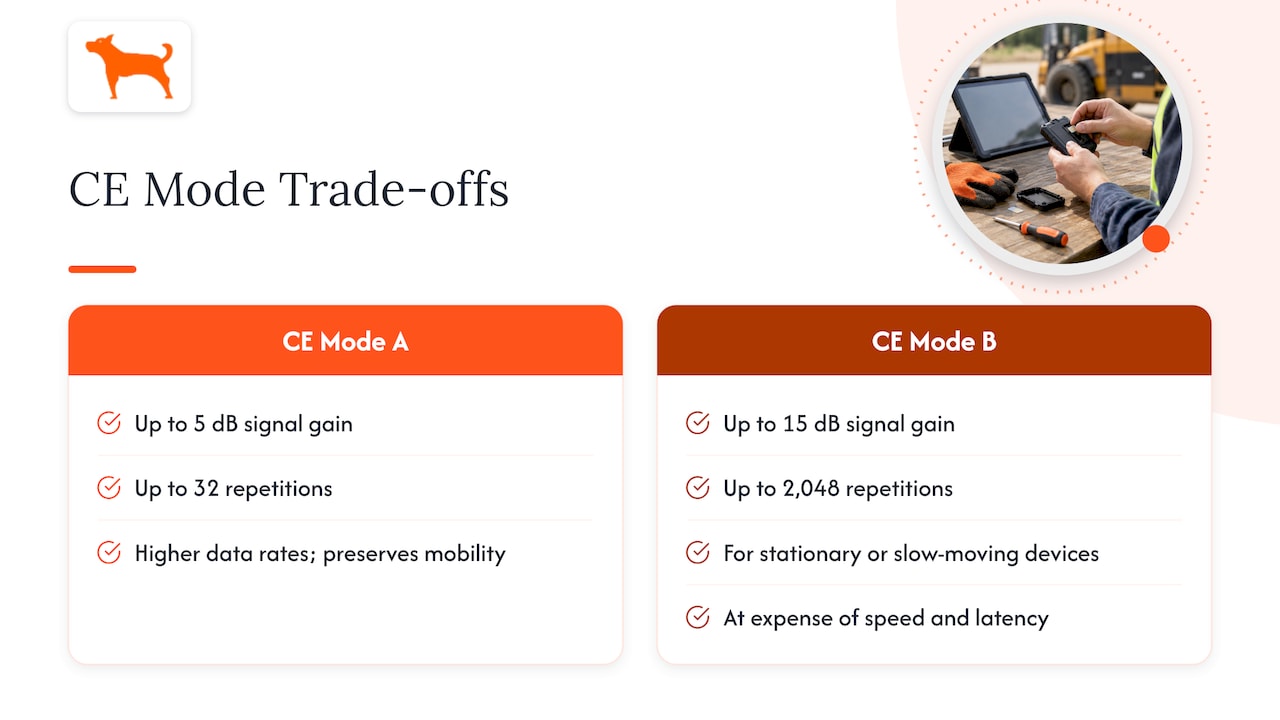
Coverage enhancement. LTE-M repeats transmissions so weak signals still get through. According to GSMA’s Mobile IoT Deployment Guide, there are two modes. CE Mode A adds up to 5 dB of signal gain with up to 32 repetitions and preserves higher data rates and mobility. CE Mode B adds up to 15 dB with up to 2,048 repetitions, and is meant for stationary or slow-moving devices deep inside buildings, at the expense of speed and latency. For equipment working outdoors, Mode A is the one that matters.
Speed and range. AWS’s LPWAN whitepaper lists a peak data rate of 1 Mbps and typical latency of 10 to 20 milliseconds for Cat-M1, with a transmission range of roughly 1 km in urban areas and 10 km in rural ones. That is plenty for location pings, ignition status, impact alerts and an occasional firmware update. It is not enough for live video.
LTE-M vs NB-IoT: which one suits moving assets
NB-IoT (Narrowband IoT) is the other low-power cellular standard you will see in the same breath. It is the more stripped-down of the two. The differences decide which one belongs on a machine that travels from yard to job site.
| Feature | LTE-M | NB-IoT |
|---|---|---|
| Mobility (tower handover) | Yes, works at vehicle speed | Limited, built for stationary devices |
| Data speed | Up to about 1 Mbps (Cat-M1) | Much lower |
| Latency | Tens of milliseconds | Seconds |
| Deep indoor coverage | Good | Stronger |
| Voice | Possible (VoLTE) | No |
| Best fit | Trucks, trailers, equipment, wearables | Meters, parking sensors, fixed monitors |
AWS states that LTE-M offers higher data rates, lower latency and better energy efficiency for larger payloads, and is better suited to mobile applications because it supports seamless handover. NB-IoT devices tend to use less power for very small payloads and cost less. T-Mobile’s business IoT page draws the same line: NB-IoT for large numbers of static devices, LTE-M for mobile devices that send small amounts of data infrequently.
What the engineering research shows
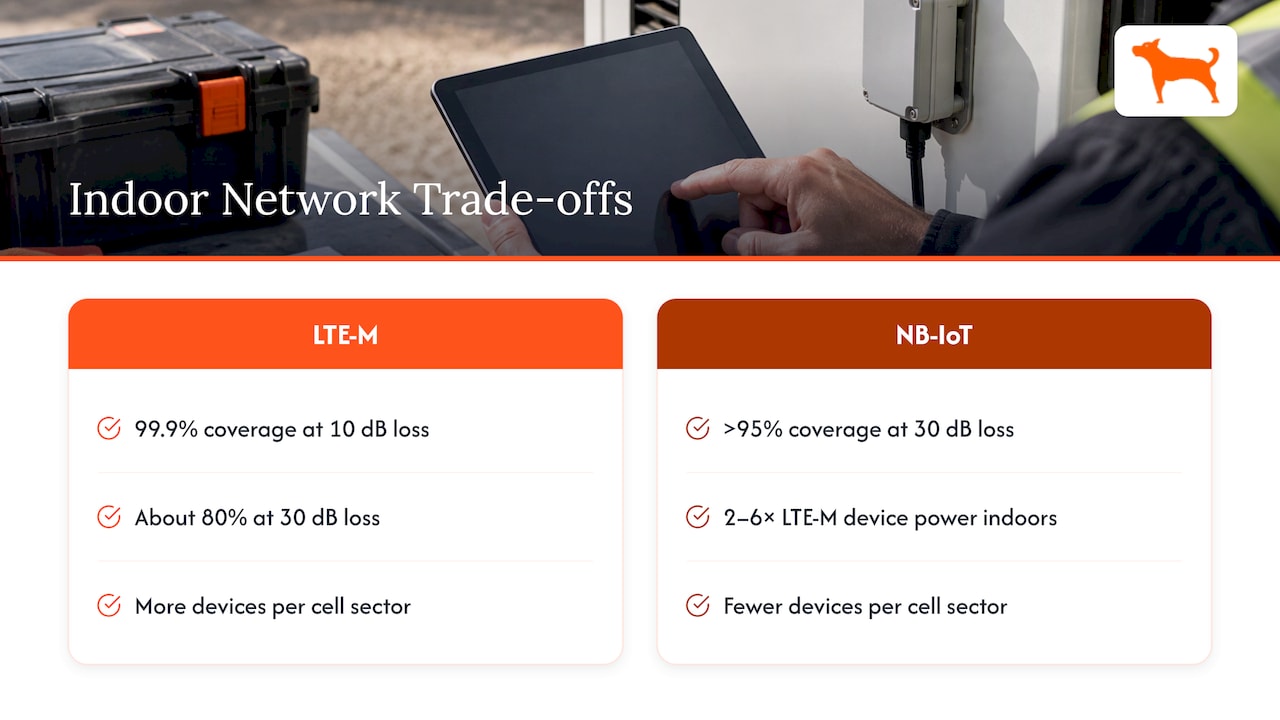
Researchers at Aalborg University measured the trade-off. They found LTE-M can cover 99.9 percent of outdoor and indoor devices at 10 dB of additional signal loss. In very deep indoor conditions, at 30 dB of loss, NB-IoT reaches over 95 percent of devices against roughly 80 percent for LTE-M. In their model, NB-IoT also supported far fewer devices per cell sector and used 2 to 6 times more device power in the challenging indoor scenario they tested.
Translated for a rental yard: if the asset is a water meter in a basement vault, NB-IoT’s deeper reach matters. If the asset is a lift, a roller or a flatbed that spends its day outdoors and moves between sites, LTE-M’s mobility and efficiency matter more.
Why mobility is the deciding factor for fleets
A cellular connection is a session between a device and a tower. When a truck drives, the device moves from one tower’s area to the next. A technology with full handover keeps the session alive. One without it has to reconnect, which costs time and battery and can mean missed reports. That is why LTE-M is the usual choice for anything that travels, and why NB-IoT is the usual choice for things bolted in place.
For heavy equipment rental, this shows up in daily work:
- Theft recovery. A machine loaded onto a trailer at night needs updates while it moves, not a position from an hour ago.
- Geofence alerts. An alert when a loader leaves the yard or a job site is only useful if the device reports promptly.
- Idle time and usage. Billing by engine hours or measuring idle time requires frequent, reliable reports.
- Firmware updates. Over-the-air updates need real throughput. A standard with very slow speeds makes updates painfully long.
LTE-M coverage in the United States
GSMA’s Mobile IoT summary reports that in the U.S., Verizon and AT&T upgraded their entire nationwide LTE networks to support commercial LTE-M, while T-Mobile deployed NB-IoT nationwide. T-Mobile’s business page now lists NB-IoT, LTE-M, LTE and 5G among its IoT network technologies. Carrier lineups and plans change, so confirm current support on the carrier’s own coverage map before you commit.
The same GSMA summary notes that upgrading a network for Mobile IoT can deliver up to a sevenfold increase in coverage area, including deep in-building and below-ground penetration. In practice, coverage still depends on towers near your sites. A quarry, a remote pipeline right-of-way and a downtown demolition project do not see the same signal.
A fleet checklist before you choose a tracker
The radio standard is one line on a spec sheet. These are the checks that change your results.
- Map your sites. List where your assets spend most of their time: yards, rural job sites, parking structures. Compare against carrier coverage maps.
- Set a reporting interval. Battery life depends on how often the device wakes. A tracker that pings every minute drains faster than one that pings every ten.
- Decide what you need in an alert. Theft, geofence breach and unauthorized movement call for quick reports. Monthly hour readings do not.
- Ask about data fees. Many trackers need a monthly plan or annual contract on top of the hardware. Multiply it by the number of assets and the years you will own them.
- Check device and user limits. Rental fleets grow. A dashboard that caps vehicles or users forces a plan change later.
- Think about roaming. If any assets cross borders, remember that LTE-M availability does not automatically mean roaming access. Telenor IoT notes that LPWA roaming is less mature than standard LTE roaming, and treats standard LTE categories as the safer default for broad international fleets.
A worked example
Suppose a rental company runs 60 pieces of equipment, and a tracker with a plan costs $10 a month per unit. That is $600 a month, or $7,200 a year, before any activation fees. Over three years it is $21,600 in connectivity alone. A tracker sold as a one-time purchase with data included moves that spend to the purchase date. The arithmetic is the same at any fleet size: recurring fees scale with assets and years, so the model matters as much as the radio.
Our view on connectivity
Fleet managers often ask us which cellular standard is best, and the honest answer is that the standard serves a result: a location you can trust, a battery that lasts through the season, and a cost that does not creep.
We built Moto Watchdog around that result. Our trackers include lifetime 4G data with no monthly or recurring fees, no activation fees and no add-ons, so the price you pay at purchase is the price of owning the device. Geofencing alerts, trip and mileage reporting, idle time tracking, maintenance reminders and push notifications are all part of the full feature set.
For contractors and rental companies, one dashboard supports unlimited vehicles and users. That matters when your fleet changes with each project: you add a unit and keep working, without renegotiating a plan.
The best way to think about telematics is as a shift from reactive problem-solving to data-driven decisions. Knowing where equipment is, how long it idles and when service is due is where the measurable savings come from.
Louis
Put real-time tracking on your equipment
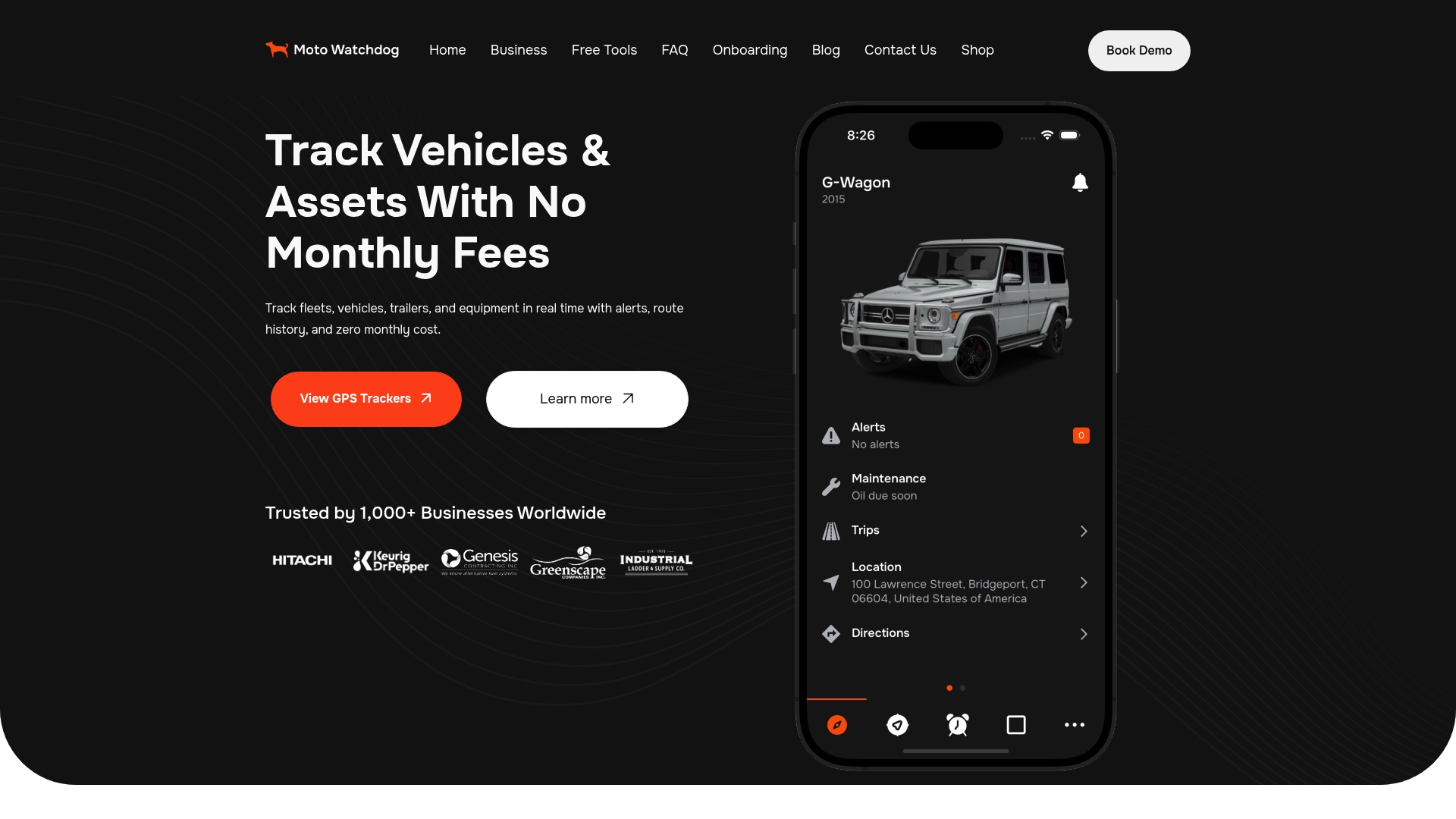
If you manage trailers, loaders, rental machines or work trucks, our GPS trackers give you real-time location, customizable geofencing and alerts, trip and mileage reports, idle time tracking and maintenance reminders from a free mobile app. Devices start from $124.99 as a one-time purchase, with lifetime 4G data included and no monthly fees. Over 1,000 businesses rely on them. You can see the Moto Watchdog trackers and choose the unit that fits your assets.
If you need to connect tracking data to your own software, we also offer API access for business customers.
How to read a tracker spec sheet
After the radio standard, a few other terms appear on almost every product page.
- Cat-M1, Cat-M2, Cat-NB1, Cat-NB2. Category numbers are generations of the same families. Higher or newer numbers generally mean more speed or capability.
- Cat-1 and Cat-1 bis. Standard LTE categories with more speed and wider roaming support, at higher power draw.
- PSM and eDRX. Power-saving settings. Longer sleep means longer battery life and slower response.
- Geofence. A virtual boundary around a yard or site that triggers an alert when crossed.
- Reporting interval. How often the device sends its position. It is the biggest lever on battery life.
The reasoning from Telenor IoT’s product team applies to every purchase: the real design question is the balance among battery life, coverage, reporting frequency and responsiveness, because longer sleep extends battery but slows response. Decide which of those four matters most for each type of asset, then pick the tracker and reporting interval to match.
Matching trackers to asset types
Powered equipment (excavators, loaders, lifts). These have a power source and move between sites. Frequent reports, idle time tracking and geofences are the priority.
Trailers and attachments. Unpowered assets are often the ones stolen. Long battery life and motion alerts matter most, with infrequent routine reports and fast alerts on movement.
Work trucks and vans. Trip history, mileage reporting and maintenance reminders support dispatch, billing and service schedules.
Small tools and containers. Compact, long-life units suit items that sit for weeks. Coverage in storage areas is worth checking.
FAQ
What does LTE-M stand for?
LTE-M stands for Long Term Evolution for Machines. It is also called LTE Cat-M1. It is a low-power version of 4G designed for small devices that send modest amounts of data and need to run for years on a battery.
Is LTE-M the same as 4G LTE?
LTE-M is part of the 4G family and runs on the same carrier towers. It is simplified for machines, so it has lower speeds than the LTE in your phone but much lower power use. It suits location reports and alerts, not video.
Is LTE-M better than NB-IoT?
It depends on the asset. LTE-M handles movement between towers, offers faster data and supports firmware updates, so it fits vehicles and equipment. NB-IoT reaches deeper indoors and suits stationary sensors that send tiny messages.
Does LTE-M work for heavy equipment tracking?
Yes, for most outdoor equipment. Handover between towers keeps reports flowing while a machine travels, and long sleep cycles stretch battery life. Check your carrier’s coverage map for the areas where your sites sit.
Do I need a monthly plan for a cellular tracker?
Many trackers require one, but not all do. Our trackers include lifetime 4G data with no monthly fees, so you pay once for the device and use the app at no added cost.
Sources
- GSMA: Long Term Evolution for Machines, LTE-M
- GSMA: Mobile IoT Deployment Guide (February 2026)
- GSMA: Mobile IoT Executive Summary
- AWS: LTE-M, Implementing Low-Power Wide-Area Network (LPWAN) Solutions
- T-Mobile: IoT Network Technologies for Business
- Aalborg University: Lauridsen et al., LTE-M and NB-IoT coverage, capacity and power study (2016)
- Telenor IoT: LTE-M (LTE Cat-M1) for IoT

