How to start saving money
Lorem ipsum dolor sit amet, consectetur adipiscing elit lobortis arcu enim urna adipiscing praesent velit viverra sit semper lorem eu cursus vel hendrerit elementum morbi curabitur etiam nibh justo, lorem aliquet donec sed sit mi dignissim at ante massa mattis.
- Neque sodales ut etiam sit amet nisl purus non tellus orci ac auctor
- Adipiscing elit ut aliquam purus sit amet viverra suspendisse potent
- Mauris commodo quis imperdiet massa tincidunt nunc pulvinar
- Excepteur sint occaecat cupidatat non proident sunt in culpa qui officia
Why it is important to start saving
Vitae congue eu consequat ac felis placerat vestibulum lectus mauris ultrices cursus sit amet dictum sit amet justo donec enim diam porttitor lacus luctus accumsan tortor posuere praesent tristique magna sit amet purus gravida quis blandit turpis.

How much money should I save?
At risus viverra adipiscing at in tellus integer feugiat nisl pretium fusce id velit ut tortor sagittis orci a scelerisque purus semper eget at lectus urna duis convallis. porta nibh venenatis cras sed felis eget neque laoreet suspendisse interdum consectetur libero id faucibus nisl donec pretium vulputate sapien nec sagittis aliquam nunc lobortis mattis aliquam faucibus purus in.
- Neque sodales ut etiam sit amet nisl purus non tellus orci ac auctor
- Adipiscing elit ut aliquam purus sit amet viverra suspendisse potenti
- Mauris commodo quis imperdiet massa tincidunt nunc pulvinar
- Adipiscing elit ut aliquam purus sit amet viverra suspendisse potenti
What percentege of my income should go to savings?
Nisi quis eleifend quam adipiscing vitae aliquet bibendum enim facilisis gravida neque. Velit euismod in pellentesque massa placerat volutpat lacus laoreet non curabitur gravida odio aenean sed adipiscing diam donec adipiscing tristique risus. amet est placerat in egestas erat imperdiet sed euismod nisi.
“Nisi quis eleifend quam adipiscing vitae aliquet bibendum enim facilisis gravida neque velit euismod in pellentesque”
Do you have any comments? Share them with us on social media
Eget lorem dolor sed viverra ipsum nunc aliquet bibendum felis donec et odio pellentesque diam volutpat commodo sed egestas aliquam sem fringilla ut morbi tincidunt augue interdum velit euismod eu tincidunt tortor aliquam nulla facilisi aenean sed adipiscing diam donec adipiscing ut lectus arcu bibendum at varius vel pharetra nibh venenatis cras sed felis eget.
The most reliable way to track unpowered assets is battery-powered GPS with event-driven reporting, supplemented by LPWAN devices where gateway coverage already exists. The central tradeoff is reporting frequency against battery life and connectivity reach: the more often a device reports, the sooner it needs a new battery or charge. Subscription-free GPS tracking options remove the recurring-fee variable from that equation entirely.
TL;DR:
- Battery-powered GPS devices are ideal for unpredictable mobile assets and can report based on motion or scheduled intervals, with solar assistance extending their outdoor runtime.
- LPWAN and LoRa devices are cost-effective but depend on gateway density, with coverage gaps and battery drain issues limiting their reliability over long periods outdoors.
- Fixed-site assets benefit from RFID or Bluetooth tags for proximity checks, while remote assets require cellular LTE-M or satellite for broader and continuous visibility.
- Accurate battery life depends on matching the reporting cadence; frequent updates drain batteries faster, so initial mapping of usage and manufacturer data is crucial.
- Subscription-free trackers eliminate monthly fees, focus on event-triggered alerts, and integrate via API, but require careful pilot testing to optimize battery life and alert accuracy.
Table of Contents
- Tracker Types and When to Use Them
- Matching Connectivity to Movement and Geography
- Specs and Installation Choices That Determine Reliability
- Matching Devices to Real Asset Types
- Costs, Power Budget, and Lifecycle Planning
- How to Choose and Deploy: A Step-by-Step Checklist
- What Makes Our Approach to Asset Tracking Different
- Technologies That Track Assets Without Any Power Source
- How Low-Power Trackers Actually Send Data
- Connecting Tracking Data to the Systems You Already Use
- Keeping Tracking Data and Assets Secure
- Unpowered Versus Battery-Powered Tracking: Weighing the Tradeoffs
- What Fleet Managers Consistently Get Wrong
- Start Tracking Your Unpowered Assets Without a Monthly Bill
- FAQ
- Sources
Tracker Types and When to Use Them
Battery-powered GPS units remain the workhorse for trailers, containers, and equipment that move unpredictably. These devices report on a schedule or when triggered by motion, and the cadence you choose determines how long the battery lasts between service visits. Solar-assisted trackers extend runtime for assets that sit outdoors consistently, but they lose effectiveness in shaded yards, stacked containers, or northern climates with short winter daylight.
LPWAN and LoRa devices sip power and can run for extended periods, but they depend on gateway density. A government evaluation of LoRa-based in-transit tracking found that LoRa units can store up to 5,000 messages and were designed to function for multiple days without recharge, but evaluations found unreliable performance due to battery drain and coverage gaps. RFID and Bluetooth tags work well for proximity checks inside a yard or warehouse but cannot provide live location once an asset leaves the read zone.
Pick hardware by asset mobility:
- Highly mobile assets (trailers, rental equipment): battery-powered GPS with event-driven alerts.
- Fixed-site or yard assets: RFID or Bluetooth for check-in and check-out accuracy.
- Remote or off-grid assets: solar-assisted GPS or LPWAN where a gateway network already exists.
Matching Connectivity to Movement and Geography
Cellular LTE-M and NB-IoT networks offer broad coverage and modest power draw, making them a solid default for trailers and equipment that travel between job sites. Message sizes are small, so devices sip battery even while reporting several times a day. Satellite connectivity fills the gaps where cellular signal disappears: remote logging sites, agricultural land, or cross-border routes. It costs more per message and drains batteries faster, so it suits assets where losing visibility entirely is the bigger risk.
LoRa and other LPWAN protocols need a gateway within range, which makes them efficient on a single yard or campus but impractical for assets that roam. Stored-and-forward reporting, where a device logs data locally and transmits only when it reconnects or hits a trigger, can help extend battery life. A PHMSA rail shipper study recommends benchmarking alerts by time, location, and event criticality, sending real-time alerts only for critical events while storing the rest for later review.
- Cellular LTE-M/NB-IoT: best default for mobile equipment with periodic reporting needs.
- Satellite: reserved for assets that regularly leave cellular range.
- LoRa/LPWAN: cost-effective only where gateway coverage is already dense.
Pro Tip: Start with event-driven alerts for movement, geofence breach, and tamper, then add scheduled check-ins only for assets where idle-time tracking matters.
Specs and Installation Choices That Determine Reliability
Battery-life claims only mean something next to a reporting profile. A device rated for years at one check-in per day might last weeks if set to report every few minutes. Before committing to a reporting schedule, map it against the manufacturer’s stated battery curve rather than the headline number alone.
- Battery life versus cadence: confirm the battery estimate matches your intended reporting frequency, not the lowest-power test case.
- IP rating and shock tolerance: an IP67 or better rating protects against rain, dust, and pressure washing on job sites.
- Operating temperature range: equipment left outdoors in winter or desert heat needs a tracker rated for those extremes.
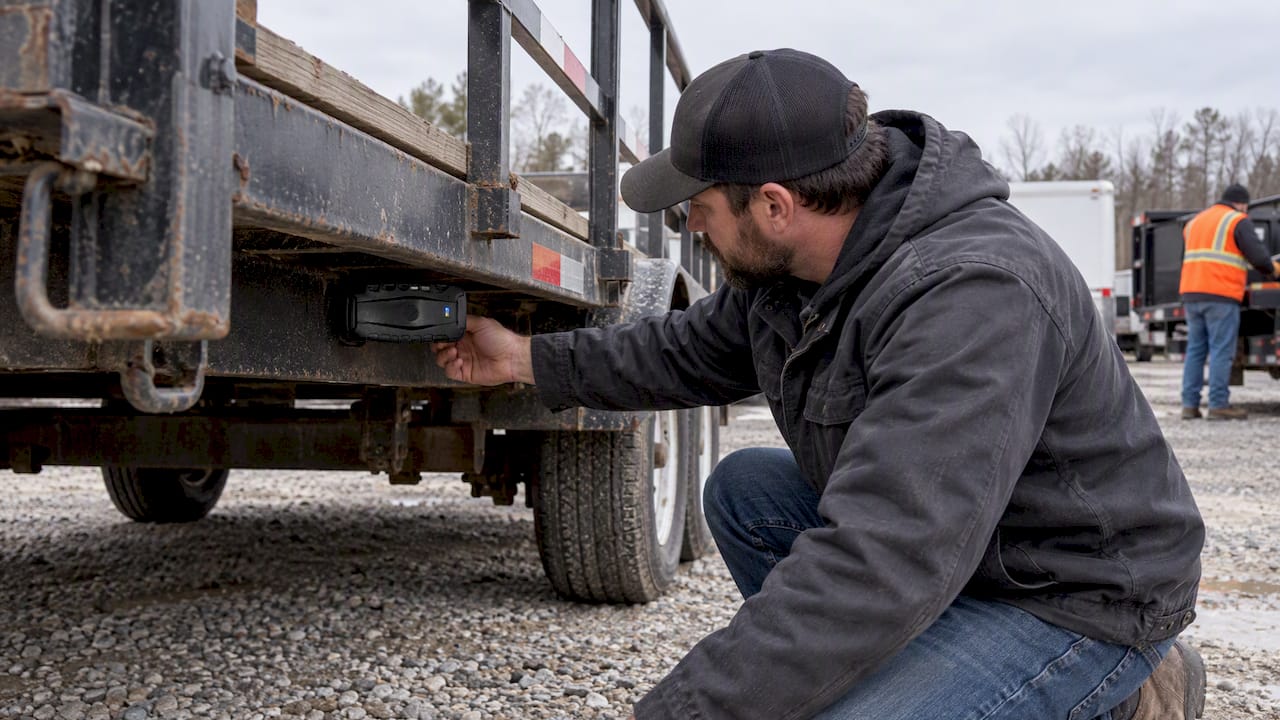
- Mounting and anti-tamper design: magnetic mounts suit quick redeployment, while bolted enclosures with tamper alerts suit higher-value or higher-theft-risk assets.
- Sensor selection: accelerometers catch motion and towing events, tilt sensors flag unauthorized movement, and temperature sensors matter for refrigerated or sensitive cargo.
- Spare-device rotation: keeping a small pool of charged or fresh-battery units on hand avoids downtime during swaps.
Our hardwiring guide for managers walks through mounting and wiring choices for assets where a hardwired power tap is available alongside battery backup.
Matching Devices to Real Asset Types
Different assets call for different combinations of hardware and connectivity. Trailers that cross state lines need cellular GPS with event-driven alerts for hitch and unhitch events. Shipping containers sitting in a yard for weeks benefit from long-life battery units with infrequent check-ins, since movement is rare and the priority is confirming presence. Rental equipment needs motion-triggered reporting so idle time and utilization are easy to calculate. Small tools scattered across job sites often do better with Bluetooth tags paired to a site gateway rather than full GPS, given their size and value. Dumpsters and yard assets, similarly low-value individually but costly in aggregate when lost, suit battery GPS with weekly check-ins.
- Trailers: cellular GPS, event-driven alerts on hitch, unhitch, and geofence breach.
- Containers: long-life battery GPS with infrequent scheduled check-ins.
- Rental equipment: motion-triggered reporting to track utilization and idle time.
- Small tools: Bluetooth or RFID tags tied to a site gateway.
- Dumpsters and yard assets: battery GPS with weekly or event-based reporting.
Key performance indicators worth tracking include time-to-locate, utilization rate, idle time, and recovery outcomes after theft. Shifting from hourly to event-driven reporting changes how these numbers look: idle-time accuracy improves, but time-to-locate on a stolen asset may lag slightly if the device waits for a trigger before reporting.
Costs, Power Budget, and Lifecycle Planning
Total cost of ownership for unpowered asset tracking splits into hardware, installation labor, and ongoing data costs. Subscription-based models charge monthly per device regardless of usage, while subscription-free models shift that cost into the upfront hardware price and the connectivity already included with the unit. Our subscription-free GPS explained guide breaks down how that tradeoff plays out over a multi-year fleet deployment.
Reporting cadence directly affects battery replacement schedules: a device reporting every few minutes may need service twice as often as one reporting on event triggers alone. Firmware updates that add always-on sensors also shorten battery life, so it pays to review settings after any update.
- One-time costs: hardware purchase, mounting hardware, and installation labor.
- Recurring costs: data plans (where applicable) and battery replacement or swap labor.
- Subscription-free models: higher upfront cost per unit, no recurring data fee.
One of the most effective pilot strategies is benchmarking alerts by time, location, and event criticality, which limits unnecessary transmissions and extends the interval between battery services.
How to Choose and Deploy: A Step-by-Step Checklist
Deployment succeeds or fails based on how clearly you define objectives before buying hardware. Start narrow, measure honestly, and expand only once the pilot proves out.
- Define objectives and KPIs: decide whether the priority is theft recovery, utilization tracking, or maintenance scheduling, and select a representative subset of assets for the pilot.
- Match device and connectivity: choose battery GPS, solar-assisted, or LPWAN based on asset mobility and existing gateway coverage, then set a reporting cadence that balances visibility against battery life.
- Plan mounting and installation: decide between magnetic, bolted, or hardwired mounts and confirm IP and temperature ratings fit the environment.
- Run a 30 to 90 day pilot: track time-to-locate, battery drain rate, and false tamper-alert frequency throughout.
- Integrate with existing systems: export data via API or CSV into your fleet management platform and confirm geofence and alert behavior works as expected.
- Scale deliberately: roll out to the full fleet only after the pilot hits its KPI targets, and treat repeated connectivity dropouts or high false-alert rates as a signal to reassess hardware choice before expanding further.
Pro Tip: Treat the pilot as a data-collection exercise, not a sales decision: let the battery drain rate and false-alert count tell you whether the reporting cadence needs adjusting before you commit to fleet-wide hardware.
What Makes Our Approach to Asset Tracking Different
The trackers run on a subscription-free model: no monthly data fee, geofencing alerts built in, and battery life designed for infrequent-charge deployment across trailers, equipment, and containers. Many businesses rely on these devices for fleet and asset visibility, and the API access supports exporting location and event data directly into existing fleet management systems.
- Subscription-free pricing removes the recurring-cost variable from multi-year TCO planning.
- Geofencing and tamper alerts cover the event-driven reporting strategy outlined above.
- API access supports integration with the fleet systems managers already use.
Our small fleet tracking guide and data export guide cover pilot budgeting and integration steps in more detail for managers planning a rollout.
Technologies That Track Assets Without Any Power Source
True unpowered tracking relies on technologies that need no onboard battery at all. Passive RFID tags draw their power from the reader’s radio signal at the moment of a scan, which means they have no internal power source to deplete but also no ability to transmit location on their own. They work well for check-in and check-out accuracy at a gate, dock door, or warehouse entrance, but they cannot report a live position once the asset moves out of range.
Magnet-based sensors offer a different kind of passive signal: they detect when a door, latch, or coupling opens or closes, useful for confirming whether a trailer has been hitched or a container has been accessed, without needing to power a transmitter continuously. Inertial sensors, including accelerometers and tilt switches, can operate on tiny amounts of harvested or stored energy to detect motion events and wake a connected system only when something changes, which is how many battery-powered trackers extend their service life in the first place.
None of these technologies alone provide continuous live GPS location. They work best paired with infrastructure, gateways, readers, or a battery-powered companion device, that handles the actual data transmission. For most fleet and equipment use cases, passive technologies serve as a layer within a broader tracking strategy rather than a replacement for GPS.
How Low-Power Trackers Actually Send Data
Energy-harvesting and ultra-low-power trackers rely on a handful of transmission strategies designed to minimize the energy cost of every message. Stored-and-forward is the most common: the device logs position and event data locally, then transmits in a single burst once it reconnects to a network or passes a gateway. This avoids the energy cost of maintaining a constant connection.
Event-triggered transmission takes a similar approach from the opposite direction: instead of waiting for a scheduled window, the device wakes and sends data only when a defined event occurs, a geofence breach, a tamper attempt, or a motion threshold. A PHMSA rail shipper study recommends this exact approach: real-time alerts for critical events, with noncritical data stored and reviewed later.
LPWAN protocols like LoRa are built around short, infrequent messages that require far less power than continuous cellular connections, which is why they pair well with energy-harvesting designs. The tradeoff, as field evaluations have shown, is that message delivery depends on gateway proximity and can suffer from the same battery and coverage issues that affect any low-power device operating outdoors for extended periods.
For fleet managers, the practical takeaway is that the transmission method matters as much as the sensor technology. A device with an excellent passive sensor but no efficient way to relay its readings is only half a solution, which is why most unpowered sensing technologies are deployed alongside a battery-powered or gateway-connected companion device rather than as a standalone system.
Connecting Tracking Data to the Systems You Already Use
Getting location and event data out of a tracker is only half the job. The harder part is often getting that data into the maintenance schedules, dispatch boards, and reporting tools a fleet already runs on. Devices that only offer a proprietary app create a second system managers have to check separately, which defeats much of the purpose of tracking in the first place.
API access and CSV export are the two practical paths around this problem. An API connection allows location, geofence, and event data to flow directly into a fleet management platform or a custom dashboard, updating automatically as new data arrives. CSV export works for simpler needs, periodic reporting, mileage logs, or utilization summaries, where real-time integration is not required.
The most common integration challenges come from mismatched update frequency and inconsistent asset naming between systems. A tracker reporting every few minutes can overwhelm a platform built for daily updates, while assets labeled differently across systems make it hard to match a tracker’s data to the right equipment record. Solving both starts before deployment: agree on a naming convention across every connected system, and confirm the receiving platform can handle the reporting cadence you plan to use.
Our data export guide walks through practical examples of exporting tracking data into common fleet management workflows, including how to structure CSV exports for mileage and utilization reporting.
Keeping Tracking Data and Assets Secure
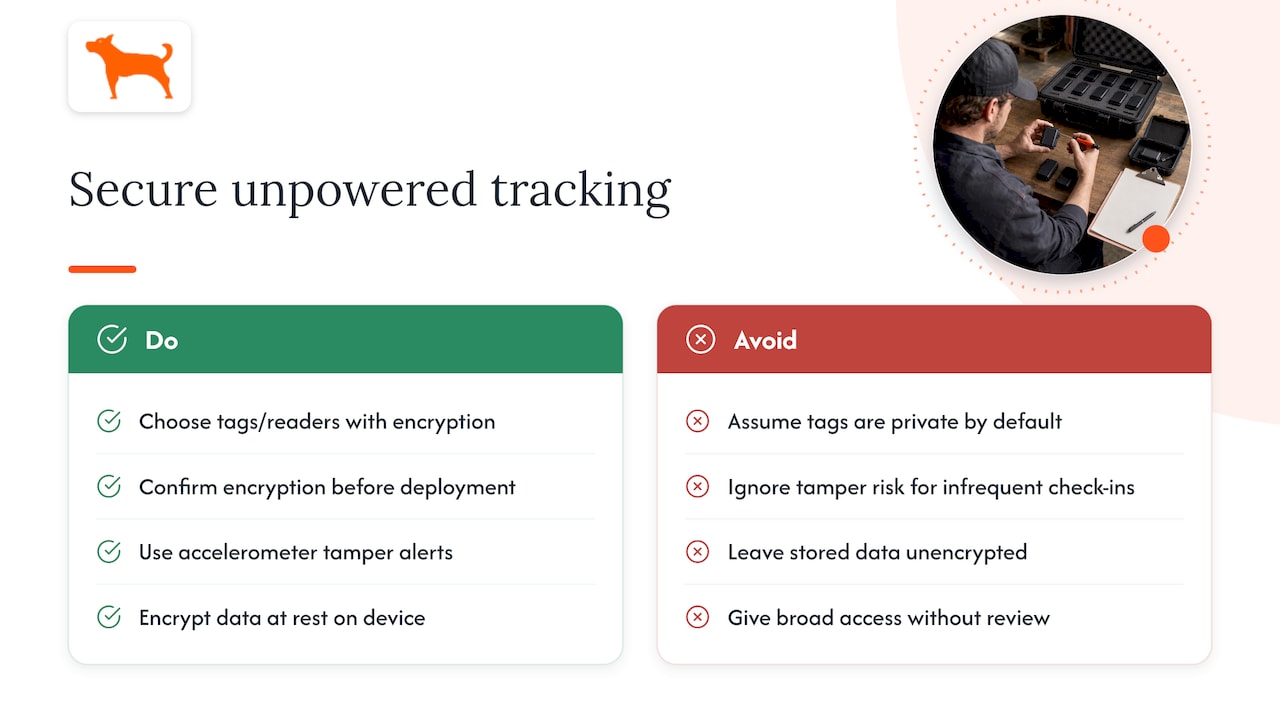
Unpowered and low-power tracking introduces security considerations that differ somewhat from standard fleet telematics. Passive RFID tags, because they respond to any compatible reader, can in theory be scanned by someone other than the intended operator, which matters for high-value assets where location data itself is sensitive. Choosing tags and readers with encrypted communication reduces that exposure, though it is worth confirming this capability before deployment rather than assuming it.
Tamper detection matters more for unpowered and low-reporting-frequency devices precisely because they communicate infrequently. A device that only checks in once a week gives a thief a wide window to remove or disable it before anyone notices. Devices with accelerometer-based tamper alerts can flag removal attempts immediately, even if the full location report waits for the next scheduled transmission.
Privacy considerations apply mainly to personal-use cases, tracking a shared vehicle or a family member’s equipment, where location data needs to stay restricted to authorized users. For business fleets, the bigger concern is usually data access control: deciding who on a team can view location history, export data, or receive tamper alerts, and ensuring that access is reviewed as staff roles change.
Stored-and-forward designs add one more wrinkle: data sitting on a device between transmissions is vulnerable if the device itself is physically compromised before it uploads. Encrypting data at rest on the device, not just in transit, closes that gap for assets where the stakes of exposure are high enough to justify the added complexity.
Unpowered Versus Battery-Powered Tracking: Weighing the Tradeoffs
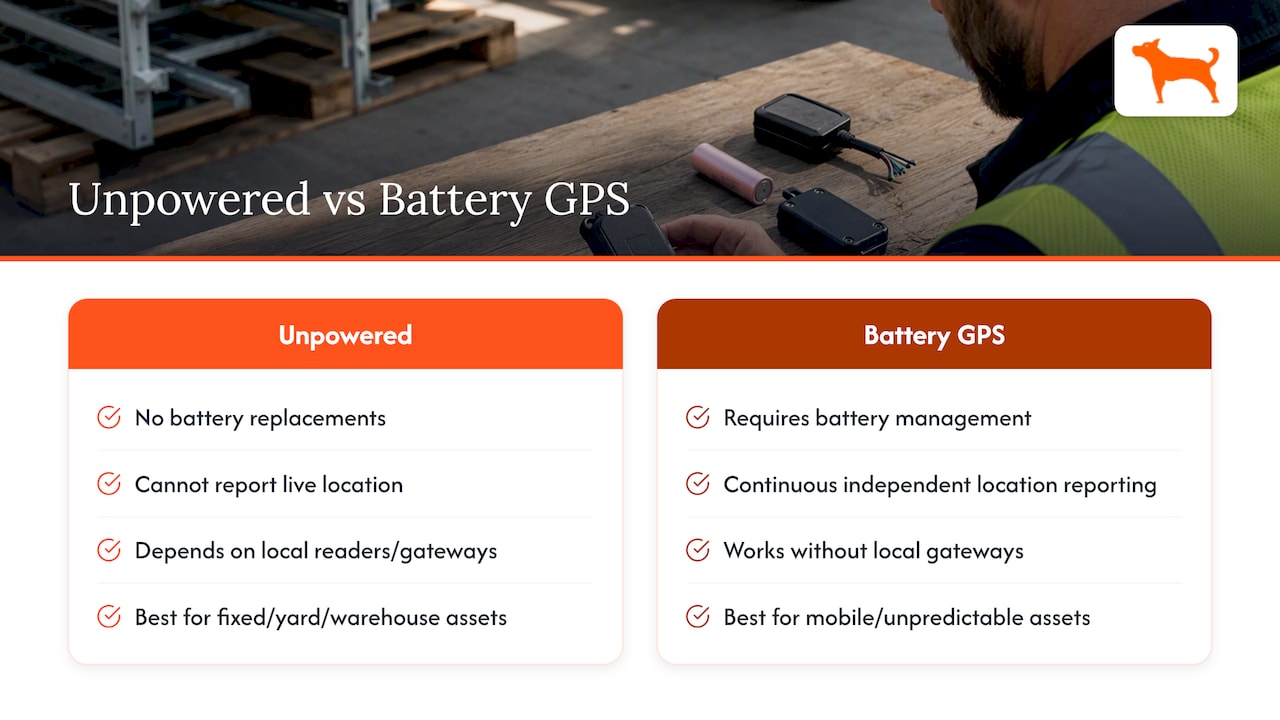
Truly unpowered technologies, passive RFID, magnet-based sensors, and similar designs, have one clear advantage: they never need a battery replaced, which eliminates a maintenance line item entirely. Their limitation is equally clear: without a continuous power source, they cannot transmit live location data on their own, and they depend on readers or gateways being present at the right place and time.
Battery-powered GPS trades that maintenance-free advantage for continuous, independent location reporting. A battery-powered tracker can report from anywhere within its connectivity range, without needing an asset to pass a specific reader location, which makes it the better fit for assets that travel unpredictably, trailers, rental equipment, delivery vehicles.
The practical choice usually comes down to asset behavior. Fixed or low-movement assets in a controlled environment, a yard, a warehouse, a job site with a gateway already installed, are well served by unpowered technologies paired with that existing infrastructure. Assets that move between sites, cross into areas without gateway coverage, or need continuous visibility for theft recovery are better served by battery-powered GPS, even with the added task of managing battery life and replacement schedules.
Many fleets end up using both: unpowered sensors for presence and tamper detection at fixed points, and battery-powered GPS for the assets that actually travel. Treating the two as complementary rather than competing often produces better visibility than trying to force one technology to cover every asset type.
What Fleet Managers Consistently Get Wrong
Most tracking deployments fail not because of bad hardware but because managers set reporting cadence too aggressively from day one, draining batteries faster than expected and souring trust in the technology. Spend pilot effort on tuning event triggers, not on comparing spec sheets. If an asset’s location only needs to be accurate within a day, do not pay for minute-by-minute reporting.
— Louis
Start Tracking Your Unpowered Assets Without a Monthly Bill
The buyer’s job here is straightforward: know where an unpowered asset is, get alerted when something unexpected happens to it, and avoid adding another recurring line item to the budget. These trackers are built around exactly that job: subscription-free GPS data, customizable geofencing, long battery life tuned for infrequent-charge deployment, and API access for managers who want tracking data flowing into systems they already use.
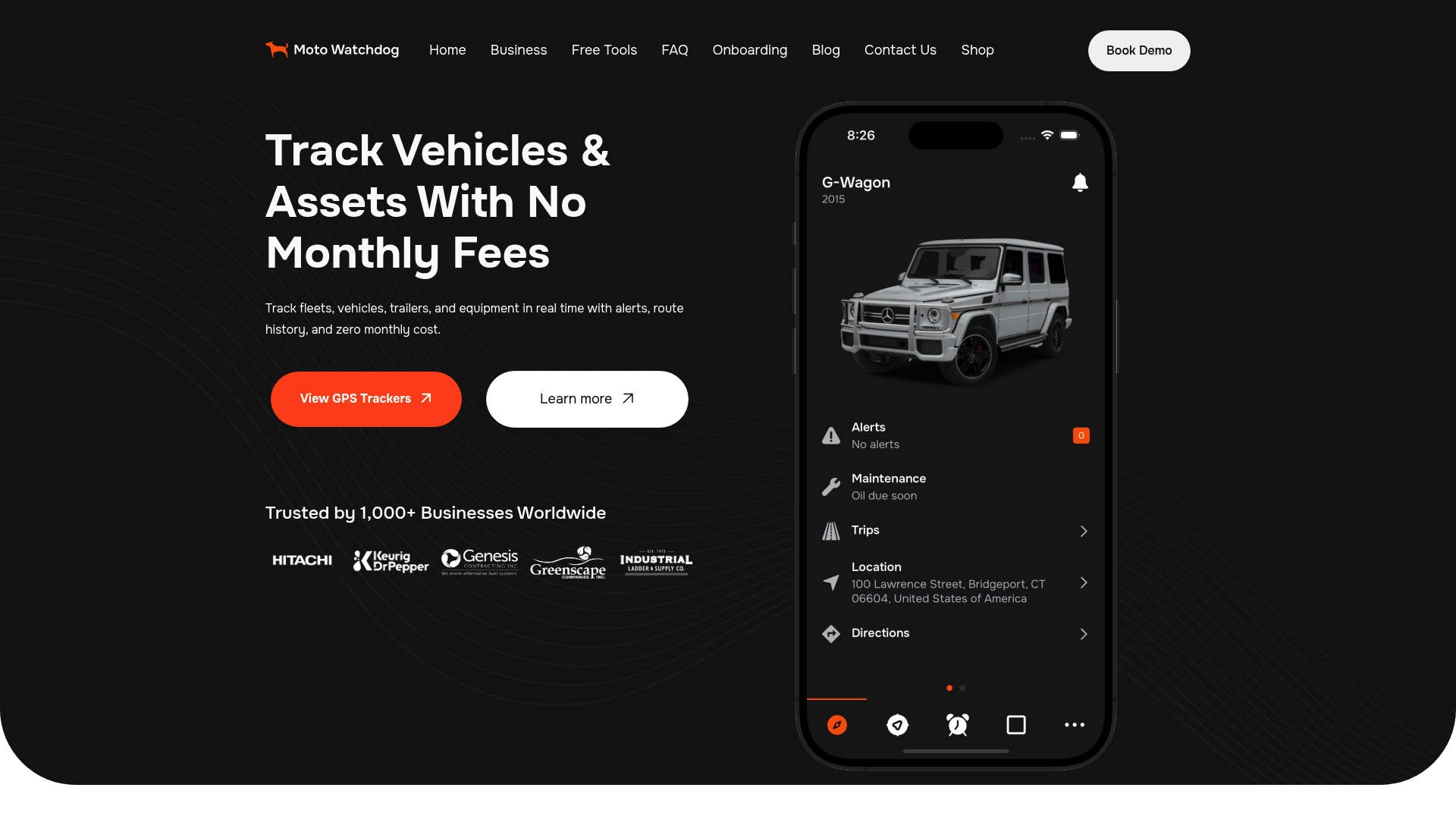
- No monthly fees: the hardware purchase is the only ongoing cost tied to the device itself.
- Geofencing and tamper alerts built in, matching the event-driven reporting approach outlined throughout this guide.
- API access for businesses that need tracking data integrated into existing fleet platforms.
A short pilot is the easiest way to see how this fits your fleet. Visit our Trackers page to review current models, or check out API access if integration with an existing system is the priority.
FAQ
Can RFID be used for asset tracking?
Yes, RFID works well for asset tracking in fixed locations like warehouses, yards, or dock doors, where a reader can scan tags as assets pass through. It does not provide continuous live location once an asset moves outside the reader’s range, so it works best alongside GPS for assets that travel.
How much does AssetTiger cost per year?
Pricing for third-party platforms like this varies by plan and asset count and is not something we track or publish. Check the provider’s own pricing page directly for current rates, since terms change over time.
Can a person track your location without you knowing?
A GPS device can report location without the person carrying or driving the asset being aware of it, which is why tamper detection and access controls matter for personal-use tracking. Most jurisdictions have legal restrictions on tracking another person’s vehicle or belongings without consent, so it is worth checking local law before deploying a device for that purpose.
What is the smallest GPS tracker available?
Tracker size varies widely by manufacturer and depends on tradeoffs between battery capacity, durability, and reporting frequency, smaller units generally carry smaller batteries and shorter service intervals between charges or swaps. Rather than chasing the smallest available unit, match the size to the asset and the reporting cadence the use case actually requires.
How do subscription-free GPS trackers compare to subscription-based models on cost?
Subscription-free models shift the cost into a higher upfront hardware price with no recurring data fee, while subscription-based models spread cost over monthly payments that continue for as long as the device stays in service. Our Trackers are built on the subscription-free model, which tends to favor fleets planning to keep devices in service for multiple years.
Sources
- Evaluations of LoRa-based in-transit tracking (government report)
- Enhancing rail transportation safety for hazardous material shipments (PHMSA report)