How to start saving money
Lorem ipsum dolor sit amet, consectetur adipiscing elit lobortis arcu enim urna adipiscing praesent velit viverra sit semper lorem eu cursus vel hendrerit elementum morbi curabitur etiam nibh justo, lorem aliquet donec sed sit mi dignissim at ante massa mattis.
- Neque sodales ut etiam sit amet nisl purus non tellus orci ac auctor
- Adipiscing elit ut aliquam purus sit amet viverra suspendisse potent
- Mauris commodo quis imperdiet massa tincidunt nunc pulvinar
- Excepteur sint occaecat cupidatat non proident sunt in culpa qui officia
Why it is important to start saving
Vitae congue eu consequat ac felis placerat vestibulum lectus mauris ultrices cursus sit amet dictum sit amet justo donec enim diam porttitor lacus luctus accumsan tortor posuere praesent tristique magna sit amet purus gravida quis blandit turpis.

How much money should I save?
At risus viverra adipiscing at in tellus integer feugiat nisl pretium fusce id velit ut tortor sagittis orci a scelerisque purus semper eget at lectus urna duis convallis. porta nibh venenatis cras sed felis eget neque laoreet suspendisse interdum consectetur libero id faucibus nisl donec pretium vulputate sapien nec sagittis aliquam nunc lobortis mattis aliquam faucibus purus in.
- Neque sodales ut etiam sit amet nisl purus non tellus orci ac auctor
- Adipiscing elit ut aliquam purus sit amet viverra suspendisse potenti
- Mauris commodo quis imperdiet massa tincidunt nunc pulvinar
- Adipiscing elit ut aliquam purus sit amet viverra suspendisse potenti
What percentege of my income should go to savings?
Nisi quis eleifend quam adipiscing vitae aliquet bibendum enim facilisis gravida neque. Velit euismod in pellentesque massa placerat volutpat lacus laoreet non curabitur gravida odio aenean sed adipiscing diam donec adipiscing tristique risus. amet est placerat in egestas erat imperdiet sed euismod nisi.
“Nisi quis eleifend quam adipiscing vitae aliquet bibendum enim facilisis gravida neque velit euismod in pellentesque”
Do you have any comments? Share them with us on social media
Eget lorem dolor sed viverra ipsum nunc aliquet bibendum felis donec et odio pellentesque diam volutpat commodo sed egestas aliquam sem fringilla ut morbi tincidunt augue interdum velit euismod eu tincidunt tortor aliquam nulla facilisi aenean sed adipiscing diam donec adipiscing ut lectus arcu bibendum at varius vel pharetra nibh venenatis cras sed felis eget.
For a single person finding a lost phone, the phone is enough. For trucks, trailers and rental equipment that have to be located every day, a dedicated GPS tracker is the better tool. It keeps reporting when a driver’s phone is dead, left behind or switched off, and it does not depend on anyone’s cooperation.
This guide compares the two approaches on the points that decide the question for contractors and rental fleets: accuracy, battery, coverage, cost, privacy, security and compliance. It ends with a simple way to decide.
TL;DR
- A phone is a general-purpose device that can be used for tracking. A GPS tracker does only that job, and a dedicated unit holds a fix where a phone app often drops it.
- Phone tracking fails in the ways that matter to a fleet: dead batteries, drivers closing apps, weak signal and phones leaving the vehicle. A tracker hardwired or fixed to the asset stays with it.
- Phone apps look cheap, but the cost shows up as subscriptions per seat, data plans and gaps in your records. A one-time-purchase tracker with no monthly fee changes the math over a few years.
- Phones still make sense for small crews, short projects and personal use. Equipment, trailers and anything without a driver need a dedicated device.
Table of Contents
- How each option actually works
- Accuracy and signal reliability
- Battery life and uptime
- Coverage in the places fleets work
- Cost: the subscription question
- Privacy, consent and data handling
- Security risks of mixing personal phones into a fleet
- Compliance: where phones fall short
- When a phone is enough, and when it is not
- A five-step way to decide
- Our perspective
- A tracker built for fleets and equipment
- FAQ
- Sources
How each option actually works
A phone tracking app uses the phone’s built-in GPS chip and its cellular or Wi-Fi connection to send positions to a dashboard or to another phone. It runs on top of everything else the phone does: calls, maps, messaging, operating system updates and battery-saving rules.
A dedicated GPS tracker is a small device with a GPS receiver, a cellular modem and a battery or vehicle power connection. It exists to record position and send it. Trackers operate independently of the driver and the driver’s phone, while apps turn the phone into the tracking tool, which keeps hardware cost low but adds variables.
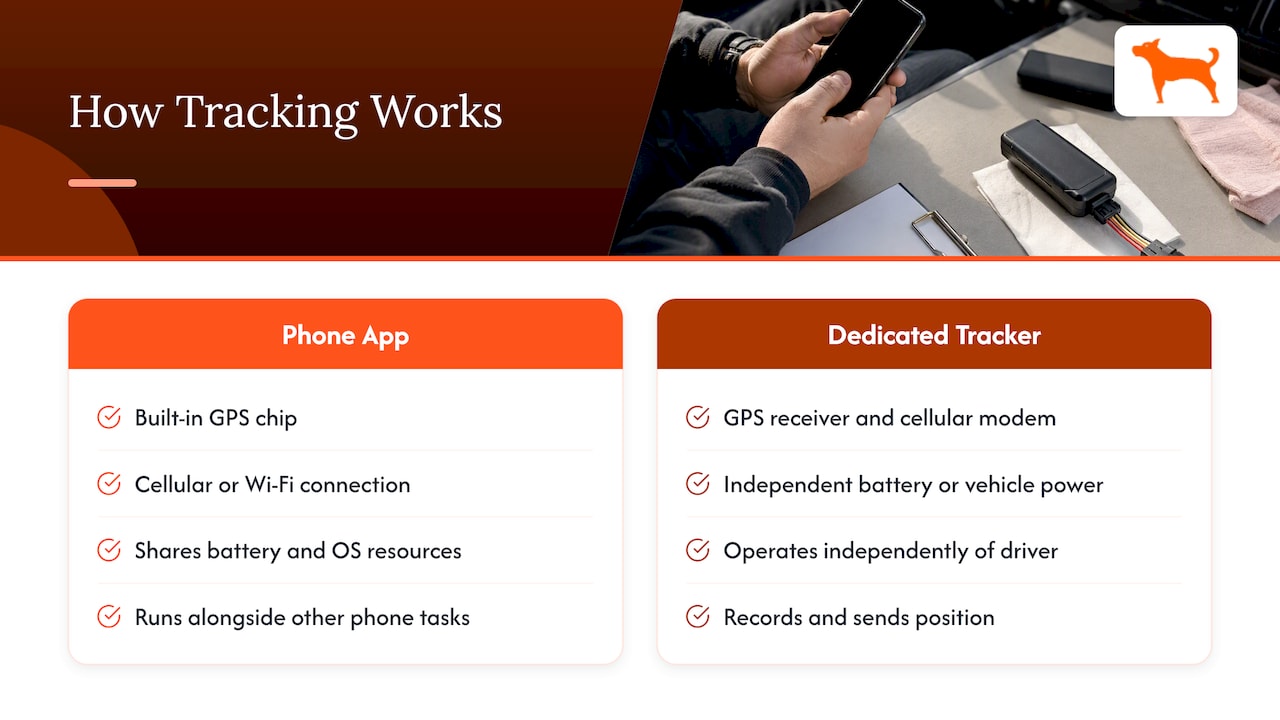
That difference in purpose explains almost every other difference in this guide.
Accuracy and signal reliability
Both approaches use satellite positioning, so under open sky the raw accuracy gap is smaller than many vendors imply. Consumer-grade dedicated trackers typically land within 3 to 10 meters (about 10 to 33 feet) outdoors with a clear view of the sky, and the same source notes that tall buildings, dense trees and indoor locations degrade any receiver.
The practical gap shows up in consistency, not the best-case reading:
- Fix retention. A tracker is built to hold a lock and keep logging. A phone may throttle location updates to protect its battery, which is why phone apps can drop a fix that a dedicated device holds.
- Placement. A tracker mounted on a trailer, a skid steer or inside a dash is in a fixed position. A phone sits in a pocket, a cup holder or a bag, often with metal around it.
- Update rhythm. Reporting intervals on a tracker are set by you. On a phone they are set by the operating system and by what the driver has open.
For a fleet manager, the question is rarely “how many meters off?” It is “was the asset on the map all day, and can I prove where it was at 2:40 p.m.?” A dedicated device answers that more reliably.
Battery life and uptime
Continuous GPS is one of the heaviest loads on a phone battery. A driver who starts the day at 100% and runs navigation, calls and a tracking app may be low by mid-afternoon. The phone then restricts background activity, and your tracking record develops holes.
Dedicated devices handle this two ways:
- Vehicle-powered units draw from the vehicle and do not depend on charging habits.
- Battery-powered units are designed for long standby and low-power reporting, which suits trailers, generators and equipment that sit for days between uses.
There is also the human factor. A phone leaves with the driver at lunch, goes home at night and gets swapped when an employee upgrades. A tracker stays with the machine. For heavy equipment rental, where the asset is the thing you need to find, that matters more than anything on this list. If you run battery-powered units, set up low-battery alerts so you replace or recharge before a device goes quiet.
Coverage in the places fleets work
Jobsites are rarely ideal for consumer phones. Quarries, rural roads, pipeline corridors and the back lots of equipment yards have patchy service. Phone apps typically depend on a data connection to report. When the mobile network is weak or unavailable, an app’s functionality may decrease or stop.
A tracker still has the same cellular dependence for live reporting, so signal matters for both. The difference is that a purpose-built modem and antenna, mounted on the asset, usually perform better than a phone in a pocket, and many trackers store points and upload them when service returns. Check that any device you buy does this, and check which networks it uses.
Cost: the subscription question
Phone tracking looks free because the driver already owns the phone. Count the full cost before you accept that:
- Software seats. Most fleet apps charge monthly per user or per vehicle.
- Data plans. Company-paid or reimbursed data for continuous location reporting.
- Phone wear. Faster battery degradation and more replacements.
- Coverage gaps. Assets with no phone (trailers, light towers, attachments) cannot be tracked at all.
Many dedicated trackers also charge monthly airtime plans, so “tracker” alone does not mean cheaper. The structure to look for is a one-time hardware purchase with data included. Here is a simple comparison:
| Factor | Phone tracking app | Dedicated tracker with monthly plan | Dedicated tracker, no monthly fee |
|---|---|---|---|
| Upfront cost | Low (existing phones) | Moderate | Moderate, one time |
| Recurring cost | Per-user subscription plus phone data | Monthly per device | None for tracking |
| Tracks unpowered assets | No | Yes | Yes |
| Depends on driver behavior | Yes | No | No |
| Cost over 3 to 5 years | Grows with headcount | Grows with device count | Flat |
With a larger fleet, recurring fees multiply per vehicle every month. That is the reason we build and sell trackers the other way.
Privacy, consent and data handling
Phone tracking puts you in the middle of personal devices. A driver’s phone holds personal messages, photos and location history outside work hours. Tracking it blurs the line between company and personal data, and that creates legal and employee-relations risk.
Regulators are paying attention to location data. The Federal Trade Commission has written about unlawful collection and use of consumer data in connected cars, and in January 2025 it took action against General Motors and OnStar over sharing drivers’ precise location and driving behavior without consent. Those cases concern automakers, not small fleets, but the principle applies to anyone collecting precise location: be clear about what you collect and get consent where required.
A tracker fixed to a company asset is simpler. It records where the company’s property is, not where an individual goes after work. Whatever you choose, write a short tracking policy, tell employees what is monitored and when, and check your state’s rules or talk to an employment attorney before tracking people rather than equipment.
Security risks of mixing personal phones into a fleet
Every phone you add to a fleet system is another device with its own operating system version, installed apps and patching habits. NIST-hosted DOT and DHS material on automotive cybersecurity frames telematics as a technology that sends, receives and stores information about remote objects such as vehicles, and security analysts point out that a closed, dedicated system presents a smaller attack surface than a mix of unmanaged phones.
In plain terms: fewer unknown devices means fewer ways in. A tracker with one function and no app store is easier to reason about than forty personal phones.
Compliance: where phones fall short
If you run commercial motor vehicles, separate two things: tracking and electronic logging.
The FMCSA states that real-time tracking is not required by the ELD rule, though a carrier may track its vehicles in real time for business purposes. So a GPS tracker is a business tool, not a substitute for a registered ELD where one is required.
ELDs themselves are tied to the vehicle. The agency’s guidance says an ELD must be integrally synchronized with the engine of the commercial motor vehicle. A phone alone cannot do that, which is why registered ELD products pair a vehicle-connected unit with a phone or tablet for display. If hours-of-service compliance is your goal, choose from the FMCSA’s registered device list. If location, theft recovery, mileage and utilization are your goals, a dedicated tracker is the right-sized tool.
When a phone is enough, and when it is not
Be honest about your situation. A phone-based approach can work when:
- You have two to five people, all with company-issued phones.
- You only need to confirm where a crew is during work hours.
- The project is short and you do not need history or alerts on machines.
It stops working when:
- You rent out equipment and need to find it after it leaves your yard.
- Assets have no driver: trailers, compressors, generators, attachments, light towers.
- You need theft alerts at night or on weekends.
- You want mileage and idle time you can defend in a billing dispute.
- You cannot control which phones, apps and settings your people use.
The Equipment World coverage of asset-tracking software describes the contractor need plainly: knowing where equipment, trucks and tools are at any moment. That is a hardware-on-the-asset problem.
A five-step way to decide
- List what you track. Separate people, vehicles and unpowered assets. Anything unpowered or unattended needs a device.
- Price the three-year cost. Multiply any monthly fee by units and months. Add data plans for phones.
- Define the alert you cannot miss. Theft after hours, a machine leaving a jobsite, or a trailer moving on a Sunday. Confirm the option can deliver that alert without anyone’s phone being on.
- Check compliance. If you run CMVs, confirm whether you need a registered ELD, and keep tracking separate from it.
- Write the policy. Decide what you collect, who sees it and how long you keep it.
Our perspective
We see the same pattern in contractor and rental fleets. A manager starts with phone tracking because it is free and fast. Then a machine goes missing, or a driver’s phone dies, or the monthly seat charges climb with each new hire, and the phone setup shows its limits.
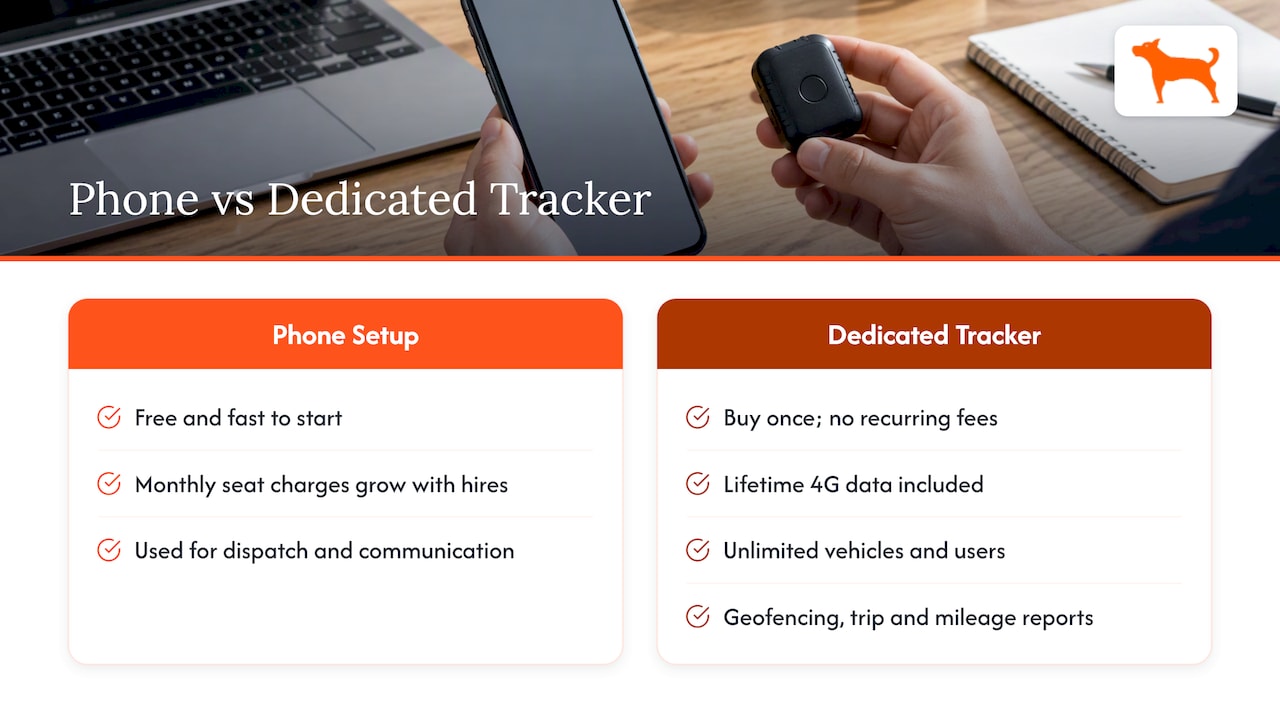
Our view is that tracking should be a property of the asset, not a favor from the person using it. That is why we sell hardware you buy once, with no monthly or recurring fees and lifetime 4G data included. You get geofencing alerts, trip and mileage reporting, idle time tracking and maintenance reminders from one app, with no activation fees and no add-on tiers. One dashboard handles unlimited vehicles and users, so adding the tenth trailer costs what the tenth tracker costs, not a new line on a monthly bill.
We also think phones have a place. Use them for dispatch and communication. Just do not make them the only thing between you and a missing excavator.
— Louis
A tracker built for fleets and equipment
Moto Watchdog trackers are a one-time purchase, starting from $124.99, with real-time location, customizable geofencing, push notifications, long battery life and multi-device management through a free mobile app. They suit vehicles, trailers, heavy equipment and personal assets. If you need to connect tracking data to your own systems, API access is available for business accounts.
For more on choosing hardware, see our guides to the benefits of fleet telematics and worldwide GPS trackers.
FAQ
Is a GPS tracker more accurate than a phone?
Under open sky, both use satellite signals and the raw difference can be small. In real use, a dedicated tracker tends to be more consistent because it is mounted in a fixed place, built for the job and not limited by battery-saving rules. Consumer trackers typically report within 3 to 10 meters outdoors.
Can I use a phone as a GPS tracker for my vehicles?
Yes, with a tracking app, and it can work for a small crew. Expect gaps when batteries die, the driver closes the app or signal drops. It also cannot track trailers or equipment that have no phone with them.
Do GPS trackers work without a monthly subscription?
Some do. Many brands charge monthly airtime, but a tracker sold with data included avoids recurring fees. Ours are a one-time purchase with no monthly fees and lifetime 4G data included, so check what any device you consider charges after the first day.
Does the FMCSA require real-time GPS tracking?
No. The FMCSA says the ELD rule does not require real-time tracking, though carriers may do it for business reasons. A tracker does not replace a registered ELD if you need one.
Is it legal to track employees with a phone app?
Rules vary by state and by whether the phone is personal or company-owned. Tell employees what you collect and get consent where required. For tracking people rather than equipment, ask an employment attorney in your state first.
Sources
- GPS Tracker vs. Phone App: Which Wins for Fleet Tracking?
- GPS Tracker vs Phone Tracking App: Which Is More Reliable?
- How Accurate Is GPS Tracking? Real Numbers Explained
- Cars & Consumer Data: On Unlawful Collection & Use, FTC
- FTC action against General Motors, January 2025
- DOT/DHS: Joint Agency Work on Automotive Cyber Security, NIST
- Does the ELD rule require real-time tracking? FMCSA
- ELD Functions, FMCSA
- Tenna software tracks assets, aids in equipment inspections, Equipment World