

How to start saving money
Lorem ipsum dolor sit amet, consectetur adipiscing elit lobortis arcu enim urna adipiscing praesent velit viverra sit semper lorem eu cursus vel hendrerit elementum morbi curabitur etiam nibh justo, lorem aliquet donec sed sit mi dignissim at ante massa mattis.
- Neque sodales ut etiam sit amet nisl purus non tellus orci ac auctor
- Adipiscing elit ut aliquam purus sit amet viverra suspendisse potent
- Mauris commodo quis imperdiet massa tincidunt nunc pulvinar
- Excepteur sint occaecat cupidatat non proident sunt in culpa qui officia
Why it is important to start saving
Vitae congue eu consequat ac felis placerat vestibulum lectus mauris ultrices cursus sit amet dictum sit amet justo donec enim diam porttitor lacus luctus accumsan tortor posuere praesent tristique magna sit amet purus gravida quis blandit turpis.

How much money should I save?
At risus viverra adipiscing at in tellus integer feugiat nisl pretium fusce id velit ut tortor sagittis orci a scelerisque purus semper eget at lectus urna duis convallis. porta nibh venenatis cras sed felis eget neque laoreet suspendisse interdum consectetur libero id faucibus nisl donec pretium vulputate sapien nec sagittis aliquam nunc lobortis mattis aliquam faucibus purus in.
- Neque sodales ut etiam sit amet nisl purus non tellus orci ac auctor
- Adipiscing elit ut aliquam purus sit amet viverra suspendisse potenti
- Mauris commodo quis imperdiet massa tincidunt nunc pulvinar
- Adipiscing elit ut aliquam purus sit amet viverra suspendisse potenti
What percentege of my income should go to savings?
Nisi quis eleifend quam adipiscing vitae aliquet bibendum enim facilisis gravida neque. Velit euismod in pellentesque massa placerat volutpat lacus laoreet non curabitur gravida odio aenean sed adipiscing diam donec adipiscing tristique risus. amet est placerat in egestas erat imperdiet sed euismod nisi.
“Nisi quis eleifend quam adipiscing vitae aliquet bibendum enim facilisis gravida neque velit euismod in pellentesque”
Do you have any comments? Share them with us on social media
Eget lorem dolor sed viverra ipsum nunc aliquet bibendum felis donec et odio pellentesque diam volutpat commodo sed egestas aliquam sem fringilla ut morbi tincidunt augue interdum velit euismod eu tincidunt tortor aliquam nulla facilisi aenean sed adipiscing diam donec adipiscing ut lectus arcu bibendum at varius vel pharetra nibh venenatis cras sed felis eget.
An IP rating is a two-digit code that tells you how well a device’s enclosure keeps out solids such as dust (first digit) and liquids such as water (second digit). For a fleet or rental yard, the useful question is not “which number is highest?” It is “which rating matches what this machine goes through every week?” A skid steer in a gravel pit, a trailer on a wet jobsite and a truck that gets pressure washed each Friday each need a different answer. The rest of this guide shows you how to read the code, what IP67 and IP68 really promise, and how to match a rating to the work.
TL;DR
- IP stands for Ingress Protection. The first digit covers solids and dust (0 to 6), the second covers liquids (0 to 9). A higher number means a different, and usually tougher, test.
- IP67 means dust-tight and protected against temporary immersion, commonly stated as up to 1 meter for 30 minutes. IP68 is also dust-tight, with deeper or longer immersion set by the manufacturer.
- IP68 does not automatically cover jets of water, and “waterproof” on a box is not a rating. Pressure washing and steam cleaning fall under their own level, IP69K.
- Match the rating to the real exposure: rain, mud, submersion in a ditch, or daily washdown. Then choose the mounting that keeps the device out of the worst of it.
Table of Contents
- What an IP rating actually is
- How to read the two digits
- IP67 meaning: dust-tight, and survives a dunk
- IP67 vs IP68: what really changes
- Waterproof ratings explained: why “waterproof” is not a rating
- Matching the rating to your equipment’s exposure
- Putting it together for GPS trackers on a fleet
- Common mistakes with IP ratings
- Why a fleet should think about the total cost, not just the rating
- Choosing trackers for your fleet
- FAQ
- Sources
What an IP rating actually is
The code comes from the International Electrotechnical Commission (IEC), the body that publishes international standards for electrical equipment. The IEC describes an IP code as a grade for how well an enclosure resists intrusion by solids and liquids. It exists, in part, to replace vague marketing words such as “waterproof” with something testable.
Two points matter for a fleet buyer:
- The rating describes the enclosure, not the whole machine. A tracker, a camera, a control panel or a connector each carries its own rating. A sealed tracker on a leaky mounting bracket is still a sealed tracker, but the connector or cable that leaves the housing can be the weak point.
- The rating is a pass in a specific test. A product is graded against a defined test for each level, which is why two devices with the same number can be compared fairly, and why a number alone does not cover conditions the test never included.
How to read the two digits
An IP code looks like IP67. The letters are fixed. The two numerals are the information.
The first digit: solids and dust
According to the IEC, the first numeral runs from 0 (no protection) to 6 (no dust ingress). For equipment that works in dirt, 6 is the number to look for. Federal Signal’s guide for work trucks and emergency vehicles notes that IP67 and IP68 both give complete dust protection because each starts with a 6.
That has a practical consequence. If a device you are comparing starts with a 6, dust is not what separates it from its neighbor. Fine silt, concrete dust, grain chaff and sand are all handled by the first digit. Look at the second digit to see where the products differ.
The second digit: liquids
The second numeral runs from 0 (no protection) to 9 (high-pressure hot water from different angles). The particular test changes with the level. In rough terms:
| Second digit | What it is about |
|---|---|
| 0 | No protection against liquids |
| 5 | Protection against water jets |
| 6 | Protection against powerful jets |
| 7 | Temporary immersion |
| 8 | Continuous immersion, conditions set by the manufacturer |
| 9 | High-pressure, high-temperature water |
The jump from 6 to 7 is where people get tripped up. Levels 7, 8 and 9 each cover their own kind of test rather than automatically including the ones before them. KTB’s glossary explains that an IP67 mark alone does not establish water-jet testing, and that is why some products carry combined marks such as IP65/IP67.
IP67 meaning: dust-tight, and survives a dunk
IP67 is the rating most searched on this topic, and the meaning is straightforward. The 6 means dust-tight. The 7 means protection against the harmful effects of temporary immersion. Caltrans defines IP67 this way in its electrical equipment specifications, and APEM summarizes it as immersion up to 1 meter for 30 minutes.
That is about 3.3 feet of water for half an hour. For a fleet, think of the situations that match:
- A truck or trailer crossing a flooded low spot or a deep puddle on a jobsite.
- A piece of equipment left out through a heavy storm with water pooling around the undercarriage.
- A device mounted low on a frame that gets splashed with slurry or wash water.
IP67 does not mean the device can live on the bottom of a pond, and it does not say anything about a hot, high-pressure wand.
IP67 vs IP68: what really changes
Both ratings are dust-tight. The difference is in the second digit. IP67 is for temporary immersion, commonly stated as up to 1 meter for 30 minutes, while IP68 allows deeper or longer immersion at the manufacturer’s specified rating. APEM puts it similarly: IP68 covers continuous immersion beyond 1 meter, with the manufacturer specifying the conditions.
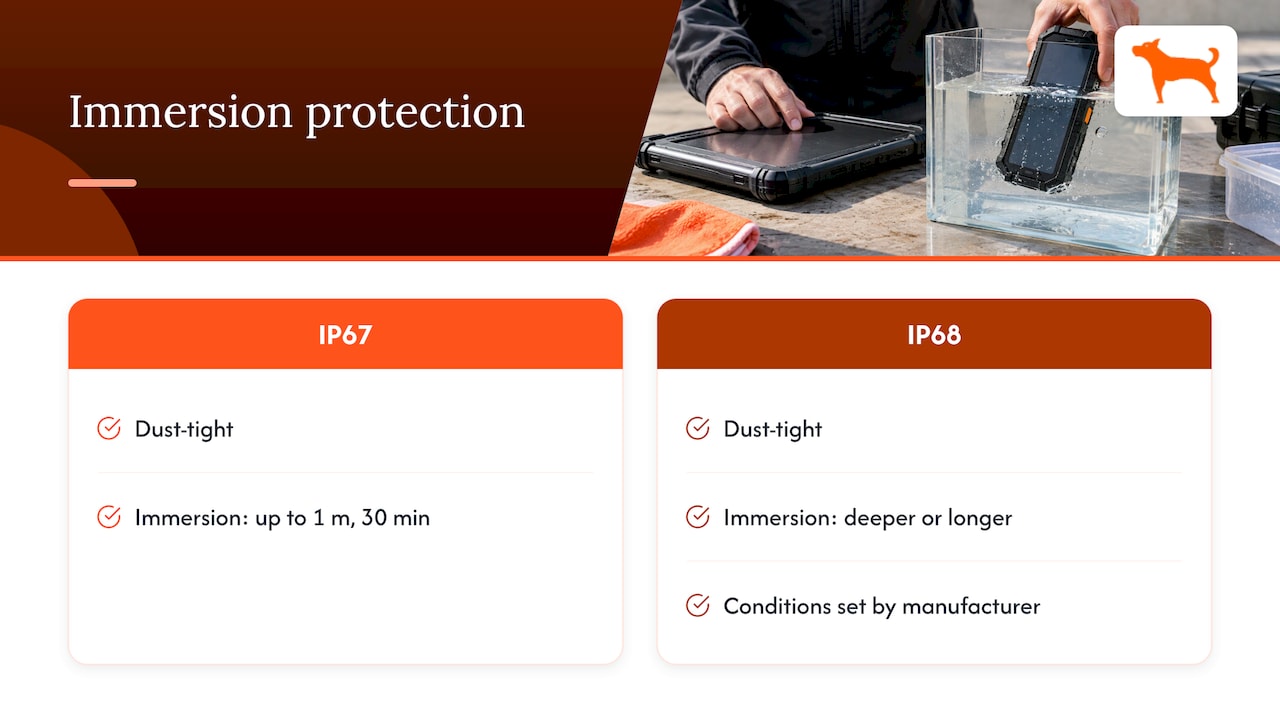
The key phrase is “the manufacturer specifies.” Level 8 has no single universal depth and duration. Omron’s washdown brochure states that level 8 immersion conditions are decided by the manufacturer and user. So two IP68 devices can be tested to different depths and times. If your equipment may sit submerged, read the stated depth and duration, not just the number.
A worked example
Say you run a rental fleet of mini excavators and a few dump trailers.
- The excavators work in trenches that collect rain. Water can pool around a low-mounted component for an hour or more. An IP67 rating covers a short dunk. If the exposure is closer to sitting in standing water for hours, you want a rating whose stated conditions cover that, which is where an IP68 listing with a stated depth and duration earns its place.
- The dump trailers sit in a yard, get rained on, and are hosed down at the end of a job. Rain and a garden-hose rinse are jet-type exposures (level 5 or 6 territory), and a rating that says only IP67 does not prove it was tested for jets. Look for a combined mark or choose a mounting spot that shields the device from direct spray.
The lesson: the higher number is not always the better match, and a single number does not cover every kind of water.
Waterproof ratings explained: why “waterproof” is not a rating
The word “waterproof” on packaging is a marketing claim. The IEC’s IP system exists to grade enclosure resistance, and its page says as much, aiming to avoid confusion over vague terms such as waterproof. An IP rating does not certify that a product is universally waterproof.
When you see a product described as waterproof, look for the code. If there is a code, read both digits. If there is none, you have a claim and no grade.
Immersion is not the same as spray
The tests are separate. IP65 indicates dust-tightness and water-jet protection, while IP67 indicates dust-tightness and temporary immersion. KTB’s glossary notes that if both jets and immersion are expected, look for a combined rating such as IP65/IP67. Caltrans draws the same line in its specification: exterior-exposed plugs and receptacles should be weatherproof to IP65, or watertight to IP67 if they can be submerged.
Pressure washing and steam: IP69K
Many fleets wash equipment with a pressure washer, and rental yards often steam-clean machines between customers. That is a different exposure again. Federal Signal describes IP69K as a high-pressure, high-temperature steam-jet washdown designation, distinct from the immersion tests behind IP67 and IP68. Omron’s brochure likewise ties level 9K to high-pressure water and steam.

So an IP67 or IP68 device is not automatically a pressure-wash device. If a wand will be pointed at the part, either the part needs a 9K rating or you need to keep the spray off it.
Matching the rating to your equipment’s exposure
Federal Signal frames IP selection as a decision about operational fit: compare the declared rating with the conditions the equipment actually meets in the field. Bailey International makes a similar point for heavy machinery, listing scissor lifts, agricultural machinery, waste-collection vehicles and telehandlers as heavy-equipment applications where controls need protection matched to the dirt and moisture of service.
Here is a simple way to do that for a yard full of mixed assets.
Step 1: List the exposures per asset
For each class of equipment, write down what actually happens to it:
- Dust and fine debris (grading, demolition, concrete cutting, agriculture)
- Rain and splash
- Standing water or fording
- Daily or weekly pressure washing or steam cleaning
- Mud and slurry packed around mounts
Step 2: Translate each exposure into a digit
| Exposure | Look for |
|---|---|
| Dusty or dirty work | First digit 6 |
| Rain, hosing, splash | Second digit 5 or 6 |
| Occasional dunking or flooding | Second digit 7 |
| Long submersion | Second digit 8, with the stated depth and time |
| Pressure washing, steam | IP69K |
| Both jets and immersion | A combined mark such as IP65/IP67 |
Step 3: Read the whole code and the conditions
Do not stop at “IP” and a number. Read both digits. For level 8, read the depth and duration the manufacturer states.
Step 4: Consider where the device goes
A rating describes the device. Placement decides how much of that exposure it ever sees. A unit tucked inside a cab or a protected compartment faces far less than one bolted to an exposed frame rail. This is where the choice between mounting styles matters as much as the number on the label.
Putting it together for GPS trackers on a fleet
Trackers ride on very different assets. A tracker for a cab-equipped truck can live in a sheltered spot. A tracker for a trailer, a skid steer or an attachment lives outside, in the weather.
That is why mounting options matter. Moto Watchdog sells OBD plug-in trackers for vehicles, hardwired trackers for hidden installs, and magnetic trackers in one-year battery and one-month battery versions. An OBD unit sits inside the vehicle. A hardwired unit can be hidden away from the elements. A magnetic unit goes where the asset is, so exposure is part of the decision. Use the exposure list from the previous section to decide which style fits which asset.
Common mistakes with IP ratings
- Assuming IP68 beats IP65 in every case. They test different things. IP68 is about immersion, IP65 about jets. A product tested for one is not proven for the other.
- Treating “waterproof” as a rating. It is a word, not a grade.
- Ignoring the cable and connector. The enclosure rating applies to the sealed housing as specified. Check how the device is installed and wired.
- Forgetting pressure washers. Yard washdown is a regular event in rental fleets. Plan for it.
- Skipping the conditions at level 8. The manufacturer sets depth and time, so the number alone does not tell you how long or how deep.
Why a fleet should think about the total cost, not just the rating
A well-matched device that stays working through weather, wash cycles and rough handling saves the cost of replacing hardware and the downtime of a missing asset. The same logic applies to the ongoing cost of tracking. Our trackers are priced from $124.99 as a one-time purchase, with no monthly fees, lifetime 4G data included and no activation fees. For a fleet with many assets, that removes a recurring line item that grows with every unit you add, and a single dashboard supports unlimited vehicles and users.
Our view on IP ratings and fleet tracking
We talk about tracking in terms of the job it has to do on the asset. A rating is useful when you read it against the real exposure, and the best habit a fleet manager can build is to list what each machine goes through before choosing hardware.
Our approach is built on what fleets and equipment rental companies need from a tracker: real-time location, geofence alerts, trip and mileage reporting, idle time tracking and maintenance reminders, managed from one app across every device, without a monthly bill attached to each one.
That is why we pair the mounting options with a one-time price. OBD plug-in, hardwired and magnetic models let you choose the placement that suits each asset, and no recurring fees mean you can cover the whole yard instead of choosing which assets are worth a subscription.
Our advice is to start with exposure, pick the placement, then decide how many assets you want visible on the map. In our experience of building for contractor fleets, coverage across the entire fleet is what delivers the measurable savings.
Louis
Choosing trackers for your fleet
If you manage vehicles, trailers and heavy equipment, start with the exposure list, then match the tracker style to each asset. Moto Watchdog trackers start at $124.99 one-time, with lifetime 4G data and no monthly fees, and API access is available for business integrations. Browse the range on our trackers page or go directly to the magnetic tracker with a one-year battery for trailers and equipment.
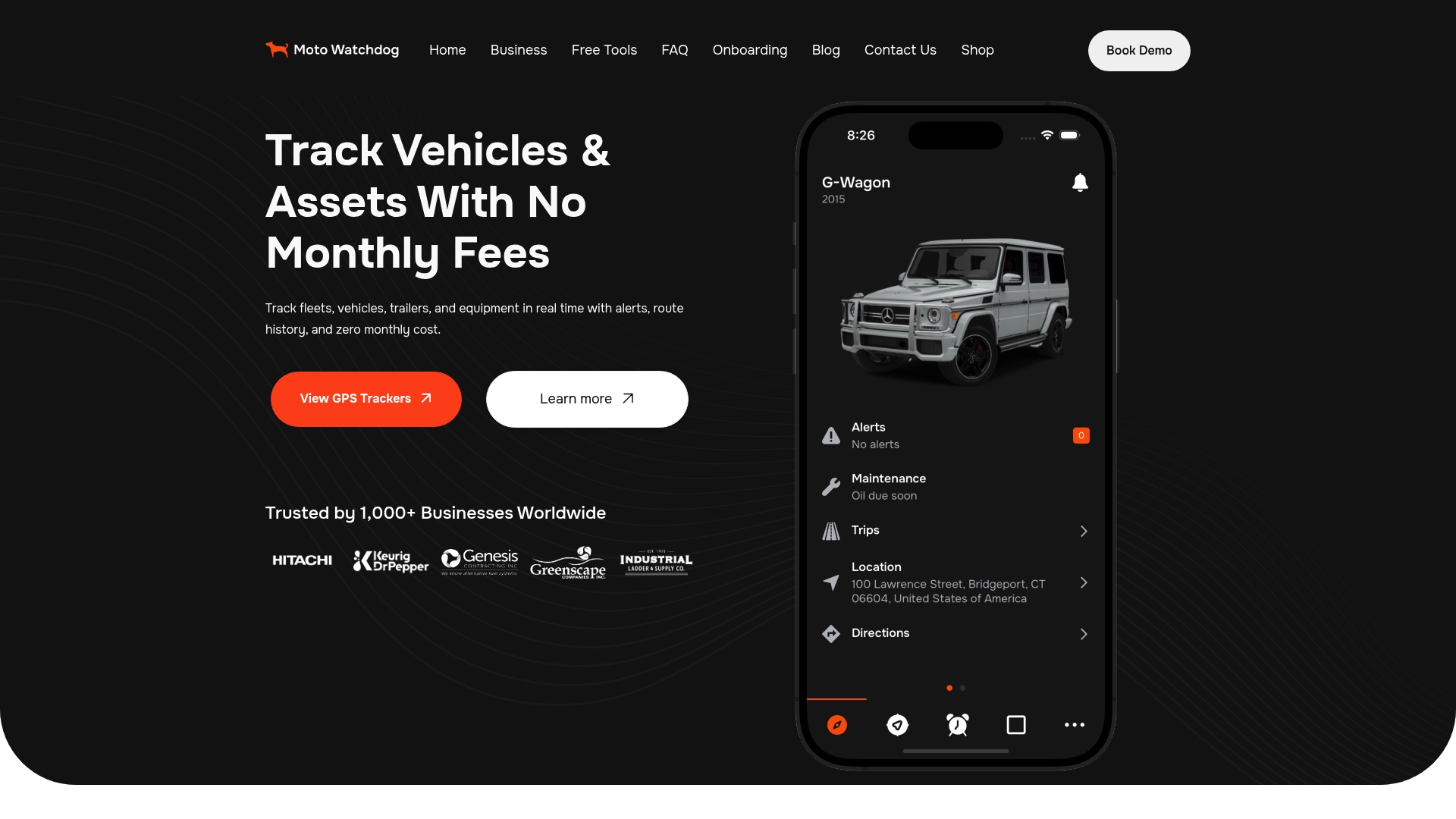
For vehicles with an OBD port, the OBD plug-in tracker is the quick way to get a truck on the map.
FAQ
What does IP67 mean?
IP67 means the enclosure is dust-tight (the 6) and protected against the harmful effects of temporary immersion (the 7). The immersion test is commonly stated as up to 1 meter for 30 minutes. It does not by itself establish protection against water jets or pressure washing.
Is IP68 better than IP67?
IP68 allows deeper or longer immersion than IP67, but the exact depth and time are set by the manufacturer. Both are fully dust-tight. Which is better depends on whether your equipment faces brief dunking or long submersion, so read the stated conditions rather than the digit alone.
Is an IP67 device safe to pressure wash?
Not on the strength of IP67 alone. High-pressure, high-temperature washdown is covered by a separate designation, IP69K. If equipment is regularly pressure washed or steam cleaned, look for that rating or keep the spray away from the device.
What do the two digits in an IP rating stand for?
The first digit grades protection against solids and dust, from 0 to 6. The second grades protection against liquids, from 0 to 9. A 0 means no protection, and each higher level corresponds to a different test.
Sources
- Ingress Protection (IP) ratings, IEC
- IP Ratings Explained: IP65, IP67, IP68 & IP69K Guide, Federal Signal
- Understanding IP rating, APEM
- Electrical equipment section, Caltrans
- IP rating: code digits and their meaning, KTB
- Products designed for harsh washdown environments, Omron
- IP Ratings for Heavy Equipment Controls, Bailey International

