How to start saving money
Lorem ipsum dolor sit amet, consectetur adipiscing elit lobortis arcu enim urna adipiscing praesent velit viverra sit semper lorem eu cursus vel hendrerit elementum morbi curabitur etiam nibh justo, lorem aliquet donec sed sit mi dignissim at ante massa mattis.
- Neque sodales ut etiam sit amet nisl purus non tellus orci ac auctor
- Adipiscing elit ut aliquam purus sit amet viverra suspendisse potent
- Mauris commodo quis imperdiet massa tincidunt nunc pulvinar
- Excepteur sint occaecat cupidatat non proident sunt in culpa qui officia
Why it is important to start saving
Vitae congue eu consequat ac felis placerat vestibulum lectus mauris ultrices cursus sit amet dictum sit amet justo donec enim diam porttitor lacus luctus accumsan tortor posuere praesent tristique magna sit amet purus gravida quis blandit turpis.

How much money should I save?
At risus viverra adipiscing at in tellus integer feugiat nisl pretium fusce id velit ut tortor sagittis orci a scelerisque purus semper eget at lectus urna duis convallis. porta nibh venenatis cras sed felis eget neque laoreet suspendisse interdum consectetur libero id faucibus nisl donec pretium vulputate sapien nec sagittis aliquam nunc lobortis mattis aliquam faucibus purus in.
- Neque sodales ut etiam sit amet nisl purus non tellus orci ac auctor
- Adipiscing elit ut aliquam purus sit amet viverra suspendisse potenti
- Mauris commodo quis imperdiet massa tincidunt nunc pulvinar
- Adipiscing elit ut aliquam purus sit amet viverra suspendisse potenti
What percentege of my income should go to savings?
Nisi quis eleifend quam adipiscing vitae aliquet bibendum enim facilisis gravida neque. Velit euismod in pellentesque massa placerat volutpat lacus laoreet non curabitur gravida odio aenean sed adipiscing diam donec adipiscing tristique risus. amet est placerat in egestas erat imperdiet sed euismod nisi.
“Nisi quis eleifend quam adipiscing vitae aliquet bibendum enim facilisis gravida neque velit euismod in pellentesque”
Do you have any comments? Share them with us on social media
Eget lorem dolor sed viverra ipsum nunc aliquet bibendum felis donec et odio pellentesque diam volutpat commodo sed egestas aliquam sem fringilla ut morbi tincidunt augue interdum velit euismod eu tincidunt tortor aliquam nulla facilisi aenean sed adipiscing diam donec adipiscing ut lectus arcu bibendum at varius vel pharetra nibh venenatis cras sed felis eget.
Idle time tracking measures how long a vehicle’s engine runs while the vehicle stays stationary, using GPS and ignition data to separate true idling from driving or power-takeoff (PTO) work. For fleet managers and contractors, this single data point drives two of the biggest line items in fleet budgets: fuel spend and maintenance intervals. Done right, it turns guesswork into a measurable reduction program.
TL;DR:
- Set the trigger at 60 seconds with the engine on and speed below 1 mph, and capture PTO separately to avoid penalizing equipment work.
- Test the system on 5 to 10 representative vehicles for 30 to 60 days, then compare idle hours against a two to four week baseline.
- Track idle hours per 100 engine hours, estimate gallons from each engine’s idle burn rate, and multiply by fuel price to calculate savings.
- Reserve auxiliary power units and battery HVAC for long haul trucks with overnight idling; local fleets usually gain more from coaching, routing, and idle policies.
- Pair weekly reports with driver coaching and incentives, and document exceptions for PTO, emergencies, or extreme weather idling to build trust and reduce resistance.
Table of Contents
- Why Idle Time Matters: The Scale and Cost of the Problem
- How Idle Time Tracking Actually Works: Signals and Definitions
- Step-by-Step: Implementing an Idle Tracking Program
- Idle-Reduction Technologies and When to Use Them
- Turning Idle Data Into Dollars Saved
- Why Moto Watchdog Fits Idle Tracking Pilots
- Lessons From the Field: What Actually Changes Idle Behavior
- Get Started With Moto Watchdog Trackers
- FAQ
- Sources
Why Idle Time Matters: The Scale and Cost of the Problem
Idling feels harmless in the moment. Across a fleet, it adds up to a measurable drain on budgets and equipment life.
The U.S. transportation sector burns more than 6 billion gallons of fuel a year on idling alone, a waste estimated to cost over $11 billion annually(https://afdc.energy.gov/conserve/idle-reduction-basics) at historical fuel prices.** That figure covers passenger and commercial vehicles combined, which means every fleet, from a two-truck landscaping crew to a regional delivery operation, carries a slice of that cost whether it tracks idling or not.
Beyond fuel, idling accelerates engine wear. Oil and coolant run below optimal operating temperature during idle, carbon builds up faster, and service intervals arrive sooner than the odometer suggests. For contractors and equipment rental companies, that means more frequent maintenance visits and shorter equipment lifespans on units that may already see hard use. Add in noise and local idling ordinances in some municipalities, and the operational case for tracking idle time becomes hard to ignore. Fuel budgets and maintenance schedules are the two levers idle data lets you actually pull.
How Idle Time Tracking Actually Works: Signals and Definitions
Idle tracking depends on a handful of signals working together, not a single sensor. Most devices combine GPS speed data, an ignition or engine-on input (often read through an OBD-II port or a discrete wired connection), and timestamped event logs. When the engine-on signal is active and GPS speed stays near zero for a set period, the system logs an idle event.
The harder problem is telling idle apart from power-takeoff use, such as a dump truck running its hydraulics or a utility vehicle powering tools on site. Without that distinction, fleets routinely misclassify engine hours as idle, penalizing drivers or technicians for necessary equipment operation rather than wasted fuel. Better systems include a separate PTO input or accelerometer-based motion detection to flag accessory use and exclude it from idle tallies.
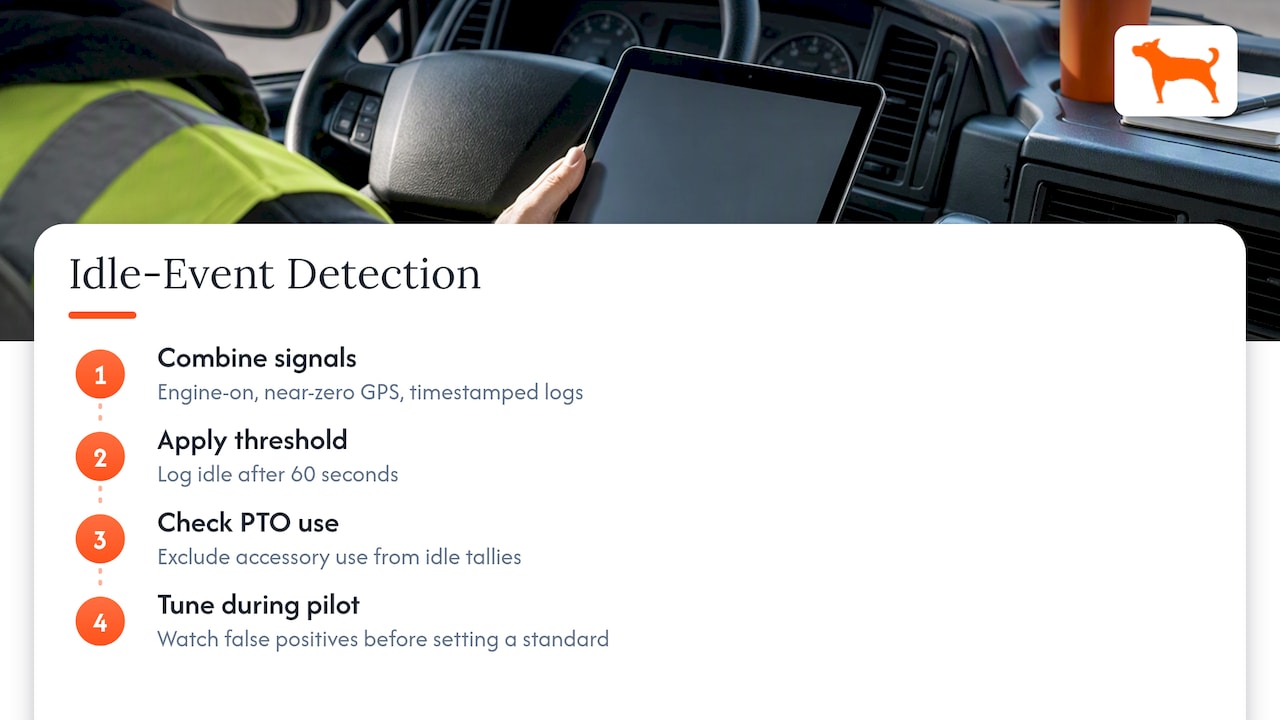
Thresholds matter too. A common starting point is flagging idle only after the engine has run for 60 seconds or more at near-zero speed, which filters out normal stops at lights and intersections. Set the threshold too low, and every red light looks like wasted fuel; set it too high, and genuine idling slips through unnoticed. Most fleets tune this threshold during an initial pilot, watching false-positive rates before locking in a standard.
Step-by-Step: Implementing an Idle Tracking Program
Rolling out idle tracking works best as a structured pilot rather than a fleet-wide mandate on day one.
- Select devices and confirm telemetry fields. Confirm the device captures engine-on status, GPS location, and timestamped events at minimum.
- Define idle thresholds and documented exceptions. Set a clear idle trigger (commonly 60 seconds of engine-on, near-zero speed) and document when PTO, emergency idling, or extreme weather idling is excused.
- Design the pilot. Choose a representative sample of 5 to 10 vehicles, run the pilot for 30 to 60 days, and track idle hours, gallons wasted, and maintenance flags as your core KPIs.
- Validate the data. Spot-check a sample of logged idle events against driver logs or dashcam footage to confirm the threshold is catching real idling, not PTO work.
- Engage drivers. Share weekly idle reports, explain the “why” behind the program, and pair data with coaching rather than silent monitoring.
- Set incentives. Recognition or small financial incentives tied to idle reduction tend to outperform policy memos alone.
Pro Tip: Run your pilot threshold conservatively at first and tighten it once you’ve confirmed false-positive rates are low.
Idle-Reduction Technologies and When to Use Them
Tracking tells you where idling happens. The next step is deciding what to do about it, and the right fix depends on duty cycle.
For long-haul trucks that idle overnight for climate control, auxiliary power units, fuel-fired heaters, and battery-powered HVAC systems cut fuel use and engine wear compared with running the main engine all night. These on-board solutions pay back fastest on vehicles that idle for hours at a stretch, like sleeper-cab tractors.
Truck stop electrification and shore power serve the same long-haul segment from the infrastructure side: drivers plug into wayside power instead of running any onboard system at all. For local delivery and contractor fleets that make frequent short stops, these investments rarely pay off. The better lever there is behavioral: tighter idle policies, driver coaching, and routing that minimizes wait time. Matching the fix to the duty cycle, rather than applying one solution fleet-wide, is what makes the investment worthwhile.
Turning Idle Data Into Dollars Saved
Idle hours only matter once you convert them into cost. A handful of KPIs make that translation straightforward:
- Idle hours per vehicle per week or month
- Idle hours per 100 engine hours, which normalizes for vehicle usage
- Estimated gallons wasted, calculated from idle hours and your engine’s typical idle fuel-consumption rate
- Dollars saved, calculated from gallons wasted multiplied by your fuel price
Using the [AFDC/DOE national estimate of over $11 billion in annual idling costs](https://afdc.energy.gov/conserve/idle-reduction-basics) as a reference point**, even a modest per-vehicle reduction in idle hours scales into real savings once applied across a full fleet. To validate ROI during a pilot, run a before-and-after comparison: capture baseline idle hours for two to four weeks, introduce your thresholds and driver coaching, then measure the same window again. Collect odometer and engine-hour readings alongside the idle logs so fuel savings can be cross-checked against actual consumption, not just estimated.
Why Moto Watchdog Fits Idle Tracking Pilots
Running a pilot shouldn’t require a new monthly bill on top of fuel and maintenance costs. Our trackers run on a subscription-free model, with idle time tracking, mileage reporting, and customizable geofencing alerts built in, backed by long battery life that keeps devices running through extended pilots without constant recharging. Over 1,000 businesses already rely on our accuracy for daily fleet decisions.
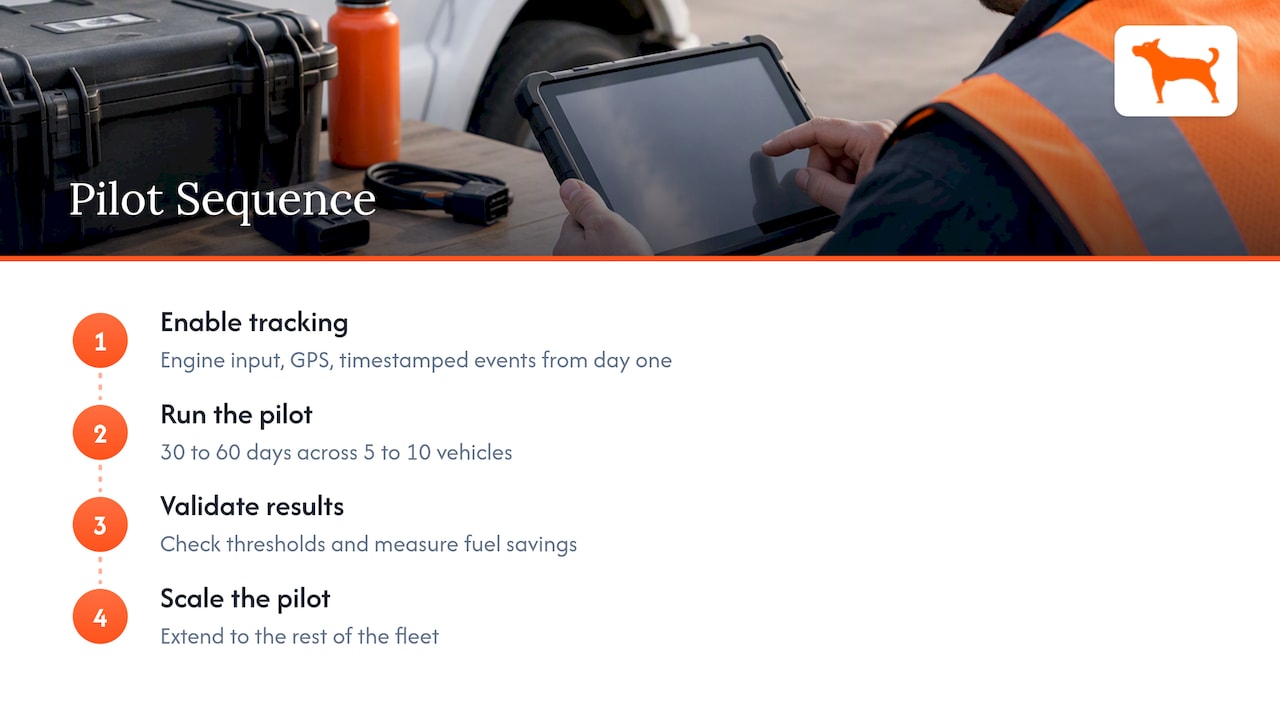
For a pilot, we recommend enabling engine or ignition input, GPS logging, and timestamped events from day one so idle, driving, and PTO events are all captured cleanly. A 30 to 60 day window across 5 to 10 vehicles gives enough data to validate thresholds and measure fuel savings before scaling to the rest of your fleet.
Lessons From the Field: What Actually Changes Idle Behavior
Devices alone rarely change behavior. The fleets that see real fuel savings pair telematics data with coaching and incentives, not just a dashboard nobody checks.
Clear exception handling matters just as much. When drivers know PTO and genuinely necessary idling won’t count against them, they trust the reports and stop fighting the system. Start small, measure fast, and adjust your thresholds before rolling out fleet-wide. That sequence saves far more frustration than launching everywhere at once.
— Louis
Get Started With Moto Watchdog Trackers
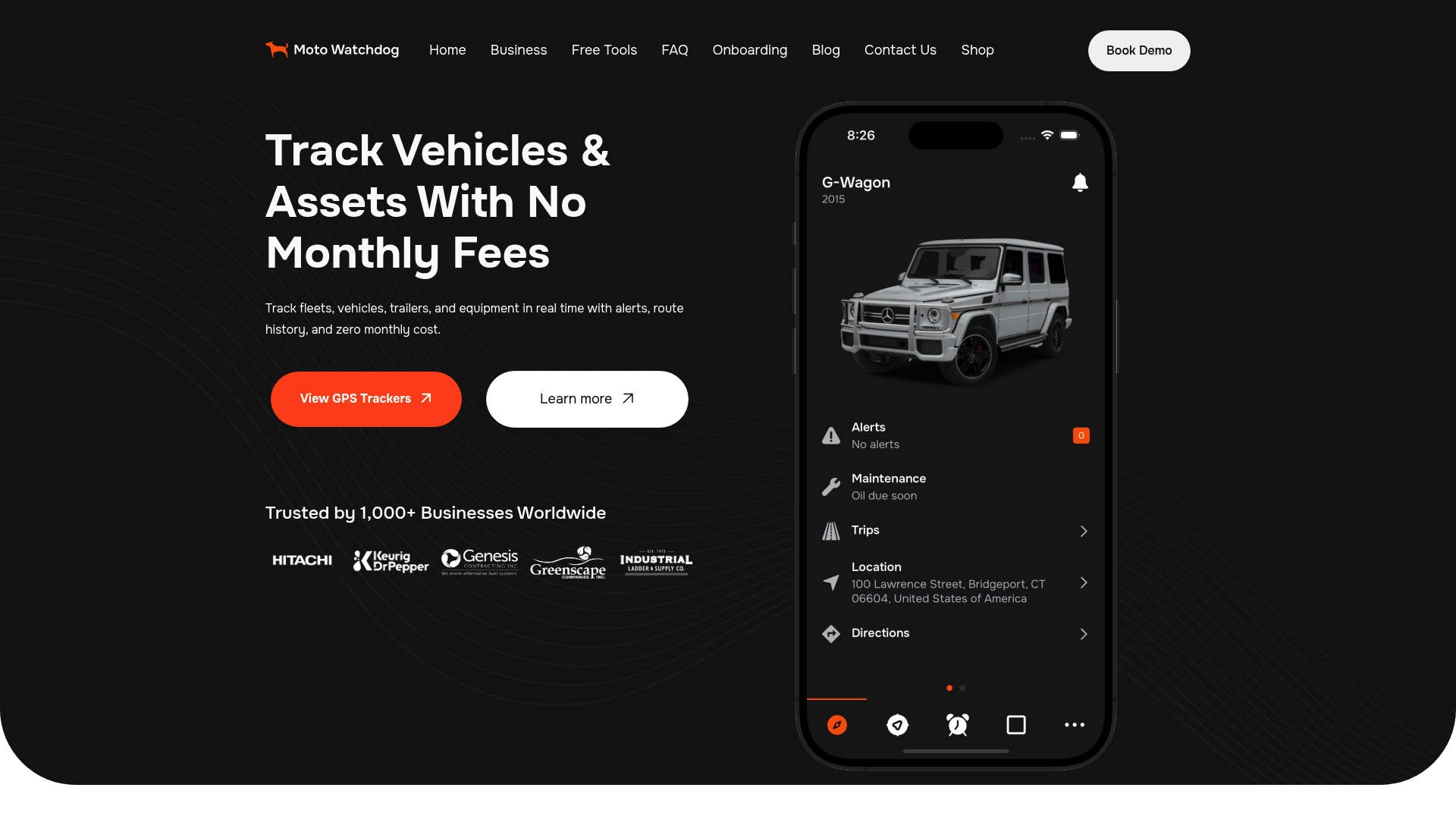
Picking the right trackers for a pilot shouldn’t mean signing up for another monthly fee on top of fuel and maintenance costs you’re already trying to cut. Our devices ship ready for idle time tracking out of the box, and our business and API tools let fleets integrate that data into existing reporting systems once the pilot proves out.
To get moving:
- Choose 5 to 10 vehicles that represent your typical duty cycle.
- Enable engine or ignition, GPS, and timestamp fields on each device.
- Run a 30 to 60 day pilot and log baseline idle hours before making changes.
- Compare idle hours before and after introducing thresholds and driver coaching.
FAQ
What counts as idle time versus PTO use?
Idle time is engine-on with the vehicle stationary and no power-takeoff activity, while PTO use is engine-on time spent running equipment like hydraulics or pumps. Accurate systems require a separate PTO signal to avoid counting necessary equipment operation as wasted fuel.
How much fuel does idling actually waste?
Across the U.S. transportation sector, idling wastes more than 6 billion gallons of fuel annually, at an estimated cost exceeding $11 billion a year. The exact cost for a single fleet depends on vehicle count, idle hours, and local fuel prices.
What idle threshold should a pilot use?
A common starting threshold is engine-on with GPS speed under 1 mph sustained for 60 seconds, which filters out normal stops at lights or intersections. Fleets typically adjust this threshold after reviewing false-positive rates during the first few weeks of a pilot.
Do idle-reduction technologies like APUs pay off for every fleet?
Auxiliary power units and battery HVAC systems tend to pay back fastest for long-haul trucks that idle for extended overnight periods. Local delivery and contractor fleets with frequent short stops generally see better returns from driver coaching and policy changes instead.
Does Moto Watchdog charge a monthly fee for idle tracking?
No. Our trackers run on a subscription-free model, with idle time tracking included alongside mileage reporting and geofencing alerts; current prices are available on the pricing page.