How to start saving money
Lorem ipsum dolor sit amet, consectetur adipiscing elit lobortis arcu enim urna adipiscing praesent velit viverra sit semper lorem eu cursus vel hendrerit elementum morbi curabitur etiam nibh justo, lorem aliquet donec sed sit mi dignissim at ante massa mattis.
- Neque sodales ut etiam sit amet nisl purus non tellus orci ac auctor
- Adipiscing elit ut aliquam purus sit amet viverra suspendisse potent
- Mauris commodo quis imperdiet massa tincidunt nunc pulvinar
- Excepteur sint occaecat cupidatat non proident sunt in culpa qui officia
Why it is important to start saving
Vitae congue eu consequat ac felis placerat vestibulum lectus mauris ultrices cursus sit amet dictum sit amet justo donec enim diam porttitor lacus luctus accumsan tortor posuere praesent tristique magna sit amet purus gravida quis blandit turpis.

How much money should I save?
At risus viverra adipiscing at in tellus integer feugiat nisl pretium fusce id velit ut tortor sagittis orci a scelerisque purus semper eget at lectus urna duis convallis. porta nibh venenatis cras sed felis eget neque laoreet suspendisse interdum consectetur libero id faucibus nisl donec pretium vulputate sapien nec sagittis aliquam nunc lobortis mattis aliquam faucibus purus in.
- Neque sodales ut etiam sit amet nisl purus non tellus orci ac auctor
- Adipiscing elit ut aliquam purus sit amet viverra suspendisse potenti
- Mauris commodo quis imperdiet massa tincidunt nunc pulvinar
- Adipiscing elit ut aliquam purus sit amet viverra suspendisse potenti
What percentege of my income should go to savings?
Nisi quis eleifend quam adipiscing vitae aliquet bibendum enim facilisis gravida neque. Velit euismod in pellentesque massa placerat volutpat lacus laoreet non curabitur gravida odio aenean sed adipiscing diam donec adipiscing tristique risus. amet est placerat in egestas erat imperdiet sed euismod nisi.
“Nisi quis eleifend quam adipiscing vitae aliquet bibendum enim facilisis gravida neque velit euismod in pellentesque”
Do you have any comments? Share them with us on social media
Eget lorem dolor sed viverra ipsum nunc aliquet bibendum felis donec et odio pellentesque diam volutpat commodo sed egestas aliquam sem fringilla ut morbi tincidunt augue interdum velit euismod eu tincidunt tortor aliquam nulla facilisi aenean sed adipiscing diam donec adipiscing ut lectus arcu bibendum at varius vel pharetra nibh venenatis cras sed felis eget.
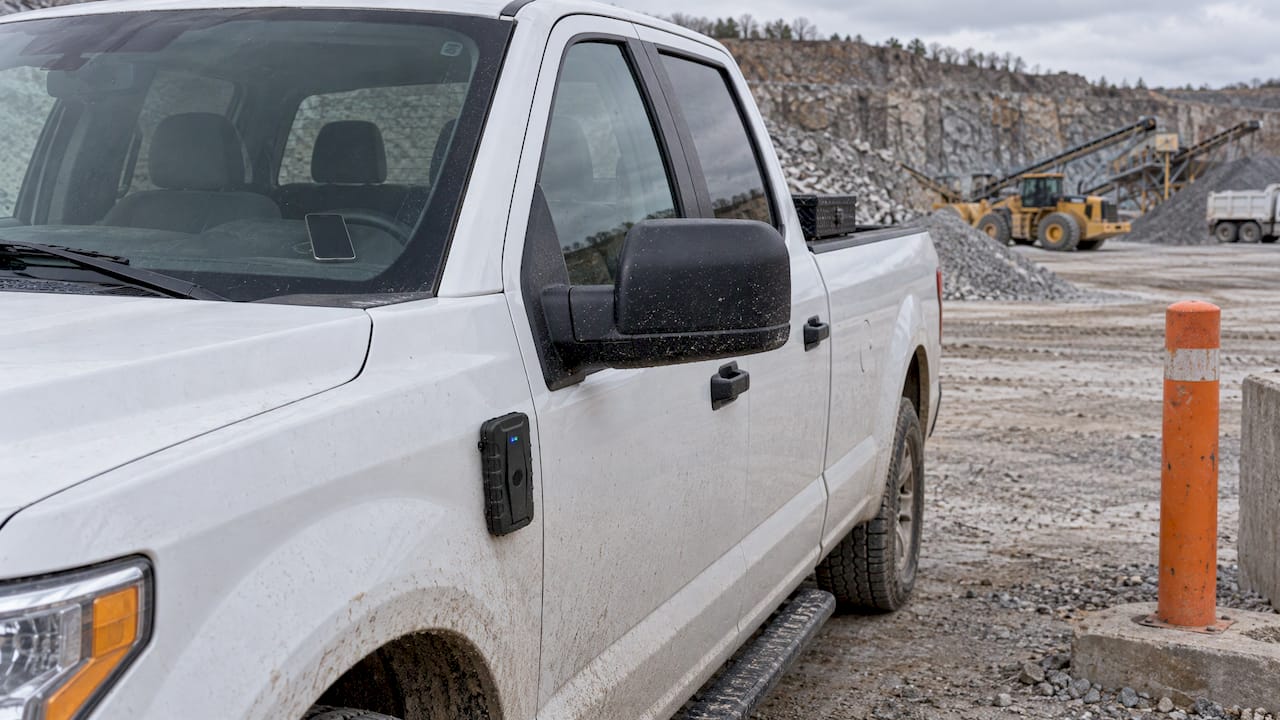
For vehicles and heavy equipment, a dedicated GPS tracker is the better fit. It stays with the asset, runs on its own power, and keeps reporting whether or not anyone has a phone charged, switched on and in the cab. Phone tracking works for people who carry a phone all day. It is not built to watch a skid steer parked overnight at a job site.
This guide compares the two approaches on the points that matter to contractors, rental yards and fleet managers: how location is determined, accuracy, coverage, power, cost and privacy. It also covers what to look for before you buy.
TL;DR
- A dedicated tracker is tied to the vehicle or machine. A phone is tied to a person, so the data follows whoever carries it.
- Under open sky, phone and standalone GPS accuracy is similar. The bigger differences are power, placement and what happens when no one is around.
- Phone apps look free at first, but they depend on a driver’s battery, settings and habits. Our trackers are a one-time purchase, from $124.99, with no monthly fees.
- Tracking company-owned equipment is generally on firmer legal ground than tracking an employee’s personal vehicle. Put a written policy in place either way.
- For unattended trailers, rental equipment and mixed fleets, choose a device that does not need a driver to cooperate.
Table of Contents
- How each method finds and reports a location
- Accuracy: closer than most people expect
- Coverage and offline behavior
- Power and installation
- Cost: one-time purchase versus ongoing plans
- Which approach fits which job
- Privacy and consent in the United States
- Perspective
- Choosing a tracker for your fleet
- Get started with a tracker built for assets
- FAQ
- Sources
How each method finds and reports a location
Both methods start in the same place: signals from GPS satellites. A receiver measures its distance from several satellites and calculates its position. The difference is what surrounds that receiver and how the result gets back to you.
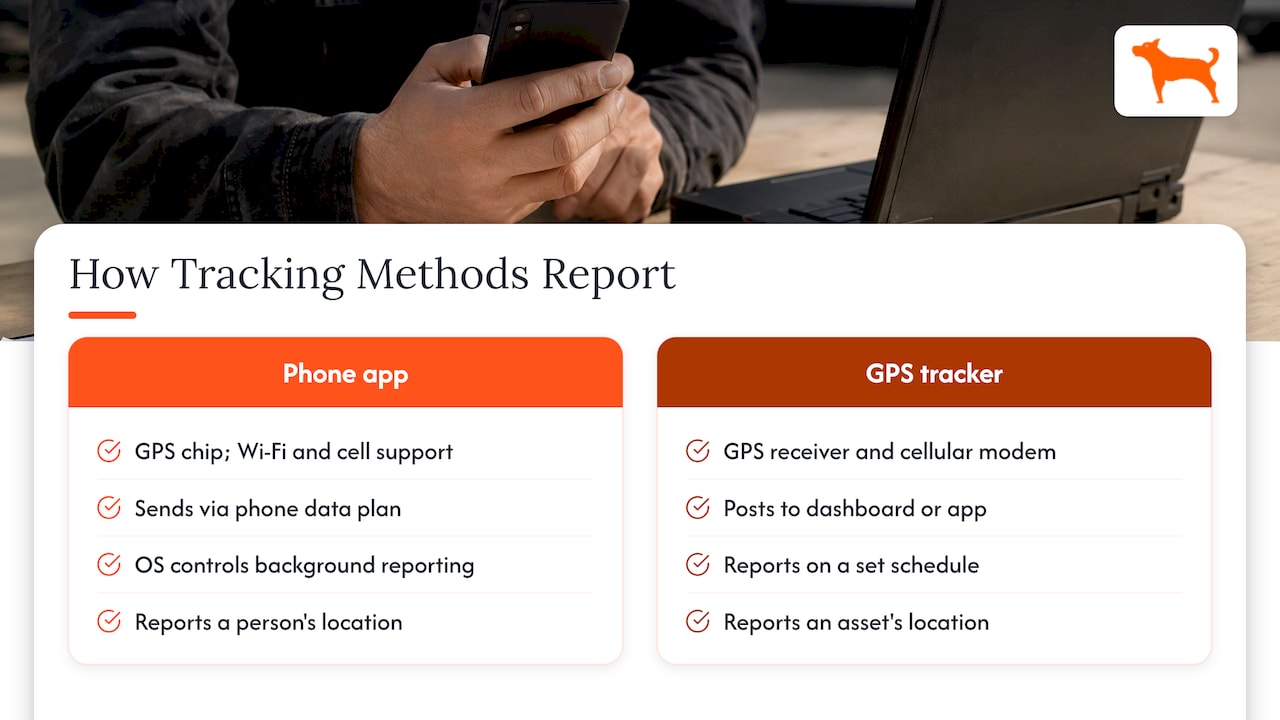
A phone tracking app uses the phone’s GPS chip, often supported by Wi-Fi and cell tower data to speed up or fill in a position. The app sends the result over the phone’s data plan to a server. The phone is also running messaging, navigation, music and everything else, and the operating system decides how often background apps may wake up and report.
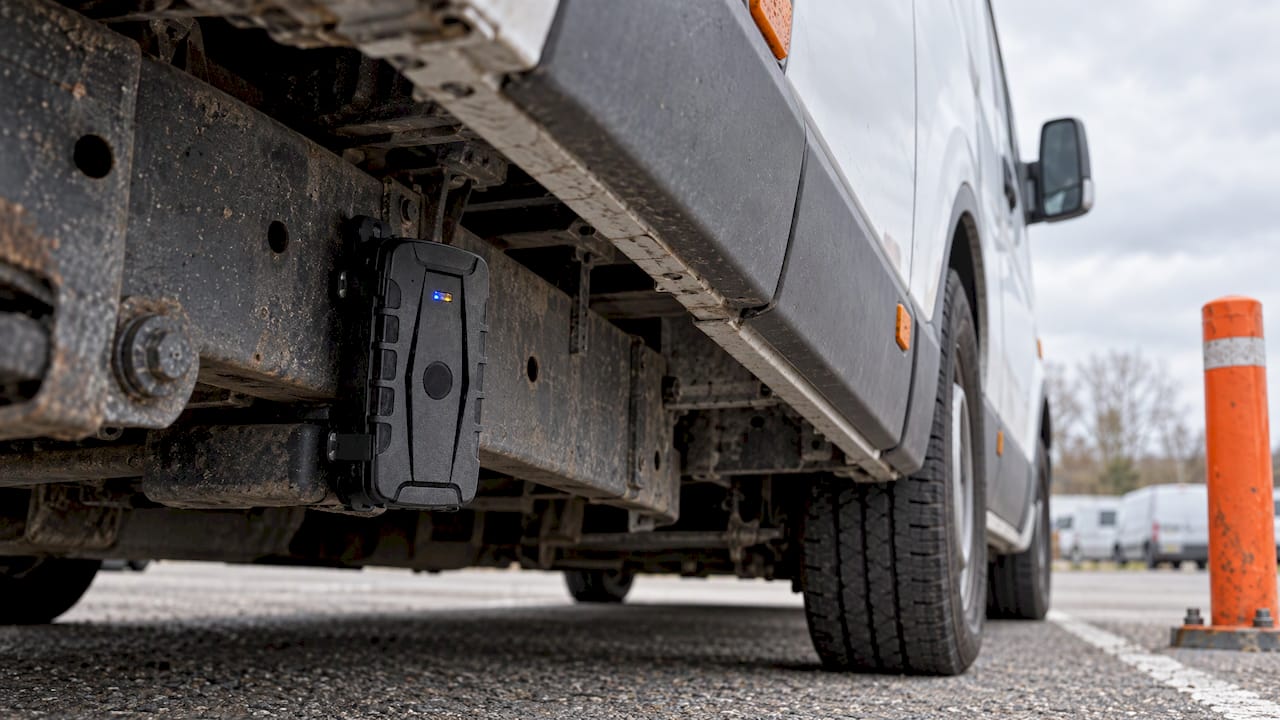
A dedicated GPS tracker has one job. It holds a GPS receiver and a cellular modem, and it posts positions to a dashboard or mobile app on a schedule you set. Our trackers use 4G data with lifetime data included, so there is no SIM to buy and no plan to renew. You mount the device on a vehicle, trailer or machine and manage it from the app.
That difference in purpose drives most of what follows. A phone reports where a person has been. A tracker reports where an asset is.
Accuracy: closer than most people expect
In good conditions, accuracy is not the deciding factor. GPS.gov states that GPS-enabled smartphones are typically accurate to within about 16 feet (4.9 meters) under open sky. It adds that accuracy gets worse near buildings, bridges and trees. A separate AWS developer post puts the average position accuracy of most mobile devices at roughly 15 meters (about 49 feet).
So what causes a wrong location? GPS.gov lists signal blockage, indoor or underground use, and multipath reflections off buildings or walls as common causes. It also notes that the receiver is sometimes fine and the mapping software is at fault.
For fleet work, the practical questions are about placement and consistency:
- Placement. A phone moves around the cab, sits in a pocket, or gets left in a truck bed. A tracker mounted in a fixed spot gives consistent, repeatable readings for that vehicle.
- Environment. Equipment yards, steel containers and dense job sites are tough for any receiver. A fixed device that you position deliberately gives you more control than a phone in someone’s hand.
- Geofence precision. A geofence around a yard or job site works best when location pings are frequent and steady. That is easier when the device is powered for the job.
If you want a quick rule: for a few feet of difference on a map, the device type matters less than where it sits and how often it reports.
Coverage and offline behavior
Trucks, trailers and rental machines do not stay where cell service is good. Blues notes that coverage maps show ideal conditions but not dead zones in valleys, handoffs between carriers or rural highways with no infrastructure. It also points out that poor connectivity drains power, because devices keep searching and retrying connections.
This matters for both approaches, and it is where purpose-built hardware helps. A tracker is designed to keep position fixes going and to report when it reconnects. Our trackers use 4G data with global coverage, which suits assets that cross state lines and regions. When you set up a new asset, check the signal where it works most, such as a remote quarry, a rural lease or a covered yard.
With a phone, there is one more variable: the driver. A phone in airplane mode, switched off, or with location permission set to “only while using” stops reporting. None of that is a failure of the technology. It is simply a dependency on a person’s habits.
Power and installation
Power is the quiet dividing line between the two.
Phones need daily charging and are used for other things all day. Tracking apps compete for battery with everything else, and a phone that dies mid-shift leaves a gap in your records.
Dedicated trackers are built to run for long stretches. Our devices are designed for long battery life, which is what you need for trailers and equipment with no ignition or wiring to tap. Install is simple: mount the device, activate it in the app and confirm the first location report.
A practical install checklist:
- Choose a spot with a clear view of the sky, such as under a plastic panel rather than beside heavy steel.
- Mount it where it is not obvious and where it will not be knocked loose by work.
- Confirm the first position in the app before the asset leaves the yard.
- Name each device in the app by unit number so your team can find it in seconds.
- Set geofences and alert preferences before the first job.
Cost: one-time purchase versus ongoing plans
Phone apps often cost little or nothing to start, and the phone is already in the driver’s pocket. That is a real advantage for tracking people. For tracking assets, the questions change: who pays for the data plan, who replaces a damaged phone, and who makes sure the app stays on?
Many dedicated tracker brands charge a monthly or annual service fee on top of the hardware. That is where the cost of a fleet grows: 20 devices with a monthly plan is 20 recurring charges for as long as you run them. Our trackers start at $124.99 as a one-time purchase, with no monthly fees, no activation fees and no add-on charges for features.
A simple way to compare:
| Cost item | Phone tracking app | Subscription tracker | Moto Watchdog tracker |
|---|---|---|---|
| Upfront hardware | Driver’s own or company phone | Device purchase | From $124.99 |
| Data | Driver’s phone plan | Monthly or annual plan | Lifetime 4G data included |
| Activation fee | Usually none | Varies by provider | None |
| Feature add-ons | Varies by app | Often tiered | Full features included |
| Works if no one carries it | No | Yes | Yes |
For a fleet, multiply by unit count and by years in service. A one-time purchase makes budgeting predictable, and that is the point of our model.
Which approach fits which job
| Situation | Better fit |
|---|---|
| Excavators, skid steers, lifts left on site overnight | Dedicated tracker |
| Trailers and rental equipment moving between customers | Dedicated tracker |
| Theft recovery and after-hours alerts | Dedicated tracker |
| Mileage and trip reporting by vehicle | Dedicated tracker |
| Field staff on foot or in personal vehicles | Phone app, with written consent |
| Mixed fleet with one dashboard | Dedicated trackers for assets, phones where people need to check in |
The pattern is consistent. If the thing you need to protect or measure is an asset, track the asset. If you need to know where a person is, a phone can do that, with the privacy steps below.
Heavy equipment rental
Rental yards have a special problem: the machine is with a customer, not with your staff. A phone cannot be assumed to stay with it. A tracker mounted on the unit gives you location, geofence alerts when it leaves an agreed area, idle time to understand use, and maintenance reminders based on actual usage. It also supports a clear conversation with customers about where equipment was and when.
Contractor fleets
For pickups, vans and trailers, trip and mileage reports simplify business reporting, and push notifications let you know when a vehicle enters or leaves a site. One dashboard supports unlimited vehicles and users in our system, so adding a truck does not change your setup.
Privacy and consent in the United States
Tracking rules turn mostly on who owns the thing being tracked. The National Law Review reports that few courts have addressed GPS tracking in employment, but most have held that employers may track company-owned equipment where the employee has no reasonable expectation of privacy. It also notes that states including California, Minnesota, Tennessee and Texas have laws limiting the use of tracking devices on other people, with exceptions for the owner’s consent.
The practical steps are straightforward:
- Track assets your company owns or holds title to. This is the clearest case, and a dedicated tracker fits it naturally.
- If you track a personal vehicle or a personal phone, get specific written consent first.
- LegalClarity advises that consent language should name the type of tracking, the assets monitored, the monitoring hours and who can see the data.
- Tell your team. Do not bury the policy in an onboarding packet.
- Rules differ by state, so have an employment attorney review your policy before you roll it out.
This is another reason trackers suit equipment. They monitor the machine, not the person’s phone, so the policy is easier to write and easier to explain.
Perspective
We built Moto Watchdog around a simple observation: most fleet owners do not need another monthly bill, they need to know where their equipment is.
A phone is a great tool for a person. An asset is different. It sits unattended, it has no one to charge it, and it still has to report. That is why we design our trackers to work on their own, with long battery life and 4G data included for the life of the device.
The same thinking drives our pricing. You buy the tracker once, you get the full feature set, and you manage unlimited vehicles and users on one dashboard. Over a fleet and several seasons, that is the difference that shows up in your budget. More than 1,000 businesses rely on our devices for that reason.
If you run a rental yard or a contractor fleet, start with the assets that cost you the most when they go missing.
Louis
Choosing a tracker for your fleet
Use these criteria when you compare options:
- Recurring cost. Ask what you will pay in year one, year three and year five.
- Power. Check how long the device runs between charges, or what wiring it needs.
- Coverage. Confirm the data plan works where your assets travel.
- Alerts. Look for customizable geofencing and push notifications.
- Reporting. Trip, mileage and idle time reports save hours at billing and audit time.
- Scale. Make sure adding vehicles and users does not add fees.
- Support. Same-day replies matter when a machine is missing.
Our trackers cover each of these. We reply to sales and support questions the same day, with no sales sequence.
Get started with a tracker built for assets
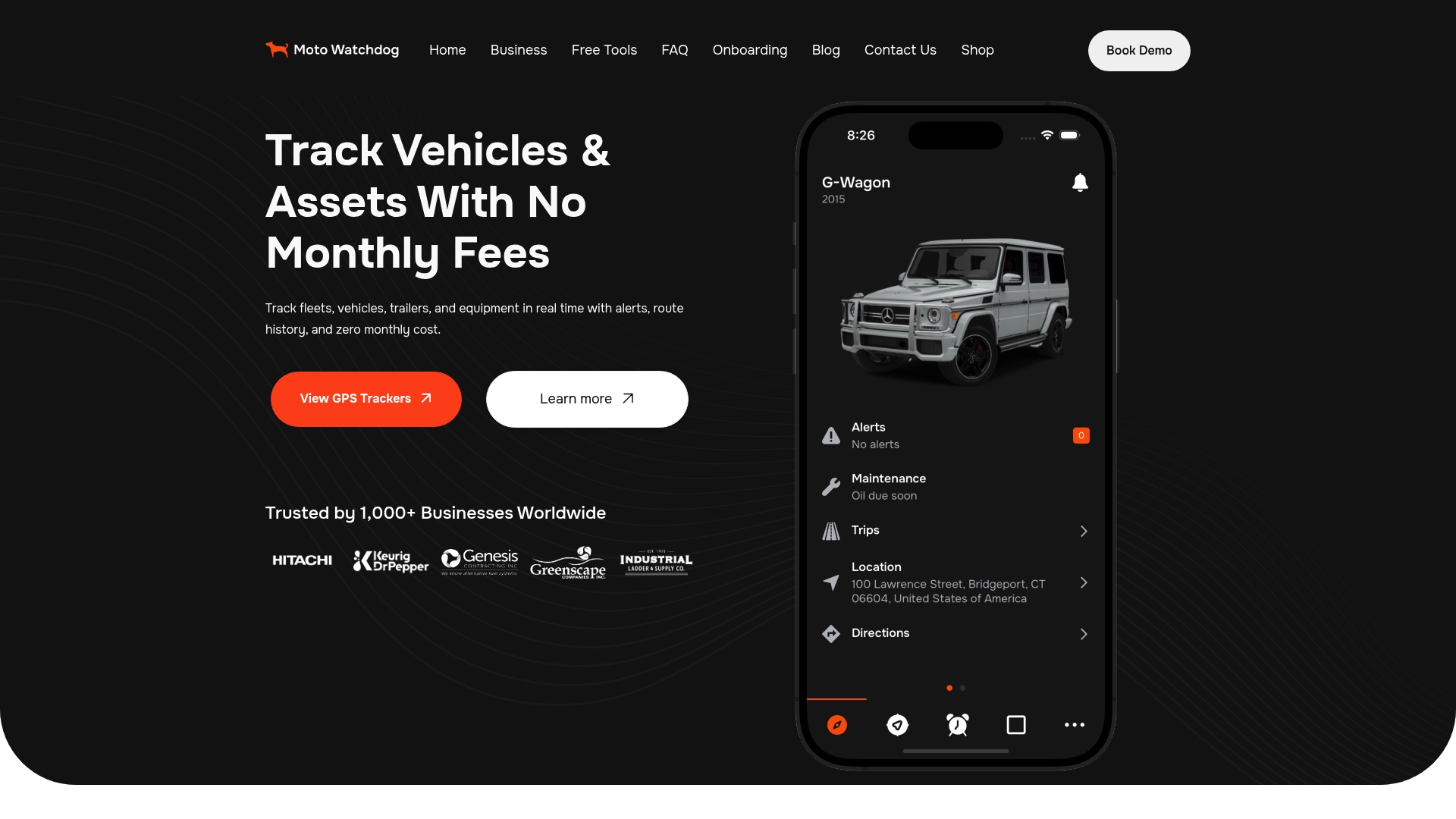
If you are ready to put eyes on your trucks, trailers and equipment without adding a monthly bill, see our GPS trackers. They start at $124.99 as a one-time purchase and include real-time location, geofencing, trip and mileage reports, idle time tracking, maintenance reminders and multi-device management in the free mobile app.
For teams that want to connect their own systems, we also offer API access for business. Contact us for details.
FAQ
Is a GPS tracker more accurate than phone tracking?
Not by a wide margin under open sky. GPS.gov puts smartphones at about 16 feet in those conditions. The more useful difference is consistency: a tracker mounted on the asset reports from the same position every time, whether or not anyone is nearby.
Can GPS give the wrong location?
Yes. Signal blockage, indoor or underground use and reflections off buildings can all shift a position, according to GPS.gov. Mount your tracker with a clear view of the sky and check the first report in the app to confirm it is right.
Is there a monthly fee for a GPS tracker?
Many brands charge one. Ours does not. Moto Watchdog trackers start at $124.99 as a one-time purchase, with lifetime 4G data included and no activation fee.
Which is better for equipment left unattended?
A dedicated tracker. It runs on its own power and reports without a driver, so you get location, geofence alerts and idle data for machines parked overnight or out on rental.
Sources
- GPS Accuracy | GPS.gov
- Amazon Location Service position filtering | AWS Mobile Blog
- Why Connected Products for Transportation Fail | Blues
- Key Considerations When Monitoring Employees Using GPS Tracking Devices | National Law Review
- GPS Tracking Policy Template: Consent and Compliance | LegalClarity