
How to start saving money
Lorem ipsum dolor sit amet, consectetur adipiscing elit lobortis arcu enim urna adipiscing praesent velit viverra sit semper lorem eu cursus vel hendrerit elementum morbi curabitur etiam nibh justo, lorem aliquet donec sed sit mi dignissim at ante massa mattis.
- Neque sodales ut etiam sit amet nisl purus non tellus orci ac auctor
- Adipiscing elit ut aliquam purus sit amet viverra suspendisse potent
- Mauris commodo quis imperdiet massa tincidunt nunc pulvinar
- Excepteur sint occaecat cupidatat non proident sunt in culpa qui officia
Why it is important to start saving
Vitae congue eu consequat ac felis placerat vestibulum lectus mauris ultrices cursus sit amet dictum sit amet justo donec enim diam porttitor lacus luctus accumsan tortor posuere praesent tristique magna sit amet purus gravida quis blandit turpis.

How much money should I save?
At risus viverra adipiscing at in tellus integer feugiat nisl pretium fusce id velit ut tortor sagittis orci a scelerisque purus semper eget at lectus urna duis convallis. porta nibh venenatis cras sed felis eget neque laoreet suspendisse interdum consectetur libero id faucibus nisl donec pretium vulputate sapien nec sagittis aliquam nunc lobortis mattis aliquam faucibus purus in.
- Neque sodales ut etiam sit amet nisl purus non tellus orci ac auctor
- Adipiscing elit ut aliquam purus sit amet viverra suspendisse potenti
- Mauris commodo quis imperdiet massa tincidunt nunc pulvinar
- Adipiscing elit ut aliquam purus sit amet viverra suspendisse potenti
What percentege of my income should go to savings?
Nisi quis eleifend quam adipiscing vitae aliquet bibendum enim facilisis gravida neque. Velit euismod in pellentesque massa placerat volutpat lacus laoreet non curabitur gravida odio aenean sed adipiscing diam donec adipiscing tristique risus. amet est placerat in egestas erat imperdiet sed euismod nisi.
“Nisi quis eleifend quam adipiscing vitae aliquet bibendum enim facilisis gravida neque velit euismod in pellentesque”
Do you have any comments? Share them with us on social media
Eget lorem dolor sed viverra ipsum nunc aliquet bibendum felis donec et odio pellentesque diam volutpat commodo sed egestas aliquam sem fringilla ut morbi tincidunt augue interdum velit euismod eu tincidunt tortor aliquam nulla facilisi aenean sed adipiscing diam donec adipiscing ut lectus arcu bibendum at varius vel pharetra nibh venenatis cras sed felis eget.
Most fleets should keep routine GPS location history for 30 to 90 days, extend detailed trip and mileage reports to 6 to 12 months for operational review, and treat two numbers as fixed regulatory floors: six months for ELD-related position records under FMCSA policy and four years for IFTA mileage and fuel records. Everything beyond those floors should map to a specific business purpose, not habit.
TL;DR:
- Retain GPS location history for at least six months as required for ELD records, with many fleets extending up to 12 months for safety and audits.
- Keep tax and mileage records for a minimum of four years to meet IFTA and IRP regulations, but only store beyond that for specific business purposes.
- Limit driver-related data collection to what is necessary, store health information separately, and restrict access based on role to comply with privacy laws.
- Use cloud storage for retention policies, archive raw data for incidents, and downsample routine movements to reduce storage costs and exposure.
- Automate data exports and archiving via APIs, verify retention settings regularly, and document policies clearly to stay compliant and avoid unnecessary data hoarding.
Table of Contents
- Quick retention cheat sheet for fleet managers
- Regulatory and legal timelines that set your minimums
- Employee privacy limits on what you can keep
- How storage design shapes what you actually keep
- Building a GPS retention policy step by step
- Why most fleets keep too much data, not too little
- Keeping retention compliant without the manual work
- FAQ
- Sources
Quick retention cheat sheet for fleet managers
Before adjusting any settings, compare your current configuration against these benchmarks.
- Routine location pings: keep for 30 to 90 days unless tied to an active dispute.
- Trip and mileage summaries: retain 6 to 12 months to support payroll, billing, and internal audits.
- ELD and hours-of-service records: retain a minimum of six months with backup copies on separate media, per 49 CFR Part 395.
- Tax and mileage substantiation: retain at least four years for IFTA and IRP purposes.
- Accident or incident evidence: hold until the statute of limitations expires or the claim closes.
Three actions you can take today: verify your platform’s current retention settings against this list, export any historical data tied to an open claim before it ages out, and turn on automated deletion or archiving so compliance stops depending on someone remembering to act. For the underlying rules, check FMCSA’s supporting documents policy, the ELD provisions in 49 CFR Part 395, and the NIST Privacy Framework for data-lifecycle practices.
Regulatory and legal timelines that set your minimums
Fleet operators don’t get to pick retention periods in a vacuum. Federal rules and tax authorities set floors that override internal preference, and litigation exposure can push those floors much higher.
FMCSA treats GPS and electronic tracking records as supporting documents under its policy on retention, which requires motor carriers to retain position history reports for six months under 49 CFR 395.8(k)(1). The agency allows electronic position records to substitute for some traditional paper logs, but only when the system can generate compliant reports on demand, meaning your platform needs to produce six months of hourly positioning data without gaps. Separately, 49 CFR Part 395 requires ELD backup copies on a device or medium separate from the vehicle unit, and it protects driver records from alteration or erasure.
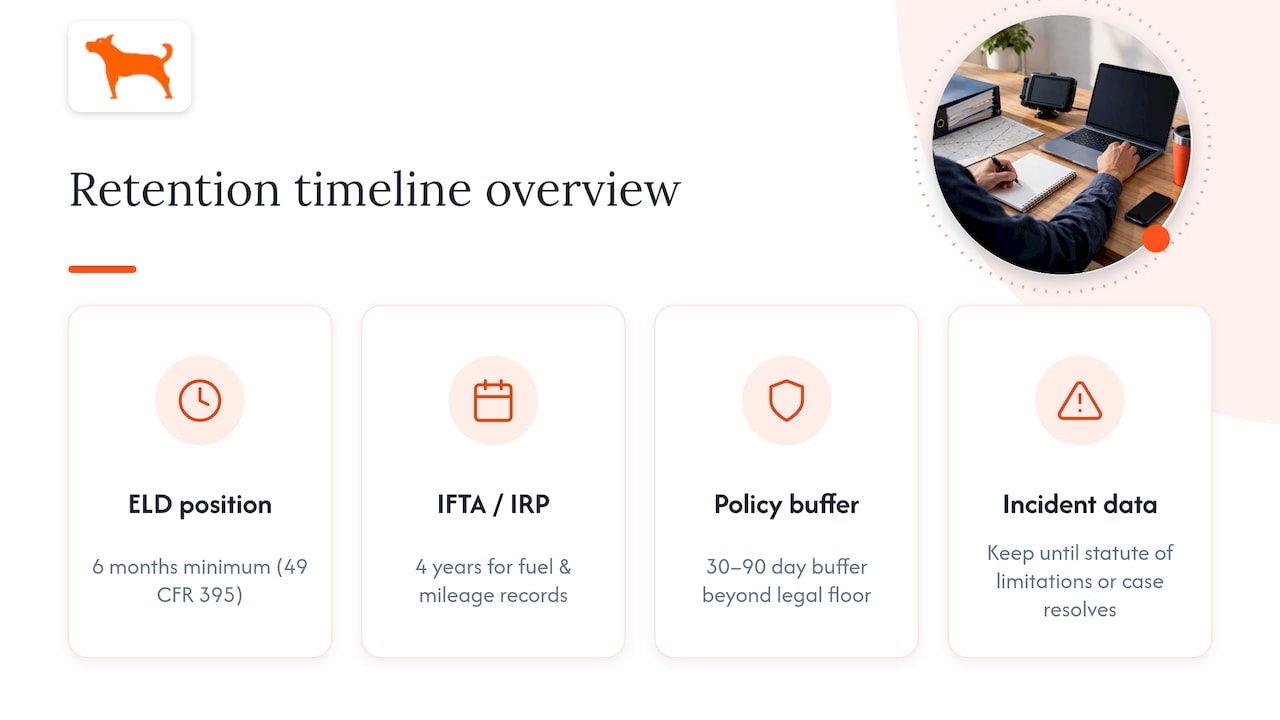
One figure to anchor your policy: six months is the floor for ELD position records under 49 CFR 395, and most fleets build in a buffer beyond it rather than deleting on the exact day the clock runs out.
IFTA and IRP tax reporting typically requires fuel and mileage records be kept for four years to substantiate quarterly returns, a standard practiced consistently across carriers that cross state lines. Litigation and insurance timelines work differently: if a vehicle is involved in an accident or a claim, retain the associated GPS, speed, and route data until the statute of limitations expires or the case resolves, whichever comes later.
A workable rule of thumb: set your policy at the legal floor plus a 30 to 90 day buffer. That buffer absorbs reporting delays, audit requests, and the lag between an incident occurring and legal counsel asking for records.
Employee privacy limits on what you can keep
GPS data about drivers is also data about people, and that status brings obligations beyond operational convenience. Two agencies shape what fleets can collect, store, and share.
The EEOC’s wearables guidance makes clear that medical or disability-related information must be treated as confidential under the ADA, a standard that extends to any tracking data that reveals health status, even incidentally. HIPAA enters the picture when tracking tools intersect with health information. HHS guidance on online tracking technologies warns that regulated entities must safeguard protected health information and use business associate agreements when vendors process that data, a scenario relevant for fleets whose dispatch or safety apps interact with medical clearance records.
Practical controls limit your exposure without sacrificing operational data:
- Collect only what a specific job function requires, not everything the device can capture.
- Store any medical-related information in files separate from routine location logs.
- Restrict access by role so dispatchers see trip data and HR sees compliance records, not both.
- Set deletion schedules tied to the purpose each data type serves, not a single blanket timer.
Pro Tip: Write your retention policy before a privacy question comes up, not after, so the answer is documented rather than improvised.
How storage design shapes what you actually keep
Device memory and server storage serve different jobs, and conflating them leads to either data loss or unnecessary hoarding. Onboard device memory is short-term by design, often holding only the most recent pings before a connection refreshes the data. Cloud or server-side storage is where real retention policy lives, because it’s configurable and where compliance records actually need to persist.
A few principles keep this manageable:
- Preserve full-resolution raw pings only when an event, dispute, or regulatory requirement demands that detail.
- Default to summarized trip records for routine operations: start and stop times, mileage, and route, not every second of movement.
- Encrypt data at rest and in transit, and maintain audit logs showing who accessed records and when.
- Export and archive ELD-related position history onto separate media to satisfy the six-month backup requirement.
This approach, sometimes called event-driven retention, keeps high-resolution data for safety incidents while downsampling routine pings, which reduces storage costs and limits what’s exposed if a system is ever breached. Fleets using geofence and event-based alerts already have a head start, since those triggers naturally separate notable events from routine movement.
Building a GPS retention policy step by step
A retention policy only works if it’s written down, mapped to legal requirements, and checked regularly. Four steps cover most fleets.
- Inventory your data types and their purposes. Separate live operational tracking, payroll support, safety monitoring, tax and mileage substantiation, and litigation evidence into distinct categories.
- Set retention windows per category. Use 30 to 90 days for routine pings, 6 to 12 months for detailed trip reports, six months minimum for ELD records, and four years for tax and mileage files, extending any category tied to an open claim.
- Implement technical controls. Automate deletion and archiving so retention doesn’t rely on manual follow-through, restrict access by role, and confirm your system can export records on request for audits or forensic review. Mileage accuracy matters here too: accurate trip summaries make IFTA substantiation far simpler than reconstructing records after the fact.
- Document the policy and audit it quarterly. Publish an employee notice where required, review settings against current regulations, and confirm backup copies of ELD data exist on separate media.
Pro Tip: Treat your retention policy as a living document. Revisit it whenever you add vehicles, change platforms, or face a new compliance question.
Why most fleets keep too much data, not too little
The instinct in fleet management is to save everything, on the theory that more data means more protection. In practice, the opposite is often true: unstructured, indefinitely retained location history creates legal exposure without adding operational value, and it’s the first thing a plaintiff’s attorney will ask to see in full.
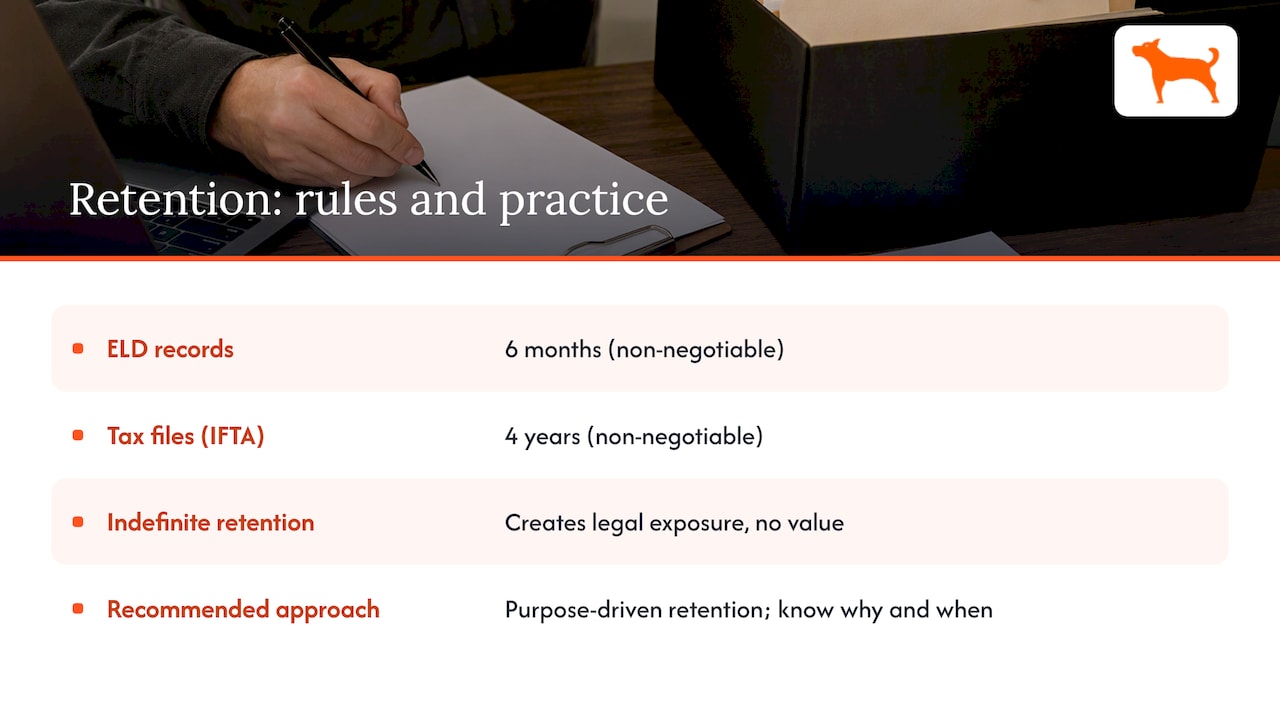
The fleets that handle this well treat retention as a design decision made in advance, not a reaction to a subpoena. They keep the regulatory floors non-negotiable, six months for ELD records and four years for tax files, and they’re deliberate about everything else. Data minimization, the principle behind NIST’s privacy guidance, isn’t a compliance checkbox. It’s a practical way to reduce what can go wrong when a device, an account, or a laptop is compromised.
If there’s one thing worth changing today, it’s moving from indefinite retention to purpose-driven retention. Know why you’re keeping each category of data, for how long, and what happens when that window closes.
— Louis
Keeping retention compliant without the manual work
Some GPS trackers support configurable history windows, so fleet managers can align routine location data with internal policy rather than relying on default device settings. Exportable trip logs simplify mileage and tax substantiation, and geofence-based event capture helps separate routine movement from the incidents worth keeping longer.
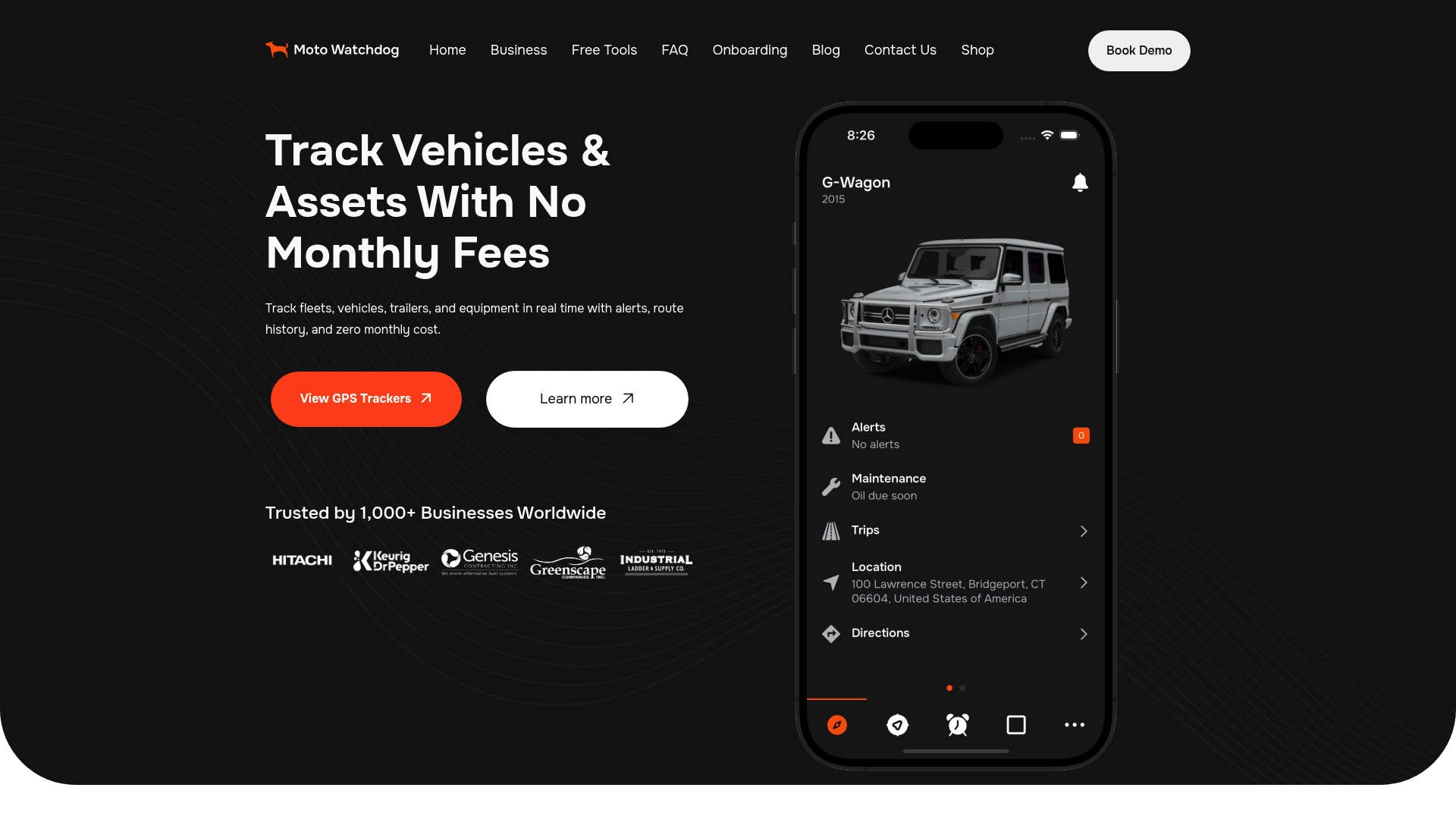
For fleets managing retention across multiple vehicles or contractor crews, API access allows automated exports and archiving, which removes the dependency on someone remembering to pull records before they age out. Certain GPS tracking devices come with no monthly fees and include lifetime 4G data, so adding retention controls doesn’t add recurring costs. Browse GPS trackers to see current configuration options for your fleet.
This article is general information, not a substitute for advice from a qualified lawyer. Consult a qualified legal professional about your own circumstances before acting on anything here.
FAQ
How long is GPS data stored?
Routine location history is commonly kept for 30 to 90 days, while detailed trip and mileage reports are often retained 6 to 12 months for operational review. Regulatory minimums apply on top of this: six months for ELD-related position records under 49 CFR Part 395, and four years for IFTA tax and mileage substantiation.
How long can GPS trackers last?
Device battery life and operational lifespan vary by model and usage pattern, so there’s no single figure that applies across all trackers. Some GPS tracking devices are designed for long battery life, supporting consistent data capture without frequent recharging or reinstallation.
Do GPS trackers show history?
Yes, most GPS trackers log location history that can be reviewed as a timeline of past trips and stops, with the exact depth and duration depending on the platform’s retention settings. Fleet managers typically access this history through a companion app or web dashboard rather than the device itself.
How far away will a GPS tracker work?
GPS tracking relies on satellite positioning combined with a cellular connection to transmit location data, so range is less about distance and more about network coverage. A tracker with reliable 4G connectivity can report location anywhere within its cellular network’s coverage area, which for most commercial trackers spans wide geographic regions rather than a fixed radius.
Sources
- Policy on the Retention of Supporting Documents and the Use of Electronic Mobile Communication/Tracking Technology
- 49 CFR Part 395 — Hours of Service of Drivers; ELD retention provisions
- NIST Privacy Framework: A Tool for Improving Privacy through Enterprise Risk Management, Version 1.0
- HIPAA guidance: online tracking technologies and PHI