
How to start saving money
Lorem ipsum dolor sit amet, consectetur adipiscing elit lobortis arcu enim urna adipiscing praesent velit viverra sit semper lorem eu cursus vel hendrerit elementum morbi curabitur etiam nibh justo, lorem aliquet donec sed sit mi dignissim at ante massa mattis.
- Neque sodales ut etiam sit amet nisl purus non tellus orci ac auctor
- Adipiscing elit ut aliquam purus sit amet viverra suspendisse potent
- Mauris commodo quis imperdiet massa tincidunt nunc pulvinar
- Excepteur sint occaecat cupidatat non proident sunt in culpa qui officia
Why it is important to start saving
Vitae congue eu consequat ac felis placerat vestibulum lectus mauris ultrices cursus sit amet dictum sit amet justo donec enim diam porttitor lacus luctus accumsan tortor posuere praesent tristique magna sit amet purus gravida quis blandit turpis.

How much money should I save?
At risus viverra adipiscing at in tellus integer feugiat nisl pretium fusce id velit ut tortor sagittis orci a scelerisque purus semper eget at lectus urna duis convallis. porta nibh venenatis cras sed felis eget neque laoreet suspendisse interdum consectetur libero id faucibus nisl donec pretium vulputate sapien nec sagittis aliquam nunc lobortis mattis aliquam faucibus purus in.
- Neque sodales ut etiam sit amet nisl purus non tellus orci ac auctor
- Adipiscing elit ut aliquam purus sit amet viverra suspendisse potenti
- Mauris commodo quis imperdiet massa tincidunt nunc pulvinar
- Adipiscing elit ut aliquam purus sit amet viverra suspendisse potenti
What percentege of my income should go to savings?
Nisi quis eleifend quam adipiscing vitae aliquet bibendum enim facilisis gravida neque. Velit euismod in pellentesque massa placerat volutpat lacus laoreet non curabitur gravida odio aenean sed adipiscing diam donec adipiscing tristique risus. amet est placerat in egestas erat imperdiet sed euismod nisi.
“Nisi quis eleifend quam adipiscing vitae aliquet bibendum enim facilisis gravida neque velit euismod in pellentesque”
Do you have any comments? Share them with us on social media
Eget lorem dolor sed viverra ipsum nunc aliquet bibendum felis donec et odio pellentesque diam volutpat commodo sed egestas aliquam sem fringilla ut morbi tincidunt augue interdum velit euismod eu tincidunt tortor aliquam nulla facilisi aenean sed adipiscing diam donec adipiscing ut lectus arcu bibendum at varius vel pharetra nibh venenatis cras sed felis eget.
An Electronic Logging Device (ELD) is a federally mandated tool that automatically records driver hours to meet FMCSA Hours of Service (HOS) requirements, while a GPS tracker is a broader operational device that captures real-time vehicle location, speed, idling, and driver behavior. Understanding the ELD vs GPS tracker difference is not optional for fleet managers. The wrong assumption, that one device replaces the other, leads to compliance gaps, inaccurate IFTA reporting, and wasted budget. This guide breaks down exactly how each device works, what regulations apply, and how to deploy both for maximum fleet control.
What is the ELD vs GPS tracker difference?
An ELD connects directly to a vehicle’s engine control module (ECM) through the diagnostic port and automatically records driving time, engine hours, and location at every duty status change. That engine connection is the defining feature. Without it, a device cannot legally satisfy HOS compliance under FMCSA rules. GPS trackers, by contrast, use cellular or satellite signals to report location independently of the engine. They do not record duty status, and they cannot substitute for an ELD in a DOT inspection.
The practical distinction matters immediately. An ELD tells regulators when a driver was on duty, off duty, or in the sleeper berth, with timestamps tied directly to engine data. A GPS tracker tells you where the vehicle is and how it got there. Both answer different questions, and fleet operations management requires both answers.

Pro Tip: Never assume your ELD covers all your GPS tracking needs. ELDs record location at duty status changes and roughly every 60 minutes while driving. That interval is too wide for real-time dispatch decisions or precise mileage reporting.
How does an ELD work compared to a GPS tracker?
ELDs and GPS trackers share some hardware overlap, but their data collection methods are fundamentally different.
How an ELD collects data
An ELD plugs into the vehicle’s OBD-II or 9-pin diagnostic port and reads engine data directly. It captures:
- Engine hours and ignition events
- Vehicle motion status based on engine output
- Driver duty status changes logged by the driver
- Location recorded at each duty status change and at set intervals, typically every 60 minutes while the vehicle is in motion
- Odometer readings pulled from the ECM
This engine-level integration is what makes ELDs legally compliant. Relying solely on GPS for driving time does not meet FMCSA standards, regardless of how accurate the location data is.
How a GPS tracker collects data
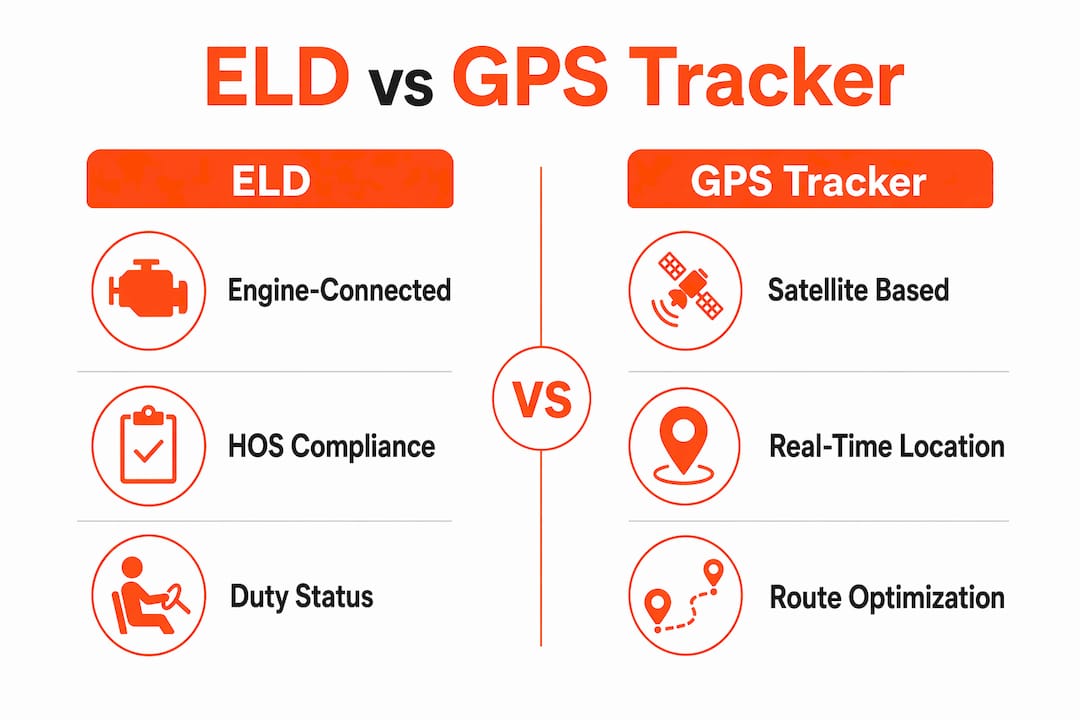
A dedicated GPS tracker uses cellular networks and satellite signals to ping the vehicle’s location at much higher frequency. Most standalone GPS trackers record location every 30–120 seconds. That frequency enables precise route reconstruction, accurate state-line crossing detection, and real-time dispatch visibility. GPS trackers also capture speed, hard braking, rapid acceleration, and idling time, none of which an ELD is designed to monitor continuously.
Pro Tip: If you run hardwired GPS trackers alongside your ELDs, check out Motowatchdog’s hardwired GPS installation guide to avoid common wiring mistakes that cause data gaps.
What are the regulatory requirements for ELDs versus GPS trackers?
Compliance obligations for these two devices are not equal. ELDs carry federal mandates. GPS trackers do not.
-
ELD mandate scope. The FMCSA ELD mandate applies to most commercial motor vehicle drivers who are required to maintain records of duty status. Exemptions exist for short-haul drivers and vehicles manufactured before model year 2000, but the majority of DOT-regulated fleets must use a certified ELD.
-
ELD certification process. Manufacturers self-certify their devices against 49 CFR §395.20 through §395.38, which governs technical specifications, data recording requirements, and tamper resistance. Certified devices appear on the FMCSA’s registered ELD list. Fleets must verify their device is on that list and monitor it, because non-compliant devices can be removed without notice.
-
Data retention requirements. ELDs must store HOS records for a minimum of six months. Drivers must be able to transfer logs electronically to enforcement officers during roadside inspections. GPS-only systems have no federal data retention mandate, though many fleet managers retain GPS data for 12 months or more for operational and liability purposes.
-
GPS tracking is voluntary. No federal regulation requires a fleet to install GPS trackers. However, GPS data supports compliance indirectly by verifying driver logs, confirming vehicle locations, and providing documentation for IFTA fuel tax reporting.
-
Inspection protocols differ. During a DOT roadside inspection, an officer reviews ELD records transferred electronically or displayed on screen. GPS data is not part of the standard inspection protocol, though it can be subpoenaed in accident investigations.
The key takeaway: an ELD is a legal requirement for covered fleets, and GPS tracking complements compliance without replacing it.
How do ELDs and GPS trackers differ in operational benefits and limitations?
Both devices deliver real value, but they excel in different areas. Understanding those differences prevents you from over-relying on one at the expense of the other.
Where ELDs win
ELDs eliminate paper logbooks entirely. Manual logbook time drops from 15–20 minutes daily to near zero, and roadside inspection review time falls from 20–30 minutes to just 2–5 minutes with electronic log transfer. For a fleet of 20 drivers, that adds up to hours of recovered time every week. ELDs also reduce HOS violations by alerting drivers before they exceed legal limits.
Where GPS trackers win
Dedicated GPS trackers provide continuous, high-fidelity location data that ELDs simply cannot match. The mileage accuracy gap is significant. ELD GPS sampling delivers roughly 90–95% accuracy for mileage reporting. Dedicated GPS trackers using polygon-based geofencing and 30–120 second pings reach 98–99% accuracy. For IFTA fuel tax reporting, that difference directly affects your tax liability and audit risk.
GPS trackers also support route optimization, unauthorized use alerts, geofence notifications, and driver behavior scoring. These are operational tools, not compliance tools.
Limitations to watch
ELDs using phone-based apps introduce reliability risks. Bluetooth drops, screen glare, and battery drain during long shifts can interrupt logging. Dedicated ELD hardware avoids these issues. GPS trackers, meanwhile, add monthly subscription costs that range from $13–$40 per vehicle for integrated packages, which affects budget planning for smaller fleets. For budget-conscious operators, Motowatchdog’s guide on small fleet GPS tracking covers cost-effective deployment strategies.
Can ELD and GPS tracking be integrated for better fleet management?
Integration is the standard approach for well-run fleets in 2026. Keeping ELD and GPS data in separate systems creates blind spots.
Integrated fleet telematics platforms bundle FMCSA-certified ELDs with continuous GPS tracking in a single dashboard. The benefits of combining both data streams include:
- Unified compliance and operations. HOS logs and real-time location appear in one view, so dispatchers and compliance managers work from the same data.
- Improved driver monitoring. GPS behavior data, such as hard braking and speeding, pairs with HOS records to give a complete picture of driver performance.
- Accurate IFTA reporting. GPS mileage data fills the accuracy gap left by ELD sampling, reducing audit exposure.
- Faster incident response. Real-time GPS location combined with ELD duty status lets you confirm whether a driver was on duty during an incident.
- Administrative time savings. Integrated platforms save approximately 5 hours per week in administrative tasks by eliminating duplicate data entry across compliance and operations systems.
The best practice for deployment is to install dedicated hardwired GPS trackers alongside your ELD units rather than relying on the ELD’s built-in GPS for operational tracking. For practical guidance on combining these data streams, Motowatchdog’s fleet GPS data integration examples walks through real-world fleet setups.
Key Takeaways
ELDs handle federal HOS compliance through direct engine connection, while dedicated GPS trackers deliver the real-time location accuracy and operational visibility that ELDs are not built to provide.
| Point | Details |
|---|---|
| ELDs are legally required | FMCSA mandates ELDs for most DOT-regulated commercial fleets under 49 CFR §395.20–§395.38. |
| GPS trackers fill the accuracy gap | Dedicated GPS trackers reach 98–99% mileage accuracy versus 90–95% for ELD GPS sampling. |
| ELDs reduce inspection time | Electronic log transfer cuts roadside inspection review from 20–30 minutes to 2–5 minutes. |
| Integration saves administrative time | Combined ELD and GPS platforms save approximately 5 hours per week in administrative work. |
| GPS tracking is voluntary but valuable | No federal mandate requires GPS trackers, but they improve dispatch, safety, and IFTA reporting. |
Why I always recommend running both devices together
Fleet managers often ask me whether they can skip the GPS tracker if their ELD already has a location feature. My honest answer is no, and the mileage accuracy data makes the case better than any opinion could.
The 90–95% accuracy ceiling on ELD GPS is not a minor rounding issue. On a truck logging 100,000 miles per year across multiple states, a 5–10% mileage error in IFTA reporting can trigger an audit and result in back taxes plus penalties. I have seen fleets pay far more in audit costs than they ever saved by skipping a dedicated GPS subscription.
The other thing I have learned is that ELD data and GPS data serve different audiences inside your organization. Your compliance manager lives in the ELD dashboard. Your dispatcher lives in the GPS dashboard. Forcing one tool to serve both creates friction and errors. Keeping them separate but integrated gives each team the data format they actually need.
The cost argument against GPS trackers also weakens quickly. At $13–$40 per vehicle per month for an integrated package, the administrative time savings alone justify the spend for any fleet running more than five trucks. The safety and liability benefits are harder to quantify but real.
My recommendation: treat ELD compliance as the floor, not the ceiling. Build your GPS tracking layer on top of it, and use a platform that connects both data streams automatically.
— Louis
Motowatchdog’s subscription-free GPS tracking for fleet managers
Fleet managers who want GPS tracking without adding another monthly line item to every vehicle have a direct option worth evaluating.
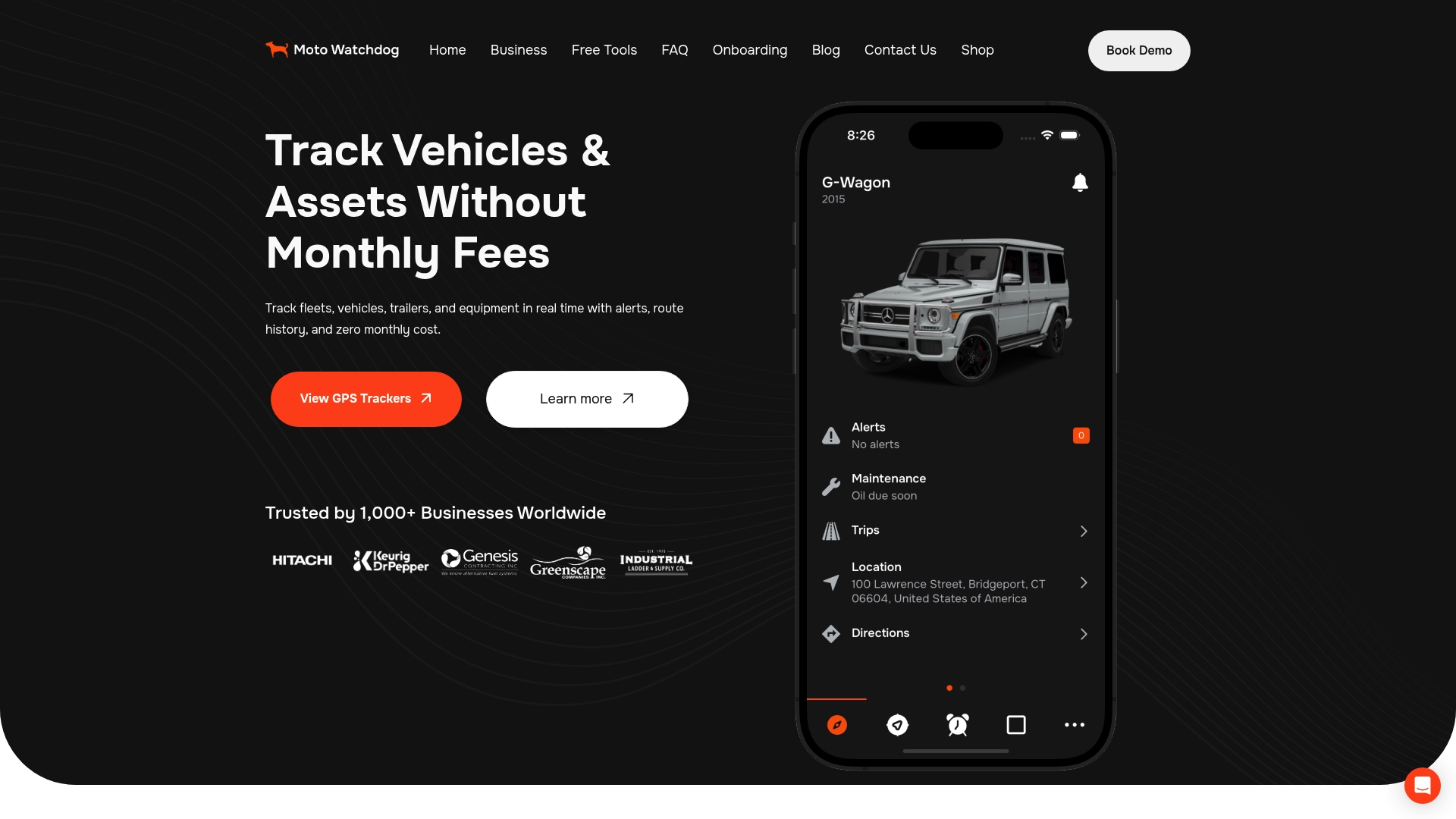
Motowatchdog offers subscription-free 4G GPS tracking built for businesses that need reliable real-time location data without recurring fees. The devices work alongside existing ELD systems, so you get continuous high-frequency location tracking to fill the accuracy gaps that ELD GPS sampling leaves behind. Over 1,000 businesses rely on Motowatchdog for mileage tracking, geofence alerts, and operational visibility. For fleet managers who want to understand the full range of subscription-free options before committing, Motowatchdog’s 2026 GPS guide for businesses covers deployment, compatibility, and cost comparisons in detail.
FAQ
What is the main difference between an ELD and a GPS tracker?
An ELD connects to the vehicle’s engine control module to record HOS compliance data, while a GPS tracker uses cellular or satellite signals to provide real-time location and operational data. ELDs are federally mandated for most commercial fleets; GPS trackers are optional but operationally valuable.
Can a GPS tracker replace an ELD for FMCSA compliance?
No. GPS trackers cannot replace ELDs because they do not connect to the engine control module or record duty status changes as required by 49 CFR §395.20. FMCSA compliance requires engine-integrated data recording that only a certified ELD provides.
Why is ELD mileage accuracy lower than dedicated GPS trackers?
ELDs record location at duty status changes and roughly every 60 minutes while driving, then interpolate state crossings between those points. Dedicated GPS trackers ping every 30–120 seconds and use polygon-based geofencing, reaching 98–99% mileage accuracy versus 90–95% for ELD GPS data.
Do small fleets need both an ELD and a GPS tracker?
DOT-regulated small fleets must use a certified ELD for HOS compliance. A GPS tracker is not legally required but improves dispatch accuracy, IFTA mileage reporting, and driver safety monitoring, making it a practical addition for most commercial operations.
How much does it cost to run ELD and GPS tracking together?
Integrated ELD and GPS packages typically cost $13–$40 per vehicle per month. Subscription-free GPS hardware options, like those from Motowatchdog, eliminate the recurring GPS fee while still providing continuous location tracking alongside your ELD system.