How to start saving money
Lorem ipsum dolor sit amet, consectetur adipiscing elit lobortis arcu enim urna adipiscing praesent velit viverra sit semper lorem eu cursus vel hendrerit elementum morbi curabitur etiam nibh justo, lorem aliquet donec sed sit mi dignissim at ante massa mattis.
- Neque sodales ut etiam sit amet nisl purus non tellus orci ac auctor
- Adipiscing elit ut aliquam purus sit amet viverra suspendisse potent
- Mauris commodo quis imperdiet massa tincidunt nunc pulvinar
- Excepteur sint occaecat cupidatat non proident sunt in culpa qui officia
Why it is important to start saving
Vitae congue eu consequat ac felis placerat vestibulum lectus mauris ultrices cursus sit amet dictum sit amet justo donec enim diam porttitor lacus luctus accumsan tortor posuere praesent tristique magna sit amet purus gravida quis blandit turpis.

How much money should I save?
At risus viverra adipiscing at in tellus integer feugiat nisl pretium fusce id velit ut tortor sagittis orci a scelerisque purus semper eget at lectus urna duis convallis. porta nibh venenatis cras sed felis eget neque laoreet suspendisse interdum consectetur libero id faucibus nisl donec pretium vulputate sapien nec sagittis aliquam nunc lobortis mattis aliquam faucibus purus in.
- Neque sodales ut etiam sit amet nisl purus non tellus orci ac auctor
- Adipiscing elit ut aliquam purus sit amet viverra suspendisse potenti
- Mauris commodo quis imperdiet massa tincidunt nunc pulvinar
- Adipiscing elit ut aliquam purus sit amet viverra suspendisse potenti
What percentege of my income should go to savings?
Nisi quis eleifend quam adipiscing vitae aliquet bibendum enim facilisis gravida neque. Velit euismod in pellentesque massa placerat volutpat lacus laoreet non curabitur gravida odio aenean sed adipiscing diam donec adipiscing tristique risus. amet est placerat in egestas erat imperdiet sed euismod nisi.
“Nisi quis eleifend quam adipiscing vitae aliquet bibendum enim facilisis gravida neque velit euismod in pellentesque”
Do you have any comments? Share them with us on social media
Eget lorem dolor sed viverra ipsum nunc aliquet bibendum felis donec et odio pellentesque diam volutpat commodo sed egestas aliquam sem fringilla ut morbi tincidunt augue interdum velit euismod eu tincidunt tortor aliquam nulla facilisi aenean sed adipiscing diam donec adipiscing ut lectus arcu bibendum at varius vel pharetra nibh venenatis cras sed felis eget.
Off-hours GPS tracking of company vehicles is legally risky and rarely justified once a shift ends. Fleet managers should default to tracking during work hours only, narrow any off-duty exception to theft recovery or genuine emergencies, restrict who can view that data, and put the rules in writing before drivers ever get behind the wheel.
TL;DR:
- Tracking outside scheduled work hours is legally risky and should be limited to theft recovery or emergencies, with strict access controls.
- Consent for data collection must be explicit, and drivers should be able to view or delete their data, especially when tracking extends beyond core work hours.
- Hardware configurations like work-hour scheduling, geofencing, and privacy modes help enforce off-duty privacy restrictions and demonstrate compliance.
- Fleets operating across states should adopt the strictest legal standard nationwide, with ongoing policy review and legal consultation to stay current with evolving laws.
- Vendors offering devices with default always-on tracking pose compliance risks, while configurable devices like Moto Watchdog support privacy-focused policies effectively.
Table of Contents
- What Federal Law Says About Driver Privacy Off Hours
- Why Off-Duty Tracking Carries Higher Privacy Risk
- Building a Driver Privacy Policy That Actually Works
- Technical Controls That Limit Off-Hours Collection
- State Laws Are Moving Faster Than Federal Rules
- Configuring Off-Hours Privacy Controls in Practice
- Why Limiting Collection Protects Everyone
- Put These Controls to Work With Moto Watchdog
- Sources
- FAQ
What Federal Law Says About Driver Privacy Off Hours
The federal framework here is thinner than most managers assume, which is exactly why regulators have started filling the gap through enforcement rather than new statutes. The Driver Privacy Act and the Driver’s Privacy Protection Act (DPPA) restrict how state DMVs and certain data holders disclose personal information tied to driver records, while 49 CFR § 563.5 governs what event data recorders can capture in a crash and who can pull that data afterward.
Neither law was written with modern telematics in mind, so the Federal Trade Commission has stepped in using its unfair-practices authority. In January 2025, the FTC took action against General Motors for collecting and selling precise geolocation and driving-behavior data without adequate consent. The agency finalized that order in 2026, requiring GM and OnStar to obtain affirmative express consent before collecting or sharing connected-vehicle data.
Three takeaways apply directly to fleets:
- Consent must be affirmative and specific, not buried in a handbook acknowledgment.
- Consumers (and by extension, employees in comparable contexts) need a real way to view, delete, or opt out of data collection.
- Selling or sharing driving-behavior data with third parties, including insurers, now carries real regulatory exposure.
Why Off-Duty Tracking Carries Higher Privacy Risk
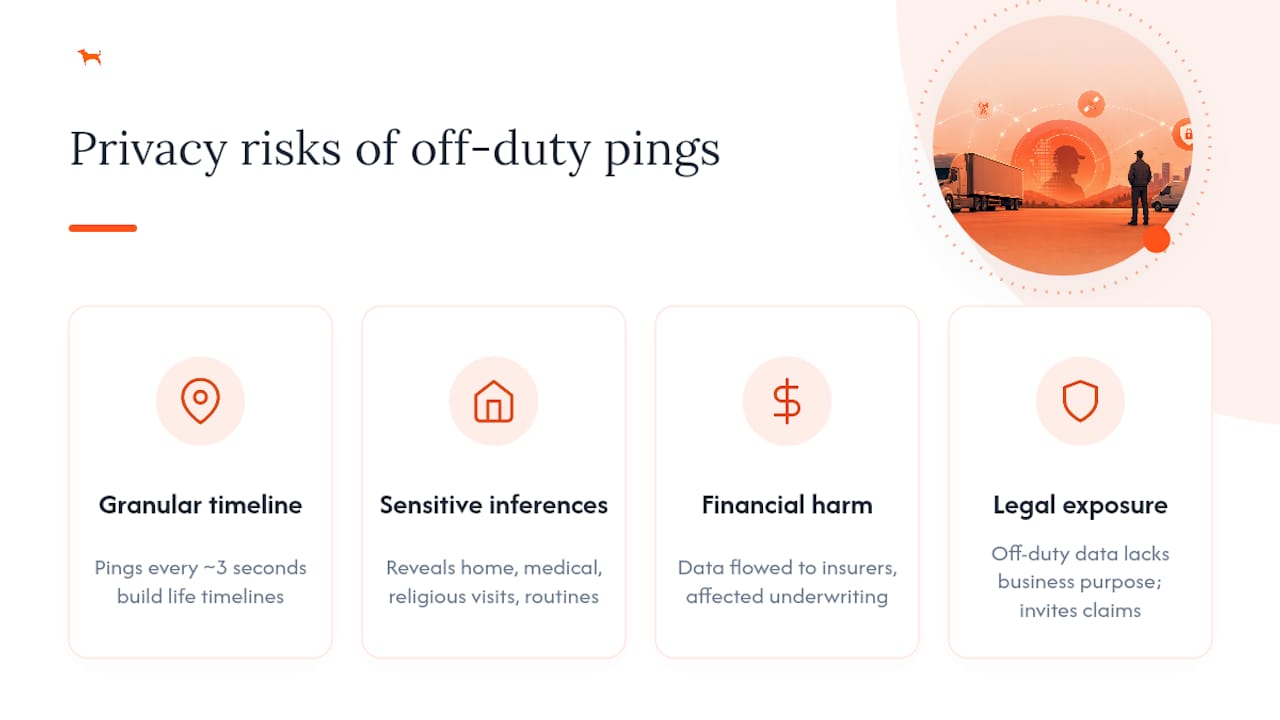
A location ping every few seconds does not just show where a vehicle is. It builds a timeline of someone’s life. The FTC’s own complaint against GM described geolocation captured as often as every three seconds, producing hundreds of thousands of data points capable of revealing a person’s home, medical visits, religious practices, and daily routines.
Statistic Callout: That same complaint documented how granular driving data flowed to insurers and shaped underwriting decisions, turning a fleet safety tool into a source of real financial consequence for the person behind the wheel.
Off duty, that data no longer serves any business purpose. It just sits there as legal exposure, capable of supporting invasion of privacy claims or running afoul of state anti-tracking statutes.
Building a Driver Privacy Policy That Actually Works
A written policy is the single strongest protection a fleet manager has, and it needs to answer five questions before a device ever gets installed.
- Define scope and timing. Track company vehicles during scheduled work hours only. For take-home vehicles, build in a hard exception process for theft recovery or safety emergencies, and document why any off-duty tracking occurred.
- Separate notice from consent. Notice tells drivers tracking exists. Consent, ideally in writing, is required whenever data collection extends beyond the vehicle’s core operating hours or feeds into disciplinary decisions.
- Control access by role. Only supervisors with a direct operational need should see raw location history. Everyone else gets summarized reports, not a live map.
- Set retention limits tied to purpose. If the data exists to verify mileage or respond to an incident, delete it once that purpose is served, not months later.
- Build in enforcement and review. Spell out what happens if a driver disables a device improperly, and revisit the whole policy annually as state laws shift.
Pro Tip: Have your policy reviewed against NLRB standards before rolling it out. The Board and courts scrutinize monitoring rules that could chill Section 7 rights, so a narrowly tailored business justification protects you better than a blanket “we track everything” clause.
Technical Controls That Limit Off-Hours Collection
Policy language only works if the hardware backs it up. The most effective fleets treat device configuration as the first line of defense, not written rules alone.
- Work-hours scheduling suppresses location pings automatically outside shift windows, which removes the temptation to review data that shouldn’t exist in the first place.
- Geofencing flags when a vehicle enters or leaves approved zones, which covers theft recovery without requiring continuous tracking the rest of the time.
- Privacy mode for mixed-use or take-home vehicles gives drivers a way to pause collection, an approach employer vehicle tracking guidance specifically recommends for personal-use periods.
- Retention settings and export logs let you prove exactly who accessed what data and when, which matters if a dispute ever reaches HR or a courtroom.
Before signing with any provider, ask directly: does precise geolocation default to “on,” does the vendor share data with third parties, and can collection be disabled outside scheduled windows without a support ticket? A vendor that hesitates on any of those questions is a liability waiting to surface.
State Laws Are Moving Faster Than Federal Rules
Multi-state fleets face a patchwork, and it’s tightening. Maine now requires written notice before electronic monitoring begins. California’s penal code restricts placing tracking devices on vehicles without consent in several circumstances, and Connecticut has pushed similar employee-notice requirements into its labor code. The state-by-state GPS tracking guide is worth bookmarking, because these rules change almost every legislative session.
The practical answer for any fleet operating across state lines is to adopt the strictest applicable standard company-wide rather than maintaining separate policies per jurisdiction.
- Centralize legal monitoring under one compliance owner, not a rotating assignment.
- Assign a single person to update policy language when a state law changes.
- Treat written notice as the floor everywhere, even in states that don’t yet require it.
Configuring Off-Hours Privacy Controls in Practice
Some GPS tracking devices let fleets schedule collection windows so location data stops recording once a shift ends, paired with geofence alerts for after-hours movement without logging a continuous trail. Data access can be controlled through role-based permissions, so dispatchers may see trip summaries while only designated administrators can access raw history, useful when a theft-recovery exception needs documentation.
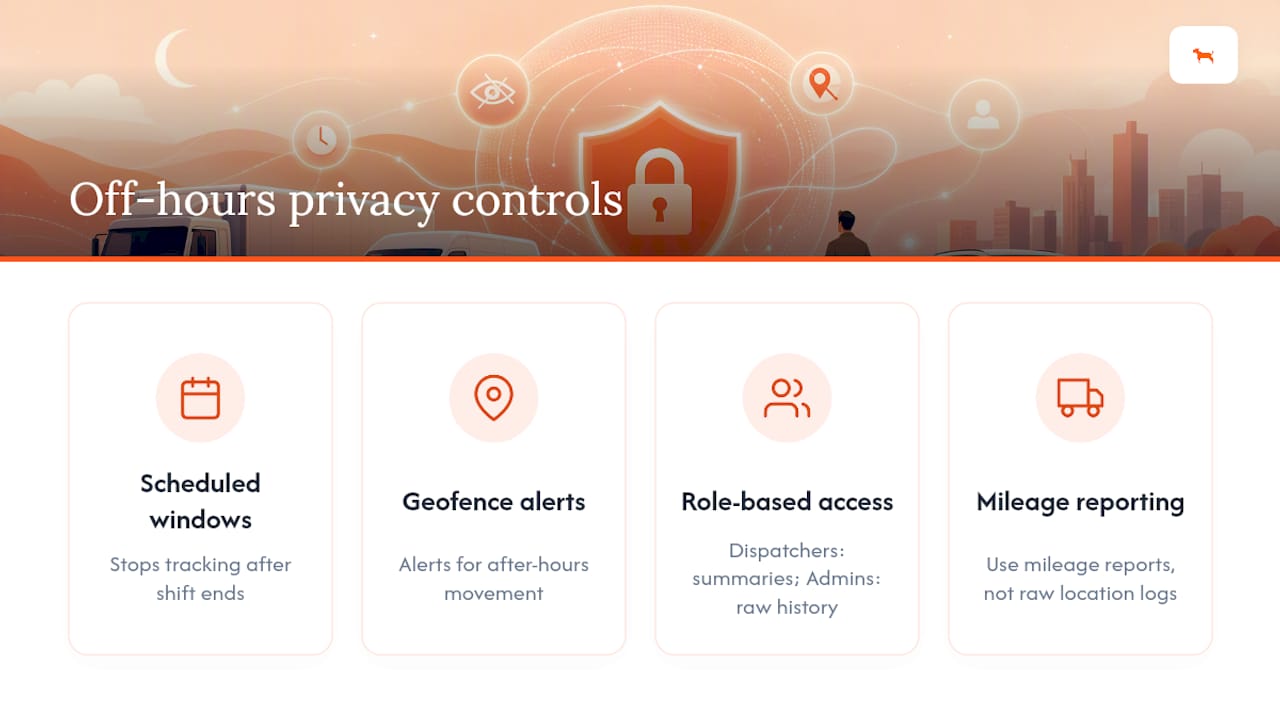
Pro Tip: Pair scheduled tracking with mileage reporting rather than raw location logs. It satisfies most business reporting needs while keeping the audit trail lean.
Why Limiting Collection Protects Everyone
Fleets that over-collect data aren’t managing risk, they’re stockpiling it. Every extra hour of off-duty tracking is potential litigation sitting in a database. A tight policy, vetted hardware, and an annual legal review cost far less than one privacy complaint.
— Louis
Put These Controls to Work With Moto Watchdog
Most GPS tracking vendors ask fleets to pay monthly for the privilege of controlling their own data. Moto Watchdog flips that: work-hours scheduling, configurable geofencing, and adjustable sharing settings come standard on every device, with no recurring subscription to justify keeping continuous tracking switched on just to feel like you’re getting your money’s worth.
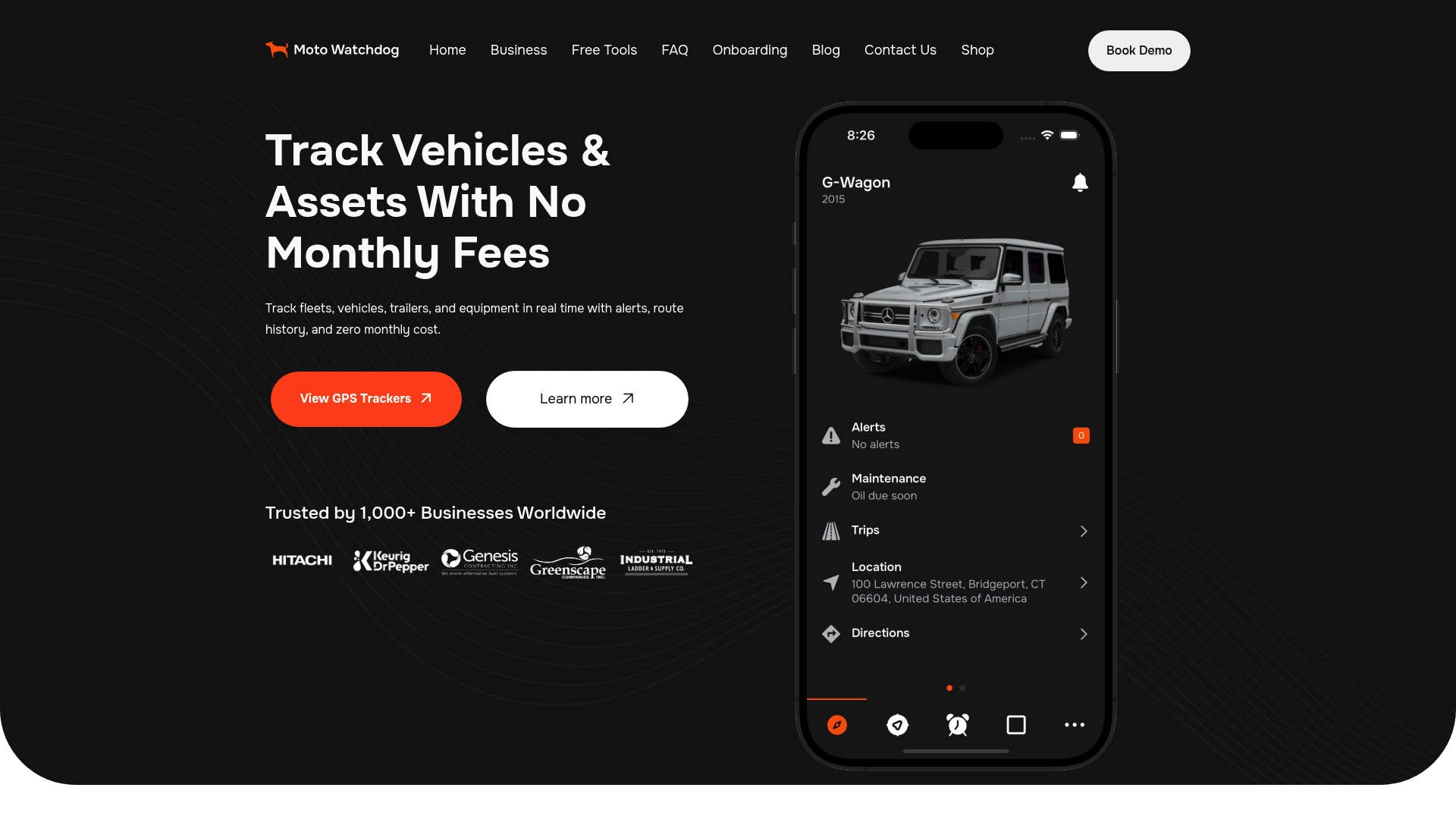
That matters for the policy you just built. A device that defaults to always-on tracking fights against everything a written privacy policy is trying to accomplish, while one built around scheduled collection and role-based access makes the policy enforceable rather than aspirational. Moto Watchdog’s trackers start at $124.99 as a one-time purchase, and fleets running multiple vehicles can review integration options on the business page. Contractors weighing take-home vehicle policies should also look at the contractor-focused configuration guide before finalizing device rollout, and check mileage reporting accuracy to see how much data you actually need to collect. Visit the product page to compare specs and place an order.
This article is general information, not a substitute for advice from a qualified lawyer. Consult a qualified legal professional about your own circumstances before acting on anything here.
Sources
- FTC takes action against General Motors for sharing drivers’ precise location and driving behavior data
- 49 CFR § 563.5 (event data recorders) — Cornell Law
- GPS tracking laws 2026: a state-by-state guide
FAQ
How Much Off-Duty Time Should a Driver Have Each Day?
Federal hours-of-service rules for commercial drivers generally require a set off-duty rest period between shifts, distinct from any privacy question about whether a vehicle should be tracked during that rest. Fleet managers should treat off-duty time as fully outside monitoring scope unless a documented theft-recovery or safety exception applies.
What Counts as a Driver Privacy Violation?
Common examples include selling location data to third parties without consent, tracking personal vehicles without notice, and retaining precise geolocation far longer than any business purpose requires. The FTC’s case against GM and OnStar, detailed in its complaint, covered exactly this pattern of undisclosed collection and third-party sharing.
What Is the 14-Hour Rule and Does It Affect Tracking?
Regulations limit how long a commercial driver’s workday can run from first coming on duty, separate from device-level tracking rules. They affect scheduling and hours-of-service logs more than data privacy directly, though any tracking system used to verify hours should follow the same work-hours-only scope discussed above.
What Does the Driver Privacy Protection Act Cover?
The Driver’s Privacy Protection Act restricts disclosure of personal information held in state DMV records, originally aimed at preventing misuse of driver’s license data. It works alongside newer FTC enforcement, like the GM/OnStar order, to shape how connected-vehicle data gets handled today.
Does Moto Watchdog Support Privacy-Focused Configurations?
Yes. Moto Watchdog devices support scheduled work-hours tracking, geofencing, and adjustable sharing settings, letting fleets limit collection outside shifts without paying a monthly fee. Current device pricing is listed on the product page.