How to start saving money
Lorem ipsum dolor sit amet, consectetur adipiscing elit lobortis arcu enim urna adipiscing praesent velit viverra sit semper lorem eu cursus vel hendrerit elementum morbi curabitur etiam nibh justo, lorem aliquet donec sed sit mi dignissim at ante massa mattis.
- Neque sodales ut etiam sit amet nisl purus non tellus orci ac auctor
- Adipiscing elit ut aliquam purus sit amet viverra suspendisse potent
- Mauris commodo quis imperdiet massa tincidunt nunc pulvinar
- Excepteur sint occaecat cupidatat non proident sunt in culpa qui officia
Why it is important to start saving
Vitae congue eu consequat ac felis placerat vestibulum lectus mauris ultrices cursus sit amet dictum sit amet justo donec enim diam porttitor lacus luctus accumsan tortor posuere praesent tristique magna sit amet purus gravida quis blandit turpis.

How much money should I save?
At risus viverra adipiscing at in tellus integer feugiat nisl pretium fusce id velit ut tortor sagittis orci a scelerisque purus semper eget at lectus urna duis convallis. porta nibh venenatis cras sed felis eget neque laoreet suspendisse interdum consectetur libero id faucibus nisl donec pretium vulputate sapien nec sagittis aliquam nunc lobortis mattis aliquam faucibus purus in.
- Neque sodales ut etiam sit amet nisl purus non tellus orci ac auctor
- Adipiscing elit ut aliquam purus sit amet viverra suspendisse potenti
- Mauris commodo quis imperdiet massa tincidunt nunc pulvinar
- Adipiscing elit ut aliquam purus sit amet viverra suspendisse potenti
What percentege of my income should go to savings?
Nisi quis eleifend quam adipiscing vitae aliquet bibendum enim facilisis gravida neque. Velit euismod in pellentesque massa placerat volutpat lacus laoreet non curabitur gravida odio aenean sed adipiscing diam donec adipiscing tristique risus. amet est placerat in egestas erat imperdiet sed euismod nisi.
“Nisi quis eleifend quam adipiscing vitae aliquet bibendum enim facilisis gravida neque velit euismod in pellentesque”
Do you have any comments? Share them with us on social media
Eget lorem dolor sed viverra ipsum nunc aliquet bibendum felis donec et odio pellentesque diam volutpat commodo sed egestas aliquam sem fringilla ut morbi tincidunt augue interdum velit euismod eu tincidunt tortor aliquam nulla facilisi aenean sed adipiscing diam donec adipiscing ut lectus arcu bibendum at varius vel pharetra nibh venenatis cras sed felis eget.
Tracking a vehicle you own, or one your company owns or leases, is generally legal in the United States. Tracking a vehicle you don’t own, or tracking a person who hasn’t agreed to it, is where most legal trouble starts. No single federal statute covers private GPS tracking of cars, so the rules come from state law, from your own paperwork, and from the way you use the data. This guide walks fleet managers and heavy equipment rental companies through what applies and how to set up tracking so it holds up.
This is general information, not legal advice. Before you roll out tracking across a workforce, have an employment attorney in your state review your policy.
TL;DR
- Congress has not passed a federal law written specifically for vehicle geolocation data, so state law does most of the work.
- Tracking company-owned vehicles and equipment for legitimate business reasons is generally allowed, but several states require employee notice or consent.
- At least 26 states and the District of Columbia have addressed tracking people without their knowledge, and the details differ by state.
- Written policy, signed acknowledgments, and limiting tracking to work use are the most practical protections.
- Hidden tracking of a vehicle you don’t own or lease is the highest-risk move. Don’t do it.
Table of Contents
- What federal law says about vehicle GPS tracking
- How state laws differ
- Tracking employees: notice, consent and limits
- Heavy equipment and rental fleets
- When tracking becomes illegal
- Law enforcement is a different rulebook
- Perspective
- Setting up compliant tracking, step by step
- Tracking for contractor fleets that own their assets
- FAQ
- Sources
What federal law says about vehicle GPS tracking
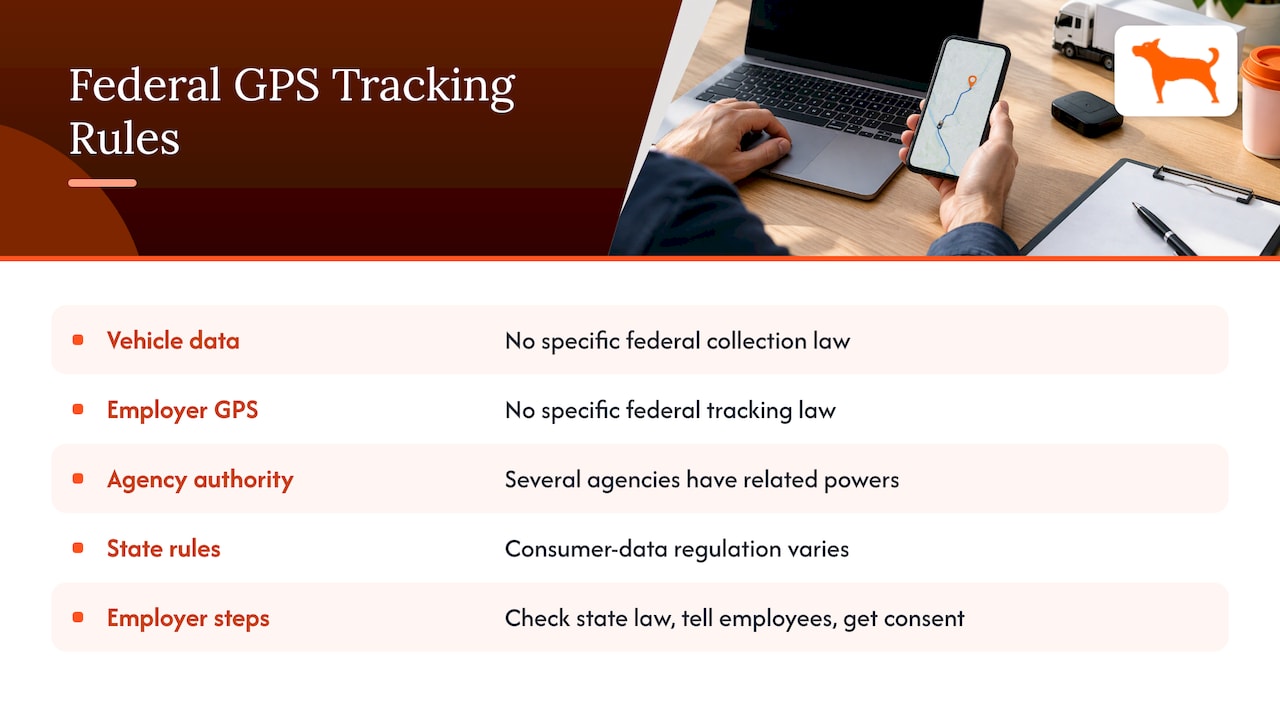
The Congressional Research Service reports that no existing federal laws specifically regulate the collection, processing and use of vehicle geolocation data. Several agencies have related authorities, but there is no federal “GPS tracking act” for private businesses. The same report notes that the lack of comprehensive federal data-privacy legislation has created a varied regulatory environment for consumer data, vehicle location included.
For employers, the American Bar Association reports that no specific federal law governs the use of GPS to track employee location. It advises employers to check state law, tell employees about tracking and get their consent.
Trucking and the FMCSA
If you run commercial motor vehicles under federal safety rules, the Federal Motor Carrier Safety Administration has addressed tracking directly. Its guidance says the ELD rule does not require real-time tracking of commercial vehicles. A carrier may still track vehicles in real time for business purposes, as long as it does not engage in harassment under 49 CFR 390.36 or violate other safety regulations. In plain terms: tracking for dispatch, theft recovery and mileage is fine, but using location data to pressure drivers in ways that push them to break hours-of-service or safety rules is not.
How state laws differ
State law is where the real differences sit. NCSL’s survey reports that at least 26 states and D.C. have addressed location-tracking privacy. Their approaches fall into three broad groups:
- Vehicle-installation restrictions: rules that make it an offense to place a tracker on a vehicle you don’t own or lease, or to do so without the owner’s consent.
- Broader tracking prohibitions: rules that bar using a tracking device to monitor a person’s location or movement without consent.
- Stalking and harassment provisions: laws that treat covert tracking as part of a stalking offense.
Exceptions and penalties vary, so a policy that works in one state may need adjusting in another. A few examples show the range.
| State | What the law does | Practical takeaway for fleets |
|---|---|---|
| California | Penal Code §637.7 generally bars using an electronic tracking device to determine a person’s location or movement, but an exception applies when the registered owner, lessor or lessee has consented. A violation is a misdemeanor. | Company-owned or leased vehicles fit the exception when the owner or lessee consents. Keep that consent documented. |
| New Jersey | N.J.S.A. 34:6B-22 requires most employers to give written notice before knowingly using a tracking device in a vehicle used by an employee, company-owned or personal. The source lists penalties of up to $1,000 for a first violation and up to $2,500 for later ones. | Give written notice before activation, every time you add a driver or vehicle. |
| Ohio | Ohio Revised Code §2903.216, effective March 20, 2025 per the source, criminalizes certain nonconsensual tracking, with exceptions for good-faith legitimate business tracking and property the tracker owns or leases. | Company-owned vehicles generally fall within the exceptions. Keep the business purpose written down. |
| Minnesota | Minn. Stat. §626A.35 prohibits an individual from using a mobile tracking device without a court order, with one exception. | Read the exception closely with counsel before tracking anything you don’t own. |
| Texas | Penal Code §16.06 covers unlawful installation of a tracking device on a motor vehicle and lists specific defenses. | Install only on vehicles you own or lease, and with the owner’s or lessee’s consent where it applies. |
These are snapshots. Statutes get amended (Ohio’s current version is recent), so confirm the current text for each state where you operate.
Tracking employees: notice, consent and limits
When the vehicle is company property and the driver is an employee, the question shifts from “can I install this?” to “what must I tell the driver?” Guidance published in the National Law Review notes that employers may use tracking on company-owned equipment where employees have no reasonable expectation of privacy. The same piece flags three situations that raise privacy concerns:
- Tracking personal property, such as an employee’s own truck or phone.
- Continuing to track after working hours.
- Sharing GPS information beyond legitimate business needs.
Its recommended policy covers the business purpose of tracking, the circumstances under which monitoring happens, notice to employees and the capabilities of the GPS system. For employee-owned equipment, it recommends a consent-based policy limited to work time.
A practical policy checklist
- State the purpose. Dispatch, theft recovery, mileage reporting, maintenance scheduling, safety.
- Describe what is collected. Location, trip history, idle time, speed alerts, whatever your devices actually record.
- Set the hours. If a driver takes a company truck home, decide whether tracking continues and say so in writing.
- Get a signed acknowledgment. Even in states without a notice law, it removes doubt later.
- Limit access. Only people with a business need should see location history.
- Review each state. A fleet that crosses state lines should write to the strictest state it operates in.
Heavy equipment and rental fleets
Equipment owners have a strong legal footing: you own the asset, and tracking your own property is the core exception in most state laws. Rental companies add one wrinkle, because the equipment sits in a customer’s hands. Your rental agreement is where the legal work gets done.
A law firm’s guidance for equipment suppliers notes that GPS data helps prove where equipment was located and used, and recommends keeping a daily location log. Build on that:
- Put a clause in every rental contract stating that the equipment carries a GPS tracking device and that location data is collected.
- Say that removing, disabling or tampering with the device is a breach.
- Define who may see the data and for what purposes: recovery, billing, jobsite disputes, theft reports.
- Keep location logs on a consistent schedule so they can be produced if a dispute arises.
- Where a customer’s operators are the ones moving the machine, have the customer acknowledge notice, so you are not relying on operators you have never met.
If you also run a service fleet with employee drivers, the employee rules above apply to those vehicles separately.
When tracking becomes illegal
The pattern across states is consistent enough to summarize. Tracking is most likely to be unlawful when:
- You install a device on a vehicle you neither own nor lease, and the owner doesn’t know.
- You track a person’s movements without their knowledge or consent, particularly a former partner, relative or ex-employee.
- You continue monitoring someone after they leave your employment or after the vehicle is sold.
- You use data for purposes the notice never covered.
Penalties range from misdemeanor charges to fines, and in California can include license consequences for specified licensees, per the ABA summary. Civil liability for invasion of privacy is a separate risk on top of criminal charges.
Law enforcement is a different rulebook
Private parties answer to state statutes. Government agents answer to the Fourth Amendment. In United States v. Jones (2012), the Supreme Court held that government installation and use of a GPS device on a vehicle to monitor its movements is a search. In Carpenter v. United States (2018), the Court held that acquiring historical cell-site location information is also a search, and that a warrant supported by probable cause was required in that case.
The practical point for fleet owners: location data you collect can be requested through legal process. Keep retention rules written, and send subpoenas and warrants to your attorney.
Perspective
Most of the legal risk in GPS tracking comes from unclear ownership and unclear notice, not from the technology itself. A fleet that owns its vehicles, tells its drivers in writing, and tracks only for business purposes is on the strongest footing in nearly every state.
That is why we build Moto Watchdog around fleets and equipment owners who track their own assets. Our devices are designed for real-time location, geofencing alerts, trip and mileage reporting, idle time tracking and maintenance reminders, all managed from one dashboard for unlimited vehicles and users. Those are the records a good tracking policy points to when it states a business purpose.
There is a compliance benefit to pricing, too. With no monthly fees, lifetime 4G data included, and no activation charges, you can put a tracker on every machine in the yard instead of only the ones you can afford to subscribe. Consistent coverage makes consistent policy easier: the same notice, the same rules, the same records for every asset.
Write the policy first, then switch the trackers on.
Louis
Setting up compliant tracking, step by step
- Confirm ownership. List every vehicle and machine and mark whether you own it, lease it or it belongs to an employee or customer.
- Identify the states. Note where each asset operates and check the state’s tracking statute for notice and consent rules.
- Write the policy. Use the checklist above: purpose, data collected, hours, access, retention.
- Collect acknowledgments. Have employees sign. Add GPS clauses to rental and lease contracts.
- Configure the system around the policy. Use geofences for jobsites and yards, alerts for after-hours movement of equipment, and mileage reports for billing and tax records.
- Audit quarterly. Remove access for people who changed roles and retire data you no longer need.
Long battery life also matters for compliance in practice. Unpowered trailers and attachments are the assets that most often go dark, and a device that keeps reporting keeps your location log complete. Our guide to GPS trackers with long battery life and no monthly fee covers what to look for.
Tracking for contractor fleets that own their assets
If you run excavators, skid steers, trailers and service trucks, you probably have the profile that tracking laws treat most favorably: you own the property, and your purpose is protecting it and running jobs efficiently. Keep the purpose written, tell the people who operate the equipment, and use the data for those purposes only.
Moto Watchdog trackers start at $124.99 as a one-time purchase, with real-time location, geofencing, trip and mileage reporting and push notifications managed through a free mobile app. You can browse the Moto Watchdog GPS trackers and choose devices for vehicles, trailers and equipment.
Businesses that want to connect tracking data to their own software can ask about API access on the business page. It has no published price.
FAQ
Is it legal to put a GPS tracker on my own car?
Yes, in general. Tracking property you own is generally legal, while tracking a person who hasn’t consented generally is not. If other people drive the car, check your state’s rules on notice, and if the car is jointly owned or leased, make sure the other owner or lessee agrees.
Can my employer track my company vehicle?
Often yes. Employers may track company-owned vehicles where employees have no reasonable expectation of privacy, and some states, such as New Jersey, require written notice first. Tracking should be tied to business purposes and generally should not continue into personal time without clear consent.
Is there a federal law on GPS tracking of vehicles?
No statute specifically regulates private vehicle geolocation data, according to the Congressional Research Service. Federal rules still matter in specific areas, such as FMCSA’s harassment rule for commercial drivers and the Fourth Amendment limits on government tracking.
Can I track a vehicle I don’t own?
Only with the owner’s consent, and in many states even that is not enough if you are tracking a person. Hidden tracking of someone else’s vehicle can trigger criminal charges and civil claims. If you have a safety concern about another person, contact law enforcement or an attorney instead.
Do I need to tell drivers about GPS tracking in a rental or fleet vehicle?
You should, regardless of whether your state requires it. Written notice and a signed acknowledgment are the standard recommendation, and some states make notice mandatory. For rental equipment, put the tracking clause in the rental agreement.
Sources
- Vehicle Geolocation Data Collection: Issues for the 119th Congress (CRS)
- FMCSA: Does the ELD rule require real-time tracking?
- American Bar Association: Is it Legal to Track Employees with Vehicle GPS Tracking?
- National Law Review: Key Considerations When Monitoring Employees Using GPS Tracking Devices
- NCSL: Private Use of Location Tracking Devices, State Statutes
- New Jersey GPS Tracking Laws
- Ohio Employee Monitoring Laws
- Texas Penal Code Section 16.06
- Protecting Your Rights: Equipment Supplier Tips
- United States v. Jones, 565 U.S. 400 (2012)
- Carpenter v. United States (2018)