
How to start saving money
Lorem ipsum dolor sit amet, consectetur adipiscing elit lobortis arcu enim urna adipiscing praesent velit viverra sit semper lorem eu cursus vel hendrerit elementum morbi curabitur etiam nibh justo, lorem aliquet donec sed sit mi dignissim at ante massa mattis.
- Neque sodales ut etiam sit amet nisl purus non tellus orci ac auctor
- Adipiscing elit ut aliquam purus sit amet viverra suspendisse potent
- Mauris commodo quis imperdiet massa tincidunt nunc pulvinar
- Excepteur sint occaecat cupidatat non proident sunt in culpa qui officia
Why it is important to start saving
Vitae congue eu consequat ac felis placerat vestibulum lectus mauris ultrices cursus sit amet dictum sit amet justo donec enim diam porttitor lacus luctus accumsan tortor posuere praesent tristique magna sit amet purus gravida quis blandit turpis.

How much money should I save?
At risus viverra adipiscing at in tellus integer feugiat nisl pretium fusce id velit ut tortor sagittis orci a scelerisque purus semper eget at lectus urna duis convallis. porta nibh venenatis cras sed felis eget neque laoreet suspendisse interdum consectetur libero id faucibus nisl donec pretium vulputate sapien nec sagittis aliquam nunc lobortis mattis aliquam faucibus purus in.
- Neque sodales ut etiam sit amet nisl purus non tellus orci ac auctor
- Adipiscing elit ut aliquam purus sit amet viverra suspendisse potenti
- Mauris commodo quis imperdiet massa tincidunt nunc pulvinar
- Adipiscing elit ut aliquam purus sit amet viverra suspendisse potenti
What percentege of my income should go to savings?
Nisi quis eleifend quam adipiscing vitae aliquet bibendum enim facilisis gravida neque. Velit euismod in pellentesque massa placerat volutpat lacus laoreet non curabitur gravida odio aenean sed adipiscing diam donec adipiscing tristique risus. amet est placerat in egestas erat imperdiet sed euismod nisi.
“Nisi quis eleifend quam adipiscing vitae aliquet bibendum enim facilisis gravida neque velit euismod in pellentesque”
Do you have any comments? Share them with us on social media
Eget lorem dolor sed viverra ipsum nunc aliquet bibendum felis donec et odio pellentesque diam volutpat commodo sed egestas aliquam sem fringilla ut morbi tincidunt augue interdum velit euismod eu tincidunt tortor aliquam nulla facilisi aenean sed adipiscing diam donec adipiscing ut lectus arcu bibendum at varius vel pharetra nibh venenatis cras sed felis eget.
For fleets that want predictable costs and real-time visibility without recurring subscription fees, Motowatchdog is the recommended starting point. Its one-time purchase model, customizable geofencing, and built-in mileage reporting give fleet managers the core operational data they need without the monthly billing cycle that compounds across every vehicle in a growing fleet.
Quick shortlist by category:
- Best subscription-free ownership: Motowatchdog — one-time hardware cost, real-time 4G tracking, geofencing, maintenance-friendly mileage data
- Best for AI-led operations: Samsara — second-by-second telemetry, integrated dashcams, AI safety scoring
- Best for compliance-heavy trucking: HOS247 — ELD-first platform with integrated GPS tracking
- Best for route optimization and clear pricing: Azuga — published entry pricing, route efficiency tools for smaller service fleets
- Best for data-heavy enterprise fleets: Geotab — open API ecosystem, extensive device marketplace, configurable hardware
According to industry data, 87% of commercial fleets with 10 or more vehicles now run some form of GPS tracking, while 43% of fleet managers say their current system fails to deliver actionable data beyond a dot on a map. That gap is where the right platform pays for itself. Unauthorized vehicle use accounts for 12% of total fleet fuel spend, and excessive idling can cost about $3,200 per vehicle per year in wasted fuel. This guide covers 16 platforms and devices available in North America, with a comparison table, decision criteria, device deployment guidance, and a pilot checklist so you can move from evaluation to rollout in 30 days or fewer.
Table of Contents
- What are the best GPS solutions for multi-vehicle fleets?
- How do you choose the right GPS solution for a multi-vehicle fleet?
- Which device type fits your fleet vehicles and assets?
- Why Motowatchdog is recommended for subscription-free fleet ownership
- Key Takeaways
- What fleet managers actually learn during GPS rollouts
- Motowatchdog gives fleets real-time GPS tracking without the monthly bill
- Useful sources for validating vendor claims and going deeper
What are the best GPS solutions for multi-vehicle fleets?
The table below compares the leading platforms and devices on the dimensions fleet decision-makers use most. Motowatchdog leads as the featured subscription-free option; the remaining entries follow in their category order.
| Solution | Best for | Pricing model | Hardware types | Location update frequency | Key features | Integrations / API | Connectivity | Scalability |
|---|---|---|---|---|---|---|---|---|
| Motowatchdog | Fleets preferring one-time ownership and low TCO | One-time device purchase, no subscription | OBD / battery / hardwired | Real-time, 4G | Geofencing, mileage reports, maintenance alerts, multi-device management | Companion app; integration notes available | 4G LTE | Multi-device dashboard, mobile app |
| Geotab | Data-heavy fleets needing open API ecosystem | Subscription (SaaS) | OBD / hardwired (GO9, GO Anywhere variants) | Up to 1-second refresh | Driver safety, diagnostics, marketplace apps | Extensive open API, large device marketplace | 4G LTE | Enterprise-grade, unlimited users |
| Samsara | AI-led safety and dense operational automation | Subscription (SaaS) | Hardwired / OBD / dashcam | Second-by-second | AI safety scoring, dashcams, diagnostics | Open API, broad integrations | 4G LTE | Large fleet, multi-site |
| Fleetio | Maintenance and lifecycle management | Subscription (SaaS) | Integrates with third-party GPS hardware | Depends on paired hardware | Maintenance scheduling, CMMS, DVIR | API, integrations with Samsara/Geotab | 4G LTE (via paired device) | Mid-to-large fleets |
| Verizon Connect | Single platform for dispatch, fuel, and compliance | Subscription (SaaS) | Hardwired / OBD | Near real-time | Dispatch, fuel reporting, compliance | Broad integrations, API | 4G LTE | Enterprise, multi-location |
| Azuga | Smaller service/delivery fleets, clear pricing | Subscription (SaaS), published entry pricing | OBD / hardwired | Real-time | Route optimization, driver scoring | API, fuel card integrations | 4G LTE | Small-to-mid fleets |
| GPS Insight | Compliance reporting and asset tracking | Subscription (SaaS) | OBD / hardwired / trailer | Real-time | Compliance reports, asset monitoring | API available | 4G LTE | Mid-to-large fleets |
| Rhino Fleet Tracking | Mixed-asset visibility across vehicles and trailers | Subscription (SaaS) | OBD / hardwired / trailer | Real-time | Mixed-asset tracking, geofencing | API available | 4G LTE | Mixed fleets |
| HOS247 | Trucking fleets needing ELD compliance | Subscription (SaaS) | Hardwired ELD / OBD | Real-time | ELD compliance, GPS tracking, DVIR | ELD integrations | 4G LTE | Trucking, mid-to-large |
| One Step GPS | Cost-conscious fleets needing basic tracking | Subscription (SaaS), lower device cost | OBD / hardwired | Real-time | Basic tracking, geofencing | Limited | 4G LTE | Small fleets |
| Geotab GO9 | Diagnostic data and marketplace extensibility | Subscription (device + SaaS) | Hardwired OBD | Up to 1-second | Diagnostics, fault codes, marketplace | Open API | 4G LTE | Enterprise |
| Geotab GO Anywhere Plus | Temporary installs and non-permanent assets | Subscription (device + SaaS) | Battery / portable | Configurable | Portable asset tracking, geofencing | Geotab marketplace | 4G / LTE-M | Multi-asset |
| Geotab Next-Gen GO Anywhere | Next-gen portable tracking | Subscription (device + SaaS) | Battery / portable | Configurable | Improved portability, geofencing | Geotab marketplace | 4G / LTE-M | Multi-asset |
| Optimus | Commercial vehicles needing durable hardware | Subscription (SaaS) | Hardwired | Real-time | Ruggedized tracking, geofencing | API available | 4G LTE | Commercial fleets |
| Matrack OBD fleet tracker | Rapid OBD deployment, basic telematics | Subscription (SaaS) | OBD plug-in | Real-time | Plug-and-play install, geofencing | Limited API | 4G LTE | Small-to-mid fleets |
| LandAirSea | Trailer and small-asset tracking | One-time or subscription options | Battery / magnetic mount | Real-time | Compact form, reliable location | App-based | 4G LTE | Asset-level |
A note on refresh rates and durability: Platforms like Samsara and Geotab GO9 offer sub-second to 1-second location updates, which matters for high-speed delivery corridors or safety-critical dispatch. For most service and contractor fleets, a 30-second to 2-minute refresh is operationally sufficient and reduces data costs. On durability, look for devices rated IP67 or higher for outdoor and trailer use; hardwired units in engine bays should carry an operating temperature range of at least -40°F to 185°F.
G2 buyer research consistently ranks route optimization, GPS integration, and maintenance scheduling as the top three features for delivery and field-service fleets, which is why those columns carry the most weight in any side-by-side evaluation.
How do you choose the right GPS solution for a multi-vehicle fleet?
The comparison table narrows the field. This section turns it into a repeatable procurement framework.
Decision criteria, ranked for multi-vehicle fleets
- Real-time refresh rate: Determine whether your operation needs sub-5-second updates (high-speed delivery, safety-critical dispatch) or whether 30-second to 2-minute intervals cover your use case. Paying for second-by-second telemetry on a 12-vehicle HVAC fleet is rarely justified.
- Maintenance and CMMS integration: Platforms that connect telematics to maintenance workflows reduce unplanned breakdowns by 41% when fault codes and mileage triggers generate automated work orders. This is the highest-ROI feature for most fleets under 100 vehicles.
- Geofencing flexibility: You need configurable zones for job sites, yards, and customer locations, with alert thresholds you can adjust per vehicle or driver group.
- API and data export: Confirm the platform exports data in standard formats (CSV, JSON, REST API). Locked data is a long-term liability, especially when switching vendors or integrating with payroll or fuel-card systems. A practical guide to fleet tracking data export covers what to test before committing.
- Multi-user roles and permissions: Fleet managers, dispatchers, and drivers need different access levels. Platforms that offer only admin/driver binary roles create security and workflow gaps at scale.
- Mobile app quality: Test the driver-facing app on both iOS and Android before signing. Poor mobile UX is the top reason driver adoption fails in the first 90 days.
- Battery life and device durability: For asset trackers and trailer devices, verify real-world battery life under your operating conditions, not just the spec-sheet maximum.
- Connectivity options: Most North American fleets are well-served by 4G LTE. Remote construction, agriculture, or mining fleets should evaluate LTE-M/NB-IoT coverage or satellite fallback options.
- Support SLAs: Confirm whether 24/7 support is included or costs extra, and whether onboarding includes on-site installation assistance.
- Total cost of ownership (TCO): Run the numbers over 36 and 60 months, not just the monthly per-vehicle rate.
Subscription vs. one-time: a 36-to-60-month TCO comparison
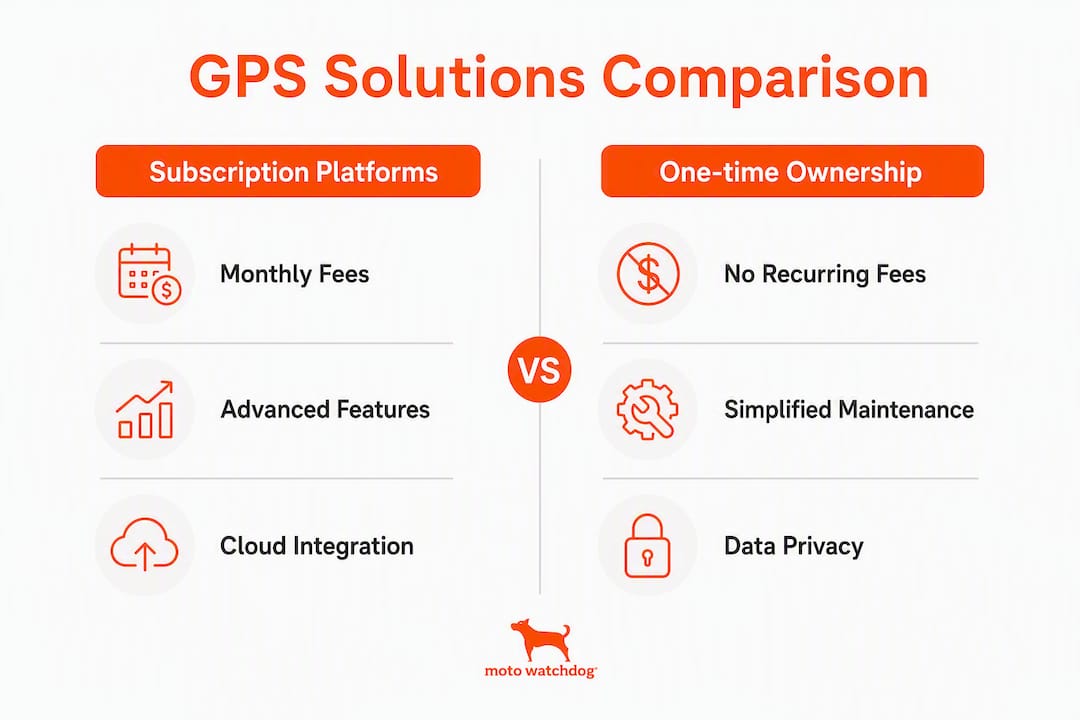
Subscription SaaS platforms typically charge a monthly fee per vehicle, which can add up to several thousand dollars per year for medium-sized fleets, leading to substantial costs over multiple years before hardware expenses. Perpetual or one-time hardware ownership can break even within months for stable fleet sizes, with the 36–48 month window being the common payback horizon versus ongoing SaaS fees. For fleets with predictable vehicle counts and internal IT support, the one-time model often delivers lower lifetime cost.
Pro Tip: For fleets under 25 vehicles, prioritize maintenance triggers and geofence alerts in your pilot before investing in AI-driven driver coaching. The ROI from preventing a single unplanned breakdown typically exceeds the cost of the device itself.
Implementation checklist and vendor questions
Run this sequence before signing any contract:
- Define your minimum viable feature set — list the three features that, if absent, would make the platform unusable for your operation.
- Run a 5–10 vehicle pilot covering at least two vehicle types and one edge-case route (remote area, underground parking, dense urban).
- Test data export — export a week of location and trip data in your preferred format and confirm it loads cleanly into your existing systems.
- Validate geofence alerts — trigger at least three geofence events and confirm alert delivery time and accuracy.
- Confirm driver app workflows — have two drivers complete a full shift using only the mobile app.
- Review the contract for hidden fees — per-vehicle overage charges, data storage limits, API call caps, and hardware replacement costs.
- Scale rollout — deploy in batches of 10–20 vehicles with a dedicated training session per batch.
Ask vendors directly: Who owns the data? What is the export format? Are there per-vehicle API call limits? What is the hardware warranty and replacement process?
Red flags to watch for
- Subscription tiers that lock basic geofencing or reporting behind a premium plan
- Per-vehicle add-on fees for features advertised as standard
- APIs that require a paid enterprise tier to access
- Hardware sourced through a single proprietary supplier with no third-party options
- Mobile apps with ratings below 3.5 stars on the App Store or Google Play
Which device type fits your fleet vehicles and assets?
Hardware choice shapes installation complexity, data quality, and long-term maintenance burden. The four main categories each suit a different vehicle or asset profile.

| Device type | Installation | Power source | Typical battery life | Best use case | Pros | Cons |
|---|---|---|---|---|---|---|
| OBD-II plug-in (e.g., Matrack OBD) | Self-install, 2 minutes | Vehicle OBD port | N/A (vehicle-powered) | Light-duty vehicles, rapid deployment | No wiring, easy swap | Accessible to drivers; limited to OBD-equipped vehicles |
| Hardwired telematics (e.g., Geotab GO9, Optimus) | Professional install, 30–60 min | Vehicle power | N/A (vehicle-powered) | Commercial vehicles, trucks, buses | Tamper-resistant, richer diagnostics | Higher install cost and time |
| Battery-powered asset tracker (e.g., Geotab GO Anywhere Plus, LandAirSea) | Self-install, magnetic or bolt-on | Internal battery | Days to months (varies by ping rate) | Trailers, equipment, containers | No wiring, portable | Battery management required |
| Next-gen portable (e.g., Geotab Next-Gen GO Anywhere) | Self-install | Internal battery / rechargeable | Improved vs. prior gen | Temporary installs, rental equipment | Flexible placement | Requires periodic recharging |
For a detailed walkthrough of hardwired installation best practices, including wiring diagrams and recommended mount points, the GPS tracker fleet hardwiring guide covers the full process.
Connectivity: 4G LTE vs. LTE-M/NB-IoT vs. satellite

Standard 4G LTE covers the vast majority of North American fleet routes and delivers the fastest data throughput for real-time dashboards. LTE-M and NB-IoT consume significantly less power, making them the right choice for battery-powered asset trackers that ping every few minutes rather than every few seconds. Satellite fallback is worth evaluating only for fleets operating in areas with confirmed cellular dead zones, such as remote mining sites or rural agricultural routes, where even LTE-M coverage is sparse.
Pro Tip: Mount hardwired devices on the windshield or roof area rather than under the dash. Devices buried in metal enclosures can lose 30–40% of GPS signal strength, which degrades location accuracy on tight urban routes.
Pilot prerequisites checklist
Before scaling beyond 10 vehicles, confirm:
- Data export tested and validated in your target format
- Driver app piloted on both iOS and Android devices
- Geofence alerts confirmed with measured delivery latency
- At least one edge-case vehicle tested (remote route, underground parking)
- Maintenance trigger tested: confirm a mileage-based alert fires correctly
Understanding OBD-II device limitations before deployment prevents the most common pilot failures. The OBD GPS tracker buyer’s guide explains which vehicle types and model years are fully compatible.
Why Motowatchdog is recommended for subscription-free fleet ownership
Motowatchdog’s core advantage is structural: you buy the hardware once, and the tracking runs without a monthly per-vehicle fee. For a 20-vehicle fleet on a typical SaaS platform at $25 per vehicle per month, that’s $6,000 per year in recurring costs that simply don’t exist with the Motowatchdog model. Over 1,000 businesses rely on Motowatchdog’s tracking accuracy across vehicle and asset monitoring use cases.
How Motowatchdog features map to fleet needs
- One-time purchase → predictable TCO: No subscription creep, no per-vehicle tier upgrades, no surprise renewal invoices. The cost is fixed at the point of hardware purchase.
- Customizable geofencing → yard and job-site monitoring: Set entry/exit alerts for specific zones, adjust thresholds per vehicle group, and receive push notifications when a vehicle leaves a defined perimeter after hours.
- Long battery life → asset and trailer tracking: Battery-powered configurations support non-powered assets like trailers, generators, and heavy equipment without requiring a vehicle power connection.
- Trip and mileage reports → maintenance triggers: Automated mileage accumulation data feeds directly into maintenance scheduling, so service intervals are triggered by actual usage rather than calendar estimates.
- Multi-device management → scalable fleet oversight: Manage all devices from a single dashboard and mobile app, with sharing features that let dispatchers and field supervisors access relevant vehicle data without full admin access.
Motowatchdog’s subscription-free GPS approach is explained in detail, including device technical specifications and integration options for business users.
When a subscription platform may be the better fit
Motowatchdog is purpose-built for fleets that want ownership, predictability, and core telematics. If your operation requires enterprise-grade AI driver coaching at scale, built-in dispatch automation across hundreds of vehicles, or a deep ELD compliance workflow for long-haul trucking, platforms like Samsara, Verizon Connect, or HOS247 are designed specifically for those use cases. The decision comes down to operational complexity versus cost control: the higher the subscription platform’s specialized automation value, the more justified the recurring fee.
Key Takeaways
The most cost-effective GPS strategy for stable multi-vehicle fleets combines one-time hardware ownership with maintenance-triggered alerts, geofencing, and validated data export before full rollout.
| Point | Details |
|---|---|
| Subscription-free ownership lowers TCO | One-time hardware purchase eliminates per-vehicle monthly fees that compound across growing fleets. |
| Maintenance integration drives the highest ROI | Telematics connected to maintenance workflows reduces unplanned breakdowns by 41% through automated work orders. |
| Pilot before scaling | Run a 5–10 vehicle pilot testing refresh rate, geofence alerts, data export, and mobile app before full deployment. |
| Match device type to asset | OBD-II for rapid light-vehicle deployment; hardwired for commercial trucks; battery trackers for trailers and equipment. |
| Motowatchdog for subscription-free fleets | Motowatchdog’s one-time purchase model with geofencing, mileage reports, and multi-device management suits fleets prioritizing predictable TCO. |
What fleet managers actually learn during GPS rollouts
Most procurement guides cover feature checklists and pricing models. What they understate is how much the rollout itself determines whether a GPS program delivers value or collects dust.
The first thing worth piloting is not the most advanced feature on the platform. Start with the two functions that protect your fleet’s capacity: maintenance triggers and geofence alerts. A maintenance alert that fires at the right mileage interval has prevented more unplanned breakdowns than any driver-scoring dashboard, because it acts before the failure rather than after. Geofence alerts on your yard and key job sites catch unauthorized use within hours, not weeks.
Driver training is where most rollouts stall. The instinct is to train everyone at once in a conference room. A more effective approach is to run a two-week shadow period where drivers see their own trip data before any performance review is attached to it. That single change tends to reduce resistance and improve data quality simultaneously, because drivers start self-correcting rather than gaming the system.
On the hardware side, the most common installation mistake is mounting OBD-II devices in vehicles where the port is directly exposed to driver interference. A tamper-resistant hardwired install takes longer upfront but eliminates a recurring source of data gaps. For trailers and non-powered equipment, battery life under real operating conditions is almost always shorter than the spec sheet suggests, so build a recharge schedule into your maintenance workflow from day one.
The balance between speed of rollout and depth of integration usually resolves itself if you sequence correctly: get the core features working reliably on 10 vehicles before adding integrations. A GPS program that works cleanly on 10 vehicles scales to 100. One that’s half-integrated on 50 vehicles creates more administrative work than it saves.
Motowatchdog gives fleets real-time GPS tracking without the monthly bill
Fleet managers evaluating Samsara, Geotab, Verizon Connect, and the other subscription platforms in this guide are weighing real operational value against a recurring cost that grows with every vehicle added. Motowatchdog offers a direct alternative: buy the hardware once, and the 4G real-time tracking, customizable geofencing, mileage reporting, and multi-device management are yours without a monthly invoice.
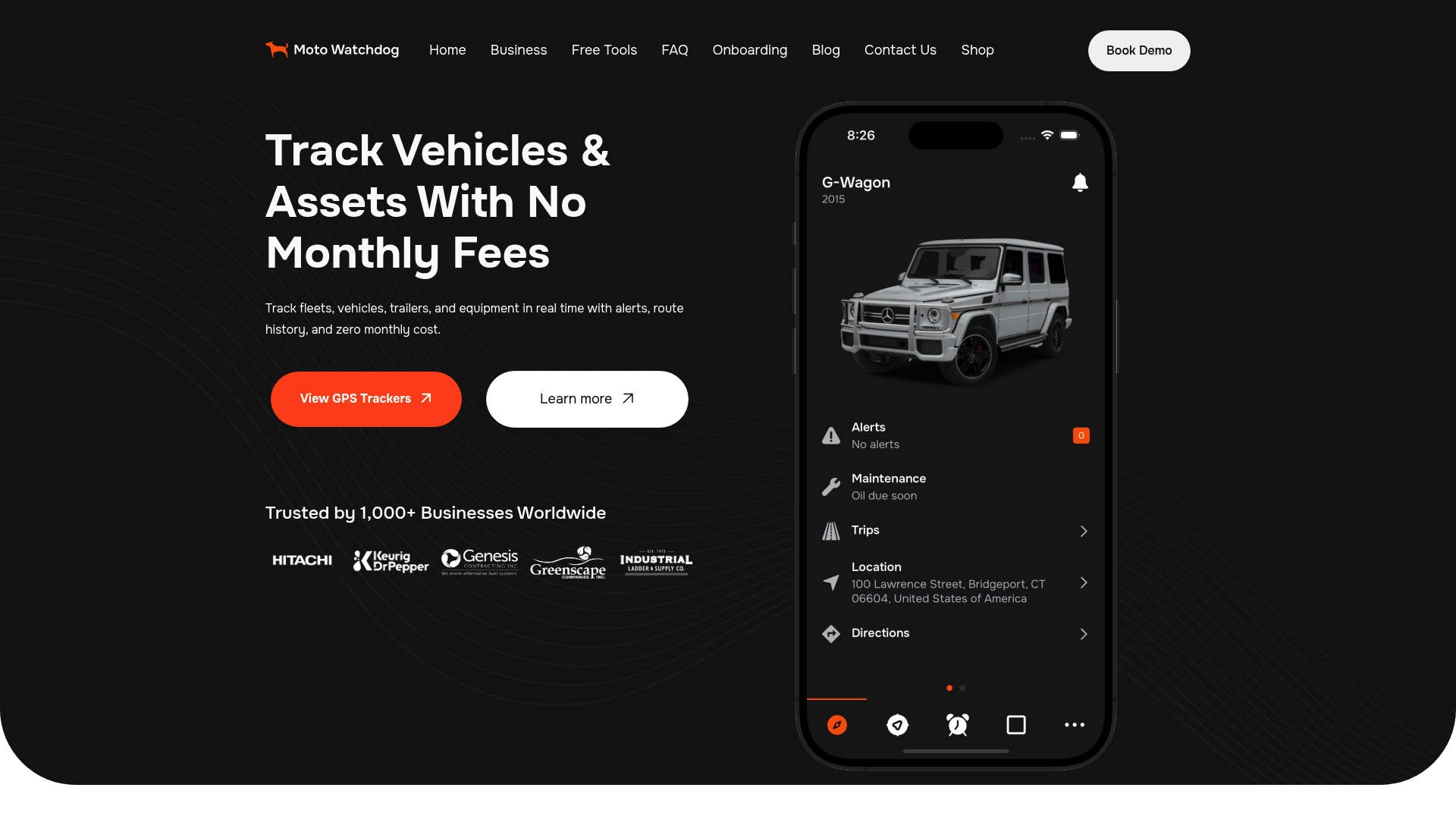
For a 20-vehicle fleet, eliminating a $25/vehicle/month subscription saves $6,000 per year, every year. The Motowatchdog devices support OBD, hardwired, and battery configurations, so you can cover powered vehicles, trailers, and equipment from a single platform. The companion app gives dispatchers and fleet managers live visibility on iOS and Android, and the built-in mileage data feeds directly into maintenance scheduling.
Start with a 5–10 vehicle pilot. Confirm the geofence alerts, validate the data export, and check the mileage triggers against your service intervals. Most fleet managers complete that pilot in under two weeks. Visit motowatchdog.com to review device specifications and purchase options for your fleet size.
Useful sources for validating vendor claims and going deeper
These are the primary references used to assemble this guide. Each is worth consulting directly when verifying vendor claims or researching specific topics.
- Identifying the Best GPS Tracking Devices for Your Fleet (Geotab) — Geotab’s own breakdown of device types, including GO9 and GO Anywhere variants; useful for device-level spec comparisons.
- 6 Best Fleet Tracking Apps for Real-Time GPS Monitoring (Fleetio) — Covers must-have app features for real-time monitoring; useful for evaluating mobile app quality during demos.
- Best Fleet Tracking Companies for Truckers (HOS247) — Focused on ELD-integrated GPS for trucking; useful for compliance-heavy fleet evaluation.
- Fleet Management Without a Subscription (MobilityManager) — Analysis of perpetual vs. SaaS licensing with break-even scenarios; essential reading for TCO comparisons.
- 6 Essential Features of Fleet Management Software (G2) — G2 buyer data on top-ranked features for delivery and field-service fleets.
- FMCSA Electronic Logging Devices — The authoritative federal source for ELD compliance requirements; consult directly for current mandate details.
- Subscription-free GPS explained for businesses (Motowatchdog) — Motowatchdog’s own explanation of the one-time purchase model, device features, and business use cases.
- Fleet GPS data integration examples (Motowatchdog) — Practical integration examples and the source for the 1,000+ businesses adoption figure.